
Casino Dice Games in Australia: What You’re Actually Playing and What It Costs
Two dice can clear a table in seconds. A come-out seven turns a quiet layout into a roar. The arithmetic behind that roar is older than the internet and it has not moved: the house always takes a cut, the size of the cut depends entirely on which bet you put your money behind, and the Australian player chasing the game online has exactly zero legal options at home. The craps table lives in Crown Melbourne or the Star Sydney. Sic Bo runs in the high-roller rooms of the same floors. Every site that streams either game to a laptop in Brisbane or Perth is an offshore operator with no Australian licence, no local consumer protection, and a bonus offer that looks generous until the wagering terms get a second reading.
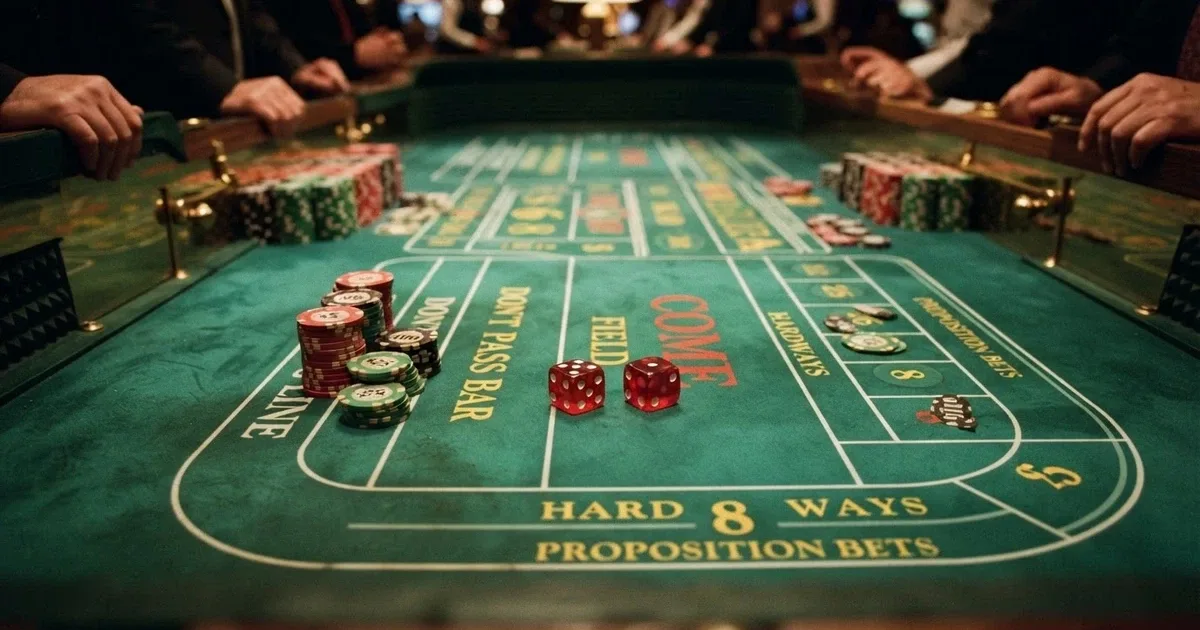
This page is a guide to the games themselves, what the mathematics actually says about every bet, and what the offshore route really looks like in 2026. The legal position is not a footnote here — it is the structure. Under the Interactive Gambling Act 2001, no online casino licence exists anywhere in Australia, not federally and not in any state or territory. The Australian Communications and Media Authority has blocked 1,788 illegal gambling and affiliate websites since November 2019, and over 230 offshore services have pulled out of the Australian market entirely since 2017. Every operator reviewed in the ranking below is one of the survivors, and every one of them is operating outside Australian law.
Data current as of 22 November 2026, verified against the ACMA, Parliament of Australia and operator terms pages.
Table of Contents
- What Casino Games Use Dice?
- Craps — How the Come-out Roll, the Point and the Pass Line Work
- Sic Bo — Big/Small, Totals and the Triple Bet
- Dice Game Variants Beyond Craps and Sic Bo
- House Edge on Every Dice Bet That Matters
- Craps Strategy for Beginners — Bets to Make and Bets to Skip
- Real-Money Play — What Changes When Cash Is on the Line
- Live Dealer Dice Games in 2026
- Free-Play and Demo Dice Games
- Online Dice Casinos Available to Australians in 2026 — All Offshore, None Licensed
- Rocket Play
- Skycrown
- Royal Reels
- Stake
- WinSpirit
- Fair Go
- Rainbet
- Bizzo Casino
- Scream Casino
- Ricky Casino
- The Law on Online Dice in Australia — Why No Site Holds a Local Licence
- The Interactive Gambling Act 2001 — What It Actually Prohibits
- ACMA Enforcement — 1,788 Sites Blocked and Counting
- Licensed Wagering vs Offshore Casino — What the Split Means for Dice Players
- The 2026 Gambling Reform Bill — New Rules from 1 January 2027
- Staying Safe While Playing Dice Online — The Tools You Have and the Ones Offshore Sites Ignore
- BetStop and the Self-Exclusion Gap
- Help Resources and How to Use Them
- Problem Gambling in Australia — the Numbers Behind the Warnings
- How We Reviewed These Casinos
- So, Should You Play Online Dice in Australia?
- Frequently Asked Questions
What Casino Games Use Dice?
Three families of casino game rely on dice, and an Australian player online will encounter all three at an offshore casino. Craps is the dominant two-dice game — the one with the stickman, the proposition bets in the centre of the felt, and the pass line that pays even money on a natural seven or eleven. Sic Bo is the three-dice classic that came out of Asia and now sits alongside baccarat in the live-dealer lobbies of the major studios. A third, looser family covers everything from one-die “under/over” games to dice-and-card hybrids that a single provider might publish under a dozen brand names.
The two-dice craps game is mathematically tighter than almost anything else in a casino. A pass line wager carries a 1.41% house edge, the don’t pass sits at 1.36%, and the free odds bet that sits behind either of them is the only wager in any casino on the floor with a mathematically verified 0% edge. Sic Bo by contrast is a spread: a big/small bet costs the player 2.78% on average, while a specific triple pays 180 to 1 and carries a 16.2% house margin. The player who picks the right bet in the wrong game is still losing faster than the player who picks the ordinary bet in the right one.
The offshore operators that serve Australian players stack their dice lobbies accordingly. Stake runs more than 150 live-dealer titles and includes Sic Bo from Evolution and Pragmatic Play Live, alongside dice-themed game-show products from Animo Studios. Rocket Play carries Evolution Gaming as one of 108 providers, which puts live craps and Sic Bo inside a library of more than 9,000 games. The studios do the filming; the offshore licence does the legal exposure. None of the dice tables an Australian actually plays at are licensed in Australia.
Craps — How the Come-out Roll, the Point and the Pass Line Work
A craps round starts with the come-out roll. The shooter throws two dice; a total of 7 or 11 wins the pass line bet at even money, a total of 2, 3 or 12 (“craps”) loses the pass line immediately, and any other total — 4, 5, 6, 8, 9 or 10 — becomes the “point.” From that moment the table changes shape. A puck marked “on” sits on the point number printed on the felt, and the shooter keeps rolling until either the point number comes up again (pass line wins) or a 7 appears (pass line loses, table “sevens out”). A new come-out roll starts the next round with a fresh shooter if the previous one sevened out.
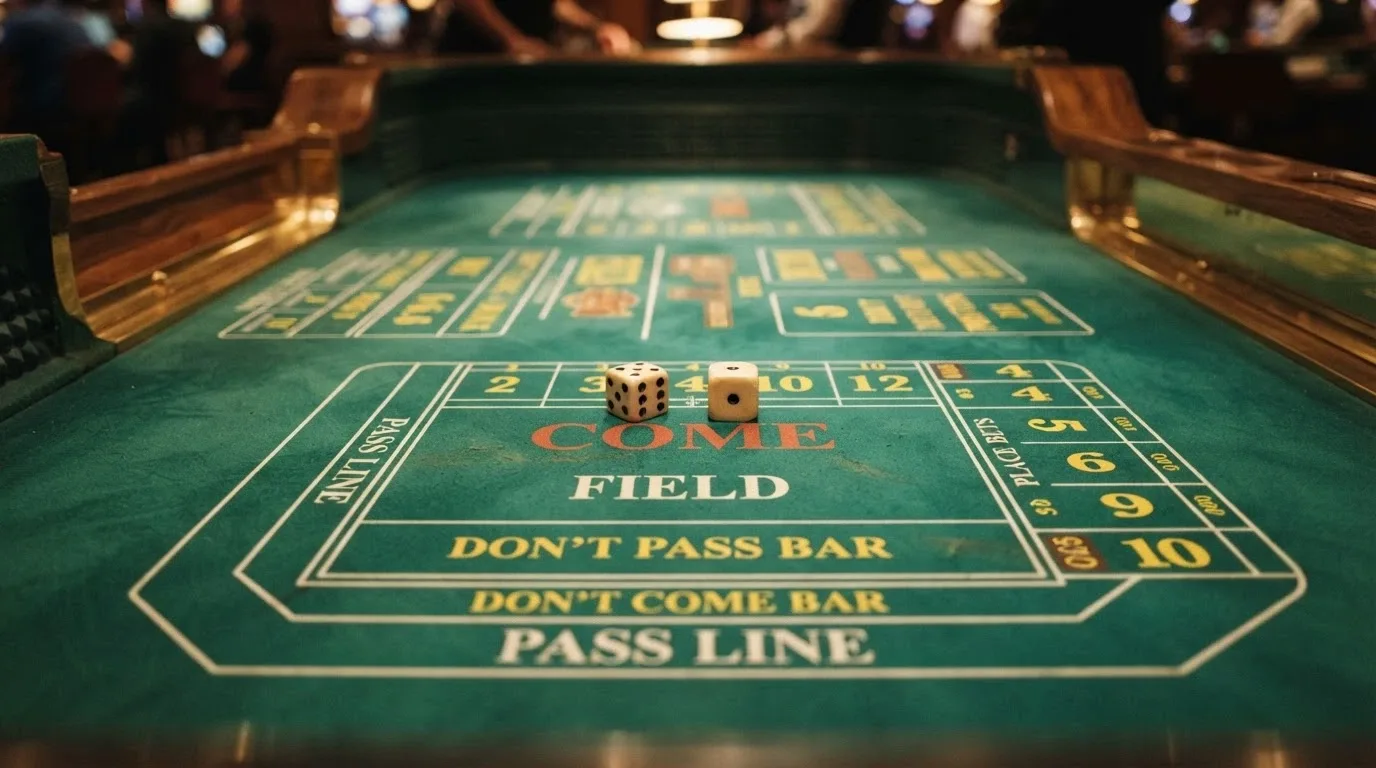
Three bet families sit underneath the come-out logic and they carry very different costs. The pass line and don’t pass bets resolve on the come-out or the point cycle. The come and don’t come bets behave like their own pass line wagers, set on the next roll after they’re placed. The free odds bet rides behind any of those four, has no house edge at all, and pays 2 to 1 when the point is 4 or 10, 3 to 2 on a 5 or 9, and 6 to 5 on a 6 or 8. A player who loads the pass line at the table minimum and stacks three to five times that amount behind in odds drives the combined house edge on that stack down to roughly 0.02% — a number no slot machine in Australia can match.
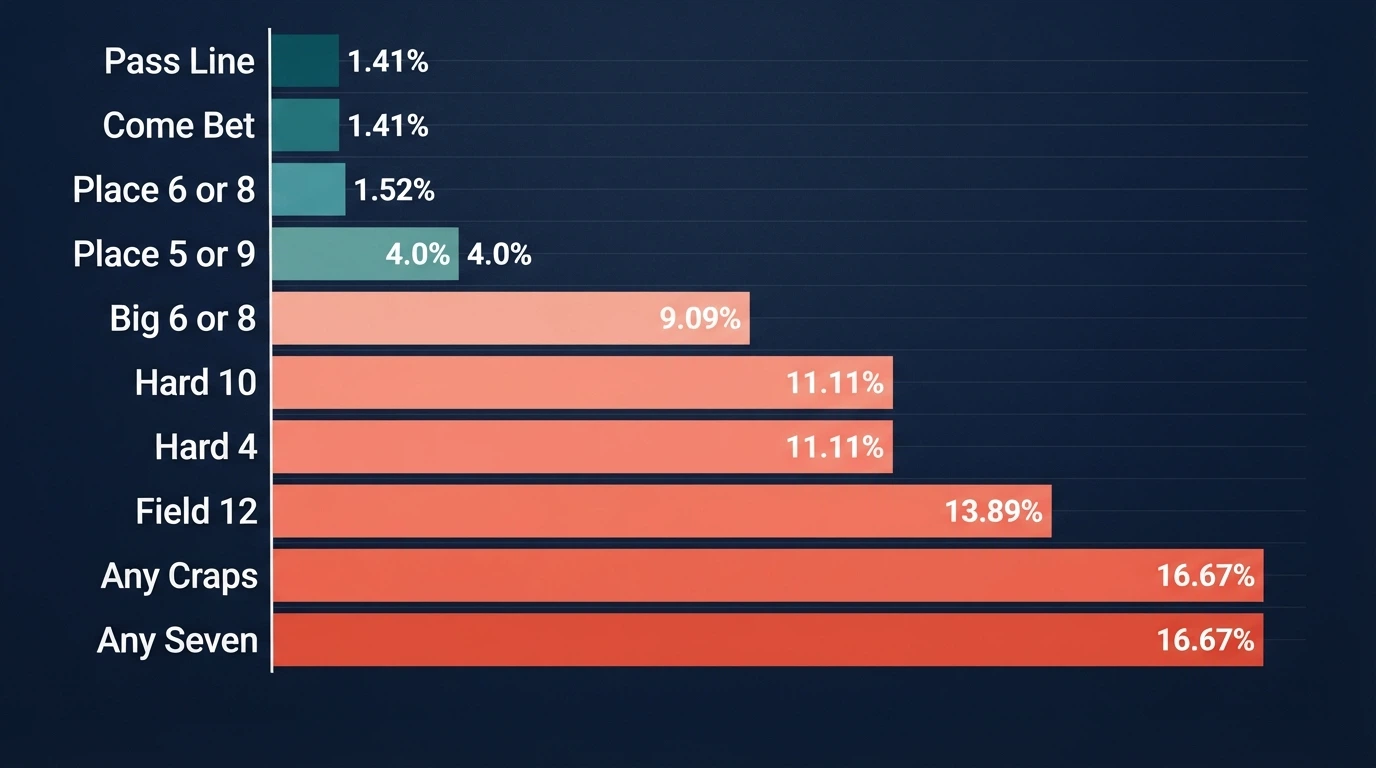
The proposition bets in the centre of the layout tell the other story. Any seven pays 4 to 1 and carries a 16.67% house edge. Hard 6 and hard 8 (dice showing 3-3 or 4-4) pay 9 to 1 with a 9.09% edge. Hard 4 and hard 10 pay 7 to 1 and the edge climbs to 11.11%. Any craps (2, 3 or 12 on the next roll) pays 7 to 1 at 11.11%. The stickman pushes these bets the way a carnival barker pushes a sideshow, and the layout positions them so the dice have to pass over them on every throw. They are the casino’s marketing. A beginner who understands why the pass line with odds exists will not need them.
Sic Bo — Big/Small, Totals and the Triple Bet
Sic Bo is craps stripped of its social theatre. Three dice determine every outcome. The betting grid covers roughly fifty different wagers, and the spread of house margins is wide enough that the player’s choice of bet is the entire game.
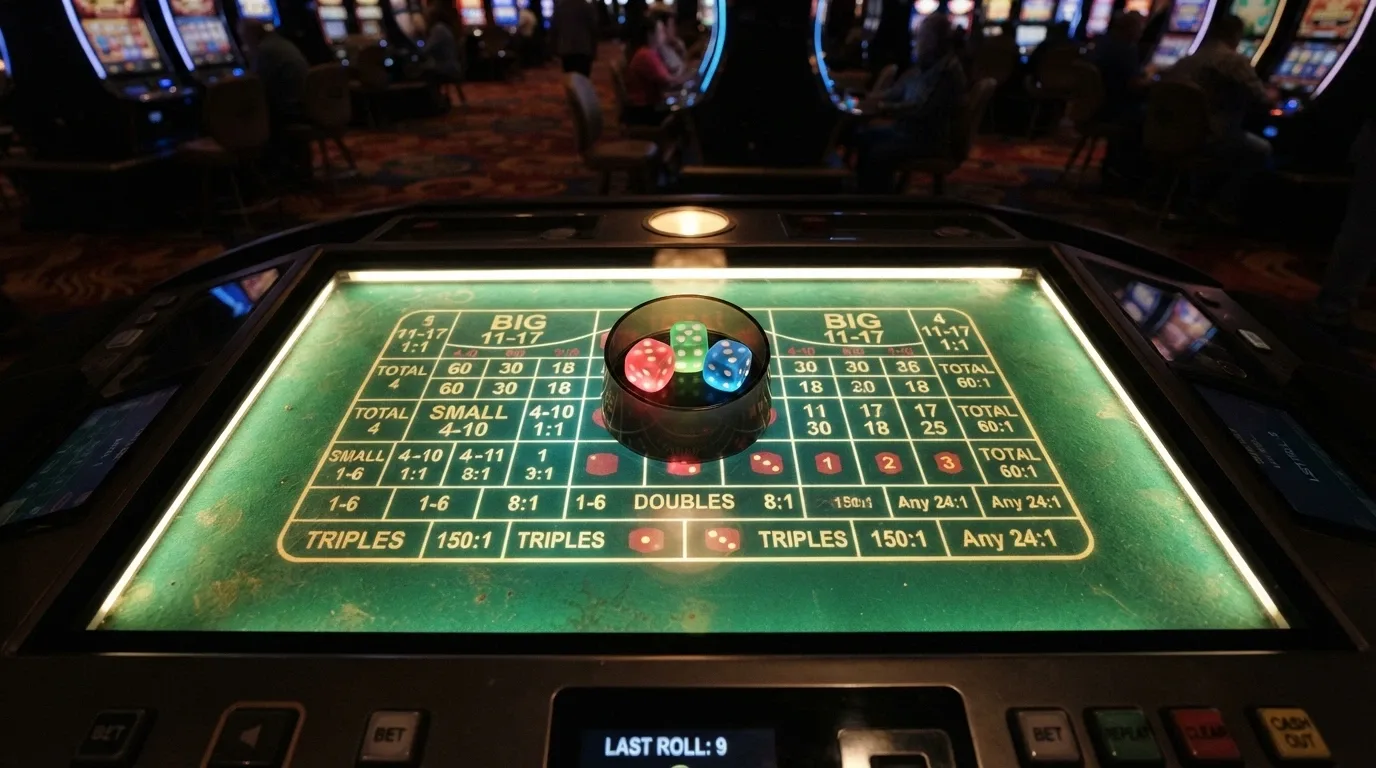
The safest entry point is the big/small bet — wager on whether the total of the three dice will fall in the low range (4 to 10) or the high range (11 to 17). A triple counts as a loss whichever side you picked. The big/small bet pays even money and carries a house margin of 2.78%. Odd/even and specific doubles (a chosen pair appearing in two of the three dice) sit in the same 2.78% band. These are the Sic Bo equivalents of craps’ pass line: dull, repeatable, and the slowest way to lose money on the layout.
From there the payouts climb and the edges climb faster. A bet on a specific total of 9, 10, 11 or 12 pays 6 to 5 at roughly 3.7% house edge. A total of 8 or 13 pays 8 to 1 at around 9.7%. A specific double (say, a pair of 5s among the three dice) pays 10 to 1 at 12.5%. The specific triple — all three dice landing on a chosen number — pays 180 to 1. The catch is the 16.2% house margin. A A$5 triple bet once an hour for an evening is a A$5 souvenir, not a strategy.
The point is not that triple bets are forbidden. The point is that the same A$100 on a big/small wager costs A$2.78 in expected loss; on a specific triple it costs A$16.20. A player who treats Sic Bo as a low-edge game because the headline payout exists is paying for the spectacle.
Dice Game Variants Beyond Craps and Sic Bo
The long tail of dice games at an offshore casino is messier than the craps-and-Sic-Bo pairing suggests. Live studios from Evolution, Pragmatic Play Live and Animo Studios publish dice-themed game shows with wheels, multipliers and bonus rounds layered over a one-die or two-die outcome. The mechanics look more like a TV quiz show than a craps table, but the betting grid still resolves on a dice roll and the RTP is whatever the studio publishes, not whatever the felt suggests. Provider breadth matters: Rocket Play carries 108 providers in total and Stake runs more than 150 live-dealer titles, so the menu of dice variants a logged-in player actually sees is determined by which studio deals to the operator.
There are also one-die and two-die table games that the same providers publish under a dozen names. Under/over (predict whether a single die lands above or below a chosen threshold), dice duels (two players roll a die each, highest total wins) and dice-and-card hybrids (a poker hand scored with one or two dice) appear in the “Other” or “Dice” tab of most offshore lobbies. The rules are usually spelled out in the help screen; the house edge rarely is, and research on this run did not turn up per-title RTP for the variants. A player who wants to know what a particular dice game costs them should treat the unverified figure as the operator’s word, which is not the same as the studio’s.
House Edge on Every Dice Bet That Matters
The numbers below are the published mathematical edges for the bets a player actually encounters. Craps and Sic Bo both appear because both show up in the same offshore lobbies and a player who switches between them needs the comparison at hand.
| Bet | House edge (%) | Payout odds | Beginner-friendly? |
|---|---|---|---|
| Craps — free odds (behind pass/don’t pass) | 0.00 | 2:1, 3:2 or 6:5 on point | Yes (always pair with line bet) |
| Craps — pass line with 3-4-5x odds | ≈0.02 | 1:1 plus odds multiple | Yes (the best stack on the table) |
| Craps — don’t pass line | 1.36 | 1:1 | Yes (better edge, awkward socially) |
| Craps — pass line | 1.41 | 1:1 | Yes (the standard play) |
| Sic Bo — big / small | 2.78 | 1:1 | Yes (the safest Sic Bo bet) |
| Sic Bo — specific total 9/10/11/12 | ≈3.7 | 6:5 | With care |
| Sic Bo — specific double | 12.5 | 10:1 | No |
| Craps — hard 6 / hard 8 | 9.09 | 9:1 | No |
| Sic Bo — specific total 8 / 13 | ≈9.7 | 8:1 | No |
| Craps — any craps (2/3/12 next roll) | 11.11 | 7:1 | No |
| Craps — hard 4 / hard 10 | 11.11 | 7:1 | No |
| Craps — any seven | 16.67 | 4:1 | No |
| Sic Bo — specific triple | 16.20 | 180:1 | No |
A A$100 pass line bet costs A$1.41 in expected loss over enough rolls for the maths to settle. The same A$100 on any seven costs A$16.67. The free odds bet is the only wager in any casino with a verified 0% edge; the only reason to bet anything else first is to qualify for the odds layer.
Craps Strategy for Beginners — Bets to Make and Bets to Skip
A beginner’s craps strategy fits in two sentences. Put the pass line down for the table minimum. Back it with the maximum odds the casino allows. Ignore everything in the centre of the layout.
The pass line costs 1.41% on its own and the don’t pass 1.36%, which is technically the lower edge but reads as betting against the shooter and tends to draw the table’s attention at a live game. The pass line keeps the math simple and the table on your side. The free odds bet behind it costs the house nothing, and stacking three, four or five times the pass line amount in odds drives the combined edge on that stack to around 0.02% — a number that no slot machine or roulette wheel gets close to.
What to skip is the centre: any seven, hardways, the horn, the world, the field at inflated odds. Each of these is a bet the house is delighted to take. Any seven at 16.67% is the most expensive regular bet on a standard craps layout. A hard 4 or hard 10 at 11.11% is not far behind. The proposition bets are sold with energy because they pay attention-grabbing multiples, and a beginner who treats the stickman’s patter as information rather than salesmanship will keep more of the bankroll.
The only complication is the table minimum versus the odds multiple. A A$15 minimum with 5x odds means each round costs A$15 on the pass line and up to A$75 in odds behind it — a A$90 round. That is not a small amount, and a player with a tighter bankroll should drop to a lower minimum or a casino that allows a lower odds multiple. The math holds at any size; the bankroll is the constraint.
Real-Money Play — What Changes When Cash Is on the Line
The rules do not change when a player swaps demo credits for real money, but everything around them does. A real-money pass line bet is a withdrawal from a payment method the site controls, governed by terms the player agreed to on signup, and subject to wagering requirements if a bonus is in play. A demo pass line bet costs nothing and settles instantly.
The wagering requirement is the part most players under-read. A 100% match bonus with 40x wagering means the player has to turn the bonus amount over forty times in eligible games before any of it becomes withdrawable cash. A A$1,000 bonus requires A$40,000 of eligible wagering. WinSpirit publishes this clearly: a bonus amount up to A$2,000 across the first two deposits, 40x wagering on the bonus, a 7-day validity from activation, a A$5 maximum bet per spin or game round during the wagering period, a A$3,000 maximum win per bonus and a A$300 cap on free-spin winnings. Royal Reels runs a 35x wagering requirement on its 100% first-deposit match, with a A$10 minimum deposit and no maximum cashout on the deposit bonus (the A$10 no-deposit bonus, by contrast, carries 30x wagering and a A$200 max cashout). Fair Go’s 300% match up to A$3,000 plus 50 free spins carries 30x wagering on deposit plus bonus with a A$10 max bet during play and no cashout cap on the deposit bonus. Rainbet separates the two: 35x on the bonus amount and 30x on free-spin winnings.
The Australian payment side adds a second layer. Credit cards, credit-related products and digital currency are banned as payment for online wagering from 11 June 2024, with penalties of up to A$247,500 for non-compliant operators. A site that asks for a credit card or a crypto deposit is not operating under Australian rules, and the payment request is itself a tell. Legal deposit routes for licensed wagering are debit card, bank transfer, PayID/Osko and BPAY. An offshore casino will accept a wider range — and the wider range is the risk.
The friction is at withdrawal, not deposit. An offshore casino that accepts a deposit in minutes can hold a withdrawal for days while the “verification team” reviews documents the player already submitted at signup. There is no Australian regulator to escalate to, no ACMA complaints process that reaches the operator, and no small-claims route. A player who has a balance at an offshore site is, for that balance, outside the Australian consumer-protection system.
Live Dealer Dice Games in 2026
A live-dealer craps or Sic Bo stream is a real table in a real studio, with a human croupier, real dice and a camera that follows the throw. The player sits on the other side of a digital betting interface, places chips on the same layout a land-based player would touch, and watches the outcome on a video feed. The social element of a craps table — the stickman’s patter, the cheers on a hot roll, the groans on a seven-out — survives the transition imperfectly; the chat window does its best.
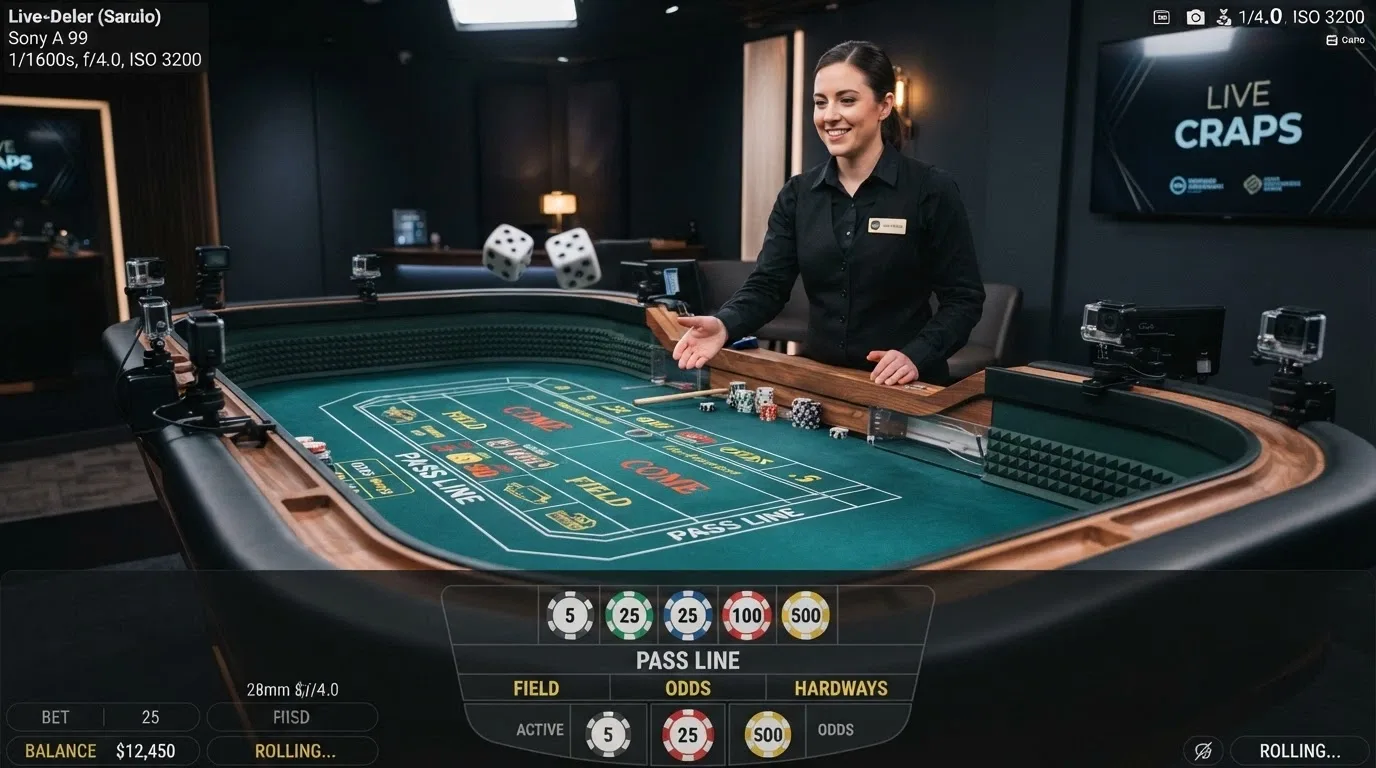
Evolution Gaming streams Craps Live and Sic Bo Live from European studios and ships them to most offshore operators carrying a Curaçao or Anjouan licence. Pragmatic Play Live publishes its own Sic Bo tables. Animo Studios has built dice-themed game shows that look more like television than a casino floor. Stake offers more than 150 live-dealer titles including Sic Bo from these three providers; Rocket Play carries Evolution Gaming among 108 providers overall. The studio product is mature. The legal exposure of the casino hosting the stream is the same as any other offshore operator serving Australians: the IGA does not care which studio the dice come from.
What the live format does change is the pace. A live craps table rolls once every three to four minutes, with betting windows that close before the throw. A live Sic Bo table resolves in under a minute. Compared to a slot machine running twenty spins a minute, the live table burns bankroll slowly — which is a better deal for the player who wants the game’s full experience and a worse deal for the player chasing a bonus’s wagering requirement, where every minute spent at a slow table is a minute the 7-day validity clock is still ticking.
Free-Play and Demo Dice Games
Most offshore casinos let a logged-out visitor open a craps or Sic Bo game in demo mode. No real money changes hands, no bonus terms apply and the player can sit at the table long enough to learn the betting grid without losing a cent. Demo mode is a useful sandbox and a poor substitute for reading the terms. What it hides is exactly what matters at the cash table: the wagering multiple, the maximum bet during playthrough, the bonus validity window, the withdrawal friction, and the absence of any Australian consumer protection if the operator decides not to pay.
A short demo session is worth doing before a first real deposit, particularly for Sic Bo, whose betting grid takes longer to read than craps’. Beyond that, free-play has a ceiling. There is no free-play path that exercises the bonus terms, simulates the seven-day expiry clock, or tests whether the withdrawal actually lands. The real test of an offshore casino is the first cashout attempt, and no demo session reaches it.
Online Dice Casinos Available to Australians in 2026 — All Offshore, None Licensed
The table below ranks ten offshore casinos that accept Australian players for dice games. The legal status is the same for every row: no Australian casino licence exists for the product, none of these operators holds one, and each operates outside the Interactive Gambling Act 2001. The columns reflect what research turned up; unverified cells carry the no-data marker.

| Casino | Licence | Welcome bonus | Free spins | Wagering | What stands out |
|---|---|---|---|---|---|
| Rocket Play | Curaçao (inferred, not confirmed this run against the register) | — | — | A$7.50 max bet during bonus playthrough | 9,000+ games from 108 providers including Evolution and Pragmatic Play |
| Skycrown | Curaçao (inferred, not confirmed this run) | 450% up to A$8,000 across four deposits | 400 | — | Largest headline welcome package in the set |
| Royal Reels | — | 100% up to A$500 (A$10 min deposit) | A$10 no-deposit bonus | 35x (match bonus), 30x (no-deposit) | One of the few no-deposit bonuses in the offshore market |
| Stake | Curaçao Gaming Authority OGL/2024/1451/0918 | — | — | — | Only operator in the set with a verifiable Curaçao licence number; 150+ live-dealer titles including Sic Bo |
| WinSpirit | — | 100% up to A$1,000 (1st dep) + 200% up to A$1,000 (2nd dep) | 170 (100 + 70) | 40x on bonus; 7-day validity | Clearly published terms; A$3,000 max win per bonus; A$300 cap on FS winnings; A$5 max bet during wagering |
| Fair Go | Curaçao (confirmed by review sites) | 300% up to A$3,000 | 50 on Cash Bandits 2 | 30x on deposit + bonus; A$10 max bet during play | On the ACMA blocked-sites list since November 2019; RTG as sole provider |
| Rainbet | — | 100% up to A$500 | 50 | 35x (bonus), 30x (FS winnings) | Separate wagering multiples for bonus and free-spin winnings |
| Bizzo Casino | — | — | — | 5x on CP redemption; 10x on level rewards | 30-tier VIP program; A$30 wagered on pokies = 1 Comp Point |
| Scream Casino | — | — | — | — | Verified specifics unavailable; presence in the offshore AU market noted only |
| Ricky Casino | Curaçao (from archived results) | 100% up to A$7,500 | — | — | Largest single-deposit match ceiling in the set |
A dash in any cell means research did not turn up a verified figure for that operator on that point during this run. A reader who needs a number the table does not show should treat the operator’s own terms page as the starting point and the table as a snapshot of what the public record carries.
Rocket Play
Rocket Play is a breadth play. The library runs to more than 9,000 games from 108 providers, which puts Evolution Gaming’s live craps and Sic Bo tables next to BGaming’s RNG titles and Pragmatic Play’s full catalogue in the same lobby. The trade-off is verification: the Curaçao licence is inferred from review sites rather than confirmed against the current register, and the welcome-bonus specifics did not turn up in this run. What Rocket Play does publish clearly is the A$7.50 maximum bet cap during bonus wagering — a tighter ceiling than many competitors, which limits how fast a player can grind through a bonus’s turnover requirement and protects the bonus value from being burnt in a single round. The Rocket Winfinity tournament distributes A$6,600 in real money across its leaderboard, which is a small live-event for an offshore operator of this size.
Rocket Play suits a player who wants the widest possible choice of live-dealer dice variants and is comfortable reading the terms on the operator’s own site rather than relying on a third-party summary.
Skycrown
Skycrown publishes the loudest welcome package in the ranking: 450% across four deposits, up to A$8,000, plus 400 free spins. The headline is large enough to flatten the comparison column, and the four-deposit structure spreads the burden across a player’s first week rather than concentrating it on the first deposit. The wagering multiple and validity window were not verifiable this run, and the licence, like Rocket Play’s, is inferred rather than confirmed against the Curaçao register. For an Australian player the legal position is unchanged from every other row in the table.
Skycrown suits a player who wants the largest headline match and accepts that the published terms on the operator’s own site are the only authoritative source. The bonus’s real cost will be a function of the wagering multiple once verified.
Royal Reels
Royal Reels is one of the few offshore operators in this set offering a no-deposit bonus, and the A$10 it extends carries 30x wagering with a A$200 maximum cashout — a small figure that tells the player the bonus is a sampling tool rather than a bankroll builder. The main offer is a 100% first-deposit match up to A$500 with a A$10 minimum deposit, 35x wagering and no maximum cashout on the deposit bonus. The asymmetry between the no-deposit cap and the deposit-bonus absence of a cap is the deal: try the site for A$10 with a A$200 ceiling, then commit real money with a wider withdrawal window.
The licence was not confirmed this run. For an Australian player that adds to the offshore risk already implicit in the table, but the published terms are the clearest in the no-deposit niche.
Stake
Stake is the only operator in the ranking with a Curaçao Gaming Authority licence number — OGL/2024/1451/0918 — that the research stage was able to verify on the operator’s own site. The live-dealer library is the deepest in the set: more than 150 titles from Evolution Gaming, Pragmatic Play Live and Animo Studios, with Sic Bo across multiple studio tables. The welcome-bonus specifics did not surface in this run, and Stake’s positioning is crypto-native, which sits awkwardly against Australia’s 11 June 2024 ban on digital currency as a payment for online wagering.
Stake suits a player who wants the most legible offshore licence in the set and the deepest live-dealer dice menu, and who understands that the crypto orientation puts the operator outside the Australian payment-method rules from the moment of deposit.
WinSpirit
WinSpirit is the operator in the ranking with the clearest published terms. The welcome package runs up to A$2,000 across the first two deposits (100% up to A$1,000 then 200% up to A$1,000), with 170 free spins split 100/70, 40x wagering on the bonus amount, a 7-day validity from activation, a A$5 maximum bet per spin or game round during the wagering period, a A$3,000 maximum win per bonus and a A$300 cap on free-spin winnings. Each of those numbers is a constraint, and the constraints are visible on the operator’s own page rather than buried in linked terms. The licence was not confirmed this run, which leaves the verification gap common to the rest of the table.
WinSpirit suits a player who reads the terms first and values knowing the bonus’s ceiling before the first deposit.
Fair Go
Fair Go is the only operator in the ranking explicitly named on the ACMA’s blocked-sites list. It has been blocked since November 2019, and Proxous, the entity behind the brand, received a formal ACMA warning in August 2022. The site still operates offshore, still accepts Australian players through mirror domains, and still offers a 300% welcome match up to A$3,000 plus 50 free spins on Cash Bandits 2, with 30x wagering on deposit plus bonus, a A$10 maximum bet while the bonus is active, and no maximum cashout on deposit bonuses. RealTime Gaming is the sole provider, which means the dice-game selection is whatever RTG publishes under that label rather than the Evolution or Pragmatic Play Live tables a wider operator carries.
Fair Go is the most visible enforcement target in the set. A player who chooses it is choosing an operator the Australian regulator has named by name. The block is a real, ongoing enforcement action, not a historical record.
Rainbet
Rainbet offers a 100% first-deposit match up to A$500 plus 50 free spins, with 35x wagering on the bonus amount and 30x on free-spin winnings. The split wagering requirement is a transparency feature: the player knows the bonus’s turnover and the free-spin winnings’ turnover are calculated separately, which makes it easier to estimate when each component becomes withdrawable. The licence was not confirmed this run and the provider mix is not documented in the public record reviewed.
Rainbet suits a player who prefers clean, separated wagering terms and does not need a deep live-dealer dice library to make a session worthwhile.
Bizzo Casino
Bizzo is the loyalty play. The VIP program runs thirty levels, with A$30 wagered on pokies earning one Comp Point, CP redemption carrying 5x wagering, and level rewards at 10x. The program is built for volume — a player who puts regular turnover through the site climbs the ladder, redeems points, and converts level rewards at predictable multiples. The welcome bonus, the licence, the provider mix and the dice-game availability were not confirmed this run, which makes Bizzo harder to recommend as a first-time dice site and easier to recommend as a second account once a player has decided they like the offshore route.
Bizzo suits a high-volume player who already has a primary offshore casino and wants a secondary loyalty account.
Scream Casino
Scream Casino is a newer offshore entrant targeting Australian players, and the research this run turned up nothing verifiable beyond its presence in the market. The licence, the welcome bonus, the wagering terms, the provider mix and the dice-game availability are all unconfirmed. A page that printed terms for Scream Casino would be inventing them, and the honest move is to name the gap rather than fill it.
Scream Casino is a brand a reader will encounter in search results, and the responsible framing is to say what cannot be verified rather than dress the absence in invented specifics.
Ricky Casino
Ricky Casino’s headline is the 100% first-deposit match up to A$7,500 — the largest single-deposit match ceiling in the ranking. The Curaçao licence is from archived results rather than a fresh verification this run, and the free-spin count, wagering multiple and bonus validity did not surface. For a player who weighs a bonus on its ceiling figure rather than its wagering fine print, Ricky Casino tops the column. For a player who reads the fine print first, the published terms on the operator’s own site are the only authoritative source.
Ricky Casino suits a player who wants the largest single-deposit headline and accepts that the rest of the terms are unverified.
The Law on Online Dice in Australia — Why No Site Holds a Local Licence
Online casino games — craps, Sic Bo and every other dice-based product — are prohibited interactive gambling services under the Interactive Gambling Act 2001. The Act was amended in 2017 to close the offshore loopholes that had let overseas operators serve Australian customers unchecked, and the 2017 amendment gave the Australian Communications and Media Authority its enforcement and ISP-blocking powers. The Act targets the provider of the prohibited service, not the individual player. No Australian player has been prosecuted for placing a bet at an offshore casino. The casino itself, and any Australian-resident who supplies or advertises the service, is the enforcement target.
There is no licence for online casino games anywhere in Australia, not federally and not in any state or territory. The Northern Territory Racing and Wagering Commission licenses online wagering operators — Sportsbet, bet365, Ladbrokes, about fifty others — but the licence covers pre-event wagering on sport and racing, not casino games. The same operator cannot add a Sic Bo table to its product and stay within its NT licence. A state lottery can offer keno. A licensed wagering operator can offer pre-event odds. Nothing in the framework allows a licence for an online craps table.
The practical consequence for a player is that every dice site an Australian visits is an unlicensed offshore operator, every deposit sits outside the Australian consumer-protection system, and the ACMA can direct Australian internet service providers to block the site at any time — including while the player has a balance on it. The credit-card and crypto ban from 11 June 2024 is the payment-method side of the same logic: a deposit route the regulator can close is a deposit route the player cannot use to fund an unlicensed site through Australian banking rails.
The Interactive Gambling Act 2001 — What It Actually Prohibits
The IGA makes it an offence to provide online casino games, online pokies and in-play sports betting to a person physically in Australia. “Provide” is the operative word — the Act targets the operator that offers the service to an Australian customer, not the customer who logs in. The 2017 amendment gave the ACMA the power to issue formal warnings, refer matters for civil penalty proceedings, and direct ISPs to block illegal services under section 313 of the Telecommunications Act 1997. Before 2017, the prohibition existed but the enforcement did not. The amendment added the teeth.
What the Act permits is narrower than the prohibition suggests. Licensed operators can offer pre-event wagering on sport and racing, lotteries, and keno. A wager placed after the event has started — in-play betting — is prohibited, which is why licensed Australian bookmakers close their markets at the first whistle. Online casino games of any kind, dice or otherwise, are outside the licensable product set entirely.
A player who understands the Act as “the government is after me” is reading it wrong. The Act is after the operator, and the consumer-protection consequences flow from the player’s choice to deal with an operator the Act does not reach. No Australian regulator can compel an offshore casino to pay a disputed withdrawal. No Australian court can enforce a judgment against a Curaçao-licensed entity in the way it can enforce one against an NT-licensed bookmaker. The consumer-protection loss is real, and it is the player’s loss to absorb.
ACMA Enforcement — 1,788 Sites Blocked and Counting
The ACMA’s enforcement record since November 2019 is the most concrete evidence the regulator’s powers are being used. The agency has directed Australian ISPs to block 1,788 illegal gambling and affiliate websites since the first blocking request in November 2019, and over 230 illegal services have pulled out of the Australian market entirely since 2017 — meaning the regulator’s existence has changed operator behaviour even where individual blocks have not. Fair Go is the named example in this ranking: it has been on the ACMA blocked-sites list since November 2019, and Proxous, the entity behind the brand, received a formal ACMA warning in August 2022.
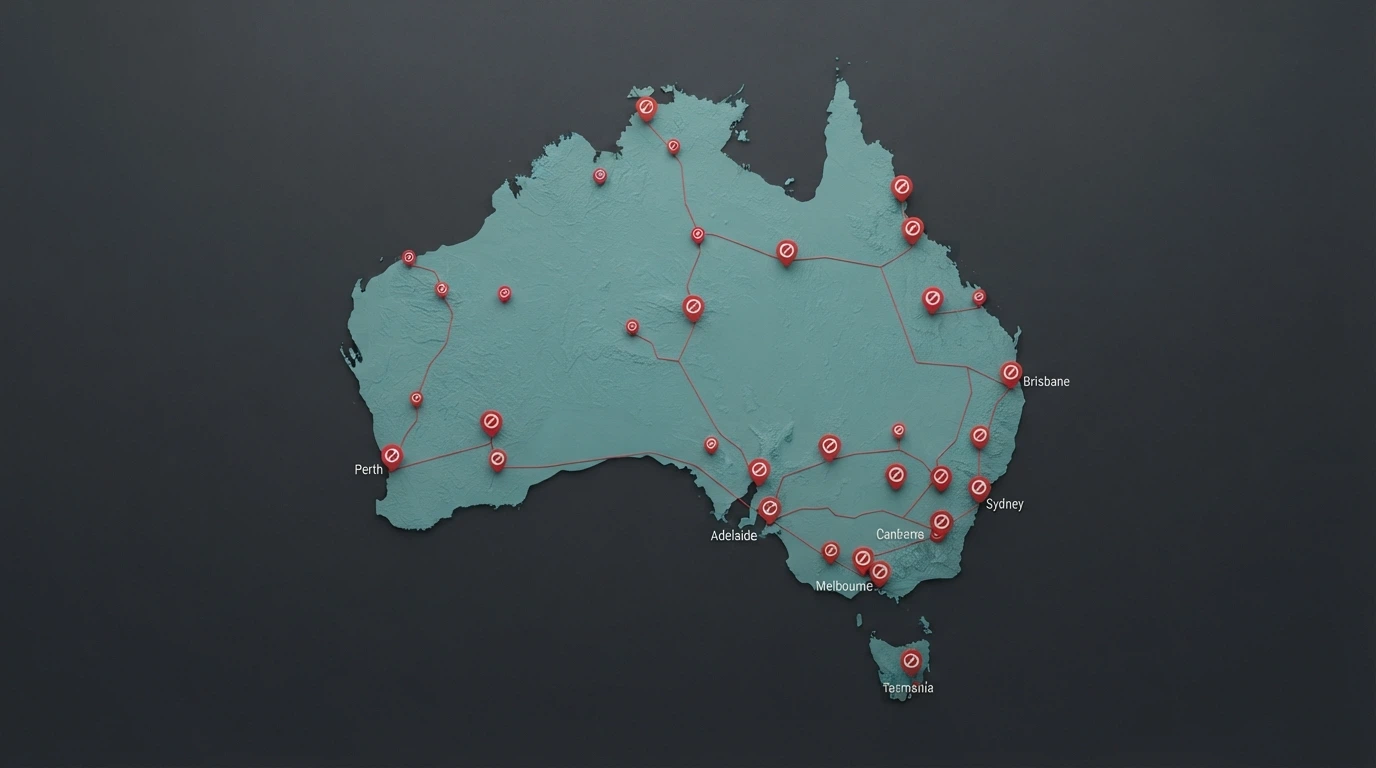
The blocking mechanism is the technical lever. Under section 313 of the Telecommunications Act 1997, the ACMA can direct an Australian internet service provider to block access to a specified service. The block applies at the ISP level, so a player on Telstra or Optus or TPG cannot reach the site through their home connection. Offshore mirror domains and VPN use exist as workarounds, and the regulator’s job is to keep up with both. For a player, the practical risk is that a block can land while a balance is still on the site — a withdrawal request submitted on Friday can be unreachable by Monday if the regulator adds the domain to the list over the weekend.
The ACMA’s published statement — that “since the ACMA made its first blocking request in November 2019, 1,788 illegal gambling and affiliate websites have been blocked” and that “over 230 illegal services have also pulled out of the Australian market since the ACMA started enforcing new illegal online gambling rules in 2017” — is the regulator’s own framing of an enforcement programme that is ongoing, not retrospective.
Licensed Wagering vs Offshore Casino — What the Split Means for Dice Players
Australia’s online gambling market is two-track. The licensed track runs through the Northern Territory Racing and Wagering Commission and the state regulators, covers pre-event wagering on sport and racing, and connects to the Australian consumer-protection system: the ACMA for complaints, BetStop for self-exclusion, the ATO for tax treatment, and the Australian Financial Complaints Authority for disputes that escalate. The offshore track covers everything the licensed track does not, including the entire casino product — craps, Sic Bo, pokies, table games, live dealer — and connects to none of it.
A dice player in Australia who sticks to the licensed track has no game to play. The NT-licensed bookmakers are not licensed to offer craps or Sic Bo. State lotteries are not licensed to offer dice games. The only legal way to play craps in Australia is to drive to Crown Melbourne or the Star Sydney and play at the felt.
A dice player who wants to play online goes offshore. The payment-method litmus test makes the boundary obvious: credit cards, credit-related products and crypto are banned as payment for online wagering from 11 June 2024, with penalties of up to A$247,500 for non-compliant operators. A licensed Australian wagering operator will ask for a debit card, a bank transfer, PayID/Osko or BPAY. An offshore casino will accept a wider range, and the wider range is the tell that the deposit is leaving the Australian-regulated payment system. The fact that crypto is now banned for any online wagering — licensed or not — means an offshore casino asking for Bitcoin or USDT is asking for a payment the regulator has already said is not allowed.
The consumer-protection gap is the price of the offshore ticket. BetStop’s self-exclusion register binds Australian-licensed wagering services only; an offshore casino is not connected, so a self-excluded person can still deposit and lose money at every operator in the ranking above. The ACMA’s complaints process does not reach offshore operators. The AFCA cannot enforce a judgment against a Curaçao-licensed entity. A blocked site can take a player’s balance with it. None of these risks is hypothetical, and all of them are the unavoidable cost of choosing the offshore route.
The 2026 Gambling Reform Bill — New Rules from 1 January 2027
The Interactive Gambling Amendment (Gambling Reform) Bill 2026 passed Parliament on 19 August 2026 and its measures commence on 1 January 2027. It is law with a start date, not a proposal: the rules are not yet binding in 2026 but the calendar is set.
The three changes that matter to a dice player are the payment-blocking powers, the advertising caps, and the inducement rules. From 1 January 2027, banks and payment providers gain express authority to block transactions to illegal gambling operators — a direct extension of the credit-card and crypto ban from 11 June 2024, but with the bank’s discretion to refuse a transaction to an offshore casino. The implication is that even the legal payment routes (debit card, PayID, BPAY) may no longer reliably reach an offshore operator, because the bank can refuse the transaction at its end.
The advertising caps run in parallel. No more than three wagering ads per hour between 6:00 am and 8:30 pm. A live-sport blackout from 15 minutes before an event until 5 minutes after it ends. No athletes, celebrities or influencers promoting wagering products. Broadcasting sporting odds is banned outright. Online ads are restricted to logged-in, age-verified users with an opt-out. Direct marketing of inducements is prohibited for 14 days after sign-up, three months after BetStop deregistration and indefinitely for at-risk customers. For a player, the practical effect is that the marketing environment around the offshore route becomes less visible: the ads a player used to see in a sports broadcast disappear, and the influencer promotion a player used to follow on social media goes quiet.
The reform does not legalise online casino. The IGA’s prohibition stays. What the reform does is harden the perimeter: harder to advertise to, harder to pay, harder to reach through an Australian ISP, and harder to remain in the market if the offshore operator is the named target of a blocking request.
Staying Safe While Playing Dice Online — The Tools You Have and the Ones Offshore Sites Ignore
Australia’s responsible-gambling infrastructure is built for the licensed market. BetStop, the National Gambling Helpline, Gambling Help Online, the state-based counselling services — every one of these tools works inside the licensed perimeter. For a player who has chosen the offshore route, the tools still exist but their reach stops at the border.
A player who recognises a problem and wants to stop has two routes that work, and several that do not. The two that work: the National Gambling Helpline on 1800 858 858 (free, confidential, staffed 24 hours a day, 7 days a week) and Gambling Help Online at gamblinghelponline.org.au (live chat and counselling). The state-based problem-gambling services in Victoria, New South Wales, Queensland and the other jurisdictions are also reachable, and a counsellor there can talk through a player’s situation without requiring them to name the offshore casino they have been using.
The route that partly works is BetStop. One registration with the National Self-Exclusion Register excludes a person from every Australian-licensed online and phone wagering service, and as at 31 July 2026 the register held 67,480 registrations, of which 41,290 exclusions were still active — more than 60% of everyone who ever registered. 78% of registrants were under 40 and 38% chose lifetime exclusion. The register binds licensed operators. It does not bind offshore casinos, and a self-excluded person can still deposit and lose money at every operator in the ranking above. BetStop is the most useful tool available to a player who has decided to keep their wagering inside the licensed market, and it is no barrier at all to a player who has decided to leave it.
The honest framing of the offshore gap is that the tools an Australian uses to protect themselves stop where the offshore site begins. The National Gambling Helpline, Gambling Help Online, BetStop, the ACMA complaints process and the AFCA all sit on the licensed side of the line. On the offshore side, the only protection is the player’s own decision to stop.
BetStop and the Self-Exclusion Gap
BetStop is the National Self-Exclusion Register, live since August 2023. A single registration excludes a person from every Australian-licensed online and phone wagering service for a chosen period — three months, six months, twelve months, or lifetime. The 38% of registrants who chose lifetime exclusion made a decision the register enforces across the entire licensed market. The 78% of registrants under 40 skews younger than the historical profile of self-excluders, and the active-registration rate of more than 60% suggests the register is being used by people who follow through, not just people who sign up on a difficult evening and never log in again.
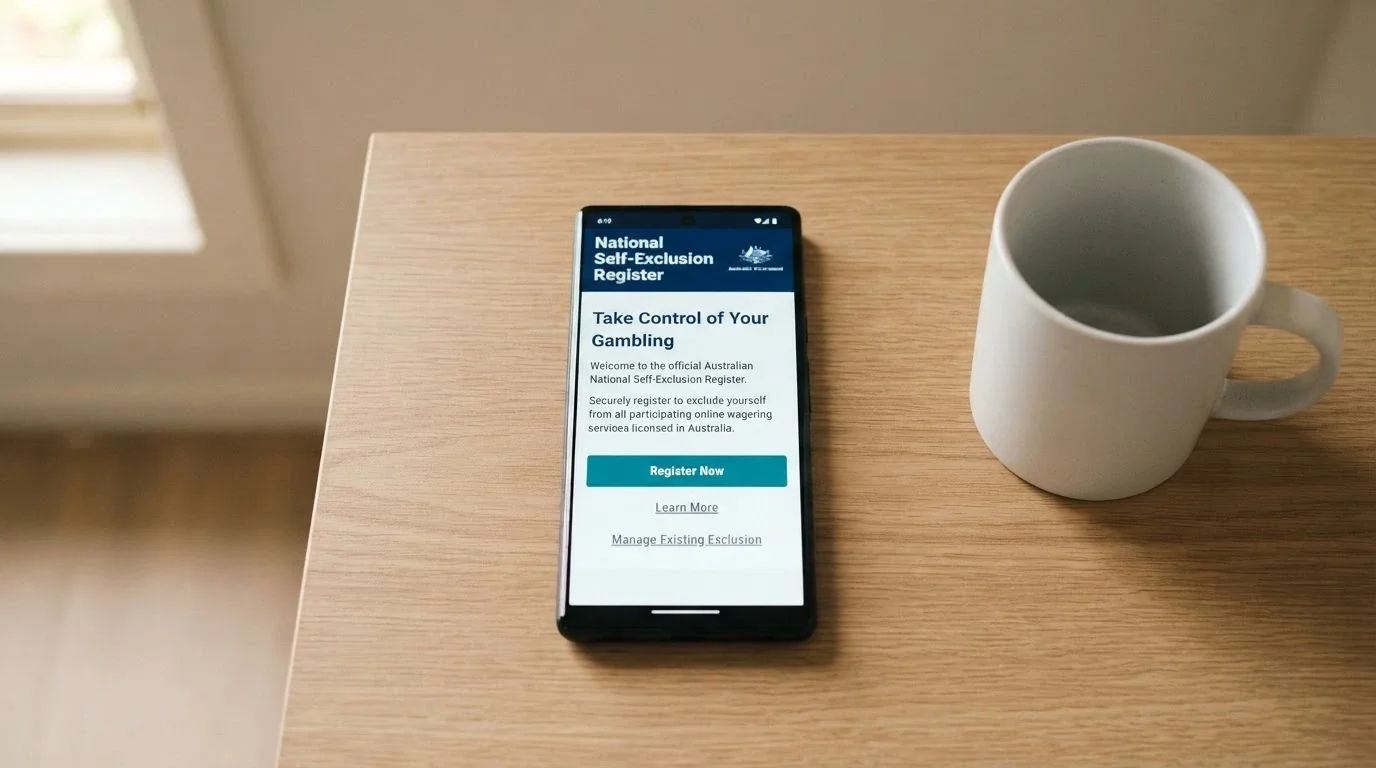
The gap is the offshore market. The register binds Australian-licensed wagering services only; an offshore casino is not connected. A self-excluded person who wants to keep playing can open a new account at every operator in the ranking above, deposit through a method the credit-card ban does not cover, and continue. The register’s protection stops at the licensed perimeter, and the offshore route is entirely outside it.
For a player who is reading this page because they suspect their own play has become a problem, the register is still worth the registration — it removes the licensed-market friction and leaves only the offshore friction to manage. For a player who is reading this page because they are choosing an offshore casino, the register’s gap is the single most concrete harm of the route, and the part of the page worth sitting with for a minute longer than the rest.
Help Resources and How to Use Them
- National Gambling Helpline — 1800 858 858. Free, confidential, staffed 24/7 by trained counsellors. A player can call to talk about their own gambling or about someone else’s. The call does not appear on a phone bill in identifying form, and the service does not share information with operators, banks or family without consent.
- Gambling Help Online — gamblinghelponline.org.au. Live chat and online counselling, available 24/7. The chat option suits a player who is not ready to talk on the phone, or who is offshore at the time and wants the same service. Counsellors can also help a player self-exclude via BetStop and walk them through the registration.
- BetStop — National Self-Exclusion Register. The registration takes a few minutes online and the exclusion applies across every Australian-licensed wagering service. The protection does not reach offshore casinos, but the registration still removes the licensed-market friction.
- State and territory problem-gambling services. Each state runs its own counselling and support service, reachable through the helpline or through Gambling Help Online. Face-to-face counselling is available in every capital city and most regional centres.
A first call to the helpline is usually a conversation, not a referral. The counsellor will ask what is going on, listen without judgement, and lay out the options. The first option is usually the easiest — the player books a follow-up call or moves to a longer counselling relationship. None of it requires the player to stop gambling before the call, and none of it requires them to name the offshore casino they have been using.
Problem Gambling in Australia — the Numbers Behind the Warnings
The Australian Institute of Health and Welfare’s 2022 estimate put problem gambling at approximately 2.1% of Australian adults — roughly 430,000 people — and high-risk gambling at 1.8%. The figures explain why the responsible-gambling infrastructure exists at the scale it does: the helpline, the register, the counselling services, the per-operator deposit limits in the licensed market, and the BetStop registration system are sized for a population where problem gambling touches roughly one in fifty adults.
Dice games with a low house edge are not safer from a problem-gambling perspective. A 1.41% pass line edge and a 0.02% combined pass-line-with-odds edge are mathematically gentle, but a player chasing losses at a craps table is exposed to the same dopamine cycle as a player chasing losses at a pokie. The difference is the pace: a craps table resolves once every few minutes, a slot machine every few seconds. The slower pace is a smaller harm per hour for a player who is playing for entertainment, and a smaller harm per session for a player who is not. It is not a different category of risk.
The offshore gap makes the prevalence data harder to act on. The AIHW figures are drawn from Australian-population surveys and Australian operator data, neither of which reaches an offshore casino. A player who uses only offshore sites is outside both the numerator and the denominator, and the absence of data is itself a form of risk.
How We Reviewed These Casinos
The ten operators in the ranking were drawn from the operators skill shortlist and confirmed against archived search results from a prior session. For each operator, the review stage checked the published terms on the operator’s own site against the archived record, the ACMA’s blocked-sites list for any enforcement action, and the Curaçao Gaming Authority register where the operator claimed a Curaçao licence.
Verification was not uniform. Stake was the only operator with a Curaçao licence number — OGL/2024/1451/0918 — that the research stage was able to confirm on the operator’s own page during this run. For Rocket Play, Skycrown and Fair Go, the Curaçao licence is inferred from review-site references rather than confirmed against the current register. For Royal Reels, WinSpirit, Rainbet, Bizzo Casino, Scream Casino and Ricky Casino, the licence is not confirmed this run. The reader should treat the licence column in the table as a snapshot of what the public record carries, not a statement of regulatory standing.
The ranking weighs published terms, licence verifiability, game-provider depth and ACMA enforcement status. No operator paid for placement. None holds an Australian casino licence, because the product is prohibited. The presence of a brand in the ranking is not an endorsement of the brand; it is a description of the brand in the position the offshore market currently gives it.
So, Should You Play Online Dice in Australia?
The pass line bet at 1.41% is genuinely one of the cheapest bets in any casino, and the pass line with 3-4-5x odds at roughly 0.02% is the cheapest bet on any casino floor in the world. A player who wants the best mathematical return on a dice wager will find it at the craps table, not at the slots. The mathematics do not change when the table moves online.
What changes is everything around the mathematics. The legal position is that no online casino dice site holds an Australian licence, because none can. The offshore operator the player deposits with has no ACMA complaints process, no AFCA escalation route, no BetStop coverage and no Australian court that can enforce a judgment. The 11 June 2024 ban on credit cards and crypto as payment for online wagering closed the easiest deposit routes, and the 1 January 2027 bank-blocking powers will tighten the remaining ones. The ACMA has blocked 1,788 sites since November 2019, and the agency adds more.
The arithmetic of a welcome bonus sharpens the picture. Take WinSpirit’s published terms: a 100% first-deposit match up to A$1,000 plus 200% on the second deposit up to A$1,000, with 170 free spins, 40x wagering on the bonus amount and a 7-day validity. The maximum bet during wagering is A$5 per spin or game round. Working the bonus-cost calculation against the largest of those figures — the A$1,000 first-deposit match with 40x wagering and the A$5 max bet — the player needs to turn the A$1,000 bonus over 40 times, a A$40,000 required turnover. At a A$5 bet on the craps pass line that is 8,000 individual bets. A live craps table resolves roughly once every three to four minutes; at one bet per resolution, the bonus’s turnover takes about 400 hours of table time. Inside the 7-day validity window that is roughly 57 hours of craps per day, which no player clears. The bonus’s actual cost, on the expected-loss formula at a pass-line RTP of 98.59%, is A$40,000 × 1.41% = A$564 in expected loss, against a bonus ceiling of A$1,000 — a deal that is mathematically defensible only if the player has the time to actually clear it, which the terms do not give them. The A$3,000 max win per bonus, the A$5 max bet and the 7-day expiry are the constraints that turn the A$1,000 headline into a smaller real-world number.
The reader’s decision is not about which offshore casino to choose. It is about whether a 1.41% pass line bet is worth the loss of every Australian consumer protection that comes with the deposit. For a player who values the game’s mathematics and is comfortable reading the terms, knowing the offshore route’s limits, and budgeting for the worst case, the offshore dice casino exists and the bonus terms are published. For a player who values the consumer protections more than the game’s edge, Crown Melbourne and the Star Sydney are the only legal Australian craps tables in the country, and the online version of the game is outside the law.
Frequently Asked Questions
What is the difference between craps and Sic Bo?
Craps is played with two dice and revolves around the come-out roll and the point, with the pass line and don’t pass bets resolving on the roll cycle and the free odds bet sitting behind at 0% house edge. Sic Bo is played with three dice and resolves on a single throw, with the big/small bet as the safest wager at 2.78% house edge and the specific triple paying 180 to 1 at 16.2%. The two games share the dice and a betting grid; they share almost nothing else in pace, social texture or strategy.
What happens if I use an offshore casino for dice games in Australia?
The offshore casino is operating outside Australian law under the Interactive Gambling Act 2001, and the player forfeits the Australian consumer protections that attach to a licensed operator: no ACMA complaints process, no BetStop coverage, no AFCA escalation and no Australian court that can enforce a judgment against a Curaçao-licensed entity. The individual player is not prosecuted under the Act — the Act targets the provider — but the operator can be blocked, the player’s balance can be locked in a blocked site, and the withdrawal can be delayed or refused without a domestic remedy.
How does BetStop protect me if I play at an offshore dice casino?
BetStop binds Australian-licensed wagering services only; an offshore dice casino is not connected to the register. A self-excluded person can still open an account, deposit and play at every operator in the ranking above. The register’s protection stops at the licensed perimeter, and the offshore route is entirely outside it. The protection BetStop offers is the licensed-market friction it removes, which is real but does not reach the offshore product.
Are online dice games fair and regulated in Australia?
No online casino dice game is regulated in Australia, because no online casino licence exists for the product. The studios that produce the games (Evolution, Pragmatic Play Live, Animo Studios, RTG) publish their own RTP figures and are tested by independent laboratories, but the operators hosting the games are licensed in Curaçao, Anjouan or another offshore jurisdiction, not in Australia. Fairness is a question the offshore operator’s own testing answers, and the Australian regulator has no authority to verify it.
Can I play live-dealer craps from Australia?
Yes, through any of the offshore operators in the ranking above — Stake runs more than 150 live-dealer titles including Sic Bo, and Rocket Play carries Evolution Gaming among 108 providers. The stream is a real table in a real studio with real dice and a human croupier, but the casino hosting the stream is offshore and unlicensed in Australia. The IGA’s prohibition applies to the provider, not the player, but the offshore route is the only route available.
What is the best bet in craps for a beginner?
The pass line at 1.41% house edge, backed by the maximum free odds the casino allows, is the cheapest bet on the craps layout. The free odds bet has 0% house edge and pays 2:1 on a point of 4 or 10, 3:2 on 5 or 9, and 6:5 on 6 or 8. Stacking three, four or five times the pass line amount in odds drives the combined edge to roughly 0.02%. The proposition bets in the centre of the layout — any seven, hardways, the horn, the world — are the bets to skip.