
What Australian Players Actually Get From a $100 No Deposit Bonus in 2026
 Available in US
Every casino promising a $100 no deposit bonus to an Australian player is operating outside Australian law. The Interactive Gambling Act 2001 prohibits online casino games for providers — there is no licence anywhere in the country to issue. The $100 figure, when it appears at all, almost always arrives wrapped in bonus credit, a wagering requirement and a maximum cashout that shrink it well below its headline value. This page walks through what a $100 no deposit bonus actually buys an Australian punter in 2026 — what it is, what it costs to clear, and the protection gaps a player inherits by claiming it.

Current as of 3 September 2026 and verified against the ACMA register and operator-published terms.
Table of Contents
- Why Your 2026 $100 No Deposit Bonus Isn’t What It Looks Like
- Why Most “$100 No Deposit Bonus” Claims Fall Short in 2026
- PayID Is Fast, But It Won’t Protect Your Deposit at an Offshore Casino
- The Pokies That Make or Break Your $100 Bonus Payout
- 10 Casinos Accepting Australian Players in 2026
- The Legal Reality: Online Casino Is Prohibited in Australia
- Responsible Gambling: Protecting Yourself in an Unregulated Space
- How We Selected and Evaluated These Casinos
- What a $100 No Deposit Bonus Actually Means for Your Play in 2026
- Frequently Asked Questions
Why Your 2026 $100 No Deposit Bonus Isn’t What It Looks Like
The phrase “$100 no deposit bonus” does three pieces of work in the same breath. It promises a hundred dollars. It promises that nothing has to be paid in first. And it borrows the grammar of a sale — bonus, claim, win — that only applies cleanly to licensed, regulated products. None of those three promises survives the offshore-Australian context intact.
The first hundred dollars is not a hundred dollars in cash. It is a fixed credit loaded into a bonus-balance ledger the moment the offer is claimed, playable on a restricted set of pokies and almost never withdrawable on its own. The “no deposit” half is the genuine part: the player does not fund an account to access the chip. But that is the beginning of a wagering commitment, not the end of a transaction. And the third promise — the framing as a normal consumer offer — is the one that costs the player most, because it makes the absence of Australian consumer protection invisible.
Wagering requirements on Australian-facing no deposit bonuses sit in a 30× to 60× range, with anything under 30× a fair deal and anything over 50× openly hostile. A $100 chip with a 60× playthrough asks for A$6,000 of slot action before a single cent becomes withdrawable. The cashout cap on the same offer typically runs between A$50 and A$200. Even on a clean run where the player hits the cap, the arithmetic says most of the headline figure never reaches a pocket.
The IGA prohibition frames all of this. There is no licensed online casino in Australia, so the operator offering the $100 chip sits outside Australian jurisdiction by definition. The individual player is not prosecuted under the Act — it targets the provider, not the consumer. That does not mean the player is protected. It means the player is exposed. No Australian consumer law covers a refused withdrawal. No ACMA complaint recovers a voided win. No Australian court has standing to compel an offshore operator to honour a bonus term. And the IGA gives ACMA the power to have the site blocked at any moment, with whatever balance remains in the account.
That is the gap between the marketing and the reality. The next three sections open it up.
Land Casinos vs Online: Where $100 Bonuses Actually Live
Australia does have casinos. Crown Melbourne, The Star Sydney, Crown Perth, Crown Adelaide, The Star Gold Coast, Treasury Brisbane and a string of state-licensed venues operate under each state’s casino control regime. Those licences are real, those protections exist, and the products on the floor are regulated by an Australian authority. They are also land-based. A “no deposit bonus” in the iGaming sense — a free credit loaded into an online account — does not exist at any of them.
What does not exist at any Australian address is an online casino operating under an Australian licence. The IGA prohibits the supply of online casino games, online pokies and in-play betting to persons in Australia. There is no application form for an online casino licence because the licensing regime was never written. The contrast with land-based gambling is sharp: Crown Melbourne can take your money at the blackjack table under a Victorian licence, and an offshore operator can take the same bet from the same person at the same laptop — but only one of them is legal.
The blocking record sits on the other side of that contrast. Since November 2019, ACMA has directed Australian ISPs to block 1,564 illegal gambling and affiliate websites. More than 225 services have withdrawn from the Australian market since enforcement strengthened in 2017. The list grows every quarter. Every A$100 no deposit bonus an Australian player sees online is offered by an operator on the wrong side of that record.
Cash vs Bonus Credit: The Distinction Every Punter Misses
A$100 in real cash and A$100 in bonus credit look identical at the moment of claim. They are not the same product, and the difference is the entire economics of a no deposit bonus.
Real cash sits in the cash-balance ledger. It can be played, lost, won and withdrawn at any time, subject only to the operator’s standard withdrawal rules. Bonus credit sits in the bonus-balance ledger. It can be played. It cannot be withdrawn — not as credit, not as winnings, not as a converted balance — until the wagering requirement attached to it is fully cleared.
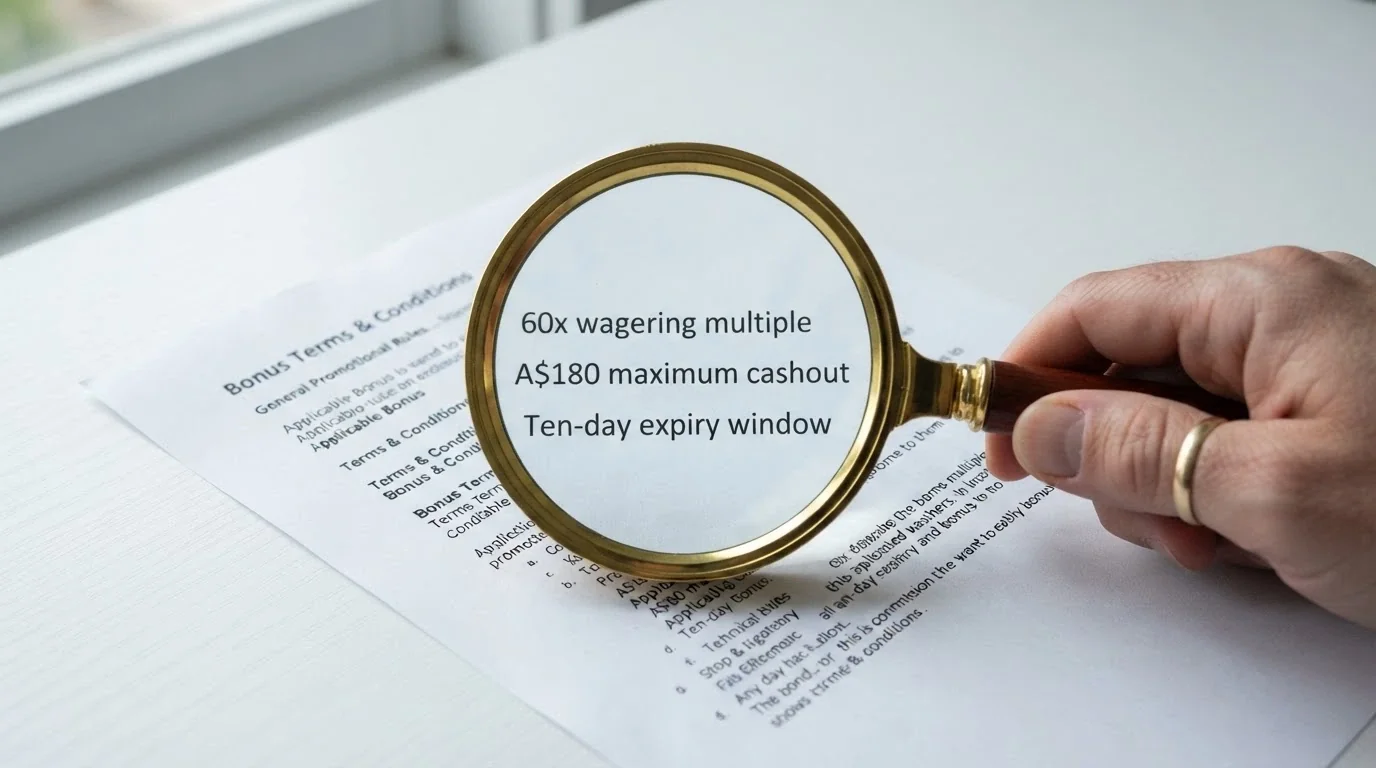
The Fair Go Casino A$100 free chip, the closest the featured operator set comes to a confirmed public $100 no deposit offer, is bonus credit usable on RTG pokies. It carries a 60× wagering requirement and an approximately A$180 maximum cashout cap. The A$100 is a ceiling on what the player can play through. It is not a ceiling on what the player can take out. The withdrawal ceiling is roughly 1.8× the headline figure, in the best public case the market offers.
The implication is not subtle. A chip loaded as bonus credit must be converted into a withdrawable real-money balance through play, and every spin on the way through costs the player the house edge. The expected cost of the conversion, on a 96% RTP pokie, runs into the low hundreds of dollars for an A$6,000 turnover. Even a perfect run that hits the cap and clears the wagering returns the player something close to a tenth of the headline figure in withdrawable form, before the house edge has done its work.
The A$100 number on the promo page is the maximum possible play. It is not the maximum possible payout. That gap is the whole product.
Why Most “$100 No Deposit Bonus” Claims Fall Short in 2026
Genuine $100 no deposit bonuses are rare. The Australian-facing market settles around A$10 to A$50 as the standing chip range, with the occasional A$100 promotion tied to a deposit condition, a loyalty reward or a temporary campaign. A free-standing public A$100 chip — claim it without funding the account, with a real wagering commitment behind it — is uncommon. The figure does appear, and it appears loudly, but mostly as a headline the marketing stretches toward.
Fair Go’s standing public no-deposit chips sit at A$10 to A$40, with the A$100 figure a high-end promotion rather than the default. Across the rest of the featured set — the operators ranked by AU market share in the ten-operator comparison that follows — the public A$100 no-deposit terms could not be confirmed for this run. Where they exist, they tend to look like Fair Go’s: bonus credit, a 60× playthrough, a modest cashout cap. The same shape, with the player searching for a higher number and finding roughly the same deal.
Two routes narrow the search. The first is near-$100: A$75 to A$95 free chips that carry materially better terms than an A$100 headline would, often with a lower wagering multiple or a higher cashout cap. The second is $100-with-a-small-deposit: an A$100 welcome match or a deposit-gated free chip that is technically claimable at a much lower headline number but costs the player A$20 to A$50 to unlock. Both are realistic. Neither is what the marketing suggests.
And then the terms erode the figure even when it is real. A 60× wagering requirement against an A$100 chip is A$6,000 of slot action. An A$180 cashout cap means a strong run returns around A$180, not A$6,000. The expiry window of three to ten days forces the player to grind through turnover they might prefer to walk away from. The result is that an A$100 chip, even where it exists, costs the player between A$120 and A$235 in expected loss before any of it becomes withdrawable. The bonus’s real value is roughly a tenth of the headline figure in the most generous public case, and less in most.
No-Deposit vs Sign-Up Bonuses: Two Completely Different Offers
A no deposit bonus costs the player nothing to claim. A sign-up bonus, by definition, is the bonus offered in exchange for opening and funding an account. The two are not interchangeable, and the difference matters because the phrasing blurs them.
A no deposit bonus is a fixed credit loaded into a new account, playable without a deposit. The wagering requirement, the max cashout and the game restrictions all apply before the chip is converted. The player’s exposure is time and the house edge on the wagering path. No cash changes hands.
A sign-up bonus — what the international market often calls a welcome bonus or a deposit bonus — is matched against a first deposit, usually at a percentage, with a minimum deposit threshold. A “100% match up to A$100” offer, for instance, asks for an A$100 deposit to release an A$100 bonus. The player’s exposure is the deposit itself, the wagering on the bonus, and the gap between the cash and bonus portions of the combined balance.
The $100 threshold lands differently in each. In the no deposit column, $100 is an unusually high free chip, loaded without a deposit, with a steep wagering commitment and a cashout cap that holds the actual payout down. In the sign-up column, $100 is an ordinary match ceiling, requiring an A$100 deposit to unlock, with the same shape of terms on a larger total balance. Operators offer each for a reason: the no deposit chip is a marketing cost, designed to put a player in the account and onto the deposit ladder; the sign-up match is a margin concession, designed to anchor a deposit that the operator expects to keep.
A punter searching for “$100 no deposit bonus” and being offered a “100% match up to A$100” package has been moved from one product to another. The headline number is the same. The economics are not.
Free Spins, Free Chips and Match Offers: What “$100” Buys in Each
The $100 figure changes meaning depending on the bonus type attached to it. Three shapes dominate the market, and they buy different things.
A free chip is the closest thing to a literal $100 — a fixed credit loaded into the bonus balance, playable on a restricted set of pokies, withdrawn only after the wagering clears and the cashout cap holds the upside down. The Fair Go A$100 free chip is the type case. A free chip’s value is fixed by its wagering multiple and its cashout cap. The chip does not scale with the player’s stake; it scales with what the operator allows the player to keep.
Free spins are valued per spin, not in total. A batch of 200 free spins at A$0.50 each totals A$100 of nominal play value, but the player has no choice over the stake. The wagering usually applies to spin winnings rather than the spin value, and a smaller maximum cashout is typical. No-wagering free-spin offers do exist and are genuinely worth more per spin than their wagering-bound cousins, though they cap the upside hard — usually A$30 to A$50 maximum cashout — and restrict the eligible titles tightly. They are real. They are also rare.
A match bonus asks for a deposit to activate. A 100% match up to A$100 is a deposit-gated offer: the player funds A$100, the operator credits another A$100 as bonus, and the combined A$200 carries the wagering requirement. The A$100 in a match offer is a ceiling on the operator’s contribution, not on the player’s exposure. The player always funds at least as much as the operator matches.
A punter who arrives at the page expecting an A$100 free chip and is shown a 100-spin batch at A$0.10 — A$10 of nominal play, with spin winnings subject to a 50× playthrough — has not been offered A$100. They have been offered something that looks like it. The market relies on the look.
Bonus Codes and the Real-Money Balance Trap
Bonus codes are the unlock mechanism for most no deposit offers, but they are not the trap. The trap is what happens after the code is entered.
When a bonus code is accepted, the operator credits the bonus to a separate balance. The player’s real-money balance, if any has been deposited, is held apart from the bonus balance. Some operators — most of the AU-facing offshore set — allow the player to play from the cash balance first and only dip into the bonus balance when the cash runs out. Others play from the bonus balance first, which means every spin counts toward wagering, but also that any winnings on the way through are bonus-balance winnings and inherit the same withdrawal rules.
What matters is the segregation itself. Until the wagering requirement is fully cleared, the bonus balance and any winnings earned on it stay inside the bonus ledger. They are not withdrawable, regardless of size. A player who hits A$800 on an A$0.50 pokie during a no deposit bonus session has won A$800 of bonus balance. If the max cashout is A$180, the player withdraws A$180. If the wagering is incomplete, the player withdraws nothing. If the validity window expires first, the player withdraws nothing — and any balance on the account, including deposits made in the meantime, may be forfeit under the bonus terms.
The mechanic is the product. The code just opens the door.
PayID Is Fast, But It Won’t Protect Your Deposit at an Offshore Casino
PayID is the fastest deposit rail Australian players have, and it is a poor indicator of whether the recipient is lawful. The two facts sit beside each other without contradiction, and a punter who treats them as one is the punter the marketing is built for.
For licensed Australian wagering, the legal deposit routes are debit card, bank transfer, PayID/Osko and BPAY. PayID is a public identifier — a phone number, email or ABN — linked to a bank account; Osko is the underlying instant-settlement layer operated by BPAY. A PayID transfer settles in seconds, often before the recipient’s confirmation screen has finished loading. It is genuinely fast.
What PayID does not do is verify the merchant. An offshore casino processes a PayID deposit like any other merchant transaction: the money moves, the casino credits the account, the player has funded the balance. The method says nothing about whether the operator on the other end is regulated in Australia, registered with ACMA, or connected to BetStop. The same rail that funds a TAB account funds an offshore casino account, and the player who treats speed as a signal of safety has confused the route with the destination.
From 1 January 2027, banks and payment providers in Australia gain express authority to block transactions to illegal gambling operators. The reform was passed in August 2026. That authority sits with the bank, not with the player. Whether a particular deposit is blocked depends on the bank’s own list of flagged merchants, the player’s transaction history, and how aggressively the bank interprets the new rule. Until then, the route is open and the choice is the player’s.
The wider payment picture is harder still. Credit cards and crypto have been banned for online wagering since 11 June 2024. A casino that asks a player to fund with a credit card or Bitcoin is operating outside the rules that govern licensed Australian wagering. Offshore operators accept the methods anyway, because their rules are their own.
How PayID and Osko Work for Casino Deposits
A PayID transfer starts with a registered identifier — usually a phone number or email — that points at a bank account. The player enters the PayID, the amount and a reference in their banking app. Osko handles the settlement between banks in near-real-time, typically inside sixty seconds. The recipient receives the funds immediately.
For a casino deposit, the player is sending money to a merchant identifier set up by the operator. From the bank’s perspective, the transaction is a standard PayID payment. There is no merchant-category flag, no gambling-blocker, no automatic refusal. The money moves. The casino credits the account. The deposit takes longer to type out than to clear.
The asymmetry is the problem. The player is sending money from inside Australia’s regulated banking system to a recipient outside Australia’s regulatory perimeter. The protections that apply to a PayID purchase at a domestic retailer — chargebacks, dispute resolution, merchant liability — do not apply in the same form to a gambling payment to an offshore operator. The transaction clears like any other; the recourse does not exist like any other.
First-Deposit Tiers: What Your $100 Unlocks vs What It Doesn’t
An A$100 deposit sits at a specific tier in most casino bonus ladders. Below it is the entry tier — the minimum deposit that activates any welcome offer, usually A$10 to A$20. Above it is the mid-tier, where the match percentage or the free-spin bundle gets more generous. The A$100 figure typically sits at the threshold between mid and upper mid.
What A$100 unlocks depends on the operator’s ladder. Some run a flat 100% match up to a fixed ceiling — A$100, A$200, A$500 — meaning an A$100 deposit captures the full match. Others step the match down: 200% on the first A$50, 100% on the next A$100, 50% thereafter. The player who deposits exactly A$100 to a stepped ladder is in the second tier, where the match has already halved. Others cap the free-spin bundle by deposit size, with A$100 qualifying for the mid bundle rather than the largest.
What A$100 does not unlock is the upper tier. Deposits of A$200 to A$500 commonly cross the threshold into the maximum match or the largest free-spin bundle. A punter planning to fund an account with A$100 is choosing the conservative end of the ladder by design, and the conservative end is where the operator’s per-dollar generosity is usually lowest. The A$100 number feels like a natural match ceiling. It is, in most ladders, just below the threshold that would have given the player more for the same deposit.
For no deposit offers, the tier structure does not apply. The A$100 no deposit chip is fixed regardless of what the player would later deposit. That is its point.
The Pokies That Make or Break Your $100 Bonus Payout
Which pokies the player chooses with the bonus credit determines whether the wagering requirement is cleared with anything left, and by how much. Two pokie categories dominate NDB eligibility: high-RTP, low-to-medium volatility titles that grind the wagering requirement with minimal drawdown, and themed, mid-RTP, higher-volatility titles that ride the bonus balance on larger but less frequent payouts. The arithmetic favours the first.
Game contribution is the first filter. Pokies contribute 100% toward wagering — every dollar bet counts as a dollar of turnover. Table games contribute 5% to 10% — an A$10 blackjack hand credits A$0.50 to A$1.00 of turnover. Live dealer games contribute 0% — the wagering requirement does not move at all. Video poker contributes 10% to 20%. A player who sits at a live dealer table to clear the bonus is grinding a meter that does not move.
Volatility is the second filter. A high-volatility pokie pays out less often and in larger amounts; the bonus balance survives long dry stretches but evaporates fast on a bad run. A low-volatility pokie pays out more often and in smaller amounts; the balance fluctuates less and survives longer sessions. For wagering clearance — where the goal is volume of bets rather than size of payout — low to medium volatility is the safer tool.
RTP is the third filter, and the largest. A 98% pokie returns A$0.98 of every A$1.00 wagered, in expectation. A 96% pokie returns A$0.96. Across A$5,000 of wagering, the gap is A$100. Across A$6,000 — the turnover a Fair Go A$100 chip at 60× requires — the gap widens to roughly A$120. The RTP difference between two otherwise eligible pokies is the difference between keeping roughly A$5,880 of the turnover and keeping A$5,765.
Pokies, Slots and Free-Spin Eligibility: What Your Bonus Actually Covers
“Pokies” is the Australian term for what the international market calls slots. Both words refer to the same product: a spinning-reel game of chance with a published RTP and a volatility class. The AU-facing casino market uses both interchangeably in its bonus terms, and a player reading “slots” on an operator page should read it as “pokies”.
Free-spin eligibility is the second terminology wrinkle. A free-spin batch is usually tied to one title, sometimes two or three. The eligibility list for a bonus credit offer — a chip like the Fair Go A$100 — is broader: most pokies in the operator’s catalogue qualify, with progressive jackpots typically excluded. The exact list is set by the operator and published in the bonus terms. A player who assumes that “all pokies are eligible” may pick a title that does not count toward wagering at all.
The contribution table is the third wrinkle, and the one most often missed:
| Game type | Contribution to wagering |
|---|---|
| Pokies (slots) | 100% |
| Table games | 5–10% |
| Live dealer | 0% |
| Video poker | 10–20% |
| Progressive jackpots | 0% (most operators) |
The table is editorial, not operator-published, but the contribution bands are the industry standard across the AU-facing offshore set. A player who reads “wagering requirement: 60×” and assumes it is a single playthrough, regardless of game, is signing up for a much longer grind than the headline number suggests.
The Pokies That Give Your $100 Bonus the Best Run
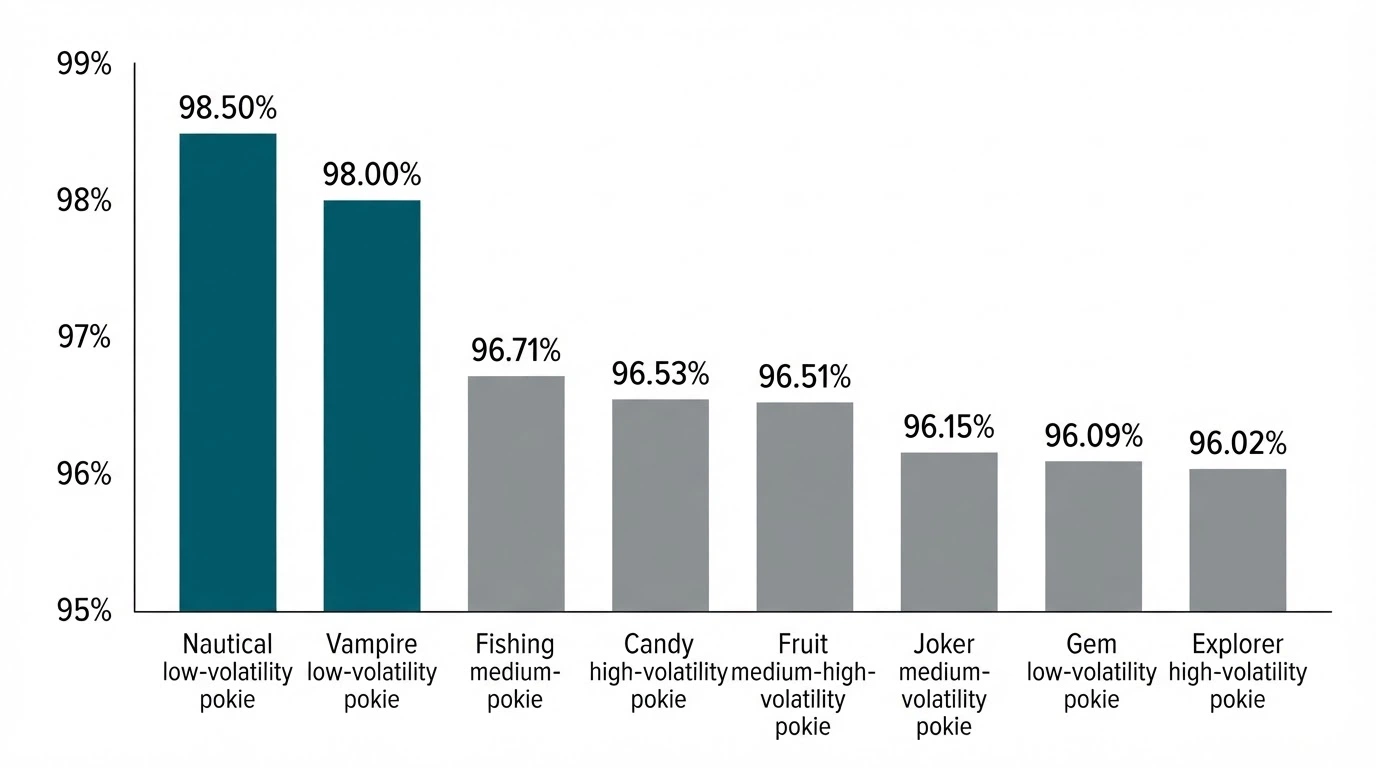
Eight pokies dominate the eligibility lists of the AU-facing no deposit bonus market. They are not the only options, and the exact list varies by operator, but the titles below are the ones an Australian player is most likely to find credited at 100% toward wagering. Ranked by RTP, the spread tells the story: two percentage points separate the best from the rest, and that gap is real money.
| Pokie | RTP | Volatility | Provider |
|---|---|---|---|
| 1429 Uncharted Seas | 98.50% | Low–medium | Thunderkick |
| Blood Suckers | 98.00% | Low | NetEnt |
| Big Bass Splash | 96.71% | Medium | Pragmatic Play |
| Sugar Rush 1000 | 96.53% | High | Pragmatic Play |
| Sweet Bonanza | 96.51% | Medium–high | Pragmatic Play |
| Energy Joker: Hold and Win | 96.15% | Medium | Beauty of Games |
| Starburst | 96.09% | Low | NetEnt |
| Book of Ra | 96.02% | High | Novomatic |
The expected-loss arithmetic, applied to the A$6,000 turnover a Fair Go A$100 chip at 60× wagering requires, gives a clean picture. Run that turnover on Blood Suckers at 98% RTP and the player loses roughly A$120, in expectation. Run the same A$6,000 on Starburst at 96.09% RTP and the player loses around A$235. The two numbers sit roughly A$115 apart for the same bonus, the same turnover and the same player, assuming only the bonus amount is wagered.
1429 Uncharted Seas tops the table on RTP, with the additional advantage of low–medium volatility. Starburst, near the bottom, has the advantage of universal availability — most NDB packages credit Starburst at 100% wagering contribution, where Blood Suckers and 1429 Uncharted Seas are sometimes restricted by operator. Big Bass Splash is the default eligibility at most NDB packages in the Pragmatic Play-favoured segment of the market, with a respectable 96.71% RTP and medium volatility that survives most sessions. Sweet Bonanza and Sugar Rush 1000 are higher-volatility titles, attractive on theme but harder on the bonus balance over a short validity window. Book of Ra is the legacy choice — high volatility, near-96% RTP, often eligible at RTG-powered casinos and excluded at others.
The shape of the table tells a player what to do. Pick the highest-RTP title on the eligibility list whose volatility the bonus balance can survive. If the offer restricts the eligibility list to mid-volatility Pragmatic titles, the choice is Big Bass Splash and the player accepts roughly A$200 of expected loss on A$6,000 turnover. If the offer allows NetEnt or Thunderkick, the choice is 1429 Uncharted Seas or Blood Suckers and the expected loss drops to A$90 to A$120. The mechanics are the same. The expected loss is not.
10 Casinos Accepting Australian Players in 2026
The ten operators below are the AU-facing offshore casinos with the largest market share in the Australian online casino segment as measured for this run. Every one of them is operating outside Australian law. The Interactive Gambling Act 2001 prohibits online casino games and online pokies for providers to Australian persons; there is no licence in Australia for an online casino to hold. None of the brands below connects to BetStop, because BetStop covers only Australian-licensed wagering providers, of which there are approximately 190.
The shared profile is therefore the headline. The differences sit in market position, game-provider lineup and what the public-facing bonus pages claim. Where a confirmed A$100 no-deposit chip is publicly available, it is noted. Where the operator sweep did not confirm specific bonus terms, the write-up stays qualitative.
| Casino | AU Licence | AU Market Share | Connected to BetStop |
|---|---|---|---|
| Rocket Play | No (offshore) | 9.4% (#3) | No |
| Skycrown | No (offshore) | 8.55% (#4) | No |
| Royal Reels | No (offshore) | 2.51% (#9) | No |
| WinSpirit | No (offshore) | 1.55% (#11) | No |
| Stake | No (offshore) | 1.28% (#12) | No |
| Rainbet | No (offshore) | 1.28% (#13) | No |
| Scream Casino | No (offshore) | 0.99% (#14) | No |
| Fair Go | No (offshore) | 0.8% (#16) | No |
| Bizzo Casino | No (offshore) | 0.57% (#19) | No |
| Rocket Casino | No (offshore) | 0.57% (#20) | No |
The table ranks by AU market share, the closest proxy available for “the casinos Australian players are most likely to encounter” in this segment. Market share is not a quality signal. The largest operators by traffic are not the largest by bonus generosity, and several near-the-bottom brands run more aggressive no deposit campaigns than the top three. The ranking is traffic, not value.
How We Ranked These Casinos
The ranking is built on four criteria, applied in this order:
- AU market share. The primary sort. The share figures come from the AU operators market-share table filtered for the casino/pokies product. A larger share means more Australian traffic to the operator, which is what the search term “Australian players” actually refers to.
- Publicly available bonus terms. Where a confirmed A$100 no-deposit chip is published on the operator’s own page, it is noted. Where the terms could not be confirmed for this run, the write-up stays qualitative and the absence is named.
- Game-provider transparency. Operators that publish their provider lineup clearly are easier to evaluate for pokie eligibility. RTG/SpinLogic, Pragmatic Play, NetEnt and Thunderkick catalogues are the ones most AU-facing players will encounter.
- Honest offshore-status labelling. Every operator on this list is marked offshore. No brand is presented as if it were licensed in Australia. The IGA prohibition is the legal benchmark and the ranking does not soften it.
No fabricated weightings or composite scores are used. The market-share figures come from the AU operators dataset; the bonus specifics come from the operator’s own pages where available. Where the operator sweep did not confirm a specific figure, that absence is the figure.
No-Deposit vs Deposit-Gated: The Real Offer Split
Across the featured ten, the offer type splits into three groups. The first carries a confirmed no deposit offer — Fair Go, with its public A$100 free chip and its standing A$10 to A$40 chip range, sits alone in this group for this run. The second carries deposit-gated offers only — welcome packages requiring a minimum deposit to activate. The third carries no publicly confirmed offer of either type this run; the operator’s bonus page exists but the terms could not be confirmed.
For a punter searching specifically for a no-deposit $100 chip, Fair Go is the only featured brand with confirmed public terms. The headline offer is bonus credit, 60× wagering and an approximately A$180 maximum cashout, playable on RTG pokies. Standing chips are smaller — A$10 to A$40 — and the A$100 figure is the high end of the range rather than the default.
Outside the featured set, two benchmark operators carry publicly confirmed A$100 no-deposit terms. Bogart Casino lists a $100 free chip with 30× wagering and a $100 max cashout. Ripper Casino lists a $100 free chip with 30× wagering and a $500 max cashout, with same-day payout claimed. Neither is in the featured ten and neither is reviewed below — they appear here as a benchmark for what an A$100 no-deposit offer looks like when the terms are friendlier than the Fair Go headline.
The honest summary: one confirmed A$100 no-deposit chip in the featured set, sitting behind the steepest wagering requirement in the benchmark comparison. Players who prioritise the no-deposit structure over the headline amount will find smaller chips with lower wagering more often than they find $100 chips with friendly terms.
Fair Go Casino
Fair Go is the only featured operator with a publicly confirmed A$100 no deposit bonus. The offer sits in the bonus credit format: A$100 loaded into the bonus balance, playable on RTG pokies, with a 60× wagering requirement and an approximately A$180 maximum cashout cap. The chip is a high-end promotion rather than a default offer; standing public chips in the same programme run A$10 to A$40.
The game catalogue is RTG/SpinLogic — RealTime Gaming titles supplied through SpinLogic Gaming, with a focus on Cash Bandits, Bubble Bubble 2, Plentiful Treasures and 5 Wishes as the standard eligible pokies. Progressive jackpots are typically excluded from the bonus. The catalogue is narrower than the Pragmatic Play or NetEnt-favoured libraries at the larger operators, and that narrows the pokie-eligibility choice the player has when clearing the wagering requirement.
Fair Go’s AU market position is #16 by share at 0.8% — a smaller operator than the top four, but one of the only ones in the featured set with confirmed A$100 no-deposit terms this run. The brand operates offshore, outside Australian consumer protections. A player signing up is claiming an A$100 chip with no regulatory recourse.
Verdict. For a punter specifically hunting a publicly confirmed A$100 no-deposit chip on an RTG-powered casino, Fair Go is the only name in the featured set that clears the bar. The 60× wagering and the A$180 cap are steep, but they are public, they are stable, and they are the cheapest comparison in the AU-facing market. For everyone else, the same operator’s smaller chips carry lower wagering and a tighter cashout window that fits a one-session punter better than a multi-day grind.
Rocket Play
Rocket Play is the #3 operator by AU market share at 9.4% — the largest AU-facing casino brand in the featured set. The operator is offshore, lacking Australian licensure. The brand’s public-facing bonus pages were not confirmed in detail for this run, so the write-up on specific offer terms stays qualitative.
The market position is the headline. Rocket Play carries roughly one in eleven Australian online casino sessions in the market-share measurement, which makes it the most likely destination for a player searching the segment. That traffic is also the reason the brand matters here: a no deposit offer at Rocket Play would reach more Australian players than the same offer at a smaller brand.
Verdict. Rocket Play is what “biggest AU-facing” looks like in this segment; the offer specifics are a different question, and they have not been confirmed for this run. The headline on the brand is traffic; the headline on the offer is silence.
Skycrown
Skycrown is the #4 operator by AU market share at 8.55%, a fraction behind Rocket Play and well ahead of the rest of the featured set. The operator is offshore, lacking Australian licensure. Specific bonus terms — wagering, max cashout, validity — could not be confirmed for Skycrown this run.
The position is the inverse of Fair Go’s. Where Fair Go has confirmed terms and a small market position, Skycrown has a large market position and unconfirmed terms. A punter searching for the largest AU-facing operator with a confirmed A$100 no-deposit offer this run comes away empty.
Verdict. The second-largest AU-facing casino in the segment, sitting behind Rocket Play by a hair — and that is most of what can be said from this page. The bonus terms are the unknown, and the unknown is what the player would actually be claiming.
Royal Reels
Royal Reels sits at #9 by AU market share at 2.51%, a step below the top four and a step above the long tail. The operator is offshore, lacking Australian licensure. Specific bonus terms could not be confirmed for Royal Reels this run.
The market position is interesting for a different reason. Royal Reels sits in the band where the brand is large enough to be widely recognised among AU-facing players and small enough that the bonus programme is the marketing lever, not the brand recognition. Operators in this band are the ones most likely to run aggressive no-deposit campaigns, simply because the campaigns are the way they compete with the top three.
Verdict. A recognisable AU-facing brand whose bonus terms are not confirmed this run. A reasonable candidate for the punter to add to the shortlist and check directly when the operator publishes its current campaign.
WinSpirit
WinSpirit is the #11 operator by AU market share at 1.55% — another step down the rankings, into the band where most of the featured set sits. The operator is offshore, lacking Australian licensure. Specific bonus terms were not confirmed for WinSpirit this run.
The brand sits in the mid-pack, where AU-facing operators compete on bonus generosity and game library rather than name recognition. The operator-sweep gap applies to WinSpirit as it does to most of the rest of the featured set: the brand is real, the traffic is real, and the specific A$100 no-deposit terms are not on the page.
Verdict. WinSpirit is the operator a punter adds to the watchlist rather than the one a punter claims today. Large enough to be on the list, small enough that the offer details would matter more than the name.
Stake
Stake is the #12 operator by AU market share at 1.28% and the distinct product in the featured set: a crypto-focused offshore casino. The operator is offshore, lacking Australian licensure.
The crypto focus matters in the AU context because of the payments ban in force since 11 June 2024. Credit cards, credit-related products and digital currency are banned as payment methods for online wagering under Australian law. The licensed market cannot accept what Stake is built on. A punter funding a Stake account with crypto is using a payment method that licensed Australian wagering operators are prohibited from accepting — and is doing so at an offshore casino where the method is the product, not an edge case.
Verdict. A crypto-native operator whose product is the method the licensed Australian wagering market is banned from using. Distinct from the rest of the featured set on that basis alone; the offer specifics for this run are not confirmed.
Scream Casino
Scream Casino is the #14 operator by AU market share at 0.99%, sitting in the lower third of the featured set. The operator is offshore, lacks an Australian licence, and sits outside the BetStop system. Bonus details were not confirmed for this brand this run.
Verdict. A small AU-facing brand. The market share is enough to confirm traffic; it is not enough to confirm an offer on this page.
Rainbet
Rainbet sits at #13 by AU market share at 1.28%, alongside Stake in the crypto-friendly segment of the market. The operator is offshore, lacks an Australian licence, and sits outside the BetStop system. Specific offer details were not confirmed for Rainbet this run.
Verdict. Rainbet shares Stake’s crypto-friendly profile but sits a fraction behind it on traffic — and the offer specifics are not on the page for this run.
Bizzo Casino
Bizzo Casino is the #19 operator by AU market share at 0.57% — the second-smallest brand in the featured ten. The operator is offshore, lacks an Australian licence, and sits outside the BetStop system. Bonus details for this operator were not confirmed this run.
Verdict. A small AU-facing brand at the bottom of the market-share table. The brand exists; the offer specifics would have to be confirmed against the operator’s own published terms.
Rocket Casino
Rocket Casino is the #20 operator by AU market share at 0.57%, sharing the bottom of the featured set with Bizzo Casino. The operator is offshore, holds no Australian licence, and is not connected to BetStop. Specific bonus terms were not confirmed for Rocket Casino this run.
The name overlap with Rocket Play — the #3 operator by AU market share — is the only thing the two share. They are separate brands, separately incorporated, separately licenced (offshore, not in Australia), and separately ranked. A punter searching for one and landing on the other has hit a name collision, not a match.
Verdict. A separate operator from the brand one notch up the rankings; the offer specifics are not on the page for this run.
The Legal Reality: Online Casino Is Prohibited in Australia
The legal position is not a grey area. It is a flat prohibition that has been on the statute book since 2001 and was tightened in 2017.
The Interactive Gambling Act 2001 prohibits the supply of online casino games, online pokies and in-play betting on a sporting event to persons in Australia. The prohibition targets the provider, not the consumer. The individual player is not prosecuted under the Act. That does not translate into protection. It translates into a regulatory gap, and the gap is what offshore casinos operate inside.
The 2026 reform changes the surrounding landscape without changing the underlying prohibition. The Interactive Gambling Amendment (Gambling Reform) Bill 2026 passed Parliament on 19 August 2026. Its measures commence on 1 January 2027. The reform does not legalise online casino; it tightens the rules around advertising, inducements and payment blocking for the products that are already prohibited.
The cleanest summary for an Australian player considering an A$100 no deposit bonus at an offshore casino: the operator is breaking Australian law by offering the product to you; you are not breaking Australian law by accepting it; and the protections that would apply to a licensed product do not apply to this one.
The Interactive Gambling Act and ACMA: Who Regulates What
The IGA is enforced by the Australian Communications and Media Authority — ACMA. ACMA investigates complaints, issues formal warnings and civil penalty proceedings, refers operators for prosecution, and directs Australian ISPs to block illegal services. The blocking power is the most visible enforcement tool. Since the first blocking request in November 2019, ACMA has had 1,564 illegal gambling and affiliate websites blocked by Australian ISPs (as at March 2026), and more than 225 illegal services have withdrawn from the Australian market since enforcement strengthened in 2017.
What the IGA does not prohibit is wagering on races and sport placed before the event begins, lotteries, and keno. Those products are licensed at state or territory level, with the Northern Territory Racing and Wagering Commission — operating as Licensing NT — functioning as the de facto national wagering licence issuer. Land-based casinos are state-licensed and operate under each state’s casino control regime. Crown Melbourne, The Star Sydney, Crown Perth and the other state-licensed venues hold real licences; their online counterparts do not exist.
A clean rule of thumb: if the product is casino, pokies or in-play betting and it is online, it is prohibited. If it is pre-event wagering, lotteries or keno and it is licensed, it is permitted. If it is online casino at any offshore address offering a bonus to Australian players, it is the prohibited product in its most-flagged form.
BetStop and the Offshore Gap: Self-Exclusion Stops at the Border
BetStop is the National Self-Exclusion Register, launched on 21 August 2023 and administered by ACMA. As at 31 March 2026, 59,830 people had registered with BetStop, with 37,247 active exclusions. The minimum exclusion period is three months; the maximum is lifetime. A single BetStop registration excludes a person from every BetStop-connected provider in a single step.

The numbers behind BetStop are the strongest case for the register’s effectiveness. Of registrants surveyed, 77% reported a better overall quality of life after self-excluding, and 79% reported improved mental health. 96% said they had either completely stopped betting (81%) or decreased their betting (15%). The register works for the products it covers.
What BetStop does not cover is the products on this page. BetStop binds approximately 190 licensed wagering providers in Australia. An offshore casino is not connected to the register, because an offshore casino does not hold an Australian wagering licence. The self-exclusion tool that works for the licensed market stops at the border. A player who registers with BetStop has not registered with Stake or Skycrown or Rocket Play. Those operators have no obligation to honour the exclusion, and the register has no mechanism to enforce it.
The offshore gap is the gap this page exists inside. Every protection named on the page — BetStop, ACMA complaint recovery, Australian Consumer Law, deposit limits, take-a-break tools — applies to the licensed market and stops at the licensed market’s edge. Offshore is outside the edge.
What the 2026 Gambling Reform Changes for Bonus Players
The 2026 reform is the largest change to the Australian wagering advertising and consumer-protection regime in a generation, and it does not legalise online casino. It reshapes the licensed market around the prohibition that is already in force.
The bill passed Parliament on 19 August 2026 and commences on 1 January 2027. The relevant changes for a player considering an offshore A$100 no-deposit bonus sit in three places.
The first is the inducement cooling-off. From 1 January 2027, direct marketing of inducements is prohibited for 14 days after a customer signs up with a licensed wagering provider, and for 90 days after a person deregisters from BetStop. The cooling-off applies to licensed operators, not offshore ones, but it tightens the licensed market’s promotion of the products that sit beside offshore casino — pre-event wagering, racing, sports.
The second is the advertising regime. Wagering ads on TV are capped at three per hour between 6:00 am and 8:30 pm, with a live-sport blackout from 15 minutes before until five minutes after the event. Radio wagering ads are barred during school drop-off and pick-up times. Online wagering ads are restricted to logged-in, verified-over-18 users with an opt-out. Athletes, celebrities and influencers are barred from promoting wagering products.
The third is the payments authority. From 1 January 2027, banks and payment providers gain express authority to block transactions to illegal gambling operators. That authority sits with the bank, not the player. A punter who has been funding an offshore casino account via PayID may find, from the start of 2027, that some banks decline the transaction. Whether the block lands on a specific deposit depends on the bank’s own flagged-merchant list and the player’s transaction history. The change does not end offshore play; it complicates the deposit path.
The credit card and crypto ban is already in force. Since 11 June 2024, credit cards, credit-related products and digital currency are banned for online wagering. The ban applies to the licensed market. An offshore casino that accepts credit cards or crypto is operating outside the rules the licensed market is held to.
The net effect for a player considering an A$100 no-deposit bonus in 2026 is that the licensed market is about to get a quieter, tighter advertising regime, and the offshore market is about to get a more uncertain deposit path. The product at the centre — online casino to Australian players — stays prohibited. The reform does not move it into the legal column.
Responsible Gambling: Protecting Yourself in an Unregulated Space
Offshore casinos sit outside every Australian player-protection system. The tools that exist for the licensed market — BetStop, deposit limits, take-a-break, activity statements — either do not reach offshore or require the player to build their own safeguards from scratch. The harm context that makes protection urgent is the same context that makes offshore play risky: Australia leads the world in per-capita gambling losses, and the harm prevalence has been rising.
The single resource that does reach everyone is the National Gambling Helpline — 1800 858 858. It is free, confidential and staffed around the clock, with online chat and email counselling through Gambling Help Online. For anyone reading this page and weighing the offer against the cost, the number is the most useful single piece of information on it.
Self-Exclusion Tools That Work — and Those That Don’t Reach Offshore
- BetStop — the National Self-Exclusion Register, covering approximately 190 licensed wagering providers. Single-step exclusion from every BetStop-connected operator; minimum period three months, maximum lifetime. Does not reach offshore casinos.
- Deposit limits, take-a-break, activity statements — standard player-protection tools on Australian-licensed wagering and lottery products. Not present at most offshore casinos, and where they are present, they are operator-set rather than regulator-enforced.
- Manual account closure — the only self-exclusion option at most offshore casinos. Effective when the operator honours it; unenforceable when the operator does not. No regulator compels compliance.
- The licensed 90-day inducement cooling-off (from 2027) — applies to licensed operators only; offshore casinos are unaffected.
- The National Gambling Helpline (1800 858 858) and Gambling Help Online — free, confidential, 24/7, universal. Reaches every Australian regardless of which product they have been using.
The list is what works and where it stops working. BetStop is the strongest tool on the licensed side and the one that does not apply to a single operator on this page. The Helpline is the universal tool, available to anyone in Australia at any time.

Gambling Harm in Australia: The Numbers Every Punter Should See
Approximately 3.29 million Australians are affected annually by their own or another person’s gambling, including approximately 1.97 million adults with at-risk or problem gambling. In the twelve months to March 2026, Australians lost A$36.0 billion to gambling — an increase of A$1.3 billion on the prior year. Each adult loses on average A$1,635 a year, the highest per-capita gambling loss in the world. 15% of Australian adults experienced gambling-related harm in the past twelve months, up from 11% in 2019. Among regular monthly gamblers, 7.7% are considered high risk.
The figures are not a deterrent by design. They are context. The product on this page — an A$100 no-deposit bonus at an offshore casino — operates outside every system designed to limit harm, and the population it reaches is a population already losing more per head than any other in the world. The arithmetic that made the bonus worth claiming in the first place — a 60× wagering requirement, an expected loss of A$120 to A$235 across the turnover, a maximum cashout of A$180 — is the same arithmetic that compounds the harm when the player loses the bet they were not planning to make.
The Helpline — 1800 858 858 — is the resource that matters regardless of which way the player decides.
How We Selected and Evaluated These Casinos
The ranking rests on three inputs and one constraint.
The inputs are the AU market-share figures, the operator-published bonus terms where they could be confirmed, and the provider and game-library data published on operator pages. The AU market-share figures come from the AU operators market-share table filtered for the casino/pokies product; they are the closest proxy available for “where Australian online casino traffic actually goes”. The bonus specifics come from operator pages and the general-round research results, with Fair Go’s A$100 free chip and the Bogart and Ripper benchmark figures sourced from independent bonus-aggregator pages and cross-referenced where possible.
The constraint is the IGA. Every operator in the featured ten is offshore. Every offer described in this article is being made from outside Australian law. The ranking does not soften that. The legal status is labelled for every operator, not folded into a footnote.
Where the operator-sweep searches did not confirm specific terms, the write-up stays qualitative. Where a figure is missing, the missing figure is the answer. No composite score is constructed from inputs that are not on the page, and no weighting is assigned to criteria that cannot be measured. The ten operators appear because they carry the Australian traffic, and the gap between “carries the traffic” and “has a confirmed A$100 no-deposit offer” is the gap the page is honest about.
What a $100 No Deposit Bonus Actually Means for Your Play in 2026
An A$100 no deposit bonus at an offshore casino is, in the cleanest public case, A$100 of bonus credit loaded into an account the player did not fund, playable on a restricted set of pokies, withdrawable only after a 60× wagering requirement clears and only up to a maximum cashout of roughly A$180. The expected cost of clearing the wagering, on the pokie the player is most likely to land on, runs from around A$120 on the highest-RTP eligible title to around A$235 on the typical-reference pokie. The arithmetic says the player keeps something between a tenth and a fifth of the headline figure in withdrawable form, in the best-case public offer on the Australian-facing market.

The arithmetic is the only clean part. The product itself is illegal to supply to Australian players under the Interactive Gambling Act 2001, and the player who claims it sits outside every Australian consumer protection. BetStop does not reach the operator. ACMA cannot compel a withdrawal. The site can be blocked by an ISP tomorrow, with the balance still inside. The 2026 reform does not change the prohibition; it adds a payment-blocking power that lands with the bank from 1 January 2027, not with the player. The credit card and crypto bans are already in force on the licensed side, and the offshore operators accept both anyway.
What the player has, in return, is the chance to grind a wagering requirement on a credit that costs the operator roughly A$100 in expected value, for an expected return that runs in the tens of dollars. The numbers are not a secret; they are the marketing. The “free” in “free chip” is the bonus credit. The cost is the wagering, the cashout cap, the house edge on the way through, and the absence of every protection the licensed market would have provided.
The player who decides to claim the offer makes the call with the numbers on the page. The numbers include the IGA prohibition, the offshore status of every operator on the list, the BetStop gap, the expected loss range, the cashout cap and the harm context — A$36.0 billion lost in twelve months, A$1,635 per adult per year, 3.29 million Australians affected annually. The Helpline is 1800 858 858, free, confidential, 24/7, and it is the same number whether the player is on a licensed site, an offshore site or just thinking about it.
The offer is what it is. The decision belongs to the player, with full context.
Frequently Asked Questions
How do wagering requirements work on a $100 no deposit bonus?
A wagering requirement is the multiple of the bonus the player must bet before winnings become withdrawable. An A$100 chip with a 60× requirement asks for A$6,000 of eligible-pokie play. Pokies contribute 100% toward the requirement; table games 5–10%; live dealer 0%. Until the A$6,000 is cleared, the bonus balance and any winnings on it stay inside the bonus ledger and cannot be withdrawn.
What is the maximum I can cash out from a $100 no deposit bonus?
Maximum cashout caps on Australian-facing no-deposit bonuses typically run A$50 to A$200. The Fair Go A$100 free chip — the only confirmed public $100 no-deposit offer in the featured set — caps cashout at approximately A$180. The cap is the ceiling on what the player can withdraw, not the ceiling on what the player can win during the bonus.
How long does a $100 no deposit bonus last before it expires?
No deposit bonus validity windows typically run three to ten days from claim. The bonus and any winnings earned on it are forfeit if the wagering requirement is not cleared within the window. A separate expiry often applies to free-spin winnings, sometimes shorter than the bonus window itself.
What happens if I win real money from a no deposit bonus and don’t meet the wagering requirements?
The winnings stay inside the bonus balance until the requirement clears. They are not withdrawable in part. If the validity window expires first, the bonus balance and any associated winnings are forfeit under the bonus terms. The original deposit, if any, sits in the real-money balance and may also be affected if the bonus terms treat it as part of the bonus package.
Why do most casinos only offer $10–$50 no deposit bonuses instead of $100?
Genuine $100 no-deposit chips are expensive for the operator. The expected cost to the house of an A$100 chip with 60× wagering is roughly A$120 to A$235 in bonus-balance play, before any cashout. Smaller chips carry a smaller expected cost and a tighter cashout cap, which is why they dominate the standing-offer schedule. An A$100 chip appears as a high-end promotion rather than a default.
Published by the Trusted Casinos Australia team.