Bitcoin Pokies in Australia: 2026 Player’s Guide
 Available in AU
Bitcoin pokies are a paradox for Australian players. They pay out in hours rather than days, and they return roughly 0.8% more per spin than their AUD-denominated counterparts. They also sit entirely outside Australian law, with no local licence, no BetStop coverage and no consumer recourse if a withdrawal stalls. This page weighs what that combination delivers and what it costs — for a player who has already decided the trade-off is worth making, not for one who has yet to think it through.

Verified 18 October 2026 against the ACMA register and ACMA enforcement record.
Table of Contents
- Why Bitcoin Is Reshaping Online Pokies for Australian Players
- 10 Bitcoin Pokies Sites Ranked: Where Australian Players Get the Most Value in 2026
- Why Bitcoin Payouts Land in Your Wallet Hours Faster Than Bank Transfers
- The Legal Reality: What Every Australian Bitcoin Pokies Player Must Know
- Keeping Bitcoin Pokies Safe: Tools and Limits Every Player Should Use
- Bitcoin’s Privacy Promise vs Blockchain Reality for Pokies Players
- How We Evaluated These Bitcoin Pokies Sites
- Where Bitcoin Pokies Stand for the Australian Player in 2026
- Frequently Asked Questions
Why Bitcoin Is Reshaping Online Pokies for Australian Players
Bitcoin pokies are not a niche curiosity any more. They are the structural feature of the offshore market Australians who want to spin online are pushed toward, because the licensed alternative does not exist. The Interactive Gambling Act 2001 prohibits online casino games to Australians; there is no state or territory licence for them. What the market is, in practice, is a list of offshore operators — most commonly licensed in Curaçao — that accept Australian players without local regulation.
The cluster of changes that brought bitcoin pokies to the front of the offshore queue is worth naming. Cryptocurrency wallets became easier to use. Casino software studios began shipping crypto-denominated catalogues with their own published RTPs. The number of bitcoin slot titles available across tested platforms passed 2,500. The marketing took the speed advantage and ran with it; the underlying product caught up behind it.
How Bitcoin Pokies Actually Work
A bitcoin pokie is a slot machine played with bitcoin (or another cryptocurrency) instead of fiat currency. The mechanics are identical to an AUD pokie: reels spin, paylines land, RTP governs the long-run return. The wrapper around the mechanics is what differs.
To start, a player opens a wallet — a self-custody hardware wallet, a software wallet, or a custodial exchange account — and acquires bitcoin. From there, the deposit flow is mechanical. The player copies the casino’s BTC deposit address (or scans a QR code), sends a chosen amount and waits for blockchain confirmation. At most tested casinos, that deposit is free on the casino side and confirms in 10 to 30 minutes; the only fee is the BTC network fee, typically A$1 to A$5 depending on congestion.
The game selection is where bitcoin pokies stop being merely “slots paid in crypto”. Across tested platforms, more than 2,500 slot titles are denominated in bitcoin, and the catalogue leans toward the same studios any AUD pokie site uses. What changes is the denomination. Bets are placed in mBTC or satoshi subunits rather than cents, and the balance updates in real time as the BTC price moves against the AUD.
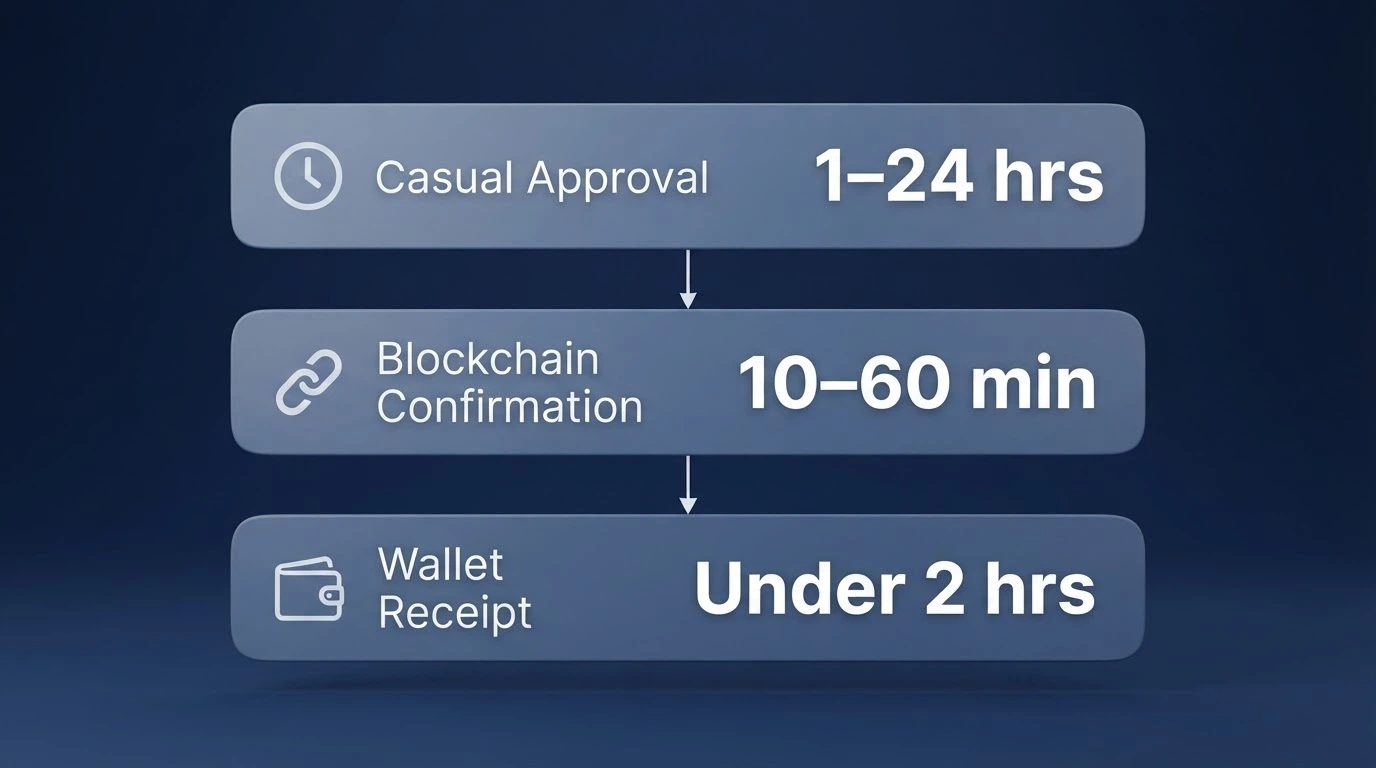
Cashout runs in reverse. The player requests a withdrawal in BTC, the casino approves it (typically 1 to 24 hours, faster once identity verification is completed), and the funds move on-chain. Most tested sites charge no withdrawal fee; processing sits between 0 and 2 hours on the casino side. End to end, a player can be holding the BTC in their wallet inside two hours of requesting a withdrawal — which is the structural advantage the marketing leans on.
Bitcoin vs Fiat Pokies: What the RTP Difference Means for Your Balance
The RTP edge is the most-quoted number in the bitcoin pokie pitch. It is also the one that matters least in isolation.
Across tested platforms, bitcoin pokies return roughly 0.8% more per spin than their AUD-denominated equivalents. The figure comes from comparing the published RTPs of the same title when it appears in a bitcoin-denominated catalogue versus a fiat one. The 0.8% gap is not a single operator’s generosity — it is a market-wide feature, and it exists because crypto-native operators carry lower overheads (no payment-processor margins, no chargeback exposure, fewer compliance staff per dollar handled) and can therefore offer a slightly thinner house edge without losing margin.
What the gap is worth depends on what it is measured against. A player running $1,000 through a fiat pokie at 95.5% RTP loses an expected $45 in house edge; the same $1,000 through a bitcoin pokie at 96.3% loses an expected $37. The difference — $8 — is real. Over a year of regular play, the cumulative gap runs into the hundreds of dollars. Neither figure justifies choosing one casino over another on RTP alone. What it does justify is treating bitcoin pokies as a viable alternative to fiat pokies for a player who has other reasons to be there — speed, bonus terms, the structural privacy gap to fiat rails.
The table below sets the 0.8% claim against three titles where the RTP, volatility and max win are independently verifiable.
| Slot Title | RTP | Volatility | Max Win |
|---|---|---|---|
| Wolf Gold | 96.01% | Medium | 2,500x stake |
| Big Bass Bonanza | 96.71% | — | — |
| Big Bass Bonanza Megaways | 96.7% | — | 4,000x stake |
Wolf Gold at 96.01% sits inside the bitcoin-pokies benchmark cluster. Big Bass Bonanza at 96.71% is the upper end of what these titles publish. Big Bass Bonanza Megaways at 96.7% sits alongside it with a higher max win. None of those RTPs are bitcoin-only figures; what matters is that the same games, hosted by bitcoin-native operators, typically publish 0.8% higher than their fiat-hosted siblings — the gap the marketing makes the most of.
The Australian Bitcoin Pokies Landscape in 2026
For an Australian player, the bitcoin pokie market has one defining feature: it is entirely offshore. There is no licensed bitcoin pokie site in the country. The Interactive Gambling Act 2001 prohibits the supply of online casino games and online pokies to anyone in Australia, and no state or territory has issued a licence that would override that. What the market is, in 2026, is a list of offshore operators that accept Australian players without local regulation.
Every brand in this ranking is licensed offshore, most commonly in Curaçao, and works as an offshore crypto casino that happens to accept Australian players rather than a locally regulated one. The same set of studios (Pragmatic Play, BGaming, Hacksaw Gaming, Evolution, NetEnt, Push Gaming, Red Tiger, Play’n GO) supplies most of the games. The bonuses vary wildly — 0x wagering at one end, 60x at the other — and the payout windows run from near-instant to a full working day. The licence holder, the wagering multiple, the bonus structure and the payout speed are the four dimensions that separate one brand from the next on this ranking.
10 Bitcoin Pokies Sites Ranked: Where Australian Players Get the Most Value in 2026
The ten operators below are the brands that combine a Curaçao licence, an Australian-player-accepting policy, a working BTC deposit and withdrawal pipeline, and a welcome offer worth describing in plain terms. The ranking is built on five dimensions, weighted qualitatively: licence transparency, bonus terms (the offer on its face and the cost of clearing it), payout speed, game library depth and the breadth of providers. None of this is a recommendation to play at any one of them — the offshore-only reality sits beneath every row of the table.
| Operator | Licence | Welcome Bonus | Wagering | Free Spins | BTC Payout Time |
|---|---|---|---|---|---|
| BitStarz | Curaçao | 100% up to A$2,000 + 180 Free Spins | 40x (bonus) | 180 | 10–30 min |
| BC.Game | Curaçao | Four match bonuses up to $1,600 + 400 Free Spins | 40x (bonus only) | 400 | 5–10 min |
| Lucky Block | Curaçao | 200% up to €10,000 + 50 Free Spins | 60x (bonus) | 50 | Near-instant |
| Wild Tokyo | Curaçao | 100% up to A$500 + 100 Free Spins | 50x (bonus) | 100 | 10–30 min |
| Jack.com | Curaçao | 100% up to A$1,000 + 100 Free Spins | 40x (bonus) | 100 | 10–30 min |
| Bets.io | Curaçao | 100% up to 1 BTC + 100 Free Spins | 40x (bonus) | 100 | 10–30 min |
| 7Bit Casino | Curaçao | 100% up to 1.5 BTC + 100 Free Spins | 45x (bonus) | 100 | 10–30 min |
| Goldenbet | Curaçao | 100% up to A$500 (rakeback model) | 0x (rakeback) | 0 | 10–30 min |
| Cryptorino | Curaçao | 100% up to 1 BTC + 10% weekly cashback | 60x (bonus only) | 0 | Instant–5 min |
| LuckyRollers | Curaçao | 200% up to $30,000 + 50 Super Spins | 60x (bonus only) | 50 | 5–20 min |
A few patterns sit behind the table. BitStarz and Jack.com are the only AUD-denominated welcome offers at the 40x floor. Lucky Block and LuckyRollers carry the largest headline bonuses, both at 60x. Goldenbet is the structural outlier at 0x. The rest of the table slots in between. The reading order that follows is the order above; the judgement is in each write-up.
How These 10 Sites Compare on Game Libraries, Bonuses and Payout Speed
Three patterns carry most of the variance in the table.
The first is game count. Bets.io lists 17,000+ games, more than any other operator on this ranking; Cryptorino follows at 10,000+; LuckyRollers runs at 6,000+. The other seven publish smaller catalogues that still number in the thousands, but the depth-versus-breadth gap is real. More games does not always mean better games — it often means a wider sweep of studio output, including titles with marginal RTPs. The 96-percent-plus benchmark the section above describes holds across the top-tier providers at every operator here; it is the long tail where the spread widens.
The second pattern is bonus generosity set against wagering burden. BC.Game’s 40x (bonus only) is the lowest wagering requirement on this ranking; Bets.io and Jack.com also sit at 40x; BitStarz at 40x. Goldenbet is the structural outlier, running a no-wagering rakeback model in place of a traditional bonus. At the other end, Lucky Block, Cryptorino and LuckyRollers all carry 60x — twice the floor. The headline figure on those 60x offers reads large, but the wagering cost is what the player pays.
The third pattern is payout speed. Wild Tokyo is the standout: ranked #1 for overall speed and reliability among bitcoin casinos for Australian players, with BTC payouts landing in 10 to 30 minutes. BC.Game publishes 5 to 10 minutes; Cryptorino claims instant to 5 minutes; LuckyRollers publishes 5 to 20 minutes; Lucky Block claims near-instant. The rest cluster around 10 to 30 minutes. One offshore operator benchmark, drawn from the wider market, averaged 5 hours 24 minutes from request to confirmation across five test cycles between February and May 2026 — a useful comparison point that shows what “10 to 30 minutes” looks like when the casino’s own approval process is the bottleneck.
Which Bitcoin Pokies Site Suits Your Style of Play
Four player types, four operators.
High-roller crypto: Jack.com. Ranked #2 for high-roller crypto, with a 100% match up to A$1,000 and a clean 40x (bonus) structure and 7-day validity. The bonus ceiling is mid-pack rather than top, but the wagering floor matches it. For a player chasing volume per deposit, the terms are the cleanest on this ranking.
Low-wagering priority: BC.Game. The 40x (bonus only) requirement is the lowest on this ranking, and the four-tier welcome structure (up to $1,600 across the first four deposits plus 400 free spins) gives a player multiple shots at it. The cost of clearing the maximum bonus is worked through in the section on bitcoin withdrawals.
Game-variety priority: Bets.io. At 17,000+ titles, the catalogue is the deepest on this ranking by a margin. A player who wants to switch between providers without leaving a site finds the most room to do it here.
Speed-first priority: Wild Tokyo. Ranked #1 for overall speed and reliability, with BTC payouts landing in 10 to 30 minutes. The bonus is modest (100% up to A$500) but the pipeline is the smoothest.
What to Look for in a Bitcoin Pokies Site
- Licence jurisdiction. Curaçao is the most common licence on this ranking; it is not a consumer safeguard, but it is the floor below which an operator has no oversight at all. Anything outside the standard licence registries deserves more questions than answers.
- Wagering terms. The number (40x, 45x, 60x) is the headline, but the qualifier is what matters: is the multiple on the bonus only, or on the bonus plus deposit? Is the bonus validity 7 days or 30? Are free spin winnings capped on cashout?
- Payout track record. The “10 to 30 minute” figure is the casino’s promise, not its measured performance. The gap between promise and performance is where payout disputes live, and the absence of Australian consumer recourse is where those disputes go nowhere.
- Game-provider mix. The presence of Pragmatic Play, Evolution, BGaming, Hacksaw Gaming, NetEnt and Play’n GO is the floor for a serious bitcoin pokie site; anything narrower is a boutique operation with fewer high-RTP options.
- KYC requirements. Most offshore sites require identity verification before the first withdrawal. Knowing what documents the casino asks for in advance is the difference between a 30-minute payout and a 48-hour one.
BitStarz
BitStarz is the established crypto casino on this ranking, running a broad provider roster that includes Pragmatic Play, BGaming, Evolution, NetEnt and Play’n GO. The welcome offer is denominated in Australian dollars — 100% up to A$2,000 plus 180 free spins — which removes the FX translation risk that comes with a BTC-denominated match. The wagering requirement is 40x on the bonus, with a 7-day validity — a tight clock by the standards of the wider list. BTC payouts land in 10 to 30 minutes; the provider mix covers both slots and live tables.
AUD denomination is the structural advantage here. A player whose balance is in dollars rather than satoshi subunits has one fewer moving part to think about, and the absence of FX risk on the welcome means the A$2,000 ceiling is the A$2,000 ceiling rather than a moving target. The 7-day validity is the corresponding pressure: a player who leaves the welcome bonus unclaimed for a week loses it.
A$2,000 of bonus for 40x and seven days. The closest thing to a clean AUD offer on this ranking.
BC.Game
BC.Game carries the lowest wagering requirement on this ranking — 40x on the bonus only — and the deepest welcome structure: four match bonuses up to $1,600 plus 400 free spins, tiered across the first four deposits. The Curaçao licence is standard for the segment; the game roster features the heavy hitters like Pragmatic Play and Evolution. Withdrawals typically hit wallets in 5 to 10 minutes, the fastest non-instant claim on this ranking.
The structure is what makes the offer work. 40x on the bonus only is materially cheaper to clear than 40x on the bonus plus deposit, and the four-tier package spreads the playthrough across four deposits rather than one. The dollar cost of clearing the maximum bonus is worked through in the section on bitcoin withdrawals.
The 40x-on-bonus-only structure is the friendliest on this ranking; the tiered welcome is the deepest.
Lucky Block
Lucky Block runs a 200% match up to €10,000 plus 50 free spins — the largest percentage match on this ranking, with a correspondingly large ceiling. The wagering is 60x on the bonus, with a 14-day validity. The library includes Pragmatic Play, Evolution, Hacksaw Gaming, and Push Gaming. BTC payouts are claimed as near-instant.
The 200% number is the headline that draws the click; the 60x multiple is what the player pays. At the maximum bonus of €10,000, a 60x wagering requirement is €600,000 of stake before withdrawal — a figure that reads as theoretical until a player tries to clear it inside 14 days.
Lucky Block suits a player who values the headline match over the playthrough cost. Anyone chasing value should compare that 60x wagering against the raw bonus amount.
Wild Tokyo
Wild Tokyo is ranked #1 for overall speed and reliability among bitcoin casinos for Australian players, with BTC payouts landing in 10 to 30 minutes. The welcome offer is 100% up to A$500 plus 100 free spins — modest by this ranking’s standards — at 50x (bonus) wagering and a 10-day validity. The provider mix (Pragmatic Play, Evolution, BGaming, NetEnt) covers the major slots and live tables.
The speed claim is the central asset; the bonus is the supporting act. AUD denomination removes FX risk on the welcome; the 50x multiple sits between BC.Game’s 40x and Lucky Block’s 60x. For a player who values the withdrawal pipeline over the welcome offer, this is the cleanest operator on this ranking.
Wild Tokyo suits the player who has already decided that payout speed matters more than bonus size.
Jack.com
Jack.com is ranked #2 for high-roller crypto, with a clean 100% match up to A$1,000 plus 100 free spins. Wagering is 40x on the bonus, with a 7-day validity — the same floor as BitStarz and BC.Game. The catalogue features Pragmatic Play, Evolution, NetEnt, and Red Tiger. Expect your BTC funds to arrive within 10 to 30 minutes.
The high-roller label is earned through the bonus ceiling rather than the wagering floor. A$1,000 at 40x is $40,000 of required stake — a heavier absolute workload than a smaller bonus at the same multiplier, but the multiplier itself is at the friendly end of this ranking.
Skip if you want anything but bitcoin — the rest of the offer is unremarkable.
Bets.io
Bets.io carries the largest game library on this ranking at 17,000+ titles, with a 100% match up to 1 BTC plus 100 free spins. Wagering is 40x on the bonus, with a 14-day validity. You’ll find studios including Pragmatic Play, Evolution, BGaming, and Hacksaw Gaming here. BTC processing is complete in 10 to 30 minutes.
The catalogue is the standout. 17,000+ titles is more than any other operator here by a margin, and the depth cuts both ways: it gives a variety-chasing player more room than any competitor, and it dilutes the high-RTP cluster with a long tail of marginal releases. The welcome offer is straightforward; the catalogue is where the operator earns its place.
Bets.io is the obvious pick for the variety-chasing player. For everyone else, 17,000+ reads as a number rather than a feature.
7Bit Casino
7Bit Casino is the longest-running operator on this ranking, established in 2014, with a 100% match up to 1.5 BTC plus 100 free spins. Wagering is 45x on the bonus, with a 14-day validity. The operator hosts titles from Pragmatic Play, BGaming, Evolution, and NetEnt. Payouts move to your wallet within 10 to 30 minutes.
The track record is the differentiator. A brand that has carried bitcoin deposits through three regulatory cycles and two BTC price cycles has tested its payout pipeline against more demand spikes than a 2022 launch has. The bonus sits in the middle of this ranking (45x between 40x and 50x), and the 1.5 BTC ceiling is mid-list. What 7Bit offers is continuity.
Continuity is the offer. Worth a second look for any player who has watched three BTC price cycles and decided the volatility was the lesson.
Goldenbet
Goldenbet is the structural outlier on this ranking. The welcome offer is a 100% match up to A$500 with no wagering requirement — the offer is structured as a rakeback rather than a traditional bonus, and there are no free spins attached. The Curaçao licence is standard for the segment; the game roster includes Pragmatic Play, Evolution, NetEnt, and Play’n GO. BTC withdrawals arrive in 10 to 30 minutes.
The 0x wagering is what changes the maths. A traditional bonus at 40x carries the cost outlined in the section on bitcoin withdrawals; a rakeback at 0x does not. The trade-off is the bonus size: A$500 is the smallest welcome ceiling on this ranking, and the rakeback replaces the bonus-plus-free-spins combo that most competitors bundle.
Worth a second look for any player who has done the 40x math before and decided it was not for them.
Cryptorino
Cryptorino runs the second-largest catalogue on this ranking at 10,000+ games, with a 100% match up to 1 BTC plus a 10% weekly cashback. Wagering is 60x on the bonus only, with no published validity confirmed in this run. Pragmatic Play, Evolution, BGaming, and Hacksaw Gaming provide the backbone of the gaming selection. BTC payouts are claimed as instant to 5 minutes.
The 10% weekly cashback is the ongoing asset; the 60x wagering is the entry cost. A player who treats the welcome as a stepping stone to the cashback rewards programme reads the offer differently from a player who values the upfront match. The payout speed is the fastest on this ranking.
10,000+ games and a payout window that opens inside five minutes. The 60x entry cost is real; the catalogue is what the player pays it for.
LuckyRollers
LuckyRollers carries the largest headline bonus on this ranking: 200% up to $30,000 plus 50 Super Spins, with the Super Spins locked to BGaming titles. Wagering is 60x on the bonus only. The provider mix (BGaming, Pragmatic Play, Evolution) covers the major slots and live tables; the catalogue runs at 6,000+ games. BTC payouts land in 5 to 20 minutes.
The bonus ceiling is the headline; the wagering multiple is the cost. $30,000 at 60x is $1.8 million of required stake — a figure that is unrealistic for almost every player to clear inside any reasonable validity window. The Super Spins lock to BGaming releases narrows where the wagering can be cleared. The combination is the offer’s clearest signal: high ceiling, high friction.
LuckyRollers suits a player whose priority is the headline match and who has read the terms.
Why Bitcoin Payouts Land in Your Wallet Hours Faster Than Bank Transfers
Bitcoin payouts move faster than bank transfers for reasons that are structural rather than promotional. A bank transfer runs through a card network or an intermediary bank, each adding its own settlement window. A bitcoin withdrawal runs through the casino’s approval and the blockchain’s confirmation — two stages that, at the operators in this ranking, total between a few minutes and a few hours.
The marketing leans hard on the speed claim, and the claim is real. The deeper question is what the speed costs: where bank transfers are slow but free of FX risk, bitcoin is fast but introduces a currency the player holds while the market moves. The next four sections work through the deposit pipeline, the withdrawal pipeline, the limits and fees, and the alternatives that move even faster than bitcoin.
Depositing Bitcoin at an Online Pokies Site
Depositing bitcoin at a crypto casino runs through four mechanical stages. First, the player opens or connects a wallet — a self-custody hardware wallet, a software wallet, or a custodial exchange account. Second, the player copies the casino’s BTC deposit address from the cashier page (or scans the QR code), enters the amount and sends the transaction. Third, the transaction broadcasts to the bitcoin network, where miners include it in a block. Fourth, the casino’s deposit system detects the confirmation and credits the balance.
At the operators on this ranking, the casino charges no deposit fee, and the deposit credits within 10 to 30 minutes. The network fee is the only cost, and it varies with congestion — A$1 to A$5 is the typical range, spiking higher during periods of mempool backlog. For a player timing a deposit to coincide with a welcome offer, the network fee is small enough to ignore; for a player making frequent small deposits, the fee-per-deposit is the larger concern.
Minimum deposits vary by operator but typically sit in the A$10 to A$30 band; maximums are higher than any reasonable player needs. What the player should bring to the first deposit is a working wallet, a small buffer of BTC for the network fee, and an awareness that the deposit address is single-use: sending a second deposit to an old address can stall the credit.
How Bitcoin Withdrawals Work and How Fast They Really Are
A bitcoin withdrawal runs through the same stages in reverse, plus one the deposit side skips: identity verification.
Once the player requests a withdrawal, the casino’s approval queue picks it up. At the operators on this ranking, that approval process takes 1 to 24 hours, and is faster once KYC has been completed — first-time withdrawals without verified identity can sit in the queue until documents are supplied, which is the most common reason a “10 to 30 minute” claim stretches into days. Once approved, the casino broadcasts the transaction to the bitcoin network. Confirmations follow; the casino’s withdrawal system typically credits the player after one to three confirmations. End to end, a player who has completed KYC in advance can see funds in their wallet in under two hours.
The real-world benchmark — drawn from one offshore operator’s published test cycles between February and May 2026 — averaged 5 hours 24 minutes from request to confirmation across five test cycles. That figure sits at the upper end of what the marketing promises, and is what the “10 to 30 minute” claim looks like when the casino’s own approval process is the bottleneck.
The cost of a bonus is where the speed advantage collides with the wagering requirement. The bonus’s real cost is the expected house edge over the stake required to clear it. A maximum BC.Game bonus of $1,600 at 40x (bonus only) means $64,000 of stake to clear. At a representative bitcoin pokies RTP of 96.5%, the expected house edge on that stake is around $2,240. As an estimate over many spins, not a guarantee for any single session, the bonus costs roughly that much to clear before any cash winnings land.
The KYC requirement is the friction to plan for. Completing identity verification before the first deposit, rather than at withdrawal, is the difference between a 30-minute payout and a 48-hour one.
Withdrawal Limits, Fees and What Slows a Payout Down
The published limits on bitcoin withdrawals are generous. At the operators on this ranking, the floor sits at AUD $20 minimum per withdrawal; the ceiling runs at $50,000 or higher. Most players will never approach either end of the range.
The fees are where the picture sharpens. BTC network fees vary with congestion, typically A$1 to A$5 per transaction. That fee is paid to miners, not to the casino; at most operators, the casino’s own withdrawal fee is zero. The casino-side processing time — the 0 to 2 hours the marketing promises — covers the approval queue; the blockchain confirmation adds another 10 to 60 minutes on top.
Three things slow a payout down. The first is the casino’s approval queue, which is where the 1 to 24 hour window sits. The second is KYC verification: an unverified account stalls at the queue until documents are supplied, which is why the first withdrawal of any account typically takes longer than every withdrawal after it. The third is the bitcoin network itself — during periods of mempool congestion, confirmation times extend and the network fee climbs.
For a player who has completed KYC in advance, none of these frictions matter on a normal day. For a player who has not, the same frictions can stretch a withdrawal from hours into days, and the published limits will not save them.
Tether and Litecoin: Faster Alternatives to Bitcoin for Pokies Payouts
Not every crypto casino is fastest at bitcoin. Tether on the TRC-20 network is consistently the fastest withdrawal option at every tested site, because TRC-20 confirmations complete in roughly one minute against bitcoin’s ten. For a player whose priority is payout speed over currency exposure, USDT on TRC-20 is the structural choice.
Litecoin sits between bitcoin and Tether. LTC withdrawals clear in 10 minutes to 2 hours at tested crypto casinos — faster than BTC on a normal day, with lower network fees. The trade-off is liquidity: not every operator carries LTC, and the major pairs (BTC and ETH) are the ones with the deepest support. For a player who already holds LTC, the speed advantage is worth chasing; for a player who would have to acquire it, the conversion cost erases the fee saving.
The case for sticking with bitcoin is integration. A player who deposits and withdraws in BTC avoids two conversions — BTC to USDT at deposit, USDT to AUD at withdrawal — and the FX risk that comes with each. A player who holds USDT for the speed advantage pays for it in two extra touch points.
The choice is not which crypto is best in absolute terms; it is which crypto’s trade-offs match the player’s priorities. Speed-first players move to USDT on TRC-20. Cost-conscious players with existing LTC holdings stay there. Everyone else stays on bitcoin and accepts the marketing claim at face value.
The Legal Reality: What Every Australian Bitcoin Pokies Player Must Know
The legal picture for an Australian bitcoin pokie player is the part of this page the marketing never reaches.
The Interactive Gambling Act 2001 makes it an offence to provide online casino games, online pokies and in-play betting to a person in Australia. There is no licence for these services anywhere in the country — not federally, not in any state or territory. The market that exists for an Australian player is entirely offshore: every bitcoin pokie site accepting Australian players is licensed in Curaçao or an equivalent jurisdiction, supplying a service the IGA prohibits, and operating without Australian regulatory oversight.
The next three sections work through what the IGA actually prohibits, what protections an Australian player does and does not have, and what changes when the Gambling Reform Bill commences in 2027.
What the Interactive Gambling Act Actually Says About Online Pokies
The Interactive Gambling Act 2001 prohibits the supply, not the consumption, of online gambling services to Australians. The wording covers online casino games (including online pokies), in-play betting on a sporting event once it has started, and any “prohibited interactive gambling service” as defined in the Act. Wagering on races and sport placed before the event begins, lotteries and keno are not covered; those remain legal through state and territory-licensed operators.
What the Act makes illegal is the act of providing these services to a person in Australia. The civil penalties for doing so are severe: up to A$2,475,000 per day for an individual provider, and up to A$12,375,000 per day for a corporation. Those penalties are why no Australian-facing operator runs an online casino locally; the licence is not denied — it does not exist. The ACMA’s enforcement record shows the regime in operation.
On 16 January 2026 the ACMA issued eight infringement notices to Tabcorp, totalling A$158,400 — a single enforcement action against a single operator. The notices sit alongside the wider record: since November 2019, 1,788 illegal gambling and affiliate websites have been blocked by Australian ISPs, and over 230 illegal services have withdrawn from the Australian market since 2017. The IGA is enforced; the enforcement is targeted.
The player is not prosecuted. The Act targets the provider, not the customer. An Australian who opens an account at an offshore bitcoin pokie site does not commit an offence under the IGA. What they do lose is every Australian consumer protection: no ACMA recourse, no state-based dispute resolution, no BetStop coverage, and no guarantee the operator will release a withdrawal when asked. The legal vacuum is the cost of the offshore market.
Licensed vs Offshore: The Protections You Do and Don’t Have
An Australian wagering licence carries a bundle of consumer protections the offshore market cannot offer.
The headline protection is BetStop, the National Self-Exclusion Register. BetStop binds every Australian-licensed wagering operator — sports bookmakers, race wagering, lotteries — but not offshore casinos. A player who has registered with BetStop cannot open an account at a licensed Australian bookmaker; offshore bitcoin pokie sites do not consult the register before accepting them. The protection the player is looking for is the one that does not apply to them.
Beyond BetStop, an Australian-licensed operator is subject to ACMA oversight, state-based dispute resolution, mandatory responsible-gambling tools (deposit limits, time-outs, activity statements), and the suite of harm-minimisation obligations that sit alongside the licence. An offshore operator offers none of these by default. The dispute resolution path is the casino’s own complaints process; the responsible-gambling tools are the ones the operator chooses to publish; the harm-minimisation obligations are governed by Curaçao rules rather than the ACMA’s.
What this means in practice: if a licensed Australian operator refuses a withdrawal, the player has an ACMA complaint path and a state-based tribunal. If an offshore operator refuses a withdrawal, the player’s recourse is the casino’s own complaints process — and if that fails, there is no further escalation. The site can be DNS-blocked at any time, with a balance still on it. The balance recovery path is the operator’s goodwill.
The offshore market is not illegal for the player; it is unprotected. That distinction matters most at the moment something goes wrong.
The 2026 Reform: What Changes for Australian Players
The Interactive Gambling Amendment (Gambling Reform) Bill 2026 passed Parliament on 19 August 2026. Its measures commence on 1 January 2027. None of them affect the offshore bitcoin pokie market directly — the offshore market is already outside Australian rules — but they reshape the licensed wagering market that sits beside it.
The advertising restrictions are the headline. From 1 January 2027, no more than three wagering ads per hour can run between 6:00 am and 8:30 pm; a live-sport blackout applies inside those hours; radio wagering ads are barred during school drop-off and pick-up times; broadcasting sporting odds is banned outright. Online wagering ads reach logged-in, age-verified users only, and only with an opt-out. No wagering advertising inside sports venues or on player uniforms; athletes, celebrities and influencers barred from promoting wagering products. Direct marketing of inducements is prohibited for 14 days after signup, three months after BetStop deregistration, and indefinitely for at-risk customers.
The crypto payment ban is already in force. Since 11 June 2024, credit cards, credit-related products and digital currency (crypto) are banned as payment for online wagering under the Interactive Gambling Amendment (Credit and Other Measures) Act 2023. An Australian-licensed operator that fails to enforce the ban faces penalties of up to A$247,500. The ban applies to licensed wagering only — it does not reach offshore bitcoin pokie sites — but it draws a hard line through the licensed market: a player who deposits in bitcoin at a licensed Australian bookmaker is using a prohibited payment method.
The reform does not change the offshore market. It changes the licensed market around it.
Keeping Bitcoin Pokies Safe: Tools and Limits Every Player Should Use
Responsible-gambling infrastructure in Australia is built around the licensed market. The offshore bitcoin pokie market sits outside it, which means the tools a player can reach for are not the tools the offshore casino offers.
The next three sections work through what BetStop does and does not cover, what deposit limits and self-exclusion actually achieve in the wider market, and how the national harm-prevalence figures frame the question. None of it is a recommendation to play. It is the picture a player should see before deciding the trade-off is theirs to make.
BetStop and Why It Does Not Cover Offshore Crypto Casinos
BetStop is the National Self-Exclusion Register, live since August 2023. It allows an Australian to exclude themselves from every Australian-licensed wagering operator at once — sports bookmakers, race wagering, lotteries — for a chosen period (six months, one year, or lifetime). Once registered, the player cannot open new accounts at participating operators, and existing accounts are closed.
The register’s coverage is the point. As at 31 July 2026, BetStop carried 67,480 registrations, of which 41,290 exclusions were still active. Of those registrants, 78% were under 40 — a youth skew that mirrors the broader pattern in problem-gambling data — and 38% chose lifetime exclusion. The register is doing what it was designed to do for the licensed market.
What it does not do is cover offshore bitcoin pokie sites. BetStop binds Australian-licensed wagering services only; an offshore casino is not connected to the register. A player who has registered with BetStop can still open an account at any of the ten operators in this ranking, deposit bitcoin and play — there is no technical block, no regulatory obligation on the operator to check. The protection the player has asked for is the one that does not reach the market they are using.
The alternative for a player trying to self-exclude from offshore bitcoin pokie play is the operator’s own self-exclusion tool, where available, combined with bank gambling blocks. The National Gambling Helpline (1800 858 858, free, 24/7) and Gambling Help Online are the harm-minimisation front door. BetStop is not in this picture.
Deposit Limits, Self-Exclusion and the Tools That Actually Work
- Deposit limits. Only 15.8% of nearly 40,000 Australians who gamble online had set a deposit limit — a low figure given the tool is built into most licensed platforms. The opt-in rate after an in-account notification sits at 0.7%. Where limits are set, more than 90% of users in the available research report finding them helpful.
- Temporary and permanent self-exclusion. 4.2% of online wagering users employed temporary self-exclusion, and 4.7% used permanent self-exclusion. Both figures sit below where the harm-minimisation literature would target for the at-risk population.
- Bank gambling blocks. Approximately 500,000 Australians have used gambling blocks offered by banks — a figure that exceeds the BetStop register by an order of magnitude, and the closest thing to a population-level intervention in the data.
- The offshore gap. None of these tools bind the offshore bitcoin pokie market by default. Bank gambling blocks are the most likely to extend across operators; operator-level deposit limits and self-exclusion are the ones most likely to be honoured only at the issuing casino.
The pattern across these numbers is consistent: harm-minimisation tools are available, lightly used, and effective where adopted. The gap is between “available” and “applied”.
How Many Australians Are Affected by Problem Gambling
The prevalence figures put the question in scale.
About 2.1% of Australian adults — roughly 430,000 people — experience problem gambling. A further 1.8% sit in the high-risk category. The figures come from the Australian Institute of Health and Welfare’s 2022 release and have not been updated at the time of writing; the direction of travel since 2022 is not formally tracked at the national level, though the ACMA’s enforcement record suggests the licensed wagering market has tightened while the offshore market has not.
The BetStop data sharpens the picture. 78% of BetStop registrants are under 40; the under-40 cohort is over-represented in problem-gambling prevalence relative to its share of the adult population. The same skew shows up in the bitcoin pokie market by composition: offshore operators targeting Australian players lean their marketing toward younger demographics, and the cryptocurrency payment method itself skews younger than the average punter.
The 430,000 figure is not the number of people who play bitcoin pokies. It is the number of Australians whose gambling causes them harm at a level the research classifies as “problem”. For a player deciding whether to take up an offshore bitcoin pokie offer, the figure is context rather than a deterrent. The player is one of roughly nineteen million Australian adults; the population-level risk is what it is.
Bitcoin’s Privacy Promise vs Blockchain Reality for Pokies Players
Bitcoin’s reputation for anonymity is the third strand of the bitcoin pokie pitch, after speed and RTP. The blockchain reality sits somewhere between the marketing claim and the sceptical reading.
Cryptocurrency, the marketing suggests, lets a player transact without an intermediary recording their name. The reality is more layered: the bitcoin ledger is public, every transaction is traceable, and most offshore casinos require identity verification before the first withdrawal. The privacy promise is real but partial; the privacy gap is where most players misunderstand the trade-off.
The next three sections work through what anonymity actually means at an offshore casino, how the public ledger lets a player verify each spin’s outcome through provably fair technology, and what bitcoin price volatility does to a balance between deposit and withdrawal.
Blockchain Transparency and Provably Fair Gaming
Provably fair is the one privacy-adjacent feature fiat pokies cannot offer.
A provably fair game commits to its outcome before the player places the bet. The casino publishes a hash of the server seed (a random string) before the spin; the player contributes a client seed (or the system generates one); the spin’s outcome is derived from both seeds. After the spin, the casino reveals the unhashed server seed, and the player can verify that the hash they saw before the spin matches the seed revealed after. The math is verifiable, the bet was not tampered with, and the player can check every spin after the fact.
The blockchain side of the same feature is the public ledger. Every bitcoin transaction is recorded on a blockchain explorer; the casino’s wallet address, the player’s deposit address, the timestamp and the amount are all visible to anyone who knows where to look. For a player who wants to verify the casino is paying out what it claims, the explorer is the audit trail. For a player who assumed their bitcoin pokie play was private, the explorer is the surprise.
The limits of provably fair matter. The technology verifies the spin was not tampered with; it does not verify the spin’s RTP, the game’s mathematical fairness over the long run, or that the casino will release a withdrawal when asked. It is a check on per-spin integrity, not on operator solvency or payout willingness. The chain analysis firms that trace wallet flows do not need the casino’s cooperation to build a profile of the player.
For a player who values per-spin integrity over RTP verification, provably fair is the cleanest feature the bitcoin pokie market offers. For everyone else, it is one piece of a larger trust picture the operator still controls.
Bitcoin Price Swings: What Volatility Means for Your Pokies Balance
A bitcoin pokie balance is exposed to the BTC market between deposit and withdrawal. A player who deposits 0.01 BTC at A$100,000 per coin has A$1,000 of play money; if BTC drops to A$80,000 before withdrawal, the same 0.01 BTC is worth A$800. The slots’ RTP has nothing to do with this loss; the price move is the loss.
The volatility exposure is asymmetric. A player who wins big and holds the BTC through a price drop loses part of the win before it reaches an AUD bank account. A player who loses at the slots and then watches BTC rise has lost at the slots and missed the price recovery. Neither outcome is the slots’ RTP talking.
For players who want to insulate a balance from BTC volatility, USDT on TRC-20 is the structural alternative. Tether is a stablecoin pegged to the US dollar; the per-token value holds at roughly US$1 across normal market conditions. A player who deposits USDT, plays and withdraws USDT has removed the BTC price variable from the position. The trade-off is the two extra conversions (USDT to AUD, AUD to USDT) and the chain analysis exposure flagged in the section on anonymity.
The volatility risk also extends to the network fee. BTC network fees vary with congestion — A$1 to A$5 per transaction is the typical range, but spikes during mempool backlog can push fees higher. A player who needs to withdraw at a specific time may pay a premium to clear the queue, and that premium is denominated in BTC.
For a player who treats bitcoin pokies as a recreational spend, the volatility is a feature of the asset. For a player who is trying to manage a bankroll across multiple sessions, the volatility is a friction the slots’ RTP does not capture.
How We Evaluated These Bitcoin Pokies Sites
The ranking in the table above is built on five dimensions, weighted qualitatively rather than by a published scoring formula.
The first is licence status. Every operator in this ranking is licensed offshore — most commonly in Curaçao, with one or two holding secondary licences elsewhere. The licence is recorded as a fact; it is not treated as a consumer safeguard. An Australian player reading the table should treat the Curaçao licence as the floor below which no oversight exists, not as the ceiling of trustworthiness.
The second is bonus terms, read in full. The welcome offer is read alongside its wagering multiple, its qualifying deposit, its validity window, and the free spin contribution to the playthrough. Two offers at the same headline value can have materially different costs to clear; the table records the wagering multiple because that is where the cost sits.
The third is payout speed. The published figures (10 to 30 minutes, 5 to 10 minutes, near-instant) are the operator’s claim. The real-world benchmark drawn from one offshore operator’s published test cycles between February and May 2026 averaged 5 hours 24 minutes from request to confirmation. The gap between claim and performance is what the table cannot record.
The fourth is game library depth. Bets.io at 17,000+ titles and Cryptorino at 10,000+ set the upper end; the rest cluster between 2,000 and 6,000. The figure is a count, not a quality measure; the provider mix is the quality floor.
The fifth is the breadth of providers. The presence of at least four of the major studios (Pragmatic Play, BGaming, Evolution, Hacksaw Gaming, NetEnt, Play’n GO, Push Gaming, Red Tiger) is the threshold for inclusion; anything narrower is a boutique operation with fewer high-RTP options.
The ranking is qualitative. Two operators with similar profiles may sit a position apart because of one criterion’s weighting on the day; the table is a guide, not a leaderboard.
Where Bitcoin Pokies Stand for the Australian Player in 2026
The case for bitcoin pokies for an Australian player in 2026 rests on three measurable advantages.
The first is payout speed. BTC withdrawals clear in 10 minutes to 2 hours at the operators on this ranking, against the days a bank transfer requires. For a player who values the speed, the structural advantage is real and unlikely to change.
The second is the RTP edge. Bitcoin pokies return roughly 0.8% more per spin than their AUD-denominated equivalents. On a $1,000 session, that is $8 of expected value. Over a year of regular play, the cumulative gap runs into the hundreds of dollars. Neither figure justifies a casino choice on its own; the cumulative effect does justify treating bitcoin pokies as a viable alternative rather than a curiosity.
The third is bonus value, in selected places. BC.Game’s 40x (bonus only) is the cheapest structure on this ranking to clear; Goldenbet’s 0x rakeback model removes the playthrough entirely. For a player who understands the wagering math, the offers at the friendlier end of this ranking are materially cheaper than the typical fiat welcome package.
The case against sits on three corresponding risks.
The first is the legal vacuum. The Interactive Gambling Act 2001 prohibits online casino games to Australians; every operator on this ranking is offshore. The player is not prosecuted, but they have no Australian consumer recourse, no ACMA complaint path and no state-based dispute resolution. If a withdrawal stalls, the casino’s own complaints process is the ceiling.
The second is BetStop’s absence. The National Self-Exclusion Register binds Australian-licensed wagering only. A player who has registered with BetStop can still open an account at any of the ten operators on this ranking. The protection the player asked for is the one that does not apply.
The third is the DNS-blocking risk. Since November 2019, 1,788 illegal gambling and affiliate websites have been blocked by Australian ISPs. A site that has been operating for years can be blocked overnight, with a balance still on it. The recovery path is the operator’s goodwill.
The honest trade-off is this: faster payouts and a measurable RTP edge on one side; no Australian consumer protection, no BetStop coverage and no guarantee the site is there tomorrow on the other. For a player who has read the terms, completed KYC in advance, set a deposit limit at the casino, and decided the trade-off is worth the speed — bitcoin pokies deliver what the marketing claims. For a player who is chasing a bonus without reading the wagering math, or treating the offshore market as a substitute for the licensed one, the offshore market delivers the protections it offers: none.
The market is what the IGA has made it. Bitcoin pokies are not going offshore by accident; they are offshore because no Australian licence exists. The crypto payment ban of 11 June 2024 closes the licensed route; the offshore market continues regardless. A player deciding whether to take up an offer from the table above is deciding whether the speed, RTP and bonus value are worth the absence of every protection the licensed market would have provided. The decision is theirs to make on the information above; the consequence, if anything goes wrong, is theirs alone.
Frequently Asked Questions
Are bitcoin pokies faster to pay out than regular online pokies?
At the operators on this ranking, yes. BTC withdrawals clear in 10 minutes to 2 hours against the days a bank transfer requires at a fiat online casino. The advantage is structural: bitcoin settles on the blockchain rather than through intermediary banks. KYC verification is the friction to plan for in advance.
Do I have to pay tax on bitcoin pokies winnings in Australia?
Betting and gambling winnings are not assessable income under section 6-5 of the ITAA 1997, and losses are not deductible under section 8-1, unless the person is carrying on a business of betting or gambling. A recreational player keeps what they win. The operator pays wagering tax; the player does not.
Can I stay anonymous when playing bitcoin pokies?
No, in the strict sense. Most offshore casinos require KYC verification before the first withdrawal, and bitcoin transactions are pseudonymous rather than anonymous — the ledger is public and chain analytics firms link wallet addresses to identities. A player can be more private than at a fiat casino, not anonymous.
What is BetStop and does it cover offshore crypto casinos?
BetStop is the National Self-Exclusion Register, live since August 2023. As at 31 July 2026, it carried 67,480 registrations and 41,290 active exclusions. It binds Australian-licensed wagering only. Offshore crypto casinos are not connected to the register, so a BetStop registration does not block play at any operator on this ranking.
Is it legal to play bitcoin pokies in Australia?
The Interactive Gambling Act 2001 prohibits the supply of online casino games and online pokies to Australians. The player is not prosecuted under the Act, which targets providers. Yet no Australian consumer protection, no BetStop coverage and no ACMA recourse apply to a player using an offshore bitcoin pokie site.
How do I deposit and withdraw with Bitcoin at an online casino?
To deposit, copy the casino’s BTC address from the cashier, send the amount from your wallet, and wait 10 to 30 minutes for confirmation. To withdraw, request a payout in BTC, complete KYC verification in advance, and the casino typically sends within 10 minutes to 2 hours after approval.
Can You Play Bitcoin Pokies Anonymously?
The short answer is no, in the sense the marketing implies.
Most offshore bitcoin pokie sites now require Know Your Customer verification before the first withdrawal. The casino asks for government-issued ID, proof of address and sometimes a source-of-funds declaration; the documents are reviewed by the operator’s compliance team. A player who has not completed verification can deposit and play, but the first withdrawal stalls until the documents land.
The verification step is a friction the marketing tries to understate. It is also where the anonymity claim meets its limit. A bitcoin transaction is pseudonymous, not anonymous: the wallet address is public, every transaction is traceable on the blockchain, and chain analytics firms have built businesses on the linkage between wallet addresses and real-world identities. An offshore casino that holds KYC documents can, in principle, link a customer’s bitcoin deposits to their name. The customer does not get the anonymity they assumed they were paying for.
A small number of operators advertise “no KYC” models. In practice, the same operators typically enforce limits on withdrawals (caps that make larger payouts impractical without verification) and operate in jurisdictions where the no-KYC claim is itself a marketing posture rather than a regulatory fact. The honest framing is “pseudonymous with friction at withdrawal” — not “anonymous”.
For a player whose priority is privacy over payout speed, the calculus runs the other way: USDT on TRC-20, deposited from a non-custodial wallet, spent quickly, withdrawn in smaller chunks to limit chain analysis exposure. None of this is anonymous in the strict sense; it is private in the operational sense.
Created by the ”Trusted Casinos Australia” editorial team.