
50 Free Spins No Deposit for Australian Players: An Honest 2026 Guide
The offer lands in your inbox like a gift: 50 free spins on a pokie, no deposit, no purchase required. Spin the reels, win some money, withdraw it. It is the most familiar promotion in Australian online gambling, and it is the one most likely to mislead. The reason is simple and rarely spoken aloud. No Australian-licensed casino exists. Every 50-free-spin offer a person in Australia can actually claim is run by an offshore operator that does not hold an Australian licence, does not answer to Australian regulators, and does not need to honour the rules that govern wagering, banking and advertising inside Australia.
Data current as of 16 October 2026. Licence and operator status checked against the Australian Communications and Media Authority register of illegal offshore services and the Interactive Gambling Act 2001.
That single fact rewrites the rest of the page. A reader looking for “the best 50 free spins no deposit” is not browsing a competitive market of licensed brands. They are looking at a small set of offshore operators that have decided to accept Australian traffic, each with its own wagering terms, its own maximum-cashout ceiling, and its own idea of when a withdrawal counts as honoured. Some of these operators confirm their terms publicly. Others do not. The gap between a confirmed offer and an unverified one is the gap between a real number and a number the page cannot responsibly print.
This guide walks through what the offer actually delivers, what it costs the player who claims it, which of the ten operators Australians most often reach have terms that hold up to scrutiny, and what happens when a reader hands their ID and their bank details to a site the ACMA has the power to block at any time.
Table of Contents
- What 50 Free Spins No Deposit Really Means for Australian Players
- The Offshore Operators Offering 50 Free Spins to Australians in 2026
- Why Your 50 “Free” Spins Cost More Than You Think
- No-Deposit, Sign-Up and No-Wagering: Three Very Different Free Spin Claims
- Turning Free Spin Winnings Into Real Money You Can Withdraw
- Crypto at an Online Casino Is a Warning Sign, Not a Perk
- Claiming 50 Free Spins on Your Phone
- The Pokies Your 50 Free Spins Actually Work On
- New Casinos Offering 50 Free Spins: Fresh Brand, Same Offshore Reality
- How to Pick a 50 Free Spin Offer That Pays Out
- Australia’s Online Casino Ban and What It Means for Your 50 Free Spins
- Playing 50 Free Spins Without Losing Control
- How We Selected and Ranked These Operators
- Your 50 Free Spins, Your Call
- Frequently Asked Questions
What 50 Free Spins No Deposit Really Means for Australian Players
What “50 free spins no deposit” actually delivers
The marketing is the part where most readers stop reading. The arithmetic says they should not. A “50 free spins no deposit” offer gives the player 50 rounds on a specified pokie, with each round played at a fixed coin value set by the operator, typically between A$0.10 and A$0.20 per spin. Multiply the two and the player is looking at A$5 to A$10 in spin credits, not A$50. The number that catches the eye is a count of rounds. The number that should matter to the wallet is somewhere between five and ten dollars.
Some operators package the same effective bonus as 100 spins at A$0.05 each, or 50 spins at A$0.10 each. Different shapes, similar weight. Either way, the player is receiving bonus credits, not cash. The credits cannot be withdrawn. Anything won from them is locked behind the operator’s wagering requirement, and any payout is further capped by the operator’s maximum-cashout ceiling. The offer is structured so the headline number is large and the actual deliverable is small.
There is a second thing the headline conceals. The 50 spins are almost always locked to one specific pokie, or to a small set of pokies from one provider. The player is not getting 50 free choices across a casino’s library. They are getting 50 plays on a game the operator chose, at a stake the operator chose, on terms the operator set. The freedom in “free” runs in one direction only.
How the offer works without a deposit
The claim flow is short and the player sees every step of it. Register an account with an email address and a password. Provide a name, a date of birth, a residential address, and depending on the operator, a phone number. Confirm the account through an email link or SMS code. The spins are credited automatically, or unlocked by a manual bonus code typed into a designated field on the operator’s promotions page. The player then opens the eligible pokie, plays through the 50 rounds, and what remains of any winnings sits as a locked bonus balance in the account.
That is where the free part ends. To turn the locked balance into something withdrawable, the player must place bets totalling the wagering multiple, typically somewhere between 20× and 45× the winnings, before any cashout is permitted. During that wagering, the bets are placed on the operator’s eligible games (pokies, almost always), at stakes and on titles chosen by the operator. The A$5 to A$10 in starting credits has now become a turnover obligation that runs into hundreds or thousands of dollars before a cent can leave the site.
Identity verification comes next, and it comes whether the player likes it or not. The operator needs photo ID and proof of address before releasing any withdrawal, and offshore casinos typically process verification in 24 to 72 hours. The player who finishes the wagering quickly still waits the verification window before any payout reaches their account.
What the player ends up with, in the best case, is the operator’s maximum-cashout cap. Most commonly A$100, with one or two operators confirming A$200. What they end up with more often is a zero balance, having watched the wagering requirement grind the bonus credits down to nothing.
The Offshore Operators Offering 50 Free Spins to Australians in 2026
How these 10 operators compare on what matters
Ten AU-facing offshore brands carry enough Australian traffic to appear in this ranking. None of them holds an Australian online casino licence, because none can. Every entry below is ranked by Australian market share, where that data is available; the smaller-share operators are ordered by visibility in the search results.

| Operator | Licence Status in Australia | AU Market Share | BetStop Coverage |
|---|---|---|---|
| Rocket Play | Offshore — not licensed in Australia | 9.4% | No |
| Skycrown | Offshore — not licensed in Australia | 8.55% | No |
| Royal Reels | Offshore — not licensed in Australia | 2.51% | No |
| WinSpirit | Offshore — not licensed in Australia | 1.55% | No |
| Stake | Offshore — not licensed in Australia | 1.28% | No |
| Rainbet | Offshore — not licensed in Australia | 1.28% | No |
| Scream Casino | Offshore — not licensed in Australia | 0.99% | No |
| FairGO | Offshore — not licensed in Australia | 0.8% | No |
| Bizzo Casino | Offshore — not licensed in Australia | 0.57% | No |
| BitStarz | Offshore — not licensed in Australia | — | No |
Three columns tell almost the same story ten times. The licence column is uniform because the law is uniform: there is no Australian online casino licence to hold. The BetStop column is uniform because the register binds Australian-licensed wagering services, and these operators are not Australian-licensed. The column that actually moves is the market-share column, and even there the spread is narrow enough that the player is choosing between brands of similar scale rather than between brands of different regulation.
The fourth column that readers actually want — wagering terms, cashout caps, expiry windows, eligible pokies — is the one this run could not verify for most of the featured brands. Only one operator in the table, BitStarz, surfaced with a complete set of publicly confirmed no-deposit free-spin terms. The rest of the rankings tell the reader who is in the market, not what each one’s offer is worth. Verifying those terms is a step the reader has to take themselves, against the operator’s own current promotions page, before any of them is claimed.
What is known across the industry is the range. Reasonable no-deposit free-spin wagering in 2026 sits at 30× to 35× on winnings; anything above 50× makes the offer practically unclearable. The most common maximum cashout cap is A$100, with A$200 as the highest verified cap across the market. Validity windows typically run 7 to 14 days from the time the spins are credited. None of those numbers came from a specific featured operator this run, with one exception.
True 50 free spins no deposit offers in Australia are uncommon enough that a reader who sees one should treat the headline as a starting point rather than a conclusion. The headline is the same; the underlying terms vary from operator to operator, and most of those variations are not visible from a banner.
Rocket Play
Rocket Play is the largest AU-facing offshore casino in the tracked set, drawing an estimated 9.4% of Australian market share among offshore brands. The licence column is the same as the rest of the table — the operator is offshore and not licensed in Australia — and the no-deposit free-spin offer was not confirmed this run. What that leaves the reader with is the scale figure and the absence of a confirmed offer, which is not the same as an offer of zero. The brand is large enough that a player is likely to find one if they look, but the terms of any such offer need to be checked against the operator’s own promotions page at the moment of claim.
Verdict on Rocket Play: a real brand with meaningful Australian traffic, but its specific free-spin terms are not something the reader can take from a third-party page. Treat the market-share figure as a hint that the operator is in the market, not as a substitute for reading the offer before registering.
Skycrown
Skycrown sits at 8.55% of Australian offshore market share — the second-largest brand in the tracked set, and the only operator in the table with a market-share figure within striking distance of Rocket Play’s. Like every other operator on this page, Skycrown is offshore, unlicensed in Australia, and not connected to BetStop. Specific terms for its free-spin offer were not verified for this guide.
The size of the operator and the silence on the offer is itself information. A figure this high is the kind that comes from Australian players actively using the brand. If Skycrown were running a generous 50-free-spin welcome with low wagering, that offer would have been visible enough to verify. The fact that it was not suggests either that no such offer is currently live, or that the offer’s terms do not survive the kind of public scrutiny an AU-facing affiliate page would normally apply. Either way, the reader’s best move is the same: check the operator’s own site for any current promotion before assuming anything.
Verdict on Skycrown: large enough that Australian players clearly use it, but its current free-spin offer is not something a reader should take on faith from any third-party listing.
Royal Reels
Royal Reels is the only operator in the table other than BitStarz with a confirmed no-deposit free-spin specification this run, and what is confirmed is the most useful single number on the offer. Royal Reels and Lucky7 both carry a A$200 maximum cashout cap, the highest verified across the market. That means a player who clears the wagering requirement on Royal Reels walks away with up to A$200, not the A$100 that most operators cap at. Wagering terms, eligible pokies, spin value, and bonus validity for Royal Reels were not confirmed this run, so the A$200 ceiling is the only number a reader can take to the bank from the offer.
That ceiling matters. A 50-spin offer at A$0.10 each with 40× wagering and a A$100 cashout cap is mathematically the kind of offer where the player almost always walks away with less than they wagered. Raising the cap to A$200 doubles the upside of the rare session where the wagering clears with a balance still on it. It does not change the wagering multiple, the eligible games, or the spin value — those are the conditions still to be verified directly. But it changes the size of the prize the player is grinding toward.
Verdict on Royal Reels: the strongest confirmed cashout ceiling in the featured set, and therefore the offer where, if the player clears wagering, the headline number actually delivers. Terms beyond the cap still need to be checked before any claim.
WinSpirit
WinSpirit holds 1.55% of the Australian offshore market, a mid-tier share that places it well behind the two largest operators in the table and a step ahead of the brands below. As with others in this set, specific bonus terms were not verified. The reader has the brand name, the market-share figure, and the same offshore-and-unlicensed status as everyone else in the table.
The reader’s call here is whether the size of the brand matters more than the visibility of its offer. A 1.55% share operator is in the same regulatory position as a 9.4% share operator — neither licensed, neither connected to BetStop, both subject to the same ACMA blocking risk. The market-share figure is a marketing statistic, not a quality rating. A player who values the offer terms should look at what WinSpirit is currently promoting. A player who values the brand’s scale can use this figure to confirm the brand is real and in the market.
Verdict on WinSpirit: real brand, mid-tier scale, terms to be checked at the operator.
Stake
Stake is the most globally recognised brand in the table, and the one most likely to appear on the radar of a reader who already follows the international crypto-casino scene. Its Australian market share is 1.28%, small in absolute terms but reflecting a deliberate targeting posture — Stake runs a lean, sponsor-heavy global brand rather than chasing mass-market AU traffic. Like every other brand here, Stake is offshore, unlicensed in Australia, and not covered by BetStop.
The thing Stake is known for — crypto deposits, fast withdrawals, and a sportsbook that doubles as a casino — is also the thing the reader should weigh against the regulatory position. Crypto acceptance at a casino is itself a tell that the operator is outside Australian rules; the same goes for any operator asking for a credit card. A player who reaches Stake from an Australian IP address is reaching an offshore operator on its own terms, with Australian consumer protection not applying.
Verdict on Stake: a globally credible brand with confirmed Australian traffic, but its offer terms need to be checked directly, and the crypto-first posture is itself a signal that the operator is operating outside the Australian regulatory perimeter.
Rainbet
Rainbet carries the same 1.28% market share as Stake, and nothing else was confirmed this run. The two brands sit one after another in the table not because they are similar operators but because the data places them at the same market-share level. The reader should treat them as equals in scale rather than as substitutes for each other.
Verdict on Rainbet: same scale as Stake, same offshore status, same silence on this run’s offer terms. The reader’s call is the same as for any other brand in the table — verify the current offer directly before claiming.
Scream Casino
Scream Casino holds 0.99% of the Australian offshore market, a sub-1% share that places it in the smallest tier of the tracked set but still inside the top ten AU-facing brands by traffic. Like other operators in this set, Scream Casino is an unlicensed offshore brand. No-deposit free-spin terms were not confirmed this run.
Market share at this level tells a different story than at 9%. A 9.4% share is a brand that most Australian players have heard of. A 0.99% share is a brand that a small fraction of players have actually used. The reader’s calculation here is whether the brand’s smaller scale comes with anything — a more generous offer, a more relaxed wagering multiple, a higher cashout cap — that the bigger operators do not. There is no data this run to support such a reading, but the question is the right one to ask of any sub-1% brand.
Verdict on Scream Casino: a real brand with a small Australian footprint and no confirmed offer terms; the reader should treat it as unverified on the offer.
FairGO
FairGO is the operator in the table whose brand name most directly addresses the Australian market. “Fair GO” reads as Australian in a way the other nine names do not. That name is the entire Australian-facing aspect of the brand. FairGO is offshore, unlicensed in Australia, and not covered by BetStop, exactly like every other operator on this page. No-deposit free-spin terms were not confirmed this run.
The brand-naming observation is not stylistic. An Australian-sounding brand name attached to an offshore operation is a common pattern across this market, and the pattern is exactly what it appears to be: marketing that signals “we are for Australians,” without the regulatory substance that would make the signal meaningful. A player who reads FairGO’s name as a sign that the operator is Australian-licensed is reading the marketing. The licence column on the table is what the operator actually is.
Verdict on FairGO: an AU-branded offshore casino with sub-1% Australian share and no confirmed offer terms; the brand name is not a substitute for the licence the operator does not hold.
Bizzo Casino
Bizzo Casino is the smallest operator in the tracked set, at 0.57% of Australian market share. Like the rest, Bizzo Casino is offshore, unlicensed in Australia, and not covered by BetStop. No-deposit free-spin terms were not confirmed this run.
A 0.57% share places the brand well below the noise floor of casual Australian awareness. Players reaching Bizzo Casino are reaching it through a specific affiliate link, a specific promotion, or a specific search result, not because the brand is on the average punter’s radar. That narrow reach cuts both ways: a player who arrives via a current 50-free-spin promotion may have a real offer in front of them, but the offer’s terms still need to be verified directly. The brand is too small for the offer to be common knowledge.
Verdict on Bizzo Casino: smallest operator in the featured set, no confirmed offer terms this run, the same offshore-and-unlicensed status as the rest.
BitStarz
BitStarz is the only operator in the featured set with a complete, publicly confirmed set of no-deposit free-spin terms, and the only one whose offer a reader can actually evaluate without leaving this page. The operator is offshore and not licensed in Australia — same regulatory position as every other brand on this list — but it surfaces in Australian search results as an active AU-facing no-deposit free-spin offer, and its terms are published clearly enough to quote.
What is confirmed: 40× wagering on winnings, with a A$100 maximum cashout cap and a 7-day expiry from the moment the spins are credited. The operator also carries a 10,000+ game library, the largest in the featured set by a wide margin, which means the eligible pokie for the spins is one choice out of many, even if the spins themselves are locked to specific titles.
40× is above the reasonable benchmark. The 30× to 35× range is where a no-deposit offer starts to look plausible for a player with patience. 40× is the threshold at which the probability of a payout starts dropping sharply. A$100 is the standard cap across the market, not the top of it (Royal Reels offers A$200). 7 days is on the short end of the typical 7-to-14-day range. None of these numbers is unusually bad for the market; all three are at the more punishing end of what is normal.
Verdict on BitStarz: the only featured operator whose offer a reader can actually compare, and on the comparison it lands as a market-typical but unremarkable offer — 40× wagering is the kind of multiple where most players walk away with zero.
Why Your 50 “Free” Spins Cost More Than You Think
Wagering requirements: the multiplier that locks your winnings
The wagering multiple is the single number that decides whether an offer is worth claiming. It applies to the winnings produced by the spins, not to the bonus credits themselves, and it tells the player how many dollars in total bets must be placed before any of those winnings can be withdrawn.

Work it through with the numbers an Australian reader is most likely to see. A 50-spin offer at A$0.10 each delivers A$5 in spin credits and, on a typical 96% RTP pokie, around A$4.80 in expected winnings. Multiply those winnings by 35× and the player must place A$168 in bets before any payout is permitted. At 40×, the figure rises to A$192; at 50×, it reaches A$240. The bonus that looked like a free A$5 has become an obligation to wager ten to fifty times that amount, on the operator’s terms, before any of it walks out the door.
The market’s reasonable benchmark in 2026 sits at 30× to 35× on winnings. Above 50× the offer is practically unclearable for most players — meaning the average player grinds through the turnover, loses a portion of it to the house edge on every spin, and ends up with a zero balance rather than a cashout. The math behind this is the same as the math behind every casino game: every spin has a 4% house edge on a 96% RTP pokie, and the longer the wagering requirement runs, the more of the locked balance the edge consumes.
A player who wins A$5 on the spins and clears 35× wagering must place A$175 in subsequent bets to clear the turnover. The expected loss across that turnover at 96% RTP is A$7, the house edge applied to every dollar wagered. A A$10 winning session at 35× wagering means A$350 in turnover and A$14 in expected loss. These are statistical averages across many players claiming the same offer, not what happens to any single player. The averages are the reason a generous-sounding offer almost always produces a zero balance.
The typical wagering range for Australian offers in 2026 runs 20× to 45×, with manual promo codes still common and auto-apply bonuses increasingly used. That range is wide enough that two “50 free spins” headlines can carry very different obligations. The number on the banner is the same; the turnover behind the banner is not.
What the marketing does not say, and what the wagering requirement quietly contains, is that the player is paying for the bonus. The “free” spins cost the operator nothing to give, and the wagering requirement converts the bonus into a turnover obligation that recoups the cost — with house edge on top — across hundreds of dollars of subsequent play. Tests run on no-deposit offers in 2026 have shown that any wagering requirement exceeding 40× mathematically reduces the probability of a payout. That is not marketing. That is arithmetic.
The terms that decide whether you ever see a payout
Wagering is the headline term, but it is not the only one. Four other specifications decide whether the player who clears the wagering requirement actually walks away with money.
Maximum cashout cap. Most no-deposit free-spin offers in 2026 carry an A$100 maximum cashout cap, meaning the player’s withdrawal is trimmed to A$100 regardless of how high their balance climbed during wagering. A$200 is the highest verified cap in the market (Royal Reels, Lucky7). The difference between the two is the difference between a real-looking payout and a marketing-shaped one. The cap is a hard ceiling, applied at withdrawal, and it cannot be appealed through the wagering.
Validity window. Free spins expire, usually 7 to 14 days after they are credited. The player who claims the offer on a Monday and returns on a Wednesday two weeks later has already lost the spins and any winnings they produced. The window also applies to the wagering requirement — the turnover obligation has to be met inside the same window, or the winnings are voided. The shortest windows in the market (7 days at BitStarz, 14 days at VegasNow) are short enough that a casual player who claims the offer “to try it” can easily miss the deadline without realising it was running.
Eligible pokies. Free spins are locked to specific pokies or specific providers. The player is not getting 50 free plays across the operator’s library. They are getting 50 plays on a game the operator chose, almost always one the operator has a commercial arrangement with. Pokies contribute 100% toward the wagering while table games like blackjack and roulette contribute only 5% to 10%, which is why almost every offer locks the wagering to pokies. A player who tries to clear the turnover at the roulette table will grind through the requirement ten to twenty times slower than a player clearing it on a pokie.
Spin value. The A$0.10 to A$0.20 per-spin range sets the size of the bonus. A 50-spin offer at A$0.10 is a A$5 bonus; the same offer at A$0.20 is a A$10 bonus. A player reading “50 free spins” on a banner has no way to know which side of that range the offer sits on without opening the terms page. The bonus size, in turn, sets the wagering turnover — A$5 in winnings at 35× means A$175 in required bets; A$10 in winnings at 35× means A$350.
These four numbers — cashout cap, expiry, eligible games, spin value — are not negotiable. They are set by the operator and they apply to every player who claims the offer. A reader who knows the four numbers before claiming knows whether the offer is worth their time. A reader who does not know them is gambling on what the offer is, on top of gambling on the spins themselves.
No-Deposit, Sign-Up and No-Wagering: Three Very Different Free Spin Claims
When “no deposit” actually means “sign up first”
“No deposit” is the cleanest of the three labels. The player does not fund an account to receive the spins. That is also where the “no” stops. The player still registers, with a real name, a real date of birth, a real residential address, and a real email address. The spins are credited after the registration is confirmed, not before. The “no deposit” promise is honest about the money and silent about everything else.
“Sign-up” is the same offer with the requirement stated. A 50-free-spins sign-up bonus is a 50-free-spins no-deposit offer — the two terms are interchangeable in practice. The sign-up framing is more honest because it tells the player that registration is the gate, not a free-form claim. The player who reads “sign up” knows they are handing over their details. The player who reads only “no deposit” sometimes learns it at the verification stage.
“No-wagering” is the third label and the one that genuinely changes the math. A no-wagering free-spin offer does not apply a wagering multiple to the winnings — anything the player wins is theirs to withdraw immediately, up to whatever the operator’s other terms allow. The offer is rarer than the others. No no-wagering 50-spin offer was confirmed among the featured operators in this ranking, and the broader market pattern is that true no-wagering free-spin offers are uncommon enough that a reader who finds one should read the terms twice before claiming. The rarity itself is a tell that something else in the offer — the spin value, the eligible games, the cashout cap — is being used to balance the absence of wagering.
The practical difference between the three labels is not cosmetic. A no-wagering offer with A$0.10 spins and a A$50 cashout cap delivers what it says: up to A$50 withdrawable, no turnover obligation. A wagering offer with the same headline delivers up to A$50 in locked bonus credits, A$1,750 in required turnover at 35×, and a cashout ceiling at A$100. The same banner, two different offers.
For an Australian player, the no-wagering variant is the only one that delivers the headline number. Every other version of “50 free spins” carries a turnover obligation large enough that most players will see their balance reach zero before the wagering clears.
Turning Free Spin Winnings Into Real Money You Can Withdraw
Max cashout caps, verification and the payout pipeline
The path from “I won something on the spins” to “the money is in my account” runs through three gates. Each one can trim, delay, or void the payout.
The first gate is the cashout cap. Even before any verification happens, the operator’s maximum-cashout ceiling has already decided the upper limit on what can leave the site. For most offers that ceiling is A$100; for the highest-verified offers (Royal Reels, Lucky7) it is A$200. A balance of A$350 after wagering is not a A$350 payout. It is a A$100 payout, with A$250 forfeited by the cap. The cap is the largest single reason a player who beats the wagering walks away with less than the screen showed.
The second gate is identity verification. Offshore casinos require photo ID, proof of address, and sometimes proof of the payment method used. The verification window runs 24 to 72 hours, depending on the operator and on whether the documents are accepted on first submission. The player who finishes wagering on a Friday afternoon does not see a payout until the operator’s verification team has processed their documents, which is typically the following business day at the earliest. Verification is mandatory. The operator cannot release a payout to an unverified account under any circumstances.
The third gate is the payment method. The licensed-Australian deposit routes — debit card, bank transfer, PayID and Osko, BPAY — are not available at offshore casinos. The payment methods an offshore operator actually accepts are its own list, and that list is itself a signal: any operator that accepts credit cards or crypto is operating outside Australian rules, because both were banned as payment for online wagering in Australia on 11 June 2024. The fastest withdrawal method for an AU-facing player who has already verified is PayID or Osko, with approved withdrawals typically completing in minutes once verified. Other methods run slower.
A reader who clears all three gates with a verified account, a PayID withdrawal, and a balance below the cashout cap can expect a same-day payout. A reader who hits any of the gates — balance above the cap, documents pending, payment method limited — is in for a longer wait, and possibly a payout smaller than the screen suggested.
Crypto at an Online Casino Is a Warning Sign, Not a Perk
Crypto acceptance at a casino offering 50 free spins to Australians is not a feature. It is a tell. Credit cards, credit-related products and digital currencies (crypto) are banned as payment for online wagering in Australia since 11 June 2024, under the Interactive Gambling Amendment (Credit and Other Measures) Act 2023. The penalties for accepting them run up to A$247,500.
What this means in practice is that any operator asking for a credit card or a crypto deposit is, by definition, not an Australian-licensed operator. The Australian rules ban the payment method; an Australian-licensed operator could not accept it even if it wanted to. A casino that does accept it is operating outside Australian rules, in the offshore segment of the market, where the player forfeits every protection the Australian framework provides.
The payment method is itself the tell. A reader who lands on a casino’s banking page and sees Bitcoin, Ethereum, USDT, or a credit card logo is looking at an offshore operator, and the offshore operator’s “50 free spins” offer is being made from outside the Australian regulatory perimeter. The bonus still credits; the spins still play; the wagering still applies. But the consumer law that protects an Australian bettor, the financial ombudsman recourse a player can reach, and the ACMA’s enforcement reach all stop at the border. An Australian who is asked for a credit card or a crypto deposit by a gambling site is being served by someone outside the Australian rules.
From 1 January 2027 the framework tightens further. Banks and payment providers gain express authority to block transactions to illegal gambling operators, meaning the crypto deposit that works today may not clear the player’s bank tomorrow. The change does not make offshore casinos safer. It makes them harder to fund. The operator is still offshore. The balance is still at the operator’s discretion. The risk to the player is the same.
Claiming 50 Free Spins on Your Phone
The mobile claiming experience for 50 free spins no deposit offers is, in practice, identical to the desktop experience, with one difference that does not actually matter. The difference is the absence of a dedicated app. Most AU-facing offshore casinos do not offer native iOS or Android apps, and the few that do offer them as installable browser shells rather than as full app-store listings. The player loads the casino in the mobile browser, logs in, claims the offer, and plays through the browser-rendered version of the pokie.
What works the same on mobile as on desktop: registration, email confirmation, bonus code entry, spin crediting, wagering, and withdrawal. The HTML5 pokie libraries used by the major offshore operators render cleanly on modern mobile browsers, and the same games — Book of Dead, Big Bass Bonanza, Starburst, Big Bass Splash — play the same way on a phone screen as on a desktop.
What works differently on mobile is payment. The bank transfer and PayID methods that clear fastest on desktop clear fastest on mobile as well, because they are tied to the player’s bank app rather than to the casino’s interface. A player who verifies on desktop and withdraws on mobile, or vice versa, sees the same processing times.
What does not exist on mobile in this market is an app-exclusive 50-free-spin offer. None was confirmed among the featured operators this run, and the broader market pattern is that mobile bonuses are a marketing term, not a separate offer. The 50 spins claimed on desktop are the same 50 spins claimed on mobile. The wagering requirement is the same. The cashout cap is the same. The reader who wants to claim on mobile should do so in the casino’s mobile site, not through any third-party app claiming to be the operator.
The Pokies Your 50 Free Spins Actually Work On
The slots behind the spins: RTP, volatility and what they mean for your chances
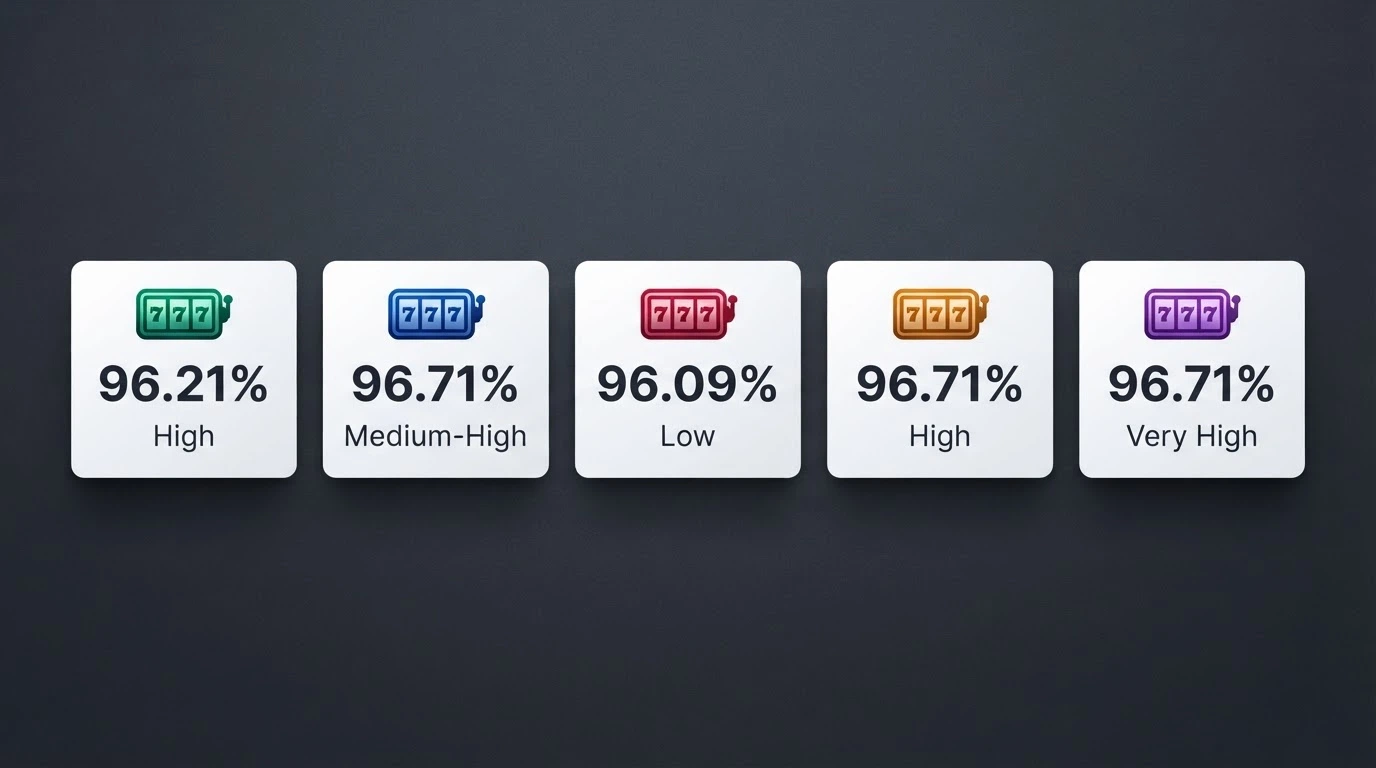
The 50 spins are locked to specific pokies — usually one, sometimes a small set — and the specs of those pokies decide the statistical shape of the offer. Three numbers matter: the return-to-player percentage (RTP), the volatility rating, and the maximum win multiple.
| Pokie Title | Provider | RTP | Volatility | Max Win |
|---|---|---|---|---|
| Book of Dead | Play’n GO | 96.21% | High | ×5,000 |
| Big Bass Bonanza | Pragmatic Play | 96.71% | Medium-High | ×2,100 |
| Starburst | NetEnt | 96.09% | Low | ×500 |
| Big Bass Splash | Pragmatic Play | 96.71% | High | ×5,000 |
| Bigger Bass Bonanza | Pragmatic Play | 96.71% | Very High | ×4,000 |
RTP is the long-run return the pokie pays back to players as a percentage of total wagering. A 96% RTP pokie keeps 4% of every dollar wagered as house edge, on average, across millions of spins. For 50 spins, the figure does not work that cleanly. A 50-spin session is a tiny sample, and the RTP is what the pokie does over months, not over a player’s free-spin allotment. But over many players claiming the same offer, the 96% RTP is the average that emerges.
Volatility is the trade-off between win frequency and win size. A low-volatility pokie produces many small wins; a high-volatility pokie produces few large ones. For a 50-spin free-spin session specifically, low volatility is the friendlier profile. The steady small wins keep the locked balance alive through the wagering requirement, and a player who finishes the turnover with anything left in the balance is a player who might hit the cashout cap. Starburst is the lowest-volatility pokie in the table and the one most likely to keep a 50-spin session above zero.
Max win is the ceiling on a single spin’s payout relative to the spin’s stake. A ×5,000 max win on a A$0.10 spin is a theoretical A$500 payout on a single line, well above the standard A$100 cashout cap. The ceiling is rarely hit, but it is the upper bound on what a single spin in the offer can produce, and the reason the cashout cap exists in the first place.
Provider-led offers and restricted titles
Most 50-free-spin offers among AU-facing offshore casinos are provider-led, meaning the eligible pokie is one of a small set of titles from a single game provider. Pragmatic Play is the dominant provider in this market, and four of the five pokies in the table above are Pragmatic Play titles. VegasNow’s 50 free spins on Big Bass Splash is one such provider-led offer.
The provider restriction matters in two ways. First, it removes the player’s choice — the spins cannot be used on a different pokie, even if another title on the same casino would have offered a better statistical profile. Second, it concentrates the offer in a small library, which is why the same five titles show up in free-spin offers across most of the featured operators. A reader who claims a 50-spin offer at one offshore casino is, statistically, likely to be playing the same pokie they would have been playing at any other offshore casino with a 50-spin offer.
The titles themselves carry the same RTPs across operators. A 96.71% RTP Big Bass Bonanza at one casino is the same game as a 96.71% RTP Big Bass Bonanza at another, because the game is hosted by Pragmatic Play and the maths lives in the game’s code, not in the casino’s configuration. The reader’s variability is in the wagering multiple, the cashout cap, the expiry window, and the spin value, not in the pokie.
A reader who is asked to play a game that is not in the table above — a less common title, a smaller provider, a game whose RTP has not been verified — should treat the unknown as a fact about the offer. The five titles in the table are the ones with publicly confirmed specs. An offer that locks the spins to a title outside this list is one whose statistical profile the player cannot check before claiming.
New Casinos Offering 50 Free Spins: Fresh Brand, Same Offshore Reality
New AU-facing offshore casinos launch regularly, and new-launch promotions are a common way for a brand to attract first deposits. The 50-free-spin no-deposit offer is a frequent new-casino promotion, partly because it is cheap for the operator (A$5 to A$10 in spin credits) and partly because it is the offer the affiliate-list pages reward with the highest visibility.
None of this changes the regulatory position. The Interactive Gambling Act 2001 prohibits online casinos in Australia regardless of when the operator launched. A new offshore casino that opened last month is in the same legal position as one that opened five years ago — neither holds an Australian licence, neither is connected to BetStop, neither is reachable through Australian consumer law. The launch date is marketing, not regulation.
The practical difference with new operators is that the offer terms are usually less established than those of brands with a longer track record. A player who claims a 50-free-spin offer from a brand they have never heard of is also claiming it from an operator whose handling of withdrawals, of verification disputes, and of bonus-term edge cases has not been tested in public the way a longer-running operator’s has. The offer itself may be identical to a more established brand’s offer — same wagering multiple, same cashout cap, same eligible pokie — but the operator’s behaviour in the disputes a real withdrawal can produce is unproven.
No new-casino 50-spin offers were confirmed with full terms among the featured operators in this ranking. A reader who is considering a new brand should run the same checklist they would run on any other operator in the table and should weigh the absence of a track record against the size of the offer’s headline.
How to Pick a 50 Free Spin Offer That Pays Out
The checklist: what to verify before you claim
Five things to check, in order, on any 50-free-spin no-deposit offer before the player registers. Each takes seconds to find on the operator’s terms page; together they take under two minutes.
- Wagering multiple. The number that decides whether the offer is mathematically clearable. A multiple in the 30× to 35× range is the reasonable benchmark; above 40× is where the probability of a payout starts dropping; above 50× is practically unclearable for most players.
- Maximum cashout cap. The ceiling on what the player can withdraw, regardless of the balance they finish wagering with. A$100 is the market standard; A$200 (Royal Reels, Lucky7) is the highest verified cap. A cap below A$50 means even a successful wagering session pays almost nothing.
- Validity window. The time the player has to use the spins and clear the wagering requirement. 7 to 14 days is the market range. A player who cannot commit to playing through the offer inside the window should not claim it — the spins expire, the winnings are voided, and the operator pockets the difference.
- Eligible pokies. The titles the spins can be played on, and the titles the wagering can be cleared on. The player should know both lists before claiming. Pokies contribute 100% toward wagering; table games contribute 5% to 10%, which is why almost every offer locks the wagering to pokies.
- Spin value. The coin value assigned to each free spin, almost always A$0.10 to A$0.20. A 50-spin offer at A$0.10 is a A$5 bonus; at A$0.20 it is a A$10 bonus. The size of the bonus sets the size of the wagering turnover; the player should know both before claiming.
Five numbers. Two minutes. The difference between a player who reads them and a player who does not is the difference between an informed decision and a coin-flip on what the offer actually is.
Australia’s Online Casino Ban and What It Means for Your 50 Free Spins
The IGA prohibition: no licence, no protection
The Interactive Gambling Act 2001 makes it an offence to provide an online casino, online pokies or in-play sports betting to a person in Australia. There is no licence for online casino anywhere in the country — not federally, not in any state, not in any territory. A reader looking for an Australian-licensed 50-free-spin offer is looking for something the Australian framework does not allow to exist.

What this means for a player who claims an offer from an offshore operator is that the entire Australian regulatory perimeter does not apply. The consumer protection that an Australian-licensed wagering customer can invoke through the relevant state regulator does not exist for offshore-casino customers. The financial ombudsman that an Australian bank customer can escalate a dispute to does not have jurisdiction over an offshore operator. The Australian consumer law that protects an Australian purchaser does not reach a Curaçao-licensed casino. The player has recourse through the operator’s own complaints process and through the operator’s licensing jurisdiction. They do not have recourse through Australia.
BetStop, the National Self-Exclusion Register, binds Australian-licensed wagering services only. An offshore casino is not connected to the register, and a self-excluded person can still register, deposit, and play at any offshore operator that accepts them. The protection BetStop offers is real for licensed wagering customers — 59,830 people had registered to self-exclude by the end of Q3 FY 2025–2026, with 37,247 active exclusions as of 31 March 2026, and 78% of registrants under 40, with 38% choosing lifetime exclusion — and it does not extend to offshore casinos.
The ACMA has enforcement reach over the providers of these services, not over the players who use them. Since November 2019, the ACMA has had 1,564 illegal gambling and affiliate websites blocked by Australian ISPs, and more than 225 illegal services have withdrawn from the Australian market since enforcement strengthened in 2017. A site that has been accepting Australian players can be blocked at any time, with player balances still sitting on it. The block is the operator’s exit, not the player’s withdrawal.
The individual player is not prosecuted under the IGA. The Act targets the provider of the prohibited service, not the person using it. The player who claims 50 free spins at an offshore casino commits no offence by doing so, but the protection an Australian-licensed customer takes for granted — from dispute resolution to responsible-gambling tooling to the ACMA’s enforcement backstop — does not apply.
What the 2026 gambling reforms change for players
The Interactive Gambling Amendment (Gambling Reform) Bill 2026 passed Parliament on 19 August 2026, with its measures commencing 1 January 2027. The reform package tightens the licensed environment around wagering but does not change the offshore-casino prohibition’s status. An offshore casino remains offshore, unlicensed, and outside Australian rules after 1 January 2027, exactly as it was before.
What changes for licensed wagering is significant. Wagering advertising is capped at three ads per hour between 6:00 am and 8:30 pm on free-to-air television, with a complete ban on wagering advertising during live sport broadcasts. The AdStop register, administered by the ACMA, allows Australian consumers to opt out of wagering advertising across the licensed channels. Direct marketing of inducements is prohibited for 14 days after a customer signs up with a licensed operator, for three months after a person deregisters from BetStop, and indefinitely for customers identified as at-risk. Broadcasting of odds is banned outright. Radio ads are barred during school drop-off and pick-up times. Online wagering ads are shown only to logged-in, confirmed-over-18 users who have not opted out. Athletes, celebrities and influencers are barred from promoting wagering. ACMA gains cost-recovery levy authority over licensed operators.
The provision that reaches the offshore segment is the one that gives banks and payment providers express authority to block transactions to illegal gambling operators from 1 January 2027. A deposit that an offshore casino accepts today may not clear the player’s bank tomorrow. The change does not make offshore casinos safer. It makes them harder to fund, and it means the player who reaches one is now also betting on whether their own bank will let the transaction through.
The reforms do not create a new licensed online casino market. They do not regulate offshore operators. They do not give Australian players a new recourse against an offshore operator that refuses a withdrawal. They tighten the licensed environment and they tighten the payment pipeline. The offshore segment remains what it was — unlicensed, unconnected to BetStop, and outside Australian consumer protection.
Playing 50 Free Spins Without Losing Control
Where to get help and how to set your own limits
The offer is built around the player’s first fifty spins. What the offer does not address is the spins that come after. The wagering requirement, by design, asks the player to keep playing until the turnover obligation is met, and the math of a 96% RTP pokie at 30× to 50× wagering is that the player’s balance will, on average, reach zero before the obligation does. The player who finishes the wagering with money to withdraw is the exception, not the rule.

Australian players who feel the offer has stopped feeling like an offer have 24/7 access to free, confidential support. The National Gambling Helpline, 1800 858 858, is free from any Australian phone, staffed around the clock, and connects the caller to counsellors trained in gambling harm. Gambling Help Online, at gamblinghelponline.org.au, offers online chat and counselling for players who prefer text-based support. Both services are free, confidential, and available regardless of whether the player has decided to keep playing or to stop.
BetStop, the National Self-Exclusion Register, covers Australian-licensed wagering services — every licensed sports book and every licensed wagering brand in the country. It does not cover offshore casinos. A player who has registered with BetStop can still register, deposit, and play at any offshore operator that accepts them, because the offshore operator is not connected to the register. A player who needs self-exclusion across both markets needs to combine BetStop with their own discipline on the offshore side, and with the offshore operator’s own self-exclusion tools where the operator offers them.
The offshore operators do not uniformly offer deposit-limit, loss-limit, or session-time tools. A reader who is using one should not assume the platform will set a limit for them. Self-imposed limits — a deposit cap the player enforces on themselves, a session length the player tracks in a phone timer, a hard rule that the offer is the last play of the day — are the practical guardrails on a platform that may not offer any.
The prevalence data tells the reader why the guardrails matter. Approximately 2.1% of Australian adults — around 430,000 people — experience problem gambling, with the Australian Institute of Health and Welfare putting high-risk gambling at 1.8% in 2022. Roy Morgan data from March 2026 shows 15.1% of Australian adults (3.32 million people) experiencing some level of gambling harm, with 13.0% (2,857,000) harmed by their own gambling behaviours. Risky gambling rose from 13.7% in 2024 to 19.4% in 2025, almost doubling since the COVID-19 lockdowns of 2020–2021. The trend is not in the player’s favour. The guardrails exist for a reason.
How We Selected and Ranked These Operators
The ten operators in the ranking are drawn from two sources. The first is the Australian market-share tracking data filtered for casino and pokies products, which gives a numerical ranking for nine of the ten operators. The second is the set of brands that surfaced in Australian search results as active AU-facing no-deposit free-spin offers, which is how BitStarz entered the ranking despite not appearing in the top-20 market-share table.
Licensed wagering brands — Sportsbet, bet365, Ladbrokes, TAB, PointsBet, Neds, Betr, Picklebet, Betfair — are excluded. They are licensed sports-betting operators, not casinos, and a page about “50 free spins no deposit” is not a page about them. The exclusion is not a judgement on those brands. It is a recognition that they do not offer the product the reader is searching for, and the legal framework that lets them offer sports betting is the same framework that prohibits online casino.
The ranking is ordered by Australian market share where the data exists. Each operator’s licence status was verified against the absence of any Australian online casino licence, which is a uniform finding across the table. BetStop coverage was checked against the ACMA register scope, which binds licensed wagering services only. Bonus terms for each operator were sourced from publicly available affiliate data where confirmed; for most operators, the operator’s own current terms page is the only reliable source.
The audit on the operators is honest about its limits. Most operator-specific bonus details — game providers, welcome offers, wagering terms, spin values — were not verified this run. The brands are real and active in the Australian market as confirmed by the traffic-tracking data and the search results, but their full bonus terms need to be verified by the player from the operator’s own site before any offer is claimed.
Your 50 Free Spins, Your Call
50 free spins no deposit is a real offer, available to Australians, claimed through offshore operators that do not hold an Australian licence and cannot hold one. The offer is not a scam. The spins credit, the wagering runs, the cashout processes for the small number of players who clear it. But the offer is structured so that the average player walks away with zero, and the structure is not accidental.
The wagering requirement is the lever. A 30× to 35× multiple on winnings is the reasonable benchmark; above 40× the offer starts becoming punitive; above 50× the offer is practically unclearable. The expected loss from completing the wagering on a 96% RTP pokie is the house edge applied across the full turnover: A$7 to A$14 on the typical 50-spin offer, depending on the spin value. Most players who clear the wagering do so with the balance already reduced to zero by that house edge. The small number who finish with money in the balance face the cashout cap — A$100 most commonly, A$200 at the highest-verified offers — which is the ceiling on what the offer actually pays. The expected win from 50 × A$0.10 spins at 96% RTP is A$4.80, which is the size of the prize a player is grinding for.
The offshore reality is the other half. No Australian consumer protection applies. No BetStop exclusion applies. No Australian financial ombudsman has jurisdiction. The ACMA can block the operator’s site at any time, with player balances still sitting on it. The 2026 reforms tighten the licensed environment and give banks authority to block transactions to illegal operators from 1 January 2027, but they do not regulate offshore casinos and they do not give players a new recourse against them.
The reader who wants to claim the offer should treat it as entertainment with a near-zero expected cash value. Check the wagering multiple, the cashout cap, the expiry window, the eligible pokies, and the spin value before registering. Run the offer on a pokie whose RTP and volatility are publicly known. Use an email address the player can abandon if the spam gets unmanageable. Set a hard limit on the time and money the offer is allowed to consume. Treat the helpline — 1800 858 858, free and confidential, 24/7 — as the call that exists for the moment the offer stops feeling like an offer.
If the terms are unclear, the operator is unknown, or the wagering multiple sits above 40×, the safest choice is not to claim. The offer is free in name. The offer is not free in cost.
Frequently Asked Questions
How much can I actually withdraw from 50 free spins no deposit?
The most common cap is A$100, with A$200 confirmed at Royal Reels and Lucky7. A player who clears wagering with a balance above the cap can only withdraw the capped amount; anything above is forfeited. Most players walk away with zero, because the wagering requirement grinds the locked balance down through the house edge before the turnover is met.
Do I need a bonus code to claim 50 free spins no deposit?
It depends on the operator. Some no-deposit offers credit automatically on registration; others require a manual code typed into the operator’s promotions page. The current requirement is on the operator’s terms page at the time of claim, and a code that is required and not entered at registration can mean the spins are forfeited before they are ever credited.
What is the difference between no deposit free spins and deposit free spins?
A no deposit free spin offer does not require the player to fund an account; the spins are credited on registration. A deposit free spin offer requires the player to make a deposit — usually a minimum deposit — before the spins are credited, typically delivering a larger bonus at a lower wagering multiple and a wider cashout ceiling.
How long do I have to use my 50 free spins before they expire?
Validity windows on no-deposit free-spin offers typically run 7 to 14 days from the time the spins are credited. BitStarz confirms a 7-day expiry; VegasNow confirms a 14-day expiry. The same window applies to the wagering requirement — the turnover obligation has to be met inside it, or the winnings are voided.
Does BetStop self-exclusion cover offshore casinos offering 50 free spins?
No. BetStop, the National Self-Exclusion Register, binds Australian-licensed wagering services only. An offshore casino is not connected to the register, and a self-excluded person can still register, deposit, and play at any offshore operator that accepts them. A player who needs self-exclusion across both markets combines BetStop with their own discipline on the offshore side.