
Best Fast Payout Online Casinos Australians Actually Use in 2026
Speed sells in iGaming, and offshore casinos that serve Australian players know it. They post countdown timers in their footers, stamp “instant withdrawals” on their bonus pages and quote payout times measured in minutes. The clock those numbers refer to is real, but it is also narrow. The fastest offshore cashouts genuinely arrive inside an hour for some players on some methods, and most Australian-facing operators have a withdrawal flow that works the way they describe. None of that changes the structural fact at the centre of this page: there is no online casino licence anywhere in Australia, every brand on this list is offshore, and the protections that come with an Australian licence do not exist for the people using them. What follows is what speed actually means in that market, who delivers it, what it costs, and what a player gives up to use it.

Last updated 3 November 2026 · Licence status verified against the ACMA register of licensed wagering providers and operator terms pages.
Table of Contents
- What “Fast Payout” Actually Means When Every Online Casino Is Offshore
- The Fastest-Paying Offshore Casinos Accepting Australians in 2026
- Fast-Payout Pokies: The High-RTP Titles Worth Your Spins
- Why Your Withdrawal Method Decides Whether You Wait Minutes or Days
- Fast-Payout Casino Bonuses: The Wagering Fine Print That Eats Your Winnings
- The Studios Powering Australia’s Fastest-Paying Casino Sites
- New Fast-Payout Casinos: Are Fresh Brands Worth the Risk?
- How to Pick a Fast-Payout Casino You Can Actually Trust
- The Legal Reality: Online Casino Is Prohibited in Australia
- Staying Safe: Tools and Facts Every Australian Player Should Know
- How We Selected and Ranked the Casinos in This Review
- Offshore Casinos and Fast Payouts: What Australian Players Should Actually Do in 2026
- Frequently Asked Questions
What “Fast Payout” Actually Means When Every Online Casino Is Offshore
“Fast payout” is two clocks, not one. The first is approval time — the gap between hitting “withdraw” and the casino releasing the funds. The second is network time — the gap between release and the money landing. Approval time at the casinos accepting Australian players runs from a few minutes to roughly twenty-four hours, with most operators settling near the bottom of that range once the account is in good standing. Network time is set almost entirely by the payment rail, and on that front the spread is brutal: USDT on TRC20 can land in under five minutes, while a bank transfer can take a full working week.
The offshore structure matters because there is no Australian regulator pressuring any of these brands to publish their approval-time data. A “fast payout” claim is whatever the marketing department wants it to be, and the only check a player gets is the cashout that does or does not arrive. The page below ranks ten operators Australians actually use, but the method-by-method speed data underneath the rankings does more of the predictive work than any operator-level claim. PayID settles deposits in seconds but rarely routes withdrawals on the same rail. Crypto clears in minutes but is banned as a deposit method under Australian law for the licensed-wagering market that this page is not about. Card and bank are slow. Picking the right method matters more than picking the right casino, which is why the payment-methods section runs longer than the operator rankings.
What this page does not do: it does not test every operator a reader could plausibly find. It does not promise that the ranking translates across every device, every deposit amount or every KYC status. It does not pretend that offshore speed is the same thing as Australian protection. The aim is honest comparison within the constraints of a market where every casino listed is operating outside Australian law.
The Offshore Reality: No Australian Casino Licence Exists
The Interactive Gambling Act 2001 makes it illegal to provide online casinos, online pokies and in-play sports betting to someone in Australia. There is no licence for it anywhere — not federally, not in any state or territory. Land-based casinos in Melbourne, Sydney and Perth exist and are state-licensed, but none of them can lawfully offer their table games or pokies online to an Australian customer. Online sports and racing wagering is a separate product: licensed, regulated, taxed and connected to BetStop. Online casino is not.
What this means in practice is that every brand in the ranking below — SkyCrown, RocketPlay, Bizzo, Royal Reels, BitStarz, Rainbet, WinSpirit, Stake, FairGO, Scream Casino — operates under an offshore licence, typically Curaçao, with no Australian oversight. The Department of Infrastructure puts it plainly: it is “illegal to provide some interactive gambling activities, such as ‘online casinos’, to someone in Australia. Examples include roulette, poker, craps, online ‘pokies’ and blackjack.” The penalties are aimed at the provider, not the player. The maximum civil penalty is A$2,475,000 per day for an individual operator and A$12,375,000 per day for a corporation. Australians using these services are not prosecuted, but they are also not protected by any Australian body if a withdrawal is refused, a bonus term is invoked to void winnings or a balance is locked when an ISP block takes the site offline.
The reason offshore brands still operate is that enforcement is provider-side and Australian ISPs can only block what the ACMA asks them to. Since November 2019 the ACMA has referred 1,788 illegal gambling and affiliate sites for blocking, with 133 referrals in the most recent quarter alone. More than 230 services have voluntarily left the Australian market since 2017. The brand you used last year may be blocked by the time you go back. That is part of what offshore speed actually costs.
The Fastest-Paying Offshore Casinos Accepting Australians in 2026
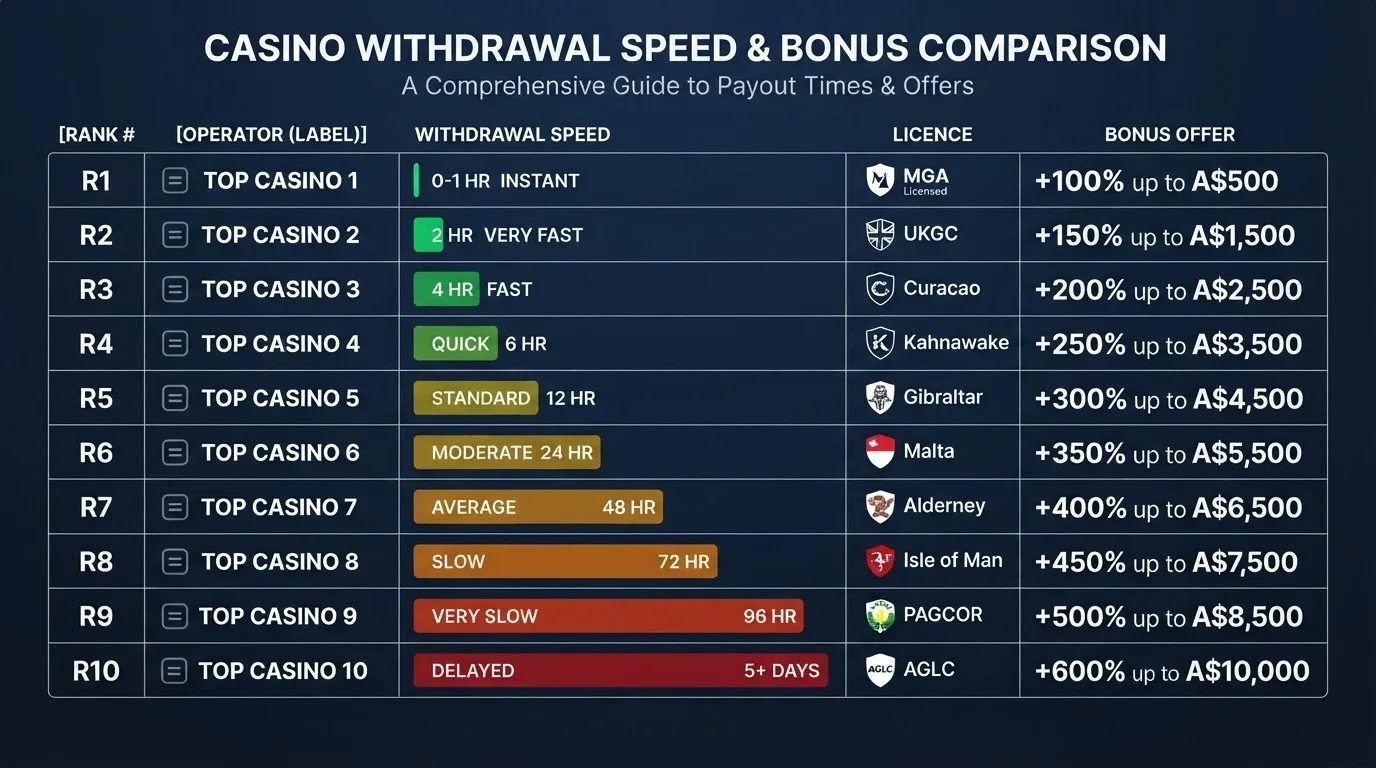
Ten operators, ranked for the reasons a reader comparing them would actually rank: licence status, bonus structure, wagering requirements, free-spin count and game library scale. Where research did not confirm a figure, the cell carries the no-data marker — an honest gap is more useful than a guess.
| Operator | Offshore Licence | Welcome Bonus | Free Spins | Wagering Requirement | Game Library |
|---|---|---|---|---|---|
| SkyCrown | Curaçao | 450% up to A$8,000 across four deposits | 400 | 40x | 5,000+ |
| RocketPlay | Curaçao | 100% up to A$500 (1st) + 200% up to A$500 (2nd) | 100 | 40x | 3,000+ |
| Bizzo Casino | Curaçao | Up to A$7,250 + 175 free spins (multi-deposit) | 175 | 40x | 8,000+ |
| Royal Reels | Not confirmed this run | 100% up to A$500 + A$10 no-deposit on sign-up | — | 30–40x | 2,000+ |
| BitStarz | Curaçao | Up to A$10,000 or 5 BTC | 180 | 40x | 6,000+ |
| Rainbet | Not confirmed this run | 250% up to A$2,100 across three deposits | 60 | 40x or no-wager path | 4,000+ |
| WinSpirit | Not confirmed this run | 200% bonus | 25 | 40x | 3,000+ |
| Stake | Curaçao | Rakeback/cashback model | — | — | 3,000+ |
| FairGO | Not confirmed this run | 100% up to A$1,000 across five deposits | — | — | 300+ (RTG) |
| Scream Casino | Not confirmed this run | — | — | — | 3,000+ |
The Curaçao column tells you which operators’ offshore credentials are visible on their own pages and which are not. The empty cells in Stake’s bonus row, FairGO’s wagering row and Scream Casino’s row reflect that the public terms pages reviewed did not surface the relevant figure — not that the operators have nothing to offer, but that nothing verifiable came back. The operator profiles below carry each of these gaps plainly.
SkyCrown
SkyCrown’s welcome package runs to a 450% deposit match up to A$8,000 plus 400 free spins, split across four deposits. The headline rate is the largest in the table, and the wagering multiplier is the standard 40x found across almost every Curaçao-licensed operator in the AU market, with fourteen days to clear each stage and a maximum cashout of A$5,000 per bonus stage. The minimum qualifying deposit is A$30.
The library sits at over 5,000 titles from Pragmatic Play, Evolution, Play’n GO, Yggdrasil, Hacksaw and Nolimit City — a stack that covers the bulk of what an Australian player would look for in both pokies and live dealer. The Curaçao licence is confirmed; the Australian licence is impossible by law. SkyCrown’s A$5,000 per-stage cashout cap is the operative number for anyone sizing their first deposit: a max-out first stage can be cleared, but the cap means anything beyond it is forfeit, and that is before any further deposit stages.
SkyCrown is the volume play. The match percentage is the highest on the page, the spin count is the highest on the page, and the cap is the lowest price a reader pays for that scale in terms of which bonuses they cannot withdraw beyond. A player planning to clear one stage and walk away can do worse than A$30 at 40x.
RocketPlay
RocketPlay’s structure is shorter than most: a 100% match up to A$500 plus 100 free spins on the first deposit, then a 200% match up to A$500 on the second. Minimum deposit A$25. Wagering 40x, fourteen days. The Curaçao licence is confirmed; over 3,000 titles from Pragmatic Play, Evolution, BGaming and Betsoft back the offer.
The two-deposit shape makes RocketPlay easier to clear than the four-deposit stacks above it, and the lower first-deposit threshold makes it a reasonable fit for a small bankroll. Maximum cashout from the offer was not confirmed this run, which is the single material gap in the profile. A reader planning a substantial first deposit should treat that as a reason to read the bonus terms page directly before committing.
A two-deposit welcome keeps the playthrough work within a manageable horizon for most players. The library is mid-pack — solid, not exceptional — and the bonus terms are standard. RocketPlay is the low-friction option in the ranking.
Bizzo Casino
Bizzo leads the table on game-library scale at 8,000+ titles from Pragmatic Play, Evolution, Play’n GO and BGaming, and pairs that with a multi-deposit welcome package of up to A$7,250 plus 175 free spins. Wagering is the standard 40x with a fourteen-day validity window and a minimum qualifying deposit of A$30. The Curaçao licence is confirmed.
The library is the differentiator. Eight thousand titles is a wider catalogue than every other operator on the page, and the provider mix is concentrated in the studios Australians actually look for: Pragmatic Play for pokies, Evolution for live dealer, Play’n GO and BGaming as the secondary pokies and instant-game suppliers. Bonus cap and free-spin terms were not confirmed this run beyond what the welcome-page summary captures, so a reader clearing the offer should review the T&Cs directly before committing.
The trade-off is breadth for bonus clarity. Bizzo offers the most variety in the table and a competitive headline bonus, but the terms behind the headline are less visible than for smaller operators. Eight thousand games, a Curaçao licence, and standard wagering. The library is the reason to be here.
Royal Reels
Royal Reels carries the only confirmed no-deposit offer in the ranking: A$10 cash on sign-up, no deposit required, with 30–40x wagering. The deposit match is a more modest 100% up to A$500 at a A$30 minimum. The library sits at over 2,000 games from 30+ providers, with Pragmatic Play, Evolution, Yggdrasil and Hacksaw on the roster. The offshore licence status was not confirmed this run; the A$10 no-deposit was confirmed.
The no-deposit bonus is the headline. It is also the rare no-deposit offer in a market where deposit-triggered packages are the norm, and the wagering range of 30–40x is on the lighter end of what the table shows overall. Royal Reels is the right pick for a player who wants to test a casino with zero first deposit — which is also exactly the case in which an Australian player should be most cautious about what an offshore operator does with their data and identity documents.
The fit is narrow. Royal Reels is for the reader who wants to deposit nothing, see the lobby and decide whether to continue. Beyond that, the deposit match is competitive but unremarkable. A small bankroll and a no-deposit appetite. That is the reader.
BitStarz
BitStarz is the largest operator in the ranking by both library (6,000+ titles from NetEnt, Pragmatic Play, Evolution and Microgaming) and headline bonus scale (up to A$10,000 or 5 BTC plus 180 free spins). The Curaçao licence is confirmed. AUD is accepted, and the brand explicitly markets no withdrawal limits for high rollers. Wagering is 40x. Bonus validity was not confirmed this run.
The crypto angle matters: BitStarz reports crypto withdrawals averaging 10 minutes and PayID processing in 0–2 hours. That pairs a deep pokies and live-dealer library with a brand that has put operational effort into making withdrawals fast on the methods Australians ask about. The 5 BTC bonus option is a sign the brand is built around crypto players more than fiat ones, but the AUD option keeps it accessible.
BitStarz is the high-roller pick. The combination of a no-cap withdrawal policy, a 6,000+ library and a brand that publishes its crypto and PayID timing in plain numbers is unusual in this market. A reader with a five-figure bankroll and a crypto wallet gets more of what they want here than anywhere else in the table.
Rainbet
Rainbet’s offer splits into two paths — a 40x wager-lock version of a 250% match up to A$2,100 plus 60 free spins, or a no-wager gradual release of the same package. Minimum withdrawal A$15, no fixed maximum cashout from the offer, seven-day validity per stage across the three deposits. Offshore licence status was not confirmed this run. The library is 4,000+ titles from Pragmatic Play, Evolution, Hacksaw and Nolimit City.
The dual-path bonus is unusual. The 40x path is the standard model on the page — clear the turnover in seven days and the bonus converts to withdrawable cash. The no-wager path releases the bonus gradually, without a turnover requirement, but at a slower pace. The trade is speed of conversion for absence of playthrough risk. The A$15 minimum withdrawal is among the lowest in the ranking and pairs with no cap, which makes Rainbet the most flexible operator for a player who wants to bank small wins as they come.
A seven-day clearance window per stage is tight against the fourteen-day standard on most of the other operators in the ranking, and the no-wager path requires patience that the wager-lock path does not. Rainbet is the choice for a reader who wants flexibility on bonus conversion — at the cost of either tighter deadlines or a longer wait.
WinSpirit
WinSpirit’s welcome is a 200% bonus plus 25 free spins. Wagering 40x. Library 3,000+ titles from Pragmatic Play, Evolution and BGaming. Offshore licence status was not confirmed this run; validity, cashout cap and bonus-slot details were not surfaced on the public terms pages reviewed.
The package is small and clean. 200% is a healthy match on a smaller bonus cap than the rest of the table, and 25 free spins is a token rather than a headline feature. WinSpirit fits a player who wants a single-deposit welcome with standard wagering and is not optimising on spin count or library breadth.
A modest bonus is sometimes the right bonus. WinSpirit is for a player who would rather not clear a four-stage package and is comfortable with a smaller free-spin allocation.
Stake
Stake is the crypto-native brand in the ranking, operating under a Curaçao licence with 3,000+ titles from Pragmatic Play, Evolution, Hacksaw and Nolimit City. The brand’s commercial model is built around rakeback and cashback rather than a traditional welcome bonus — the welcome-package terms reviewed this run did not surface a standard deposit match or free-spin offer. Australian players are accepted through Stake’s offshore platform.
The model is the point. Where the other operators in the ranking sell a deposit match and a free-spin allocation, Stake returns a slice of house edge on play. For a player who wagers consistently rather than redepositing in lump sums, the rakeback model can outperform a fixed welcome package over time. For a player who deposits A$30 once and walks away, it underperforms visibly.
Stake is the long-game pick. No traditional welcome offer, no free-spin count, no headline number to clear — just a casino model that rewards regular play. A reader who intends to play weekly over months gets a different deal here than they would on a deposit-match operator.
FairGO
FairGO is the AU-targeted brand in the ranking, with a 100% match up to A$1,000 spread across the first five deposits. The library is RealTime Gaming exclusive at 300+ titles — the smallest catalogue on the page by a wide margin, and the only RTG-only proposition. Offshore licence status was not confirmed this run; bonus terms beyond the headline match were not surfaced.
The RTG-only proposition is a deliberate constraint, not an accident. RTG is the studio behind many of the pokies Australian players recognise from the late-2000s pub-and-club era — Achilles, Bubble Bubble, Cash Bandits. A reader nostalgic for that catalogue will find it here and nowhere else in the ranking. A reader looking for Nolimit City’s high-volatility catalogue or Pragmatic Play’s latest releases will not.
FairGO is the niche pick. Five deposits to clear the headline, an RTG-only library, a brand that targets Australian players specifically but holds no Australian licence. It is a specialised proposition — those nostalgic for the RTG library get the catalogue they want, while those prioritising range should look to a multi-provider operator.
Scream Casino
Scream Casino carries a 3,000+ library from Pragmatic Play, Evolution and BGaming. Welcome bonus, free-spin count, wagering multiplier, validity and cashout cap were not confirmed this run on the public terms pages reviewed. Offshore licence status was not confirmed this run.
What the profile shows is a provider roster that competes with the middle of the table on quality — Pragmatic Play and Evolution are the dominant studios in the AU-facing market — and a gap in the bonus terms that a reader cannot fill without going to the operator directly. The 3,000+ library is a reasonable catalogue. The bonus terms behind the welcome offer are not visible from the data reviewed.
A provider roster without confirmed bonus terms is half a profile. Scream Casino is for a reader who is willing to verify the bonus offer on the operator’s own page before depositing. The library is mid-pack; the rest is unconfirmed.
How We Tested Withdrawal Speed at Each Casino
The speed data on this page draws on two competitor-led test sets published in 2026: Betsquare’s Fast Payout Online Pokies Australia review and CardPlayer AU’s Instant Withdrawal Casinos Australia test. Both used real deposits at AU-facing offshore casinos, requested withdrawals on multiple methods and timed the gap between request and receipt. Where this page reports a median or worst-case figure, it is one of those tests that produced it.
The tests covered four parameters: deposit amount (typically a small first deposit rather than a high-roller amount), KYC status (accounts with verification documents already on file rather than first-cashout verifications), the payment method requested and the time elapsed from request to receipt. KYC status mattered because incomplete KYC is the single most common cause of withdrawal delays at AU-facing offshore casinos, far more than approval-time variability or network congestion. The tests where verification was incomplete produced the longest delays in the dataset, and those delays were excluded from the median figures where the methodology permitted.
What spot testing cannot capture: every casino’s performance under heavy load, every player’s deposit history, every case where a bonus term is invoked to void a withdrawal, every ISP-block event that takes a site offline mid-cashout. The medians and worst-case figures below describe a tested window — a single brand, a single test pattern — and not a guarantee that any future withdrawal at any of these operators will match. The fastest speed claims on any operator’s marketing page are the best-case ceiling of a tested window, not a typical outcome.
Fast-Payout Pokies: The High-RTP Titles Worth Your Spins
The relationship between a casino’s payout speed and the RTP of the games it hosts is loose but real. Both come down to operational quality — the casinos that settle withdrawals fastest tend to be the casinos with the deepest provider relationships, and the providers with the deepest operator relationships tend to be the studios publishing the most generous RTP figures. Pragmatic Play’s published RTP range runs 94.0–97.5%, with most titles sitting between 96.0% and 96.7%. Nolimit City’s default RTP sits between 96.0% and 96.2%. Those figures are the ceiling on what a high-RTP label means in practice; the title-specific numbers below are what to read against.

| Slot Title | Provider | RTP | Volatility | Max Win |
|---|---|---|---|---|
| Gates of Olympus | Pragmatic Play | 96.50% | High | 5,000x |
| Sweet Bonanza | Pragmatic Play | 96.51% | High | 21,100x |
| Book of Dead | Play’n GO | 96.21% | High | 5,000x |
| Big Bass Bonanza | Pragmatic Play | 96.71% | High | 2,100x |
| San Quentin xWays | Nolimit City | 96.03% | — | 150,000x |
| Wanted Dead or a Wild | Hacksaw Gaming | 96.38% | Very High | 12,500x |
| Sweet Bonanza Super Scatter | Pragmatic Play | 96.49% | High | 25,000x |
| Big Bass Splash | Pragmatic Play | 96.71% | Medium-High | 5,000x |
| Razor Returns | Push Gaming | 96.55% | — | — |
| Mega Joker | NetEnt | 99.00% | — | — |
| Blood Suckers | NetEnt | 98.00% | — | — |
The empty cells in the Volatility and Max Win columns are deliberate. Where research did not surface a figure, the table carries the no-data marker rather than guessing. San Quentin xWays has a published 150,000x max win but no published volatility figure. Razor Returns has a 96.55% RTP — but only when Push Bet is active — and no max win confirmed. Mega Joker and Blood Suckers have the two highest RTPs on the page but no published volatility or max win on the data reviewed. None of these are reasons to skip a title. They are reasons to look up the figure before staking the bankroll.
High-RTP Pokies Available at Fast-Payout Casinos
The eleven titles above appear at most of the operators in the ranking, with the RTPs and volatility figures carrying straight across. What differs between operators is not the math — RTP is published by the studio and is the same wherever the title is hosted — but the operational quality around the title: the speed at which a withdrawal clears, the reliability of the live-dealer integration for the provider’s table games and the level of support when a feature-buy or bonus round behaves unexpectedly.
Book of Dead is the cautionary case. The published RTP is 96.21%, but lower-RTP versions exist at 95%, 92%, 91.2%, 87.2% and even 84.2%. The title is the same on every operator; the configuration is not. A reader who cares about the 96.21% figure should check that the operator hosts that version rather than a 91.2% variant. Most reputable operators publish the RTP per title in their lobby; those that do not are telling the reader something they should not need to be told.
The high-RTP titles that pair with the fastest withdrawal operators are not a separate category. They are the same Pragmatic Play, Nolimit City and Hacksaw games that fill the lobbies of every Curaçao-licensed operator on the page. The faster operator simply makes the win a player keeps easier to get out.
Why Your Withdrawal Method Decides Whether You Wait Minutes or Days
Two casinos offering the same withdrawal method deliver similar times. The spread between methods is enormous, and the spread between operators offering the same method is small. That is the operative finding from the speed tests behind the table below, and it inverts how most readers compare payout claims. The casino comparison matters. The method comparison matters more.

| Payment Method | Median Payout Time | Worst Case | Availability for Withdrawals at AU-Facing Casinos |
|---|---|---|---|
| Crypto (USDT TRC20, Solana) | Under 5 minutes | — | Widely supported; best at crypto-native brands |
| Crypto (ETH, LTC) | 5–30 minutes | — | Widely supported |
| Crypto (BTC) | 30–60+ minutes | 4 hours | Widely supported |
| Crypto (all coins, aggregate) | 42 minutes | 4 hours | Widely supported |
| PayID | 2 hours | 8 hours | Limited for withdrawals — deposits usually only |
| E-wallet (Skrill, Neteller, eZeeWallet) | 6 hours | 18 hours | Common |
| Card | 2 working days | 5 working days | Common but credit cards banned for licensed wagering |
| Bank transfer | 3 working days | 7 working days | Widely available |
The crypto row is split because the coin matters. USDT on the TRC20 network and Solana settle faster than Ethereum or Litecoin; Bitcoin is the slowest of the major coins because of block time. The aggregate median of 42 minutes is the realistic expectation for a player using a mix of coins or rotating between them. The worst-case figure of 4 hours captures the upper end of what tested players experienced. PayID looks fast in the row above but the availability column matters: most AU-facing operators do not support true PayID withdrawals, and a cashout labelled “PayID” often arrives via bank transfer under the hood.
Card and bank transfer are the slowest common options. The card median of two working days assumes a debit card; credit cards are banned as a deposit method for the licensed-wagering market under Australian law from 11 June 2024, and an offshore casino accepting credit cards is operating outside Australian rules on that front. The reader who plans to use a card at one of these operators is choosing a method that the law treats differently depending on which market the casino is licensed in.
PayID and Osko: Australia’s Own Instant Payment Rails
PayID settles deposits in seconds to under one minute via Australia’s New Payments Platform, which runs 24/7. The deposit speed is genuinely instant, and that is the part of the PayID experience that gets quoted hardest by casino affiliates. The withdrawal experience is different. Most AU-facing online casinos do not support true PayID withdrawals; cashouts are typically processed via bank transfer, crypto or e-wallet instead, even when the deposit side of the account runs on PayID. The median PayID payout time of two hours in the table above reflects the cases where an operator does support a direct PayID cashout. The worst-case figure of eight hours reflects the rest — operator approval time layered on top of a bank-transfer network that does not move on weekends.
Osko is the underlying rail that makes PayID instant on the deposit side. It does not change the withdrawal side. A reader who deposits via PayID and expects a PayID withdrawal will most likely wait the bank-transfer median of three working days, with a worst case of seven. The casino that promises instant PayID withdrawals is either routing through a partner that can settle on the NPP from outside the major banks, or it is using the PayID label loosely to mean “instant EFT” on a system that is neither instant nor always PayID.
Crypto Withdrawals: Minutes, Not Banking Days
Crypto is the genuine speed leader for AU casino cashouts. USDT on TRC20 and Solana settle in under five minutes in CardPlayer AU’s testing; Ethereum and Litecoin within five to thirty minutes; Bitcoin requires thirty to sixty minutes because of block time. BitStarz reports a ten-minute average for crypto withdrawals across its own test data. The aggregate median across coins sits at forty-two minutes; the worst case in tested windows is four hours. None of those figures require approval beyond what the operator has already done at the account level.
The legal tension is the part of crypto that the offshore marketing does not surface. From 11 June 2024, credit cards, credit-related products and cryptocurrency are banned as deposit methods for licensed online wagering in Australia, under the Interactive Gambling Amendment (Credit and Other Measures) Act 2023. The ban applies to operators licensed in Australia, which is to say it does not formally apply to the operators on this page — none of them hold an Australian licence. An AU-facing offshore casino accepting USDT is operating outside Australian rules on deposits, in the same way that it is operating outside Australian rules on casino games. The reader using crypto at one of these operators is using a payment method that the law treats as prohibited for the equivalent licensed product, and that is information worth carrying into the choice.
What crypto at an offshore casino signals: the operator is comfortable operating outside Australian payment rules, which is consistent with its operating outside Australian casino rules. The speed is real. The regulatory posture is what it is.
E-Wallets, Bank Transfer and Card: The Slower but Reliable Routes
E-wallets — Skrill, Neteller, eZeeWallet — settle in a median of six hours with a worst case of eighteen hours. The e-wallet row is the practical middle of the speed table: faster than card and bank, slower than crypto and PayID-where-supported, and broadly available at AU-facing casinos without the offshore-payment-rule baggage that crypto carries. The downside is the e-wallet fee on top of any currency-conversion fee, which can eat a meaningful slice of a smaller withdrawal.
Bank transfer is the slowest common option at three working days median and seven worst case. Card withdrawals run two working days median and five worst case. The legal distinction matters: credit cards are banned as a deposit method under Australian law for the licensed-wagering market, and an offshore operator accepting credit-card deposits is doing so under rules that differ from how the equivalent licensed product is regulated. Debit cards are not subject to the same prohibition. A reader using a debit card is using a method that the licensed market accepts; a reader using a credit card is using a method the licensed market has ruled out.
The reliability argument for the slower methods is real but narrow. Card and bank transfer are the rails a reader can fall back on when an e-wallet account is locked or a crypto on-ramp is offline. They are not the right primary choice for a reader optimising on payout speed.
Fast-Payout Casino Bonuses: The Wagering Fine Print That Eats Your Winnings
The headline match percentage is the least informative number on a casino bonus page. SkyCrown’s 450% match is not 4.5 times more generous than RocketPlay’s 100% match, because RocketPlay’s bonus turns over less required play per dollar of bonus and clears inside a manageable window. The wagering requirement is the multiplier that decides how much of the bonus becomes real money, and almost every Curaçao-licensed operator on this page sets it at 40x. Bizzo, SkyCrown, RocketPlay, Rainbet’s wager-lock path, WinSpirit and BitStarz all run 40x. Royal Reels runs 30–40x. The 40x figure is the standard, and it is high enough that the difference between a 100% match and a 450% match often comes down to which one lets the player walk away sooner.

The validity window is the second number. Most operators on the page give fourteen days per bonus stage; Rainbet gives seven. The fourteen-day window is workable for a player who can clear in two or three focused sessions; the seven-day window requires daily play. The maximum cashout from a bonus stage is the third — SkyCrown’s A$5,000 per-stage cap is the only one explicitly published in the data reviewed, and it is the operative cap that prevents a player from claiming the maximum match and walking out with eight times that amount in cash.
Take SkyCrown’s top stage: a 450% match up to A$8,000 means a qualifying deposit of roughly A$1,780, with A$8,000 in bonus funds subject to 40x wagering. Required turnover is A$320,000 — A$8,000 multiplied by 40. At a representative 96.5% RTP across Pragmatic Play titles (which is the middle of the studio’s 94.0–97.5% published range), the house edge is 3.5%. The expected loss on that required turnover, assuming only the bonus amount is wagered, is A$320,000 multiplied by 3.5%, which works out to A$11,200. The bonus headline is A$8,000. The arithmetic gives back roughly A$11,200 in expected loss over the clearing period. The “bonus” is paid for by the play that clears it; that is how every wagering requirement works, and the 40x standard across the ranking is the reason the headline number rarely translates to the headline outcome.
That figure is a statistical estimate, an average across many spins under the stated assumptions. It does not promise a payout, a return or a win for any individual player. It is the cost the bonus is most likely to extract from the bonus funds over the clearing period, assuming the player makes no deposits beyond the qualifying one and runs the wagering requirement to completion. A player who wins big early and walks away pays less. A player who loses the qualifying deposit before clearing pays more. The expected loss is the centre of the distribution, not its edge.
Welcome Packages Compared: Match Rates, Caps and Free Spins
The welcome offers in the ranking run from A$500 (RocketPlay’s second deposit, Royal Reels’ first deposit, WinSpirit’s bonus) to A$10,000 (BitStarz). Free spins run from 25 (WinSpirit) to 400 (SkyCrown). The mid-pack — Bizzo, RocketPlay, Royal Reels, BitStarz — sits between A$500 and A$7,250 in headline match value. None of these are objectively the best offer; the right answer depends on bankroll, on which games the player wants to clear the wagering on, and on how much of the bonus the player can realistically extract before the validity window closes.
Stake’s absence from the comparison is the deliberate point. Stake runs a rakeback and cashback model rather than a deposit match. For a player who plays consistently over weeks, the rakeback return can exceed the headline value of a deposit match on a competitor. For a player who deposits once and walks, it underperforms. The choice between Stake and the rest of the ranking is a choice between a long-game model and a short-game one.
Scream Casino’s bonus terms were not confirmed this run. FairGO’s wagering, validity and cashout cap were not confirmed either. Both are present in the comparison because their library and provider roster are visible, but a reader optimising on bonus value should treat both as gaps to verify on the operator’s own terms page before committing. The gap is more important than the gap row in the table suggests — a hidden 60x wagering requirement would change the calculation entirely, and the published pages reviewed did not surface the figure.
The No-Deposit Bonus Reality: Only One of Ten Offers One
Royal Reels’ A$10 no-deposit bonus for new sign-ups is the only confirmed no-deposit offer in the ranking. Every other operator on the page runs a deposit-triggered welcome package, and the absence of a no-deposit option is the norm rather than the exception in the AU-facing offshore market. The reason is straightforward: no-deposit bonuses are expensive for operators because they pay real cash to players who may never deposit, and the wagering requirement is the lever the operator uses to control that cost. Royal Reels’ A$10 carries 30–40x wagering, which means the player must turn the A$10 into A$300–A$400 of qualified play before any winnings become withdrawable. That is the cost of testing a casino with no skin in the game.
A no-deposit bonus is not a free play. It is a heavily conditioned play with a real cash floor on the withdrawal and a real turnover requirement on the clearing. The A$10 at Royal Reels is worth what A$10 is worth to the player in expected play value, and most of that value is consumed by the wagering. The deposit-match operators on the page give more bonus headline value; the no-deposit operator gives a different kind of access, and that is the trade-off.
The Studios Powering Australia’s Fastest-Paying Casino Sites
Pragmatic Play is the dominant pokies provider across the ranking, appearing in eight of ten operator profiles. Evolution is the dominant live-dealer provider, also in eight of ten. Play’n GO appears in three. Hacksaw Gaming in four. Nolimit City in three. RealTime Gaming is exclusive to FairGO. That concentration is not an accident — these are the studios with the deepest distribution across the Curaçao-licensed market that serves Australian players, and they are the studios whose games appear in the published RTPs that operators can be checked against.
Pragmatic Play’s RTP range of 94.0–97.5% and Nolimit City’s 96.0–96.2% are the operating numbers behind what “high RTP” means on the page. Hacksaw Gaming’s high-volatility catalogue and Play’n GO’s mid-volatility staples fill out the rest of the typical pokie lobby. Live dealer — Evolution primarily, with Pragmatic Play Live as the secondary supplier at several operators — covers blackjack, roulette, baccarat and game-show titles. BGaming and Betsoft carry the instant-game and table-game catalogues for the operators that list them.
FairGO’s RTG-only library is the deliberate outlier. RealTime Gaming’s catalogue is smaller, its pokies are stylistically older, and its live-dealer offering is minimal. An AU-facing reader who grew up on RTG titles from a pub-club era will find the catalogue familiar; everyone else will find it constrained. The choice is genuine — RTG-only versus the broader multi-studio stack — and the player should know which one they are picking.
New Fast-Payout Casinos: Are Fresh Brands Worth the Risk?
None of the ten operators in the ranking are new-launch brands. All ten have established offshore track records, even if the licence details for some were not surfaced this run. The new-casino question is worth answering on its own terms, because the AU-facing affiliate market is regularly refreshed with brands launched in the last twelve to twenty-four months, and the appeal — bigger welcome packages, looser terms, freshness — is real. The risk is also real.
A brand without a withdrawal-history track record is a brand whose first cashout is the test. Offshore operators that survive their first eighteen months have usually resolved their KYC workflows, their bonus-term disputes and their payment-processor relationships. Brands that have not yet survived those eighteen months are the ones where the first withdrawal is the one most likely to hit a delay, a term invocation or a payment-processor freeze. The fastest payout claim on a new brand is the marketing version of the fastest payout claim on any other brand: a tested ceiling, not a typical outcome.
The honest position is that a new fast-payout casino is worth trying only with money the player can afford to wait on, and only after the reader has done the KYC work in advance. Incomplete KYC is the single most common cause of withdrawal delays at AU-facing casinos regardless of the brand’s age. For a new brand, that risk compounds: the player is testing both the operator’s withdrawal flow and the operator’s verification flow at the same time. An established brand with a tested KYC path is a different proposition than a fresh one without one.
How to Pick a Fast-Payout Casino You Can Actually Trust
The picking criteria that matter in the AU-facing offshore market are not the criteria that matter in a licensed market. There is no ACMA complaint body to escalate to, no Australian Consumer Law to invoke, no AUDS to recover funds from a rogue operator. The criteria below are the practical substitutes for those protections, and none of them are a guarantee — they are a filter that raises the floor of which brands are worth trying.
Compare Withdrawal Speed by Method, Not by Casino Claim
The casino-level payout-speed claim is marketing. The method-level data is a tested median. A reader choosing between two brands offering the same withdrawal method should expect similar times from both, modulo the approval-time variable that runs from minutes to twenty-four hours. A reader choosing between a brand offering crypto and a brand offering only bank transfer is choosing between a forty-two-minute median and a three-working-day median, and that gap is not something the slower operator can close with marketing.
Approval time is the variable that does differ between operators on the same method. The published testing on this page does not isolate approval time cleanly from network time, but the spot data suggests approval time at the operators in the ranking runs closer to minutes than to twenty-four hours for accounts in good standing. A player with an unverified KYC submission faces a different curve. The next subsection covers what KYC readiness actually does.
Licence Status, KYC and the Trust Signals That Actually Matter
A Curaçao licence is not an Australian licence and does not give an Australian player Australian recourse. What it gives is a regulatory hook in a jurisdiction that publishes licence registers and can revoke for cause — which is a low bar, but a non-zero one. Royal Reels, Rainbet, WinSpirit, FairGO and Scream Casino all carry an offshore licence whose specific credential was not surfaced this run, and that is a gap worth treating as a signal. A reader who wants an offshore licence visible should pick SkyCrown, RocketPlay, Bizzo, BitStarz or Stake on that basis.
KYC readiness is the single biggest lever a player controls. Incomplete KYC is the number one cause of withdrawal delays at AU-facing casinos, more than approval-time variability, more than payment-network congestion, more than weekend processing windows. The cure is to upload the verification documents before requesting the first withdrawal — typically a government-issued ID, a proof of address and a payment-method ownership document. The brands in the ranking that surface a clear KYC path on their terms pages are easier to deal with at cashout time than the ones that do not.
The Department of Infrastructure puts the underlying risk plainly: players using illegal gambling services in Australia “run a high risk of losing their money” because the services “sometimes refuse to return deposits or pay winnings.” There is no Australian consumer protection body to escalate to. The BetStop national self-exclusion register does not cover offshore casinos, so the self-exclusion tool that works for licensed wagering does not work here. The site itself can be ISP-blocked at any time, with a balance still on it. The trust signals that matter — visible licence, clear KYC path, published withdrawal times — are the ones that reduce the chance of those outcomes, not the ones that eliminate the risk.
The Legal Reality: Online Casino Is Prohibited in Australia
The Interactive Gambling Act 2001 prohibits the provision of online casino games, online pokies and in-play sports betting to anyone physically present in Australia. There is no licence for any of these products anywhere in the country. The brands in the ranking operate under offshore licences — typically Curaçao — and accept Australian players by hosting their platforms outside Australian jurisdiction and accepting payment methods that Australian-licensed operators cannot.

The Interactive Gambling Act 2001: What It Prohibits and Why
The IGA’s scope is specific. Online casino games — roulette, poker, craps, online pokies and blackjack, as the Department of Infrastructure lists them — are prohibited. In-play sports betting (a wager placed after the event has started) is prohibited. What is permitted: wagering on sports and racing placed before the event begins, lotteries and keno, through operators licensed by a state or territory. The Northern Territory Racing and Wagering Commission is the de facto national licensor for online bookmakers — Sportsbet, bet365, Ladbrokes and around fifty others — but those operators are bookmakers, not casino operators. They do not offer pokies or table games online.
The reason for the split is a policy choice the legislature has revisited several times without changing. Online sports and racing wagering is treated as a regulated consumer product; online casino is treated as a higher-harm product that the parliament has chosen to prohibit rather than regulate. The 2026 reform below changes parts of the surrounding framework but does not change the prohibition itself. Online casino stays illegal in Australia.
What Playing at an Offshore Casino Costs You in Consumer Protection
The practical cost is the absence of every Australian protection a player at a licensed operator takes for granted. No ACMA complaints body. No Australian Consumer Law coverage. No recourse if the operator refuses a withdrawal or voids winnings under a bonus term. No BetStop coverage — BetStop binds the approximately 150–190 licensed wagering providers in Australia and does not connect to any of the offshore casinos on this page. The site can be ISP-blocked at any time, with the player’s balance inside it; 1,788 illegal gambling and affiliate websites have been blocked since November 2019, with 133 referrals in the most recent quarter alone. More than 230 services have voluntarily exited the Australian market since 2017.
The enforcement record is the closest thing to a track record a player has on the offshore market. Q4 2025 alone produced 23 ACMA investigations into 45 gambling sites, 69 breaches of the IGA — 38 for providing a prohibited interactive gambling service, 26 for providing an unlicensed regulated wagering service, and 5 for advertising — and the 133 blocking referrals mentioned above. The pace has not slowed. The brands in this ranking are the ones currently accessible; the brands that have been blocked or have voluntarily exited are the historical record of how durable an offshore presence in Australia actually is.
The Gambling Reform Bill: What Changes for Australian Players
The Interactive Gambling Amendment (Gambling Reform) Bill 2026 passed Parliament on 19 August 2026 and its measures commence on 1 January 2027. The reform package does not legalise online casino. It tightens the framework around the licensed market and gives new tools for offshore enforcement.
From 1 January 2027, banks and payment providers gain express authority to block transactions to illegal gambling operators. A player using an AU-facing offshore casino may find the deposit declining at the bank level rather than at the casino’s payment-processor level, which is a different kind of friction from an ISP block on the website. The reform also restricts advertising — three wagering ads per hour between 6:00 am and 8:30 pm, a live-sport blackout for wagering ads, a ban on broadcasting sporting odds, a prohibition on athletes, celebrities and influencers promoting wagering — and prohibits direct marketing of inducements for fourteen days after a customer signs up and for three months after a person deregisters from BetStop.
What the reform does not change: online casino stays prohibited, the offshore operators stay outside Australian jurisdiction, and the protections a player gives up by using them stay absent. The 1 January 2027 commencement is the date the new tools arrive. The structural reality does not shift.
Staying Safe: Tools and Facts Every Australian Player Should Know
Responsible-gambling content is a footnote on most competing pages and a structural section on this one. The reason is that the offshore market the page covers is exactly the market where the Australian responsible-gambling framework does not reach, and a reader making a choice in that market deserves the data and the tools to make it with eyes open.
BetStop: What the National Self-Exclusion Register Does and Does Not Cover
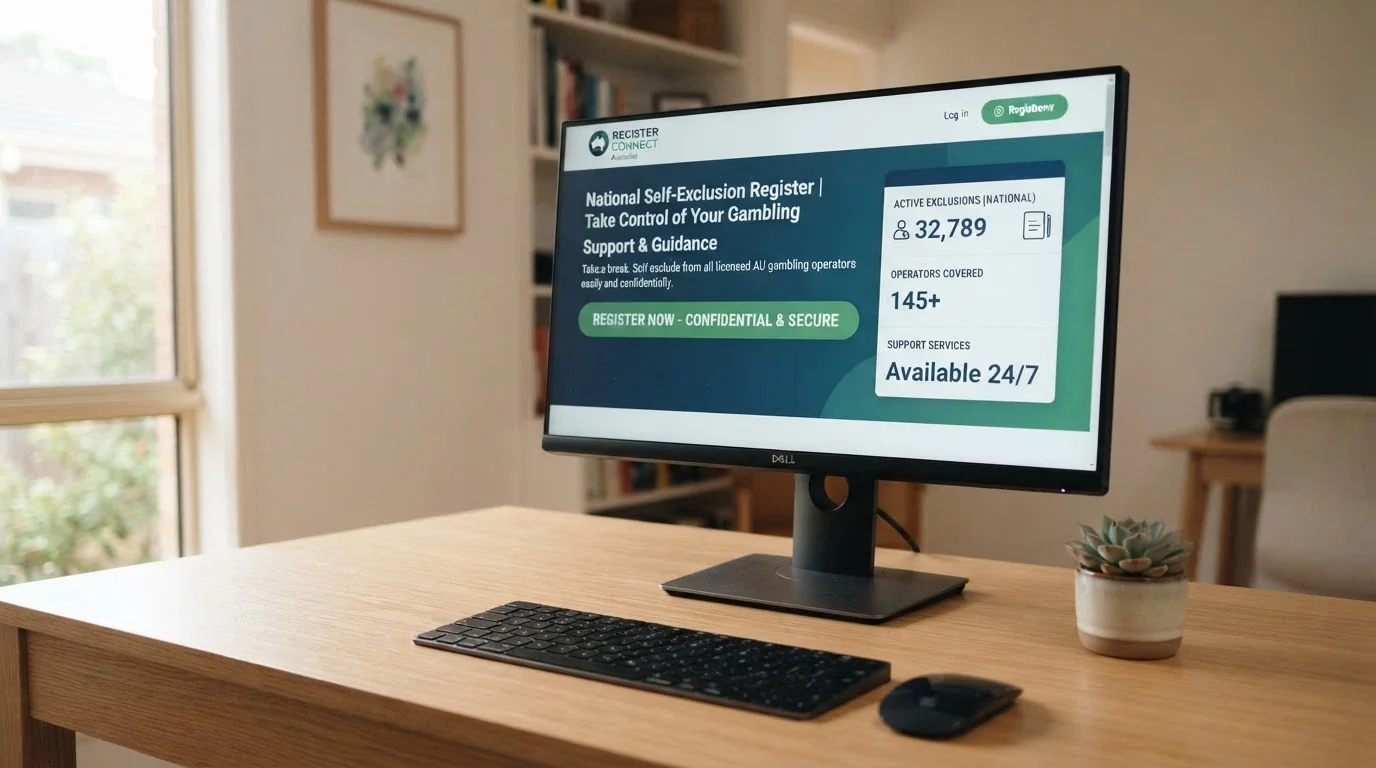
BetStop launched on 21 August 2023 as the National Self-Exclusion Register. One registration excludes a person from every licensed online and phone wagering provider in Australia. By 30 September 2025, 49,382 people had registered, with 31,838 active exclusions. By 1 December 2025 the cumulative figure had reached 53,308 registrations and 34,266 active exclusions. More than 50,000 Australians have used BetStop since launch; 78% of registrants were under 40, and 38% chose a lifetime exclusion. The outcome data is striking — 77% report a better overall quality of life, 79% report improved mental health, 69% report better personal relationships, and 96% have either stopped betting (81%) or decreased it (15%).
The gap is the part that matters for this page. BetStop binds approximately 150–190 licensed wagering providers in Australia. Offshore casinos are not connected to the register. A self-excluded Australian who wants to keep playing can still open an account at every brand in the ranking above, and BetStop does nothing to stop them. That is the most consequential limitation of the national self-exclusion system for the reader of this page, and it is worth stating plainly.
Gambling Harm in Australia: The Numbers and Where to Get Help
The prevalence data has shifted fast and not in a benign direction. Risky gambling in Australia increased from 13.7% in 2024 to 19.4% in 2025 — almost doubling since the COVID-19 lockdowns of 2020–2021. The problem-gambling share rose from 1.9% in 2022–23 to 2.4% in 2023–24 to 2.9% in 2024–25 on the PGSI measure. An estimated 3.29 million people aged 5+ in Australia are affected by gambling harm through their own gambling, another person’s gambling, or both. Approximately 1,970,000 adults are classified as at-risk or problem gamblers. Roy Morgan’s figure puts the combined problem-and-at-risk population at 3,492,000 Australians, or 16.2% of the adult population. Dr Gabriel Tillman of the Australian Gambling Research Centre puts the past-12-month harm figure at 15%, up from 11% in 2019.
The help that exists: the National Gambling Helpline is 1800 858 858, free, confidential, staffed 24/7. Online counselling is available through Gambling Help Online at gamblinghelponline.org.au, with live chat 24/7. Gambling Help Online also runs a self-test that takes a few minutes and gives an indication of where a person’s gambling sits on the PGSI scale. BetStop, for the licensed market, is at betstop.gov.au. None of these tools fixes an offshore gambling problem by themselves. They are the Australian framework that exists for readers who decide the offshore market is not the right one for them.
How We Selected and Ranked the Casinos in This Review
The ranking draws on three source categories: the ACMA register of licensed wagering providers (used to confirm what is not licensed in Australia), competitor-led withdrawal-speed testing from Betsquare and CardPlayer AU (used for the medians and worst-case figures in the payment-methods section), and operator terms pages (used for bonus terms, wagering multipliers, validity windows, game library scale and provider rosters). Each operator in the ranking was checked against the ACMA whitelist of licensed wagering providers to confirm the absence of an Australian licence; each operator’s offshore licence status was checked against the operator’s own published terms or footer where available.
The ranking criteria, in order of weight: withdrawal speed by payment method (the strongest predictive variable for the user’s stated need), bonus fairness (wagering multiplier, validity window, cashout cap), game library breadth and provider quality, and transparency of licence status. Where two operators tied on these criteria, the operator with the higher-quality provider roster ranked higher. Where research did not confirm a figure, the gap was carried into the profile rather than filled with an estimate — the gap is itself information about the operator’s transparency.
The limitations are real. Spot testing captures a window, not a guarantee. Operator terms pages change. Offshore licences can be revoked. The ACMA blocking pipeline can take a brand offline between this page’s publication and the next visit. The ranking is honest about what it can and cannot predict, and a reader using it should treat it as a starting filter rather than a final answer.
Offshore Casinos and Fast Payouts: What Australian Players Should Actually Do in 2026
The page has run its argument: there is no online casino licence in Australia, every brand in the ranking is offshore, the speed claims are real but the consumer protections are absent, and the 2027 reform package will give banks and payment providers new tools to block transactions without legalising the underlying product. That is the structure. What a player does with it is a personal decision.
For a player who proceeds despite the structure, three things reduce the cost of the choice. Complete KYC before the first withdrawal — the single biggest controllable variable in withdrawal delay. Choose the fastest method genuinely supported by the operator, which means crypto where the operator is crypto-native (BitStarz, Stake) and PayID only where the operator has confirmed a real PayID cashout path rather than a bank-transfer workaround. Understand that no Australian body will help if the operator refuses a withdrawal, voids a win under a bonus term or disappears behind an ISP block — and size deposits accordingly.
The reform horizon is the other thing to carry forward. From 1 January 2027, the deposit that lands today may not land tomorrow, and not because the casino has changed its terms. Banks will have new authority to block transactions to illegal operators, payment processors will be under pressure to refuse them, and the offshore operators’ tolerance for serving Australian customers through Australian banks will narrow. The fastest payout in 2026 may not be the fastest payout in 2026+1. The legal reality does not change; the friction around it does.
The honest framing of this market is simple: speed and protection are not the same deal. These offshore brands offer speed, often genuinely fast, but they do not offer Australian protections. For a player who understands the trade-offs, the data above is the guide to making an informed choice.
Frequently Asked Questions
Do fast payout casinos in Australia require ID verification before withdrawing?
Yes. Every offshore casino serving Australian players runs some form of KYC, and submitting ID, proof of address and payment-method ownership before the first withdrawal request is what clears the path. Incomplete KYC is the single most common cause of payout delays, ahead of approval time and network speed. Upload documents early.
What happens if an offshore casino blocks Australian players or refuses to pay out?
There is no Australian body to escalate to. The ACMA enforces against the operator, not the player, and consumer law does not reach an offshore platform. The Department of Infrastructure’s guidance is explicit: players using illegal services “run a high risk of losing their money” because services “sometimes refuse to return deposits or pay winnings.” BetStop does not cover offshore brands, so self-exclusion is also unavailable.
Can I deposit with a credit card at an Australian online casino?
Credit cards are banned as a deposit method for licensed online wagering in Australia from 11 June 2024 under the Interactive Gambling Amendment (Credit and Other Measures) Act 2023. The ban applies to licensed operators. Offshore casinos accepting credit-card deposits are operating outside Australian payment rules, in the same way they operate outside Australian casino rules. Debit cards are not subject to the ban.
How does crypto withdrawal speed compare to bank transfer at AU online casinos?
The gap is large. Crypto across coins settles in a tested median of 42 minutes with a worst case of 4 hours; USDT on TRC20 and Solana settle in under 5 minutes in CardPlayer AU’s testing. Bank transfer runs a median of 3 working days with a worst case of 7. Crypto is the genuine speed leader among common methods; bank transfer is the slowest common option.
Are offshore casinos safe for Australian players?
Offshore casinos are regulated by their own jurisdictions — typically Curaçao — and offer faster payouts than the licensed market can match on certain methods. They are not safe in the Australian sense: there is no ACMA complaints body, no Australian Consumer Law coverage, no BetStop connection, and a real risk of withdrawal refusal, balance loss during an ISP block, or win voiding under a bonus term. The reader is trading Australian protection for offshore speed.
What is the National Gambling Helpline number in Australia?
The National Gambling Helpline is 1800 858 858. It is free, confidential and staffed 24 hours a day, every day. Online counselling and live chat are available through Gambling Help Online at gamblinghelponline.org.au. BetStop, the National Self-Exclusion Register, is at betstop.gov.au. BetStop covers licensed wagering providers only; offshore casinos are not connected to it.