
Casinos That Accept Litecoin Australia: The Honest 2026 Guide for Australian Punters
Verified as of 29 October 2026 against the ACMA register and operator-owned terms pages.

Litecoin-accepting casinos promise Australian punters faster deposits, lower fees and the privacy of crypto-native banking. They also operate outside Australia’s licensing framework — every single one of them. That is the starting point for this guide, not a footnote at the bottom. The Interactive Gambling Act 2001 prohibits providing online casino games to anyone in Australia, and the June 2024 crypto payment ban makes the position even sharper: an Australian asked to deposit Litecoin is being served by an operator that does not answer to the Australian Communications and Media Authority. None of that makes the offshore route unusable. It does mean the reader has to know what they are buying and what they are not.
This page covers what an LTC casino actually is, how deposits and withdrawals move on the Litecoin network, which of the ten operators the featured set ranks the highest by Australian market share, what a typical welcome bonus really costs once the wagering requirement is paid out, and where the BetStop self-exclusion register leaves a hole the offshore route cannot close. The page does not recommend a brand. It lays out the numbers and the jurisdictional facts and lets the reader judge.
Table of Contents
- Why Australian Punters Are Turning to Litecoin Casinos in 2026
- The Crypto Trust Layer: Provably Fair, Anonymous and Outside the KYC Gate
- The Pokies, Blackjack and Live Dealer Tables LTC Casinos Actually Deliver
- Why Your 2026 Litecoin Casino Bonus Costs More Than It Looks
- The 10 Litecoin Casinos Australian Players Can Access in 2026
- From Wallet to Wager: How Fast Litecoin Casino Payouts Really Are
- LTC Casinos on Your Phone: Apps, Mobile Sites and What Actually Works
- New Litecoin Casinos Worth a Look in 2026
- Licensed Where? What the ACMA, the IGA and the Crypto Ban Mean for Your LTC Play
- Staying Safe When BetStop Cannot Reach: Responsible Gambling Offshore
- How We Evaluated These Litecoin Casinos
- What Australian Punters Should Actually Do About Litecoin Casinos in 2026
- Frequently Asked Questions
Why Australian Punters Are Turning to Litecoin Casinos in 2026
Litecoin has been producing a block roughly every 2.5 minutes since 2011 — four times Bitcoin’s pace — and the chain has not halted once in that time. Transaction fees sit below a US cent. For a punter who has tried to deposit with a credit card, watched a bank transfer bounce and waited three business days for a withdrawal to clear, the technical appeal is obvious: the money moves in minutes and the intermediary fees are nearly zero.
That technical appeal has produced a category of casino built around it. A quick look at the market shows affiliate listicles ranking offshore brands against each other on bonuses, payout speed and game count. No government page, regulator page or news-journalism outlet covers the topic for the punter. The reader is being served by an industry, not a public-interest source — and the page has to compensate for that.
The Australian-facing LTC casino landscape has grown in two waves. The first wave added Litecoin as one payment option among many at established fiat-first operators. The second wave built crypto-native platforms where the wallet, the balance and the wager all live on-chain until cashout. Both types are represented in this guide, and the difference matters more than the marketing lets on.
This page covers the mechanics, the costs, the operator set, the legal reality, and the responsible-gambling infrastructure a player can still reach when an offshore site connects to none of it. It does not cover token-price speculation, mining hardware, or anything off-topic from a casino-guide perspective.
What a Litecoin Casino Actually Is (and What It Is Not)
A Litecoin casino is an online gambling site that accepts LTC for deposits and pays withdrawals in LTC. At the technical level, this means the casino runs a wallet, generates a deposit address for each player session, watches the Litecoin network for incoming transactions and credits the player’s balance once enough block confirmations have passed. The player’s balance at the casino is then displayed in LTC, mLTC or a fiat equivalent the casino converts to on the fly.
What it is not is a decentralised gambling protocol. The games still run on the casino’s own servers; the bets still settle inside the casino’s database; the rules and the house edge are still set by the operator. The blockchain sits at the deposit and withdrawal boundaries — money in, money out — and not at the level of each individual spin or hand. The “blockchain casino” label is therefore closer to a payment-method description than a fairness guarantee.
The operational difference from a fiat casino is where the friction sits. A fiat casino moves money through banks and card networks, which means chargeback risk, slow settlement and Know Your Customer checks at the deposit stage. An LTC casino moves money through the Litecoin network, which means a 1-confirmation basic deposit clears in roughly 1 to 2.5 minutes, and a standard 3-confirmation deposit clears at around 7.5 minutes. Network fees are sub-cent. The player trades the institutional protections of the banking system for speed, lower cost and a different risk profile: no chargeback, no Section 313-style enforcement reach, no Australian consumer law.
That trade-off sits at the centre of every section that follows.
The Offshore Starting Point: What “Accessible to Australian Players” Really Means
No Litecoin casino holds an Australian licence. None can. The Interactive Gambling Act 2001, as strengthened by the Interactive Gambling Amendment Act 2017, prohibits providing online casino games to a person in Australia. There is no licence for online casino in any state or territory. The only wagering services Australia licenses — lotteries, keno, pre-event sports and race betting — are not what an LTC casino offers.
Since 11 June 2024 the position has been even harder to mistake. Credit cards, credit-related products and digital currency are banned as payment for online wagering under the Interactive Gambling Amendment (Credit and Other Measures) Act 2023, with penalties of up to A$247,500 for non-compliant operators. The ban is enforced against the operator, not the player, but its signal value is clear: any gambling site asking an Australian for a crypto deposit is, by definition, outside the rules the Australian government applies to anyone who wants to serve Australians.
The individual player is not prosecuted under the IGA. The Act targets the provider of the prohibited service. What the player does lose is the entire stack of protections that comes with operating inside Australian law — no Australian consumer protection, no BetStop coverage, no dispute resolution in an Australian court, no recourse if the operator refuses a withdrawal or closes the account. The full legal picture is laid out in the section on the IGA, the ACMA and the crypto ban.
The trade-off a punter accepts is the trade every offshore player accepts: speed and lower fees in exchange for zero local protection. Knowing what that trade actually costs is what this page is for.
The Crypto Trust Layer: Provably Fair, Anonymous and Outside the KYC Gate
Two trust mechanisms show up across almost every LTC casino affiliate page: provably fair verification and the promise of no-KYC play. Both are real, both carry weight, and both cover less than the marketing language suggests. When the operator answers to no Australian regulator, these markers are also doing more of the load than they would at a licensed venue.
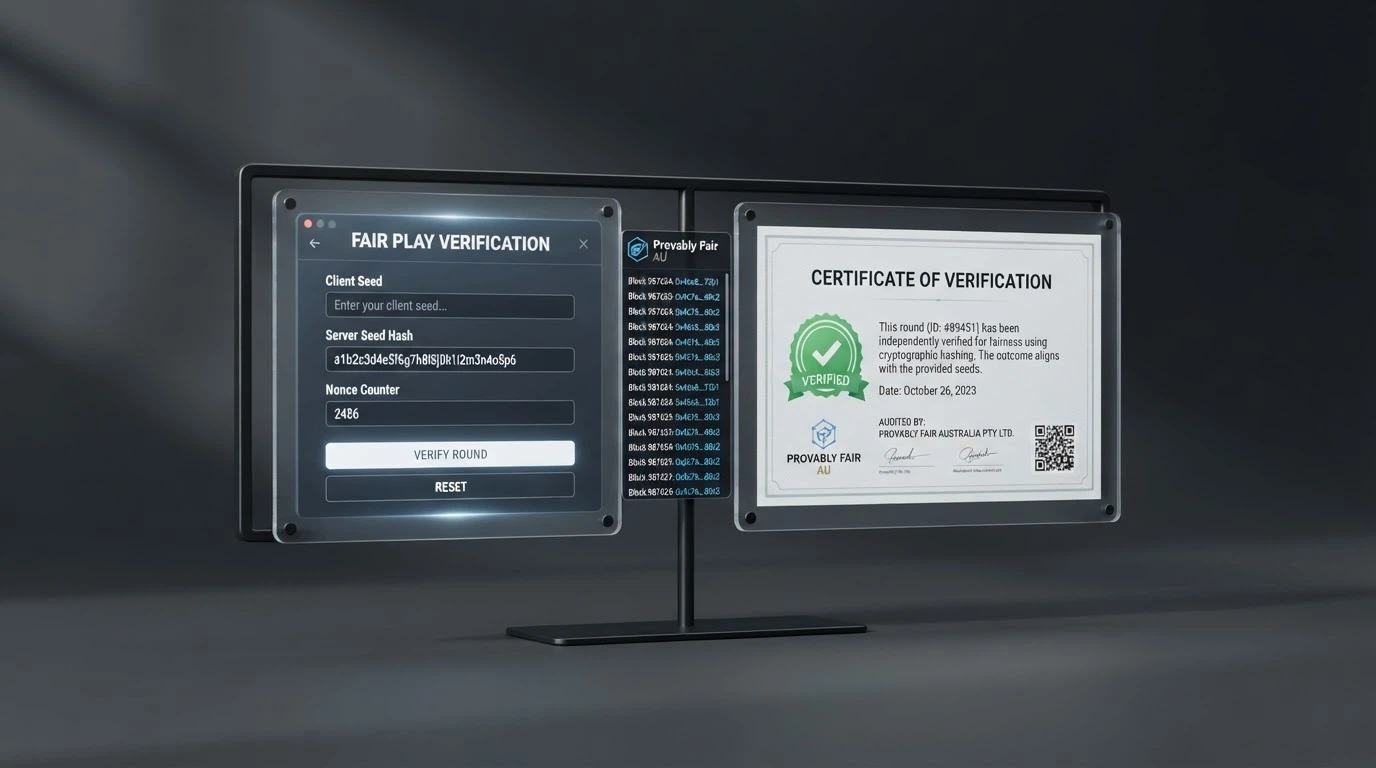
How Provably Fair Actually Works (and What It Does Not Prove)
Provably fair is a cryptographic method that lets a player verify, after each round, that the casino did not change the outcome after the bet was placed. The mechanism relies on three inputs: a client seed generated in the player’s browser, a server seed produced by the casino and revealed after the round, and a nonce that increments with each bet. The casino commits to the server seed in advance (a hashed version is visible to the player before betting), and the player can recompute the round’s outcome after the seed is revealed.
The guarantee it provides is narrow but real: given the three inputs, the outcome is deterministic. Neither side can shift the result after the fact. A player who actually verifies their rounds can prove the casino did not tamper with that specific game.
The guarantee it does not extend to is the size of the house edge. Provably fair does not lower the house edge from 5% to 1%; it does not certify that the stated RTP in a slot’s paytable matches the realised RTP; it does not tell the player whether the casino has enough cash on hand to pay a large withdrawal; and it does not stop the casino from refusing the withdrawal in the first place. A provably fair casino is still an offshore casino, and a provably fair round does not change the jurisdiction the player is operating in.
Across the LTC casino category, provably fair verification is a shared trust marker rather than a per-operator audited standard. The mathematical mechanism is the same wherever it appears; what varies is whether the operator actually lets the player inspect the inputs and recompute the round. A player who cares about this should look for the provably fair verification panel in the footer or game settings and check that the server seed is hashed before play and revealed after, with no way for the casino to swap it mid-session.
No-KYC Play: What Stays Private and What the Casino Still Knows
No-KYC, in the LTC casino context, usually means the casino does not require a passport, driver’s licence or utility bill at registration. An email address, a username and a password are enough to open an account, and an LTC deposit can be made without naming the wallet owner. That is a meaningful step beyond the document-checks-before-deposit model at a fiat-licensed casino.
What the casino still knows is more than the marketing suggests. The casino sees the wallet address that funded the account, the IP address the player connected from, the bet history, the device fingerprint, and the pattern of deposits and withdrawals. If a player connects from an Australian IP, that is metadata on file from the first session. If a player withdraws a five-figure sum in a single transaction, the casino’s anti-money-laundering rules can trigger an ask for source-of-funds documentation regardless of the “no-KYC” label.
The honest reading is that no-KYC at an offshore LTC casino means no upfront identity check at registration, not anonymity in any forensic sense. The trade-off the player is making is privacy against the loss of identity-verified dispute rights. If the casino refuses to pay a withdrawal, a no-KYC account has no verified identity to anchor a complaint to, no local regulator to escalate to, and no Australian ombudsman to file with. The privacy of the registration is the same privacy that disables every later protection.
Crypto-Native vs Hybrid: Why the Difference Matters When the Operator Answers to No Australian Regulator
Crypto-native casinos are built on the assumption that crypto is the only payment rail. Balances are denominated in LTC or another token, withdrawals flow back to the player’s wallet without a manual review, and there is no fiat on-ramp from a bank account. Hybrid casinos take a fiat-first architecture and bolt a crypto payment gateway onto it. Players can deposit and withdraw in LTC, but the operator’s internal systems — bonus calculations, KYC thresholds, customer support workflows — were designed around traditional banking rails.
The distinction matters for two reasons. First, the crypto-native casino is more likely to have genuinely sub-five-minute LTC withdrawals because its payout pipeline is automated end-to-end; the hybrid casino is more likely to add a manual processing delay at the cashier. Second, the crypto-native casino is more likely to honour the no-KYC pitch in practice, because its fraud model was not built around bank-grade identity verification.
The featured set on this page is predominantly hybrid rather than crypto-native, mirroring the wider Curaçao-licensed offshore category. The few crypto-native operators in the set — Stake is the clearest example — show up at the speed end of the payout ranking and at the looser end of the verification ranking. The choice is not “good vs bad”; it is a different risk profile, and a player should know which one they are walking into before they deposit.
The Pokies, Blackjack and Live Dealer Tables LTC Casinos Actually Deliver
LTC-accepting casinos tend to run larger game libraries than fiat casinos because the platform economics work differently. A Curaçao-licensed operator can integrate any number of studios from a single aggregator without an Australian-certified RNG audit, and several studios in the offshore supply chain are happy to integrate on those terms. The top of the featured set carries between 5,000 and over 16,900 titles from 50 to 80-plus providers, including Pragmatic Play, Evolution, NetEnt, Hacksaw Gaming, BGaming, NoLimit City, Play’n GO, Yggdrasil, Relax Gaming and Wazdan.
That volume comes with one substantive caveat: none of these titles is tested by an Australian-certified testing lab. The studios themselves carry independent certifications from laboratories like GLI, eCOGRA and iTech Labs, and the maths on individual games is generally sound. What is missing is the layer of country-specific auditing that would normally cross-check whether a game marketed in Australia performs as advertised. Offshore play accepts that gap.
The Pokies Catalogue: 5,000+ Titles and the RTP Figures That Matter
Pokies make up the bulk of an LTC casino’s library, and the volume is not a marketing trick. The aggregator model really does let the operator stock thousands of titles without curating each one. Across the category, slot RTPs sit in a 94% to 97% band, with an industry average somewhere between 94% and 95%. That three-point spread is the difference between a slot that returns 94 cents for every dollar wagered and one that returns 97 cents, and over a long session the spread is the difference between a moderate loss and a slow one.

The table below shows eleven high-profile pokies with the RTP and volatility research carries for each title. Where research did not state a volatility figure, the cell takes the no-data marker — a player should not infer a volatility class from a single missing data point.
| Slot | Provider | RTP | Volatility |
|---|---|---|---|
| Gates of Olympus | Pragmatic Play | 96.50% | High |
| Sweet Bonanza | Pragmatic Play | 96.51% | High |
| Big Bass Bonanza | Pragmatic Play | 96.71% | High |
| Starburst | NetEnt | 96.09% | Low |
| Book of Dead | Play’n GO | 96.21% | High |
| Wanted Dead or a Wild | Hacksaw Gaming | 96.38% | Very High |
| San Quentin xWays | Nolimit City | 96.03% | Extreme |
| Wolf Gold | Pragmatic Play | 96.01% | Medium |
| Elvis Frog in Vegas | BGaming | 96.00% | Medium–High |
| Dead or Alive | NetEnt | 95.03% | — |
| Age of Asgard | Yggdrasil | 96.20% | — |
The pattern in the table is what a serious punter should look at, not any individual row. Pragmatic Play dominates the high-profile end with four of the eleven titles and a consistent 96%-plus RTP. NetEnt’s Starburst sits at the low-volatility end of the band, which is what the title has been known for since its 2013 release; Dead or Alive, the same studio’s older high-volatility hit, comes in lower on RTP than the table average. Hacksaw and Nolimit City crowd the very-high and extreme volatility end — those are slots where a session can produce long stretches of small returns punctuated by a single large multiplier hit. Big Bass Bonanza tops the RTP column at 96.71%, which is not far above the band average but is the highest figure the table records.
A high-RTP slot does not make a winning strategy. It compresses the house edge from 6% to 3%, which over a long session means a player loses less per dollar wagered — not that the player wins. Volatility controls the shape of the loss: low-volatility slots produce small frequent wins, high-volatility slots produce rare large ones, and extreme-volatility slots can eat a bankroll before they pay anything.
Table Games: Blackjack, Roulette and the Games with a House Edge You Can See
Table games at LTC casinos come from the same supplier list as the pokies — Pragmatic Play and Evolution both run RNG table games alongside their slots and live-dealer studios. The titles available mirror the European and US classics: blackjack, European roulette, American roulette, baccarat, craps, and a long tail of single-deck and multi-hand variants. The headline difference from a slot is structural. A slot’s RTP is set by a paytable and verified across millions of spins. A table game’s RTP is set by its rules, and the rules are visible to the player before a single hand is dealt.
European roulette with a single zero returns 97.3% to the player across every spin. American roulette with the double zero returns 94.74%. The gap between the two is the entire house edge, sitting on a single extra pocket on the wheel. Blackjack, played with basic strategy on a standard 6-deck shoe, returns above 99% — close enough to even money that the house is running on volume, not margin. Baccarat on the banker bet sits at 98.94%. Craps on the pass line with odds returns above 99%.
The point for an LTC casino player is that table games make the cost of play legible. A punter who plays European roulette is paying 2.7% per spin and can see the rule that produces that number. A punter who plays a 96% RTP slot is paying 4% per spin, but the 4% hides behind tumbling reels and bonus features and free-spin retriggers. Both are losing bets in expectation, but one of them lets the player check the maths with a glance at the table layout.
Live Dealer: Real Studios, Real Croupiers and the Same Offshore Caveat
Live-dealer tables at LTC casinos stream from professional studios run by Evolution and Pragmatic Play Live, with smaller studios filling the gap. Real croupiers deal real cards and spin real wheels; the player places bets on a digital interface that updates as the round progresses. The technology has matured to the point where the live-dealer experience is the closest thing in offshore play to the energy of a physical casino floor.
The minimum-stake band on live-dealer tables is lower than most players expect. Roulette and blackjack tables routinely open at sub-A$1 minimums, which makes live-dealer play accessible to bankrolls that would be shut out of a real venue. Baccarat and game-show titles sit at slightly higher minimums. The exact figure varies by operator and table, and the player should check the table limits in the live lobby before sitting down.
The jurisdictional caveat applies in full. The studio the croupier is in is licensed under the studio’s home jurisdiction — typically Malta, the UK or a small number of European hubs — and the casino streaming the studio is licensed under its own. Neither licence is Australian. The studio’s certification covers the integrity of the equipment and the round procedure; the casino’s licence covers the financial relationship with the player. The fact that a real person is spinning a real wheel does not change the offshore position the player is operating from.
Why Your 2026 Litecoin Casino Bonus Costs More Than It Looks
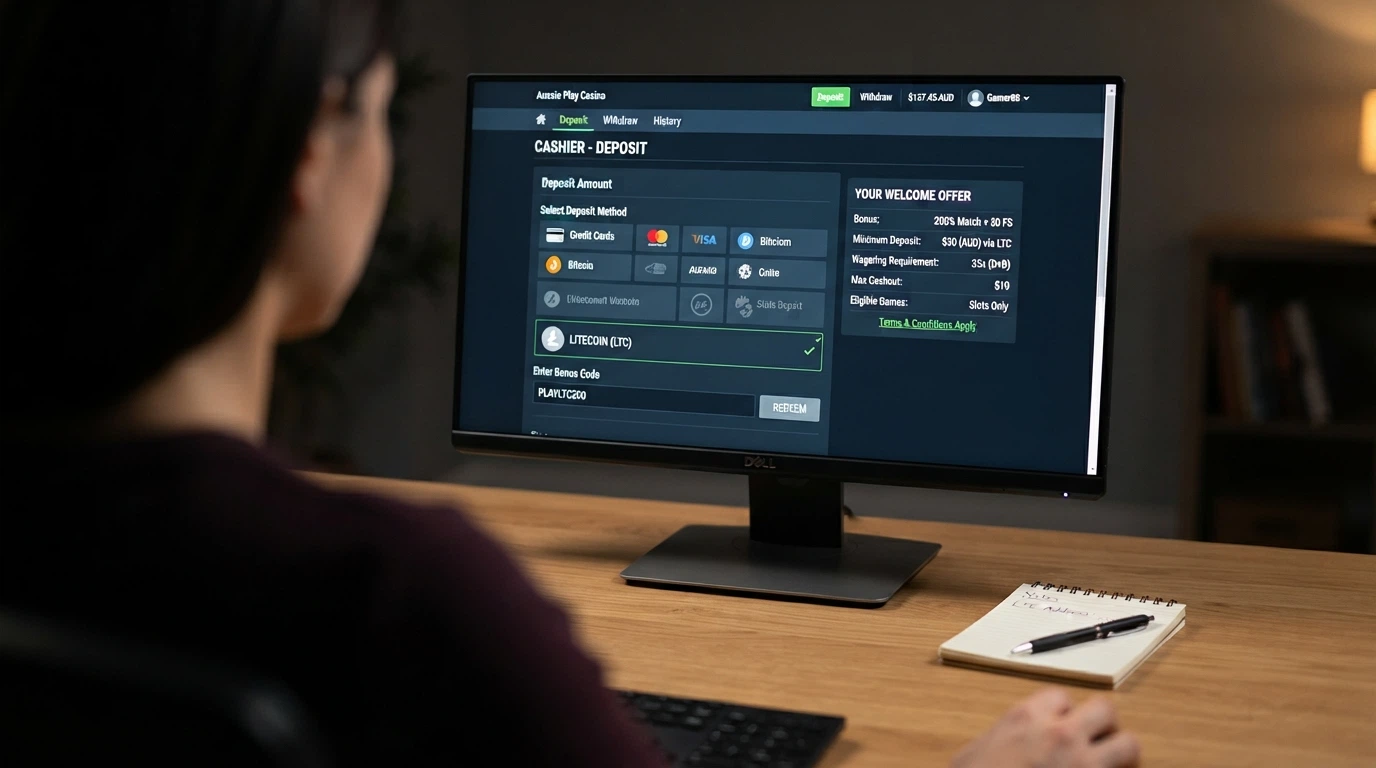
A welcome bonus looks like free money until the wagering requirement is applied to it. The structure is consistent across the offshore LTC casino category: a matched-deposit percentage, a cap, a wagering multiple, a validity window, and often a max-cashout limit. Each of those terms costs the player something. A 200% match at 40× wagering can cost more than a 100% match at 30×, because the wagering multiple is applied to the deposit-plus-bonus balance, not to the bonus alone, and the larger the base the more turnover the player has to produce.
This section runs the arithmetic on one worked example and then sets out the welcome offers research confirmed at eight operators. The conclusion the calculation supports is about the bonus’s real cost in expected terms — not about whether the bonus is worth claiming, which depends on the player’s bankroll, their session length and the variance profile they prefer.
The Welcome Bonus Table: What Eight LTC Casinos Actually Put on the Table
The table below covers the eight welcome offers research confirmed terms for. The min-deposit column is the threshold below which the bonus does not trigger; the wagering column is the multiple applied to deposit-plus-bonus unless the table notes otherwise.
| Casino | Welcome Offer | Wagering | Free Spins | Min. Deposit |
|---|---|---|---|---|
| Lucky Block | 200% up to A$10,000 | 35× | 50 | A$1 |
| Mega Dice | 200% up to 1 BTC | 35× | Yes (count not specified) | A$30 |
| Wild.io | 350% + FS | 40× | Yes (count not specified) | A$30 |
| Vave | 100% up to 1 BTC (or 1.5 BTC + 150 FS) | 40× | 150 (top tier) | A$30 |
| BitStarz | Up to 5 BTC / A$10,000 + 180 FS across 4 deposits | 40× | 180 | A$20 |
| Fair Go | 100% up to A$200 × 5 deposits (A$1,000 total) | 30× (deposit + bonus) | — | A$20 |
| StoneVegas | 100% up to $500 + 200 FS | 35× (deposit + bonus) | 200 | $10 |
| PlayCroco | 200% up to A$5,000 | 30× (deposit + bonus) | — | $20 |
Reading the table from the headline match down produces the right sense of where the cost hides. A 350% match is the largest headline percentage in the set; a 40× wagering multiple is the highest. Combined, they tell the player almost nothing — a 350% bonus at 40× is heavier on turnover than a 100% bonus at 30× because the base on which wagering is calculated is larger. StoneVegas and Fair Go both apply the wagering multiple to deposit-plus-bonus rather than bonus-only, which roughly doubles the turnover requirement compared to a bonus-only structure. BitStarz and Vave spread their offer across multiple deposits, which lowers the per-deposit headline but stretches the total commitment.
The numbers on a single row do not decide whether the offer is good. The comparison with the rest of the row — and with the bonus terms that research did not confirm at every operator, which are visible in the table as missing cells — is what gives a player the basis for a judgement.
No-Deposit Bonuses and Free Spins: What the Search Results Ask About vs What Research Found
Interest in LTC casinos runs heavily toward no-deposit bonuses and free spins. These refinements appear frequently in affiliate coverage. The reality research confirmed is thinner: no checked operator in the featured set currently offers a verified no-deposit bonus. Free-spin bundles do exist, and research confirmed them at Lucky Block (50), Vave (150 on the top tier) and StoneVegas (200), plus BitStarz (180 across four deposits) — but these operators sit outside the featured ten, which means a player reading this page for the ranked list should not expect a no-deposit path at any of the operators ranked here.
The free-spin offers that did verify come with the same wagering structure as the matched-deposit offers. Free-spin winnings are usually credited as bonus money and carry their own playthrough before they convert to withdrawable cash. A player who picks an operator specifically for the free-spin count should check the wagering multiple on spin winnings before the deposit is made, because a 40× spin-winnings playthrough turns 50 free spins into a long grinding session before any cash lands.
The honest summary is that the search pool’s appetite for no-deposit bonuses runs ahead of what the verified offshore market currently delivers at the operators featured here. That mismatch is itself information.
Wagering Requirements: The Number That Decides Whether a Bonus Is Worth Claiming
A wagering requirement is the turnover the player has to produce before a bonus converts to withdrawable cash. A 30× requirement on deposit-plus-bonus means the player wagers 30 times the combined deposit-and-bonus figure. A A$200 deposit with a 100% match produces a A$400 balance and a A$12,000 turnover requirement; a A$2,500 deposit with a 200% match produces a A$7,500 balance and a A$225,000 turnover requirement. The ratio of bonus money to required turnover is what makes the headline figure misleading.
The worked example for this section uses Fair Go’s A$200 first-deposit offer: a A$200 deposit + A$200 bonus = A$400 balance × 30× wagering = A$12,000 in required turnover. At the industry-average slot RTP of 94–95%, the expected loss on that turnover is A$12,000 × (1 − 0.945) = roughly A$660 across the clearing window, sitting between A$600 at the 95% midpoint and A$720 at the 94% floor.
That figure is the bonus’s real cost in expectation, assuming only the bonus amount is wagered. The player who takes the bonus and clears it will, on average, walk away with about A$340 in profit on the A$400 starting bonus balance after the A$660 expected house edge has been paid — but only if the player has the bankroll and the time to complete the full A$12,000 turnover. A session that runs out of bankroll before the turnover clears leaves the player with whatever is left in the bonus balance and nothing to withdraw. The house edge compounds across every spin of the A$12,000, which is why a smaller bonus with a lower wagering multiple is usually a better starting point than a larger bonus with a heavier one.
The PlayCroco example takes the same arithmetic further up the deposit ladder. A A$2,500 deposit with a 200% match yields a A$7,500 balance × 30× wagering = A$225,000 required turnover. At the same RTP, the expected loss is roughly A$12,400 across the clearing window, which is the largest single session of bankroll exposure the table produces. The headline figure — “200% up to A$5,000” — looks generous; the wagering multiple makes the bonus four times as expensive to clear as the headline suggests.
The conclusion this arithmetic supports is straightforward: the wagering multiple and the matched-deposit base together decide the cost, and the headline percentage alone is a marketing figure. A player comparing two offers should run the deposit-plus-bonus figure through the multiple before the headline percentage has any weight.
The 10 Litecoin Casinos Australian Players Can Access in 2026
The table below ranks the ten featured operators by AU market share where that figure is available, with the Curaçao licence jurisdiction carried for each. Stake has the most distinctive profile in the set and is not assigned a market-share figure; the remaining nine are ranked by the share of Australian-facing traffic they capture.

| Casino | Licence Jurisdiction | AU Market Share |
|---|---|---|
| Stake | Curaçao | — |
| Rocket Play | Curaçao | 9.4% |
| Skycrown | Curaçao | 8.55% |
| Royal Reels | Curaçao | 2.51% |
| WinSpirit | Curaçao | 1.55% |
| Rainbet | Curaçao | 1.28% |
| Scream Casino | Curaçao | 0.99% |
| FairGO | Curaçao | 0.8% |
| Bizzo Casino | Curaçao | 0.57% |
| Rocket Casino | Curaçao | 0.57% |
Every operator in the featured set holds a Curaçao licence — none carries an Australian one, because none can. Stake’s licence status is recorded as not verified from the operator’s own site this run; the remaining nine are stated as typical for the offshore AU-facing category based on the pattern the ACMA enforcement reports and competing affiliate pages show, not confirmed individually. A player who cares about licence specifics should check the Curaçao Gaming Control Board’s public register before depositing.
The market-share figures measure the share of Australian-facing traffic that reaches each operator, not the share of Australian players who use them. A 9.4% figure means nine out of every hundred Australian visits to LTC casino sites land at Rocket Play; it does not mean 9.4% of Australian LTC players are Rocket Play customers. The gap matters when a player reads the table as a recommendation.
Stake — The Crypto-Native Giant with Near-Instant LTC Payouts
Stake is the clearest crypto-native casino in the featured set. Its architecture is built around LTC and BTC balances from the ground up, which is what produces the sub-five-minute withdrawal figures research confirmed — Stake averages two minutes of casino-side processing plus another two to five minutes of Litecoin network confirmation time. The provider mix pulls in Pragmatic Play, Evolution, Hacksaw Gaming and NoLimit City, which gives Stake a serious live-dealer floor and a deep high-volatility pokies catalogue.
The licence is Curaçao, the same as every other operator on this page, but the licence status was not verified from Stake’s own site this run. A player should not take the jurisdiction as settled until they have checked the Curaçao Gaming Control Board’s register against the operator’s stated licence number. The crypto-native architecture is genuine and visible in the cashier flow; the jurisdictional paperwork is the part that needs the reader’s own eyes.
For an Australian punter who values payout speed above game-library breadth, Stake is the strongest fit in the featured set. The cost is the standard offshore cost: no Australian regulator, no BetStop coverage, no Section 313 enforcement reach if a withdrawal is refused.
Rocket Play — The Market Leader for Australian LTC Players
Rocket Play takes 9.4% of Australian-facing LTC casino traffic, the largest slice in the featured set. The figure comes from the operator-skill measurement and should be read as a traffic-share signal rather than a player-share signal. A brand that captures the most visits has the most brand familiarity in the market, which usually correlates with how long it has been operating and how aggressively it has advertised to Australian search terms.
Curaçao-licensed like the rest of the set, Rocket Play sits in the typical offshore-AU-facing category. The market-share lead tells the reader Rocket Play has been visible; it does not tell them the bonus is worth claiming. Player reports suggest checking the operator’s site directly for the current welcome offer and wagering multiple.
For an Australian punter who wants the most-visited brand in the category, Rocket Play is the obvious starting point. The trade-off is the same as every other operator here — offshore means no Australian protection.
Skycrown — A Close Second in the Australian LTC Casino Race
Skycrown’s 8.55% AU market share puts it less than a percentage point behind Rocket Play. The two operators occupy the same tier of the market and run similar Curaçao-licensed offshore models. For a player who is choosing between them, the question is which one offers the better welcome package and which one has a payment flow they prefer. Player due diligence is advised here, as specific terms were not retrieved from operator sources this time.
The gap to Rocket Play is small enough that a player should not assume one is materially better than the other on traffic-share grounds alone. Where Skycrown will pull ahead is on specific terms — a wagering multiple that is 5× lower, a free-spin count that is 50 higher, a withdrawal time the player can verify from recent player reports. None of that is visible from the market-share column.
Skycrown is a fit for a player who has decided the offshore route is worth taking and wants one of the two largest AU-facing brands. The standard offshore caveats apply in full.
Royal Reels — A Familiar Name with a Modest Slice of the Market
Royal Reels holds 2.51% of the AU market in the featured set, a smaller footprint than the top two but a real one. The brand is familiar enough to Australian search traffic that a player will see it appear in multiple affiliate listicles, which is itself a marketing signal worth reading: a brand that affiliate pages recommend by name is one that converts clicks at the affiliate level, not necessarily one that retains players.
The Curaçao licence is typical for the category. A player who lands on Royal Reels via an affiliate link should treat the landing page as a sales pitch and check the wagering terms, withdrawal minimums and bonus expiry window before depositing. Exact bonus and provider details were not verified for this update.
Royal Reels is a reasonable second-choice option behind Rocket Play and Skycrown for an Australian punter shopping around. The share of the market is real, and so are the offshore trade-offs.
FairGO — The RTG Specialist with a Five-Deposit Welcome Package
FairGO is the one operator in the featured set where research confirmed the bonus terms from a Casipto review page. The welcome offer is a 100% match up to A$200 on each of the first five deposits, totalling A$1,000 in matched bonus money, with 30× wagering applied to deposit-plus-bonus. The provider focus is RealTime Gaming, which is narrower than the multi-studio aggregators the larger operators use but which produces a coherent, long-running game catalogue Australian players recognise.
The 0.8% AU market share is the smallest in the tier of operators with confirmed terms, and the Curaçao licence is stated as typical for the offshore AU-facing category. The five-deposit structure spreads the A$1,000 bonus across the player’s first week on the site, which lowers the per-deposit headline but extends the time commitment across five separate turnover clearances. A player who clears all five deposits is committing to roughly A$60,000 in total turnover at 30× wagering on the deposit-plus-bonus base.
FairGO is the right fit for a player who values RealTime Gaming’s catalogue and a transparent, multi-deposit welcome structure over the larger headline match percentages elsewhere in the set. The offshore position is the same as every other operator here.
Bizzo Casino — A Smaller Player with a Growing Australian Following
Bizzo sits at 0.57% of the AU market, the same share as Rocket Casino at the bottom of the featured set. The operator’s bonus terms and game-provider list were not accessible for review this time, so the only verified signal is the traffic share itself. A player landing on Bizzo via an affiliate link is being served a brand that captures roughly one in 175 Australian LTC casino visits — modest, but not nothing.
The Curaçao licence is typical for the offshore AU-facing category. A player who wants to use Bizzo should verify the welcome package, the wagering multiple and the withdrawal minimums on the operator’s current site before depositing. The traffic-share figure is not a quality signal on its own; it is a measure of how visible the brand has been in the Australian search market.
Bizzo is a reasonable option for a player who has already decided the offshore route is the trade they want to make and is working through the smaller operators in the set. The position in the ranking is a marketing indicator, not an endorsement.
WinSpirit — Mid-Tier Volume with a Steady Australian Base
WinSpirit holds 1.55% of the AU market — solid mid-tier positioning, well below Rocket Play and Skycrown but comfortably above the smallest operators in the set. Like most of its peers, it holds a Curaçao licence. Bonus terms, free-spin counts and game-provider lists were not retrieved from operator sources for this guide.
For a player comparing options, WinSpirit sits in the bracket of operators that have a real Australian traffic base but are not the headline brands of the market. The standard offshore caveats apply in full: no Australian regulator, no BetStop coverage, no Section 313 enforcement reach if a withdrawal is refused.
WinSpirit is a fit for a player who wants a brand with a stable Australian presence rather than the top-of-market name. The trade-off is unchanged.
Rainbet — A Compact Option in the Offshore LTC Set
Rainbet captures 1.28% of the Australian LTC casino traffic in the featured set, placing it in the lower mid-tier. It operates under a standard offshore Curaçao licence. Specific operator details were not verified from internal site sources for this article, meaning the traffic-share figure is the primary signal available to the reader.
A player choosing Rainbet is choosing a brand with a smaller footprint than the top two and a presence on affiliate pages. The marketing slot the operator occupies is a mid-tier LTC casino serving the Australian offshore market — not the headline brand, not a niche specialist, somewhere in between.
Rainbet is a fit for a player who has decided the offshore trade is worth it and is looking for an operator below the top-tier names. The position in the ranking is the verifiable signal.
Scream Casino — A Niche Entry with a Loyal Pocket of Players
Scream Casino holds 0.99% of the AU market in the featured set, just under the 1% line. It is another Curaçao-licensed offshore entity. Comprehensive bonus terms and provider lists for the operator were not available for this run.
The traffic-share figure suggests Scream has carved out a small but persistent slot in the Australian-facing market — a niche entry with a loyal pocket of players rather than a broad-appeal operator. A player landing on Scream is probably doing so via a search result rather than a brand-name recall, which is consistent with the share it holds.
Scream Casino is a fit for a player who has already shortlisted the offshore route and is willing to look beyond the top-tier names. The standard offshore caveats apply in full.
Rocket Casino — Smallest of the Reviewed Set, Same Curaçao Roots
Rocket Casino’s 0.57% AU market share ties it for the smallest slice in the featured set, alongside Bizzo. It shares the same Curaçao licence roots as the rest of the offshore cohort. Operator bonus and provider data were not accessible for this update. The overlap with Bizzo at the bottom of the table is the most obvious signal — two operators with identical share, both offshore Curaçao-licensed, both carrying the standard trade-off.
A player choosing between Rocket Casino and Bizzo is choosing between two operators at the same tier on traffic-share grounds. The deciding factor will be the welcome package, the wagering multiple, the game-provider mix or the withdrawal experience — and those specifics are not on this page.
Rocket Casino is a fit for a player who has decided to walk through the entire featured set before deciding. The position in the ranking is the verifiable signal; the rest is on the operator’s site.
From Wallet to Wager: How Fast Litecoin Casino Payouts Really Are
The end-to-end LTC payment flow has three legs: the casino’s automated processing, the network confirmation chain, and the player’s wallet software displaying the inbound transaction. The casino’s marketing tends to describe the first leg only, because that is the part the operator controls. The network confirmation chain is the same regardless of which casino the player uses, and the player’s wallet is a separate variable.
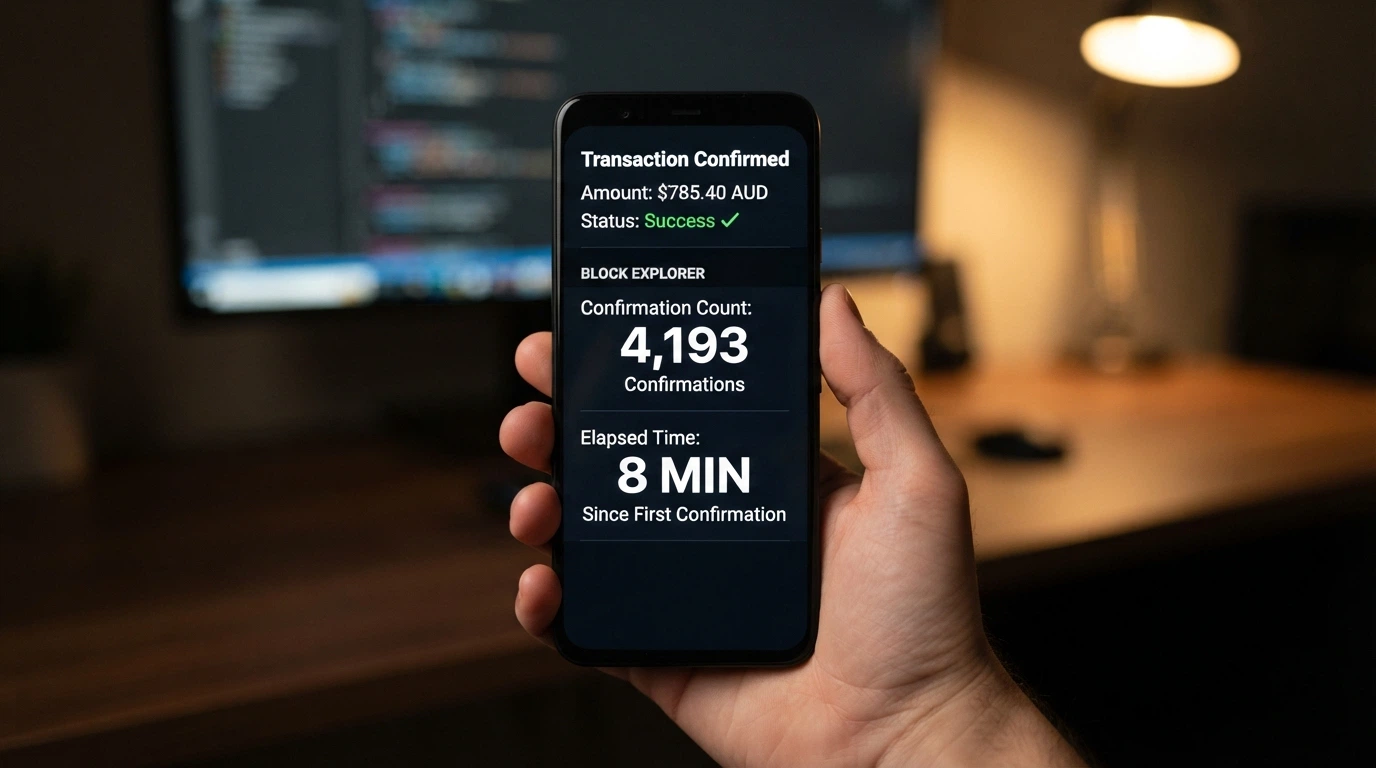
A Litecoin block arrives roughly every 2.5 minutes. The chain has not halted since 2011. For deposits, one confirmation clears in 1 to 2.5 minutes at basic security, three confirmations in roughly 7.5 minutes at standard security. Network fees are sub-cent. For withdrawals, the casino typically requires 3 to 6 confirmations, which means network confirmation time of 7.5 to 15 minutes beyond whatever the casino’s own processing takes. The casino-side processing is the only leg the operator can compress.
What the Fastest LTC Withdrawal Times Actually Look Like, Operator by Operator
Stake averages two minutes of automated processing plus another two to five minutes of network confirmation time — the fastest end-to-end figure research confirmed, at roughly four to seven minutes for a fully cleared withdrawal. BC.Game runs one to three minutes of automated processing with the same network confirmation overhead. Cloudbet processes instantly for accounts that have already cleared verification. The common pattern is that the casino’s own queue adds minutes, not hours, and the network confirmation chain adds another fixed block of time on top.
A 40× wagering requirement takes longer to clear than the withdrawal itself, which is a useful frame for what “fast” actually means. The fastest LTC casino in the set will deliver a withdrawal in under five minutes after the player requests it; clearing the bonus turnover to get to that withdrawal point can take hours of play at standard slot RTPs. Speed on the payout side does not compensate for time spent on the wagering side.
The marketing phrase “instant withdrawal” describes the casino’s processing leg, not the full end-to-end timing. A realistic total withdrawal time at a fast LTC casino is eight to ten minutes for a clean request with no manual review — two to three minutes of casino processing plus the network confirmation chain. The player should plan around the full figure, not the marketing number.
LTC Casinos on Your Phone: Apps, Mobile Sites and What Actually Works
Dedicated mobile apps are rare across the LTC-accepting casino category. Most operators run a mobile-optimised browser site that adapts the desktop layout to a phone screen, with HTML5 game containers that load pokies and live-dealer tables without requiring a native download. The lack of an app is not a quality signal either way — a Curaçao-licensed offshore casino sitting on the Apple App Store is a different operator from one that ships a PWA-style mobile site.
The practical differences between mobile and desktop play are smaller than most players expect. The game library is largely the same: HTML5 pokies and RNG table games run in the phone browser with the same paytables as the desktop version, and live-dealer tables stream to a mobile display with controls sized for touch input. The cashier flow is comparable, with the LTC deposit address generated from the mobile browser session and the QR code scannable from the player’s wallet app on the same device.
What changes on mobile is the live-dealer table sizing and the session-length ergonomics. A live roulette table laid out for a desktop monitor compresses to fit a phone screen, which makes bet placement slower on smaller displays. A long session on a phone is also harder on the player physically than a desktop session of the same length, which matters for a bonus-clearance grind that runs into hours of play.
Mobile Play vs Desktop: What Changes When You Wager LTC on a Phone
Game-count parity is the standard across the featured set. The mobile and desktop versions of an LTC casino share the same backend, so the library is the same and the bets are the same. What the mobile version changes is the deposit UX: scanning a QR code from a phone wallet app on the same device is faster than copying and pasting a deposit address on a desktop, which makes mobile the more convenient choice for an LTC deposit in particular.
The live-dealer experience on mobile is the one place the trade-off is visible. Live-dealer tables are designed for landscape viewing, and a phone in portrait mode shows a small playing field with side panels that scroll. The croupier is visible, the bets place correctly and the round resolves in real time, but the player is working harder to read the interface than they would on a desktop monitor. For an Australian punter who plays live roulette or live blackjack as their main game, a tablet or desktop is the more comfortable choice; for an LTC punter who plays pokies and only drops into a live table occasionally, mobile is fine.
Native apps, where they exist in the offshore category, tend to add little over the mobile browser site beyond a faster initial load. The marketing case for a native app is usually weaker than the marketing case for the same operator’s welcome bonus, which is why most operators have stopped building them.
New Litecoin Casinos Worth a Look in 2026
A “new” LTC casino is one that has launched in the past 12 to 24 months. The category’s churn is high: a brand that is new this month may be rebranded or shut down by next year, and a brand that has been around for five years has usually survived at least one enforcement cycle from the ACMA. The risk profile of a new operator is therefore inverse to its marketing: the freshest welcome bonus often comes with the thinnest track record.
The featured set on this page is weighted toward established operators, not because new ones lack value but because research could not confirm terms, licences or payout performance for brand-new entrants. The pool signals Australian interest in new LTC casinos, and that interest is rational — new operators compete harder on welcome bonuses to build a player base — but the interest has to be paired with more due diligence than an established brand demands.
What to Check Before You Deposit at a Brand-New LTC Casino
Four things matter when a player is sizing up a brand-new LTC casino. First, the licence register. The Curaçao Gaming Control Board publishes a public register of licence holders; an operator that claims a Curaçao licence should be findable on that register with a live status. A licence number that does not resolve is the clearest single red flag.
Second, the withdrawal terms. A new operator that is tight on withdrawals — high minimums, slow manual reviews, max-cashout caps that contradict the bonus terms — is signalling that the marketing is doing more work than the cashier. The withdrawal page should be checked before the deposit is made, not after.
Third, the provider list. A new casino that integrates Pragmatic Play, Evolution and NetEnt through a recognised aggregator is shipping a real game catalogue. A new casino that lists only proprietary or unknown studios is shipping a thin one. The provider names on the game lobby footer are the easiest single check.
Fourth, community reputation. Player forums and recent complaint threads will surface withdrawal delays and account closures faster than any review page. A new brand with no community footprint is not necessarily bad, but it is unverified, and the player should treat unverified as the default until the community has had time to weigh in.
The framework above is the same regardless of whether the operator is brand-new or ten years old. The difference is that an established brand has had time to be tested; a new one has not, and the deposit that proves the brand is the deposit the player has to be willing to lose.
Licensed Where? What the ACMA, the IGA and the Crypto Ban Mean for Your LTC Play
The Australian legal framework for LTC casino play has three parts. The Interactive Gambling Act 2001 prohibits the supply of online casino games to Australians. The Interactive Gambling Amendment (Credit and Other Measures) Act 2023, in force since 11 June 2024, bans credit cards and digital currency as payment methods for online wagering. The Australian Communications and Media Authority enforces both, with the power to request ISP-level blocking under section 313 of the Telecommunications Act 1997.
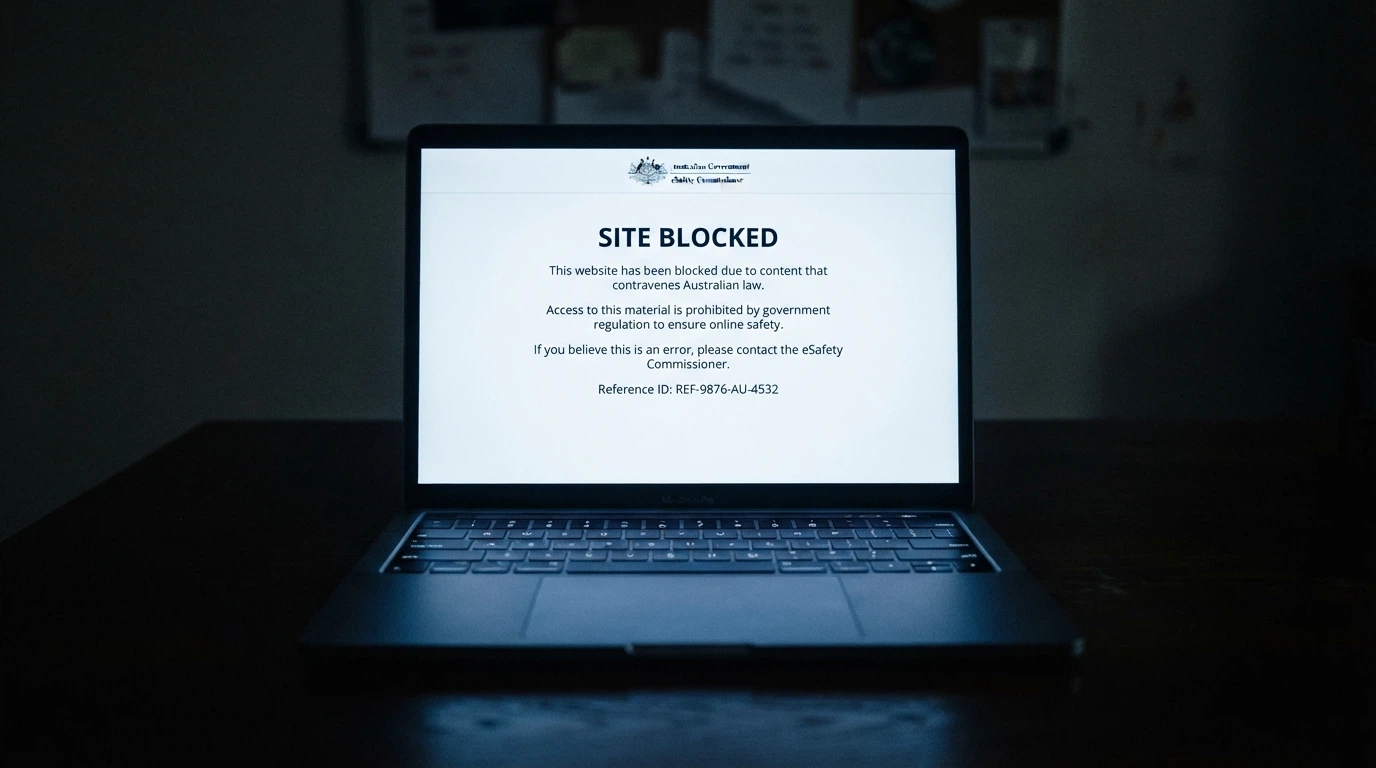
The IGA targets the provider of the prohibited service, not the individual player. An Australian punter using an offshore LTC casino is not committing an offence under the IGA itself. What the player loses is the entire protective architecture that comes with operating inside Australian law — no Australian consumer protection, no BetStop coverage, no dispute resolution in an Australian court, no recourse if the operator refuses a withdrawal or closes the account. The ACMA cannot help recover funds. The site can be blocked at any time, with a balance still on it.
The Interactive Gambling Act: What It Actually Prohibits and What It Does Not
The Interactive Gambling Act 2001, strengthened by the Interactive Gambling Amendment Act 2017, prohibits the provision of online casino games, online pokies and in-play sports betting to a person in Australia. There is no licence for online casino anywhere in the country — not federally, not in any state or territory. The only wagering services Australia licenses are lotteries, keno, and pre-event sports and race betting.
The IGA targets the provider. An individual player is not prosecuted under the Act. That does not make the offshore route safe. It makes it outside the Australian framework, which means the framework’s protections — consumer law, dispute resolution, payment-ban enforcement, BetStop coverage — do not reach the player.
The 2026 reform bill has passed Parliament but its measures do not commence until 1 January 2027. The Interactive Gambling Amendment (Gambling Reform) Bill 2026, passed on 19 August 2026, tightens advertising rules: an hourly cap of three wagering ads per hour between 6 am and 8:30 pm, a live-sport blackout for wagering ads, radio ad restrictions, a ban on broadcasting sporting odds, online ads restricted to logged-in confirmed-over-18 users, a ban on ads in sports venues and on uniforms, and prohibitions on athletes, celebrities and influencers promoting wagering. Inducement marketing is restricted for 14 days after sign-up and three months after BetStop deregistration. None of this changes the offshore LTC casino position for the player, because the advertising reforms apply to Australian-licensed operators, not to Curaçao-licensed offshore ones.
The legal position of an Australian LTC punter at the start of 2027 is the same as at the start of 2026. The offshore route is not a regulatory grey area; it is outside the regulatory framework, and the player is on their own.
The Crypto Payment Ban: Why It Exists and What It Tells You About Any Casino Asking for LTC
The Interactive Gambling Amendment (Credit and Other Measures) Act 2023 banned credit cards, credit-related products and digital currency as payment methods for online wagering, with effect from 11 June 2024. Penalties for non-compliant operators run up to A$247,500. The ban targets the operator side: a licensed Australian wagering provider cannot accept a credit card or a crypto deposit. The ban does not criminalise the player who tries to make one.
The signal value is sharper than the enforcement reach. Any gambling site asking an Australian for a crypto deposit is, by definition, outside the rules the Australian government applies to anyone who wants to serve Australians. There is no licensed Australian casino asking for LTC. The June 2024 ban is not a tax on the offshore route; it is a marker that draws a line around the licensed route and leaves everything outside the line.
For a player who wants to deposit Litecoin, the practical question is not whether the ban makes the deposit illegal — the operator is the target, not the player — but whether the ban tells them anything about the operator’s posture. The answer is yes: an operator that asks for crypto from an Australian is signalling that it does not expect to be licensed in Australia, and the protections that come with an Australian licence are not in scope.
ACMA Enforcement at Scale: 1,788 Sites Blocked and What Happens When Yours Is Next
The ACMA has had 1,788 illegal gambling and affiliate websites blocked by Australian ISPs since November 2019. Over 230 illegal services have withdrawn from the Australian market since 2017. In Q4 2025 alone, the ACMA worked through 483 enquiries and complaints, completed 23 investigations into 45 gambling sites, found 69 IGA breaches, issued 10 formal warnings, and referred 133 websites to ISPs for blocking. The 69 breaches split into 38 for providing a prohibited interactive gambling service, 26 for providing an unlicensed regulated interactive gambling service, and 5 for advertising a prohibited or unlicensed service.
The ACMA’s blocking authority comes from section 313 of the Telecommunications Act 1997, which lets the regulator request that ISPs prevent Australian customers from reaching a blacklisted site. The mechanism is fast, technical and final from the player’s perspective. Once a site is blocked, the player’s browser returns the standard ACMA-blocked notice, and the funds on the account are on the operator’s side of the connection. The ACMA cannot recover any player’s money. No Australian consumer protection law applies. The only path to a withdrawal at that point is the operator’s own goodwill, and offshore operators have no obligation to honour it.
For an Australian LTC punter, the blocking risk is the most concrete loss attached to the offshore route. A punter with a balance on a site that gets blocked loses the deposit and the winnings; a punter who has already withdrawn has the LTC in their own wallet and is unaffected. The asymmetry means the timing of a withdrawal request matters more than the marketing of the casino.
Staying Safe When BetStop Cannot Reach: Responsible Gambling Offshore
BetStop, the National Self-Exclusion Register, has recorded 59,830 registrations since its 21 August 2023 launch, with 37,247 active exclusions as of 31 March 2026. Self-exclusions run from a minimum of three months to lifetime, with no removal permitted in the first three months. BetStop binds roughly 150 Australian-licensed wagering providers. It does not bind offshore LTC casinos.

The gap is concrete. An Australian punter who has self-excluded through BetStop cannot place a bet with a licensed Australian bookmaker, but can still register, deposit and play at every operator on this page. The 37,247 Australians with active exclusions are not blocked from offshore LTC play; they are blocked only from the licensed side of the market. That asymmetry is the most direct harm the offshore route creates on top of the gambling itself.
Responsible-gambling prevalence numbers frame the scale. Approximately 1,970,000 Australian adults are classified as having at-risk or problem gambling; approximately 3.29 million Australians aged five and over are affected annually by their own or another person’s gambling; the annual health loss runs to over 400,000 Years Lived with Disability. Only one in three wagerers — 33.5% — know BetStop exists. Among an estimated five million wagerers nationwide including 400,000 high-risk gamblers, just 30,000 had used BetStop. The Australian Gambling Research Centre’s executive manager, Dr Kei Sakata, has flagged that gap publicly.
The licensed side of the market has the protective architecture — BetStop, state-level deposit limits, customer-set time-outs, activity statements, the National Gambling Helpline on 1800 858 858, Gambling Help Online at gamblinghelponline.org.au. None of these reach the offshore route. A player who uses them has to do it themselves.
The Tools You Can Use Even When the Casino Does Not Answer to the ACMA
Four self-limitation strategies work regardless of whether the casino is licensed in Australia. First, set LTC deposit limits at the wallet or exchange level before funding a casino account. The wallet can apply a daily, weekly or monthly cap on outbound LTC transactions, which becomes a hard ceiling on what the casino can receive. The casino’s own deposit limits do not exist for an offshore operator, so the limit has to be set one layer above.
Second, use session-time tracking independent of the casino platform. A phone timer, a browser extension or a kitchen clock is the only reliable session timer when the casino does not offer one. A player who commits to a 30-minute session and walks away at the buzzer — win, lose or break-even — is the player who controls the time spent.
Third, use BetStop for the licensed wagering side of a player’s gambling. BetStop cannot stop an offshore LTC deposit, but it can stop a Sportsbet, a Ladbrokes or a Bet365 account from accepting a bet during a high-risk period. Removing the licensed side of the action removes a parallel channel that compounds the harm.
Fourth, use the 24/7 helpline as the immediate fallback. The National Gambling Helpline is 1800 858 858, free, confidential and staffed nationwide. Gambling Help Online at gamblinghelponline.org.au offers free 24/7 online chat and email counselling. Both services are reachable from any Australian phone or device, regardless of which casino the player is using.
The four tools are not substitutes for the licensed Australian framework. They are the tools that work when the framework does not.
How We Evaluated These Litecoin Casinos
Three source sets informed the ranking. First, the ACMA’s published register of blocked services and enforcement reports, used to confirm the legality framework and the offshore status of the featured operators. Second, operator-owned sites and terms pages, used to confirm welcome-offer terms where the operator’s site returned them under search. Third, affiliate review pages including Casipto, Bitcoincasinos.com, BetterChoiceCompany and Slotozilla, used to cross-check terms where the operator’s site did not and to populate the slot-RTP table.

Two ranking criteria ordered the list. AU market share, where available, set the order for the nine operators with a measured share. The remaining operator, Stake, sits at the top of the list by virtue of its payout-speed profile and crypto-native architecture, both of which research confirmed directly. Licence jurisdiction was a constant — every operator in the set is Curaçao-licensed — rather than a discriminator.
Verification gaps are stated plainly. The welcome-offer table covers terms research could confirm from operator-owned sources or from named review pages; cells without confirmation are visible in the table. Bonus terms, free-spin counts and game-provider lists for Stake, Rocket Play, Skycrown, Royal Reels, Bizzo, WinSpirit, Rainbet, Scream Casino and Rocket Casino were not confirmed from operator-owned pages this run, and a player who wants those terms before depositing should check the operator’s current site. The Curaçao licence is stated as typical for the category based on the pattern across competing affiliate pages and ACMA enforcement reports; a player who needs certainty on a specific operator should check the Curaçao Gaming Control Board’s public register.
The ranking is a market-position snapshot, not a recommendation. The page describes what each operator is and where it stands in the Australian-facing offshore set; it does not tell the reader where to play.
What Australian Punters Should Actually Do About Litecoin Casinos in 2026
The offshore LTC casino route exists, and a meaningful slice of Australian-facing traffic is on it. The speed is real. The lower fees are real. The game libraries are large and the providers are legitimate. None of that changes the structural fact that the route is outside Australian law by design, that the ACMA blocks sites at scale, that BetStop does not reach any of these operators, and that a single withdrawal request on a freshly blocked site leaves a balance the regulator cannot recover.
The wagering arithmetic is the second-order cost. A A$200 deposit at 30× wagering requires A$12,000 in turnover to clear, and at the industry-average 94–95% slot RTP the expected loss is roughly A$660 across the clearing window. A player who takes the bonus and clears it loses, on average, about A$660 of the A$400 starting bonus balance. A player who plays through the bonus and runs out of bankroll before the turnover clears walks away with nothing. The headline match percentage is not the offer; the wagering multiple is.
The responsible-gambling infrastructure is the immediate action every player can take regardless of where they play. BetStop at betstop.gov.au for the licensed wagering side; the National Gambling Helpline on 1800 858 858 for 24/7 confidential support; Gambling Help Online at gamblinghelponline.org.au for chat and email counselling; wallet-level LTC deposit caps for the offshore side. None of those tools replace an Australian-licensed framework, but each of them works without one.
For the typical Australian punter — someone with a small bankroll, a casual interest in crypto deposits, and no specific reason to seek an offshore route — the arithmetic and the legal framework both point the same direction. The licensed Australian wagering market does not offer online casino games and does not accept crypto deposits, which means the offshore route is the only way to make this specific bet. That makes the route a choice, not an inevitability, and the cost of the choice is on the page above. The reader has the numbers; what they do with them is theirs.
Frequently Asked Questions
Is it legal to use a Litecoin casino in Australia?
Online casino games are prohibited to be provided to people in Australia under the Interactive Gambling Act 2001, and crypto payments for online wagering have been banned since 11 June 2024. The IGA targets the provider of the prohibited service, not the individual player, so an Australian punter is not prosecuted for using an offshore LTC casino. What the player loses is the entire Australian protective framework — no consumer law recourse, no BetStop coverage, no ACMA help recovering funds if a withdrawal is refused or the site gets blocked.
How do I deposit Litecoin at an online casino from Australia?
The casino generates a unique LTC deposit address in the cashier, the player sends LTC from their wallet to that address, and the casino credits the balance once enough block confirmations have passed. One confirmation takes roughly 1 to 2.5 minutes at basic security; three confirmations take about 7.5 minutes at standard security. Network fees sit under one US cent. The whole flow takes a few minutes and does not require a bank or card network in the middle.
What happens if the ACMA blocks a casino I have money in?
The site becomes unreachable through Australian ISPs, the standard ACMA-blocked notice replaces the casino’s homepage, and the funds on the account remain on the operator’s side of the connection. The ACMA cannot recover any player’s money and no Australian consumer protection law applies. The only path to the balance is the operator’s own goodwill, and offshore operators have no obligation to honour it. The risk is asymmetric — players with a balance on a blocked site lose access; players who have already withdrawn are unaffected.
How does Litecoin compare to Bitcoin for casino deposits and withdrawals?
Litecoin produces a block roughly every 2.5 minutes — four times Bitcoin’s pace — and the chain has not halted since 2011. That means a Litecoin deposit typically clears in minutes at one confirmation, where a Bitcoin deposit waits longer for comparable security. Network fees on Litecoin sit under one US cent, generally lower than Bitcoin’s. For a casino punter prioritising deposit and withdrawal speed, Litecoin is the more practical of the two.
What does a wagering requirement actually cost in real money?
A wagering requirement is the turnover the player has to produce before a bonus converts to withdrawable cash. A Fair Go A$200 deposit at 100% match with 30× wagering on deposit-plus-bonus means A$12,000 in required turnover. At the industry-average slot RTP of 94–95%, the expected loss is roughly A$600 to A$720 across the clearing window. A player who clears the bonus loses, on average, about that much of the A$400 starting bonus balance; a player who runs out of bankroll before the turnover clears walks away with nothing.
Is BetStop connected to offshore Litecoin casinos?
No. BetStop binds the roughly 150 Australian-licensed wagering providers; it does not reach any offshore LTC casino. An Australian punter with an active BetStop exclusion can still register, deposit and play at every operator on this page. The 37,247 Australians with active exclusions as of 31 March 2026 are blocked from the licensed side of the market only, which leaves the offshore route as a parallel channel the register cannot close.
Are Litecoin casinos provably fair and safe to use?
Provably fair is a real cryptographic method that lets a player verify, after each round, that the casino did not change the outcome. It covers game fairness, not operator solvency, payout behaviour or jurisdictional protection. An offshore LTC casino with provably fair games is still an offshore casino — no Australian regulator answers for it, no Australian consumer protection applies, and the ACMA can block it at any time. A punter who values safety in the full sense needs the licensed framework, which is exactly what offshore play does not offer.