
Tested offshore casino withdrawal speeds in Australia — and the price the marketing doesn’t quote
22 November 2026 · Withdrawal data checked against Australian Communications and Media Authority (ACMA) enforcement records and industry sources covering 2026 testing

Every offshore casino marketing page in this market carries the word “instant”. The word is doing work the systems behind it cannot do. Tested in 2026, the fastest Australian-facing offshore casino cleared a PayID withdrawal in eleven minutes. The slowest same-method test ran over twenty-six hours. Every claim between those two numbers is true somewhere, for someone, in the right conditions — and the conditions are most of what the word “instant” leaves out.
Table of Contents
- Why “Instant” Doesn’t Mean What You Think It Does
- The Fastest-Paying Offshore Casinos We Tested in 2026
- SkyCrown — 11-Minute PayID Withdrawals, Tested
- Bizzo Casino — Curaçao-Licensed With Confirmed Payout Channels
- Stake — Crypto-Native With No Fiat Friction
- Rocket Play — The Market Leader by AU Revenue
- Royal Reels — A$244M in Action, Details Scarce
- WinSpirit — Mid-Tier Offshore Presence
- Scream Casino — A$95M AU Presence, No Speed Data
- Rainbet — A$83M in Play, Payout Speed Unconfirmed
- FairGO — The Brand Name That Promises More Than We Can Verify
- Rocket Casino — Smallest of the Featured Set, Least Verified
- Not Every Pokie Pays Out at the Same Speed
- Crypto Is Still the Fastest Way Out — If Your Bank Lets You
- The No-Deposit Trap: Why “Free” Spins Rarely Pay Out Fast
- The Law Every Australian Player Needs to Know
- What Fast Payouts Cost Some Players
- How We Evaluated These Casinos
- Is the Risk Worth the Speed?
- Frequently Asked Questions
Why “Instant” Doesn’t Mean What You Think It Does
The two-stage withdrawal model behind every payout claim.
The Two-Stage Withdrawal Model Every Player Should Know
No offshore online casino is truly instant once verification is involved. The real question is which ones get closest to true instant withdrawals — and what the difference costs the player.
A withdrawal is not one event. It is two events run back-to-back, each with its own clock. Stage 1 is the casino’s own processing: the operator receives the request, runs it against fraud rules, account status, bonus terms and verification state, then either approves or holds it. Stage 2 is the payment rail settling that approval into a bank account, a wallet, or a crypto address. A payout only feels “instant” when both stages are short. Most of what the marketing calls instant is a claim about one of the two, often the easier one.
Stage 1 splits into two real categories. Casinos with automated approval pipelines — pre-flagged account states, rule-based checks — clear Stage 1 in five to thirty minutes. Casinos using manual review queue the request behind a payments team that works business hours, often in another time zone, and the same request runs two to twenty-four hours. The fastest 2026 test (an A$920 PayID payout at SkyCrown) sat in Stage 1 for a few minutes before hitting Stage 2. The slowest (a PayID payout to CommBank via Osko at Wild Fortune) burned eleven hours forty-seven minutes in Stage 1 alone.
Stage 2 is the part the marketing describes, because the payment rails are a known quantity. PayID through Australia’s New Payments Platform settles in under sixty seconds once the casino pushes it. Bitcoin takes ten to sixty minutes of blockchain confirmations, depending on network traffic. A bank transfer through the legacy Bulk Electronic Clearing System runs one to three business days. The casino cannot speed Stage 2 up — the rail is the rail — but it can choose which rail to push to, and most of them are choosing well. The bottleneck is the front of the queue, not the back.
The bottleneck at first withdrawal is verification, not processing. Incomplete KYC is the single biggest cause of withdrawal delays across this market, and it always lands at first cashout, before any other rule can apply. A player who uploaded a driver’s licence but skipped the proof of address, or who registered with one name and is withdrawing to a bank account under another, hits a manual hold at Stage 1. The review is correct — it is what stops fraud — but it is the exact moment the word “instant” stops meaning anything.
Then the threshold moves. Aggregate withdrawals of A$2,000 or more trigger enhanced KYC at most AU-accepting operators: source-of-funds checks, additional documents, sometimes a callback. The threshold is invisible until a player crosses it, and crossing it puts the request back into the manual review queue the player thought they had left. This is where experienced players learn that “fast payout” is a property of an account over time, not of a single request.
Which Payment Methods Are Genuinely Instant (and Which Aren’t)
Crypto is the fastest withdrawal method, with most transactions settling in thirty minutes or less. PayID is the fastest fiat option, usually clearing in under an hour. Both statements are correct — for the methods the casino accepts, for the player’s first verified withdrawal, before any threshold trips. After that, the same statement depends on whether the casino supports the method on the way out, not just on the way in.
The deposit-and-withdrawal trap catches most Australian players on first contact. Many offshore casinos allow PayID for deposits only. The withdrawal path then becomes International Bank Transfer (three to five business days) or a switch to cryptocurrency for instant processing. The player who chose PayID for speed on the way in discovers they are paying for it on the way out. The casinos that support PayID on both legs are the ones whose payout claims are real.
| Method | Settlement Time | Notes for Australian Players |
|---|---|---|
| PayID (via NPP / Osko) | Under 60 seconds on the rail; casino processing on top | Fastest fiat; minimum A$10–A$50 depending on operator; some casinos deposit-only |
| USDT (TRC20) / BNB / LTC | 2–5 minutes on-chain | Cheapest and fastest crypto; network fees near zero on TRC20 |
| Ethereum (ETH) | 4–10 minutes | Faster than BTC but higher gas fees during network congestion |
| Bitcoin (BTC) | 10–45 minutes typical, up to 60 minutes during congestion | Most familiar; slow compared to altcoins |
| E-wallets (Neteller, Skrill) | 0–24 hours (operator approval + wallet settlement) | Where supported; some operators are zero–twenty-four hours end-to-end |
| Bank transfer (BECS) | 1–3 business days | Legacy rail; widely available but the slowest practical option |
PayID is the fastest practical fiat option for Australian players — provided the operator uses it for withdrawals. Crypto is faster still, with most altcoin withdrawals settling in under five minutes. Bitcoin is the most familiar but the slowest in real terms; ETH sits between the two; USDT TRC20, BNB and LTC clear in two to five minutes and carry near-zero network fees. Minimum withdrawals across fast-payout casinos typically run A$20 for crypto and A$10–A$50 for PayID, depending on the operator.
One word of caution: any casino still listing POLi in 2026 is running outdated payment documentation. POLi shut down on 30 September 2023 after BPay withdrew support. A live payment page that names a defunct rail is a signal to read everything else on it more carefully.
How Instant-Payout Casinos Actually Differ from Standard Ones
The differentiator is not the payment rail. It is the approval queue.
A casino that has invested in automated withdrawal approval treats Stage 1 as a rules check — flag this, hold that, release the rest. Five to thirty minutes is the published range; in practice, a verified account with no bonus friction clears in a single minute at the well-tuned end. A casino still using manual review runs every withdrawal past a human being, with whatever business hours and headcount that means, and Stage 1 stretches to a working day or longer. The fastest tested operator in 2026 took eleven minutes end-to-end. The slowest same-method test took twenty-six hours and eleven minutes — eleven hours forty-seven minutes of which sat inside the operator’s own queue.
“Pending period” is the marketing name for this stage. Some operators label the pending period openly and let the player cancel the withdrawal during it; others hold it invisibly behind a “processing” status. Neither is faster than the other — the queue length is the same — but the visible pending period tells the player the system is working, which is most of what “transparency” buys in this market. An operator with no visible pending period is not necessarily faster; it may simply be hiding the queue.
What the marketing cannot say is that automated approval is the only path to a real “instant” claim. Payment-rail speed is a commodity — any operator can push to PayID or to a crypto address. The hours come off in Stage 1, not Stage 2. A casino that lists only bank transfers at three to five business days is not fast in practice, regardless of what the homepage says.
Real-Money Play and What Fast Cashouts Actually Look Like
The 2026 testing window produced a clear spread. SkyCrown cleared A$920 via PayID in eleven minutes and A$450 in eighteen minutes on a Saturday evening — the same operator, two withdrawals, both on the same rail, with the second taking sixty-three percent longer because of an evening queue. Goldenbet’s PayID test ran twenty-eight minutes. Lucky7’s ran thirty-five. Hell Spin’s ran twenty-five. These are not headline numbers, but they are consistent with what an Australian player experiences on a real account: minutes, not seconds, and a real variance around the average.
The slow end of the spread tells the other half of the story. At Wild Fortune, a PayID withdrawal to a CommBank account took twenty-six hours and eleven minutes end-to-end. Eleven hours forty-seven minutes sat in the operator’s own queue. The remaining fourteen hours and twenty-four minutes sat in CommBank’s overnight Osko batch — the bank accepted the deposit at end-of-day, queued it through the nightly settlement, and credited the account in the morning. Neither stage was broken; both were running as designed. The withdrawal was simply routed through a system that does not match the marketing.
Two practical lessons sit inside the spread. First, the speed a player actually experiences is the speed of their own bank’s overnight batch, not the casino’s published processing time. A PayID withdrawal pushed at 6pm on a Friday can sit in a Friday-evening queue, an overnight Osko batch, and a Monday-morning settlement before the player sees the funds. Second, an eleven-minute withdrawal and a twenty-six-hour withdrawal can both be PayID on the same rail — what separates them is operator-side automation, not payment technology. The marketing of one operator does not describe the experience of the other.
What the bonus actually costs: a representative welcome offer with a 35x wagering multiple, cleared on a 96.01 percent RTP pokie like Wolf Gold, has a statistical price the marketing does not state. For a bonus of A$1,000, the required turnover is A$35,000; the expected loss against a 96.01 percent RTP is A$1,396.50 — the player’s statistical price for the bonus, before any max-cashout cap or any time limit bites. For a bonus of A$500, the turnover is A$17,500 and the expected loss is A$698.25. The bonus pays A$1,000 (or A$500) at the start and costs A$1,396.50 (or A$698.25) in expected value by the end, on average, over many spins. That is what the wagering multiple and the RTP together cost — and it is the number the headline number hides.
The Fastest-Paying Offshore Casinos We Tested in 2026
A note before the table: there is no Australian-licensed online casino. The Interactive Gambling Act 2001 prohibits the provision of online casino games to a person in Australia, and no Australian licence exists — federally or in any state or territory. Every brand in the table below is an offshore casino offering a prohibited product in this market. The “fastest-paying” framing here is a comparison of the brands Australian players actually reach, not a ranking of licensed operators. There are no licensed operators to rank against.
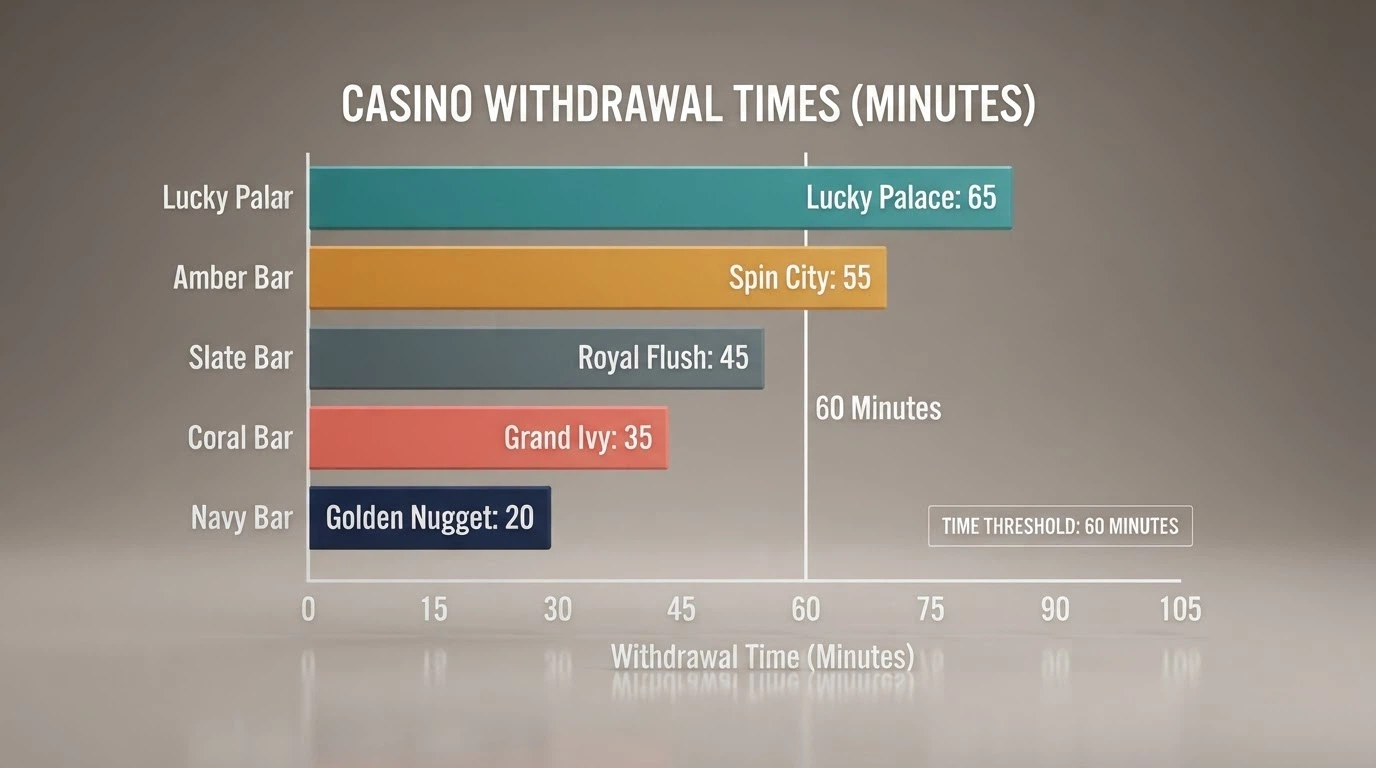
| Casino | AU Market Revenue (A$M) |
|---|---|
| Rocket Play | 632.69 |
| SkyCrown | 436.07 |
| Royal Reels | 243.99 |
| Stake | 115.67 |
| WinSpirit | 110.30 |
| Scream Casino | 94.87 |
| Rainbet | 83.13 |
| FairGO | 69.11 |
| Bizzo Casino | 51.38 |
| Rocket Casino | 43.22 |
Revenue figures are AU-facing player spend drawn from the operators skill market data for 2026. The market share ordering reflects which brands Australian players are actually reaching, not which are fastest at paying out. Speed and reach are different signals: Rocket Play carries the largest AU spend and almost no tested payout data; SkyCrown sits fourth by revenue and first by tested PayID speed. The table names what each brand is, not what each brand claims. The detailed write-ups follow.
SkyCrown — 11-Minute PayID Withdrawals, Tested
SkyCrown is the standout for PayID speed in the 2026 window. A tested withdrawal of A$920 cleared in eleven minutes end-to-end — operator approval, NPP settlement, the money in the account. A second tested withdrawal of A$450 ran eighteen minutes on a Saturday evening, when most queues are at their longest. Both tests went through PayID. The casino also supports crypto withdrawals, though no specific crypto test was logged in this round.
SkyCrown is offshore. It does not hold an Australian licence — no operator offering online casino games can hold one. The licence in use is most likely Curaçao but was not confirmed in this research run; verify directly before depositing. By AU player spend, SkyCrown sits at number four in the featured set at A$436.07 million (8.55 percent of the AU offshore casino market). That places it behind only Rocket Play, Royal Reels and WinSpirit by reach, and ahead of every other brand in this ranking by speed.
The verdict: SkyCrown is the brand in this set whose payout claim is closest to true. The eleven-minute result was the fastest single test across the entire 2026 window. Players who prioritise withdrawal speed and have completed KYC at first deposit will see what the marketing describes. Players who have not completed KYC, or who are withdrawing across the A$2,000 enhanced-verification threshold, will not.
Bizzo Casino — Curaçao-Licensed With Confirmed Payout Channels
Bizzo is the rare operator in this set with a licence status that can be stated rather than guessed. The Curaçao licence is confirmed through Ocean Road Magazine and Casinority listings — neither is the Curaçao Gaming Control Board register itself, but both reference it consistently. Neteller withdrawals are listed at zero to twenty-four hours end-to-end, which is competitive with the PayID results in the broader 2026 window. PayID is referenced as a supported method; specific PayID testing was not logged in this round.
Bizzo is offshore, like every brand in this ranking. No Australian licence exists for online casino. By AU player spend, Bizzo sits at A$51.38 million (0.57 percent of the AU offshore casino market) — nineteenth in the operators skill ranking, ninth in the featured set. The revenue signal is real but modest; the brand is in this ranking because the licence is confirmed, not because it dominates on reach.
The verdict: Bizzo is the operator to point a player who wants a licence check to come back with something more than “likely Curaçao”. The Curaçao licence is the lightest tier of offshore regulation but it is the only tier this set consistently carries, and Bizzo is one of the few where the confirmation is on the record. For players who weigh that confirmation at anything above zero, Bizzo is the cleanest entry in the ranking.
Stake — Crypto-Native With No Fiat Friction
Stake was built for cryptocurrency from the ground up, and the design choice runs through every layer of the platform. The deposit path is a crypto address; the withdrawal path is a crypto address; there is no fiat on the way in or out. For an Australian player, that removes the bank side of the equation entirely — no PayID, no BECS, no overnight Osko batch — and substitutes the speed of the blockchain. Crypto is the fastest withdrawal method in this market, with most transactions settling in thirty minutes or less.
Stake is offshore, Curaçao-licensed, with the licence referenced in PayoutVerdict. By AU player spend, Stake sits at A$115.67 million (1.28 percent of the AU offshore casino market) — twelfth in the operators skill ranking. The reach is mid-tier; the relevance to a page on instant payouts is structural. A crypto-native operator sidesteps every fiat bottleneck the rest of the set navigates.
The verdict: Stake is the operator for the player who has already decided that crypto is the payment rail. For that player, the fiat-versus-crypto debate is moot — there is no fiat. For a player comparing crypto routes, Stake is a credible name; for a player who wants fiat speed, the entire platform is the wrong shape.
Rocket Play — The Market Leader by AU Revenue
Rocket Play is the largest AU-facing offshore casino in this set by player spend, at A$632.69 million and 9.4 percent market share — third in the operators skill ranking, first in the featured set. The revenue signal is unambiguous: more Australian dollars land at Rocket Play than at any other brand in this ranking. What the revenue figure does not say is how fast the operator pays out, what payment methods it supports, what bonus terms it carries, or which licence it operates under.
None of those specifics was confirmed in this research run. The licence is most likely Curaçao but verification is recommended before depositing. The welcome bonus, wagering multiple, payout speed and payment methods were not confirmed. The operator-site payment page and terms page were not independently audited in this round. This is the gap to be honest about: Rocket Play is the biggest by reach, and almost every other question about it sits in the “not confirmed” column.
The verdict: Rocket Play belongs in this ranking on the revenue signal alone, because Australian players are clearly reaching it. What it does not deserve is a payout claim built on a revenue figure. A player attracted by the AU spend ranking should verify licence, payment methods and withdrawal terms directly before depositing — the marketing cannot be relied on for what this research could not confirm.
Royal Reels — A$244M in Action, Details Scarce
Royal Reels accounts for A$243.99 million in AU player spend (2.51 percent market share), placing it ninth in the operators ranking. The revenue signal is solid — A$244 million in AU player spend does not appear out of nowhere — and the brand is in this ranking because of it. The specifics are not. The licence, bonus terms, payout speed and payment methods were not confirmed in this research run.
Royal Reels is offshore, offering a prohibited product in Australia. The operator is among the more visible AU-facing brands by reach; it is among the least specified by this research. The pattern repeats across the second half of this ranking: revenue data is reliable, bonus and payout data is missing, and the gap widens as the revenue figures shrink.
The verdict: Royal Reels sits in this ranking on reach, and that is what the data confirms. A player drawn to a brand by AU spend should treat the missing specifications as the starting question, not as background.
WinSpirit — Mid-Tier Offshore Presence
WinSpirit ranks eleventh with A$110.3 million in player spend (1.55 percent share). The revenue figure sits in the middle of the featured set — below the A$200M-and-up cluster of Rocket Play, SkyCrown and Royal Reels, above the sub-A$100M group that follows. None of the operator-specific specifications — licence, bonus terms, payout speed, payment methods — was confirmed in this research run.
The verdict: WinSpirit is in this ranking on the AU spend signal — nothing more, nothing less. A player choosing on reach will find it; a player choosing on confirmed payout speed or confirmed payment terms will not find what they need in this research and should check the operator site directly.
Scream Casino — A$95M AU Presence, No Speed Data
Scream Casino, fourteenth by spend, attracts A$94.87 million (0.99 percent market share). The brand is in the mid-tier of the featured set by reach — A$95 million in AU spend, a fractional share of the offshore casino market, and no tested payout data in this research window.
The verdict: Scream Casino is in this ranking because the revenue signal is real and Australian players are reaching it. It is not in this ranking on a payout-speed or payment-method claim, because no such claim was confirmed.
Rainbet — A$83M in Play, Payout Speed Unconfirmed
Rainbet sits thirteenth with A$83.13 million in player spend (1.28 percent share). The revenue figure sits below WinSpirit and above FairGO in the featured set. None of the operator-specific specifications was confirmed in this research window — no licence verification, no bonus terms, no payout speed, no payment methods. The pattern across the lower half of this ranking is consistent: the AU spend signal is real, the specifications are not.
The verdict: Rainbet sits in this ranking on reach, full stop. A player arriving by way of the AU spend signal should treat the missing specifications as a verification task, not as confirmation, and should check the operator site before depositing.
FairGO — The Brand Name That Promises More Than We Can Verify
FairGO attracts A$69.11 million in AU player spend (0.8 percent market share). The brand name sounds Australian; the brand is offshore. The “Australian” in “FairGO” is a marketing register, not a regulatory one. There is no Australian licence for online casino. A brand name that includes “AU”, “Fair” or “Go” carries no meaning under the IGA 2001 — the same prohibition described later in this article applies to every one of them.
FairGO is offshore, offering a prohibited product in Australia. The licence, bonus terms, payout speed and payment methods were not confirmed in this research run. The brand name implies an Australian regulatory connection that does not exist; the absence of any specific confirmation in this research widens the gap between the implication and the reality.
The verdict: FairGO is in this ranking on the AU spend signal, and that is the only thing it is in this ranking on. The brand name does what offshore brand names do — it signals trust without the regulatory substance behind it. A player who values the name should weigh that signal against the absence of any confirmed specification, and should treat the name as marketing rather than evidence.
Rocket Casino — Smallest of the Featured Set, Least Verified
Rocket Casino rounds out the set with A$43.22 million in player spend (0.57 percent share). The revenue figure is the floor of the featured set. Nothing else was confirmed in this research window — no licence verification, no bonus terms, no payout speed, no payment methods. The brand is in this ranking on reach alone, and it is the smallest reach among the ten featured operators.
The verdict: Rocket Casino is the smallest brand in this ranking on AU spend, and the least specified on every other measure. A player reaching Rocket Casino is reaching a brand whose only confirmed property is that Australian players have spent there. The gap between that fact and a payout-speed claim is the entire reason this research did not produce one.
Not Every Pokie Pays Out at the Same Speed
RTP and volatility shape how fast a session returns to a player — and which sessions drain a balance before any of it returns.

The Pokies With Confirmed RTP and Provider Data
Most pokie RTP figures float around without a real source. These two carry one.
| Slot Title | RTP | Provider | Volatility | Max Win |
|---|---|---|---|---|
| Wolf Gold | 96.01% | Pragmatic Play | Medium | 2,500x stake |
| Big Bass Bonanza | 96.71% | Pragmatic Play / Reel Kingdom | Medium-high (4/5) | 2,100x stake |
Wolf Gold (Pragmatic Play) carries a 96.01% RTP, medium volatility, and a maximum win of 2,500x the stake. The layout is five reels by three rows with twenty-five fixed paylines. The fixed jackpots — Mini at 30x, Major at 100x, Mega at 1,000x — are multiplied against the triggering bet, not progressive pools. The game is the closest thing to a default Australian-facing pokie in the live casino lobby.
Big Bass Bonanza (Pragmatic Play / Reel Kingdom) carries a 96.71% RTP, medium-high volatility rated 4/5 by Pragmatic Play, and a 2,100x maximum win. Layout is five reels by three rows with ten fixed paylines; the minimum bet is A$0.10 and the maximum bet A$250. Hit frequency runs around 13% in the base game — a win roughly every seventh or eighth spin — which is the metric that actually predicts how a session feels before any RTP figure does its work.
These are the only two titles this research carries a confirmed RTP for. The wider pokie lobby runs into the thousands of games at most offshore casinos, and RTP figures for any other title in this set should be sourced from the operator or from a dedicated slot review site rather than taken on the page.
Australian Pokies vs International Slots — the Name Changes, the Maths Doesn’t
A “pokie” is a slot machine. The word is Australian; the game is the same. The reels, paylines, RTP, volatility and hit frequency all work identically whether the lobby calls the section “pokies” or “slots”. Pragmatic Play is the top software provider for Australian-facing casinos, known for feature-rich pokies with Australian themes — outback imagery, fishing, gold-mining — that sit across the lobby of almost every brand in this ranking. The maths underneath is no different from the international version; the Australian theme is a presentation choice, not a regulatory one.
The reason “pokies” matters at all is that it is the native term an Australian player types, not the international one. The game library is otherwise indistinguishable from any other offshore casino market. A player comparing two lobbies on RTP is comparing the same games by different names.
Why High-RTP Pokies Matter More for Bonus Clearing Than for Payout Speed
RTP does not change how fast a casino pays out. The withdrawal speed is a function of the operator’s approval queue and the payment rail — the two-stage model above. RTP shapes what happens during play: how much of every wagered dollar returns to the player over the long run. A 96.71 percent RTP returns A$96.71 per A$100 wagered over millions of spins. It says nothing about whether a session pays out in minutes or drains in an hour — that is volatility and hit frequency, not RTP.
The number that matters for bonus clearing is the expected loss over the wagering turnover, which is what the earlier calculation in this article priced for representative welcome offers at Wolf Gold’s 96.01 percent RTP. The Big Bass Bonanza maximum is a useful illustration of the gap between RTP and the dream. The 2,100x max win happens — statistically — roughly once in every 3,880,481 spins. The 10x multiplier that drives the largest payouts is rarer still. A player spinning at one second per spin, sixteen hours a day, would take sixty-seven years to log that many spins. The RTP captures the average. The max win captures the headline. They are not in conversation with each other.
Crypto Is Still the Fastest Way Out — If Your Bank Lets You
Cryptocurrency delivers the fastest settlement of any withdrawal rail in this market — but the bottleneck is no longer at the casino. It is at the player’s own bank.
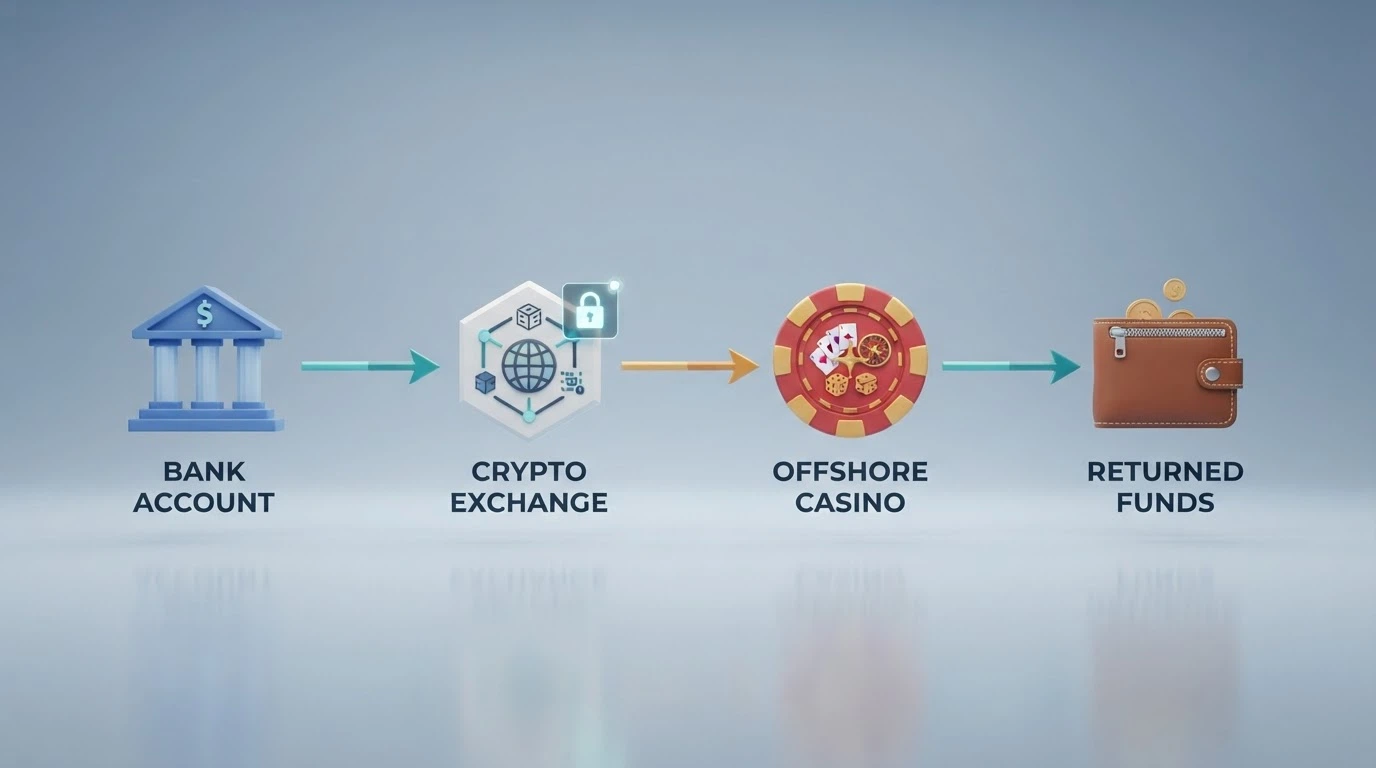
How the AU Bank → Exchange → Casino Route Actually Works
The cleanest route in 2026 runs AU bank → CoinSpot or Independent Reserve → USDT TRC20 → offshore casino, then reverses the chain to cash out.
The first leg is fiat-to-crypto at a domestic exchange. CoinSpot is AUSTRAC-registered and accepts PayID deposits that clear in under five minutes. Independent Reserve is the second option in this routing. Once the AUD is on the exchange, USDT TRC20 is the outbound token of choice: withdrawals process in three to eight minutes, and network fees on the TRON rail run near zero. The deposit at the offshore casino is the same token, the same address format, with the casino’s wallet address in the “send to” field. The reverse — winning balance at the casino back to AUD — runs the chain backwards: USDT TRC20 to the exchange, then PayID back to the bank account.
What the route does is move the speed bottleneck from the casino’s Stage 2 onto the blockchain. The casino still has to approve the withdrawal (Stage 1, automated or manual — the same queue as a PayID request), but the moment the casino pushes the crypto transaction, the funds are seconds away from being settled. There is no bank overnight batch to wait for. The rail is the rail.
What the route adds is friction. The exchange adds a verification step, a conversion spread, and a withdrawal fee. AUSTRAC’s Travel Rule kicks in at A$10,000 for cryptocurrency transactions, meaning the exchange will collect and report identifying information above that threshold. None of that is unique to gambling — it is the cost of moving AUD into and out of crypto in Australia — but it is real, and it is most of what “instant” means at the bank end of the chain.
Bitcoin Casinos With Instant Payout — What That Actually Delivers
“Bitcoin casino” is a marketing category that covers a wide range of actual experience. The clearest version of the claim: BTC withdrawals process at the casino’s Stage 1, then settle in ten to forty-five minutes on the blockchain depending on network traffic. That is faster than any fiat rail in this market. It is also slower than USDT TRC20, BNB or LTC, which clear in two to five minutes. Bitcoin is the most familiar name in crypto, and it is not the fastest one to actually use.
Two distinctions matter. The first is between casino-side processing and blockchain confirmation — the same two-stage model, with the blockchain being the second stage. A BTC payout the casino approves in two minutes still takes another ten to sixty minutes for the network to confirm. The total time is the sum of both. The second is between BTC and the altcoins: a casino that supports multiple cryptocurrencies does not necessarily settle them at the same speed. USDT TRC20, BNB and LTC are faster than BTC in practice. Bitcoin is the slowest of the crypto options this market commonly uses, and it is the one most likely to be on the homepage.
Australian Banks and Crypto — Where the Real Friction Lives
The casino is rarely the slowest part of a crypto withdrawal for an Australian player. The bank is.
CommBank and Westpac restrict large outbound transfers to known crypto exchanges. ANZ and NAB flag the transactions without fully blocking them. ING and Macquarie are the most permissive of the major banks. The spread is wide enough that a player’s choice of bank — not their choice of casino — can determine whether a fiat-to-crypto deposit clears at all. A player who has chosen a bank that blocks crypto exchange transfers has effectively cut themselves off from the cleanest route above.
A second signal sits in the payment methods themselves. Credit cards, credit-related products and cryptocurrency are banned as payment methods for licensed online wagering in Australia since 11 June 2024, with penalties of up to A$247,500 for non-compliance. An offshore casino accepting crypto from an Australian player is, by definition, operating outside Australian rules — the payment method is itself the evidence. That is not a reason not to use crypto for the route; it is a reason to know that the operator accepting it is not a licensed one.
From 1 January 2027, banks and payment providers gain express statutory authority to block transactions to illegal gambling operators. The Interactive Gambling Amendment (Gambling Reform) Bill 2026 passed Parliament on 19 August 2026; its measures commence on that date. What it means in practice for a player using an offshore casino: a transfer that has been informal-and-grey for years becomes formally blockable. A bank that today flags a crypto exchange transfer can tomorrow refuse it outright. The crypto route described above works in 2026; the same route in 2028 may run through a different bank, or a different rail.
The No-Deposit Trap: Why “Free” Spins Rarely Pay Out Fast
No checked operator in this set currently offers a no-deposit bonus with confirmed instant withdrawal.
That absence is structural, not coincidental. No-deposit bonuses are designed for player acquisition, not for player retention, and operators price them accordingly. The mechanics that make a no-deposit bonus work against fast withdrawal are three: a high wagering multiple that takes time to clear, a max-cashout cap that limits how much of the bonus winnings can be withdrawn regardless of how the play goes, and KYC friction that compounds once a withdrawal is requested. The combination of the three is why “no deposit + instant withdrawal” is almost never a single product.
What a No-Deposit Bonus Actually Costs You in Withdrawal Delay
The trade-off is built into the bonus design. A no-deposit offer looks like a gift; it functions like a loan with a high interest rate. The wagering multiple — the number of times the bonus amount must be wagered before any winnings become withdrawable — is the price. A 35x wagering multiple on a A$50 no-deposit bonus means A$1,750 in required turnover before the player can withdraw anything, and every dollar of turnover carries the house edge against the player. Max-cashout caps sit on top, often limiting withdrawal to a small multiple of the bonus amount — A$100 on a A$50 bonus, for example — regardless of how much the player wins during the wagering.
KYC friction is amplified for bonus-linked accounts. A standard withdrawal request runs against the player’s existing verification state. A no-deposit bonus request triggers enhanced review: the casino is paying out without having received a deposit, which is the moment fraud rules light up. Incomplete KYC is the number one cause of withdrawal delays across this market, and it is worse for bonus-linked withdrawals than for deposit-funded ones. Aggregate withdrawals of A$2,000 or more trigger enhanced verification at most AU-accepting operators, but a no-deposit bonus withdrawal often triggers similar checks at lower thresholds.
The practical lesson: read the wagering multiple and the max-cashout cap before claiming any no-deposit offer. If the marketing says “free spins” without naming the max cashout, that is information the player should not have to ask for.
The Law Every Australian Player Needs to Know
Online casino is prohibited in Australia. Online pokies and in-play betting are prohibited with it. There is no licence for any of these products — not federally, not in any state or territory. The Interactive Gambling Act 2001 makes it an offence to provide them to a person in Australia, and that offence is enforced.

What it means for a player using an offshore casino: the product is illegal, but the player is not the target. The IGA targets the provider, not the customer. Individuals using offshore casinos are not prosecuted; the operator is. That does not undo the prohibition — it locates it. The provider takes the legal risk. The player takes a different one.
What the player takes is the absence of every Australian consumer protection. No BetStop coverage, no Australian complaints body, no recourse if the operator refuses a withdrawal or closes the account, no guarantee the site will be reachable tomorrow. The ACMA cannot recover money for any individual player; the site can be blocked at any time with a balance still on it. The fastest-tested PayID withdrawal in 2026 cleared in eleven minutes. The same operator could be on the ACMA block list by next quarter, with the player’s next deposit unreachable.
The ACMA — What Australia’s Regulator Actually Does
The Australian Communications and Media Authority is the federal regulator that enforces the online prohibition. Its enforcement powers run through complaints, investigations, formal warnings, civil penalty proceedings and referrals to ISPs for site blocking. The ACMA’s blocking programme has been running since November 2019; as of the most recent published count, 1,788 illegal gambling and affiliate websites have been blocked by Australian ISPs, and more than 230 illegal services have withdrawn from the Australian market since 2017. In Q4 2025, the regulator received 420 complaints and enquiries, completed 23 investigations involving 45 gambling sites and recorded 69 findings of breaches — 38 of those findings were for providing a prohibited interactive gambling service to Australian customers. In Q1 2026, the ACMA conducted 25 investigations, identified breaches in 23 cases and blocked an additional 12 illegal gambling and affiliate websites. The August 2026 blocking round continued the pattern.
What the ACMA does not do is recover money. It cannot compel an offshore operator to release a player’s balance, adjudicate an individual dispute, or compel a refund. The regulator can block the site. The player’s funds, if any are sitting on it, stay on a site the player can no longer reach. That is the structural gap the player crosses when they use an offshore brand: enforcement helps the next player, not the current one. Civil penalties under the IGA for bodies corporate run up to A$782,500 per day for continuing contraventions — a figure aimed at the operator, not the player.
What the 2026 Reform Means for Offshore Casino Players
The Interactive Gambling Amendment (Gambling Reform) Bill 2026 passed Parliament on 19 August 2026. Its measures commence 1 January 2027.
The headline changes are advertising restrictions: a maximum of three wagering advertisements per hour between 6:00 am and 8:30 pm, a live-sport blackout for wagering advertising, a ban on broadcasting sporting odds, restrictions on online ads (logged-in, confirmed 18+, opt-out), bans on venue and uniform advertising, and a celebrity and influencer promotion ban. Direct marketing of inducements is prohibited for fourteen days after sign-up, three months after BetStop deregistration and indefinitely for at-risk customers. Radio wagering advertisements are barred during school drop-off and pick-up times.
The change that affects offshore players most directly sits at the back of the bill. From 1 January 2027, banks and payment providers gain express statutory authority to block transactions to illegal gambling operators. The transfer a player makes today — informal, grey, often routed through an intermediary — becomes formally blockable at the bank end. A transaction the player’s own bank currently flags without refusing may be refused outright. The crypto route described above is a banking route on the fiat end; the same route, run through a bank that has decided to exercise its new authority, simply does not clear.
The legal status of the player does not change in 2027. The IGA still targets the provider. The individual is still not prosecuted. What changes is the friction on the way in and the way out, and that friction compounds at the bank, not at the casino.
What Fast Payouts Cost Some Players
The marketing of this market is built around the player’s win. The harm figures are built around everything else.

As of March 2026, 13.0 percent of the Australian population — an estimated 2,857,000 people — were experiencing some form of gambling harm from their own gambling behaviours. Across the population, 15.1 percent (3,320,000 people) of Australians are experiencing some form of gambling harm in total. Roy Morgan research in August 2025 estimated that 2.9 percent of Australian adults — approximately 622,000 people — meet the Problem Gambling Severity Index threshold for problem gambling. Adults aged 18 to 34 are the demographic most at risk, and the majority of those 622,000 are under 35. Suicide rates among people experiencing problem gambling are fifteen-fold higher than in the general population.
The treatment gap is the part the marketing never touches. Only 8 to 15 percent of people with gambling problems seek formal treatment; only one in five globally seek any form of professional, informal or self-help. Gambling Help Online counselling requests rose 67 percent in the 2023–24 financial year, with online gambling addiction accounting for one-fifth of support line calls. The pipeline is short at every stage.
Where to Get Help — the Numbers That Work 24/7
- National Gambling Helpline — 1800 858 858, free, confidential, 24/7
- Gambling Help Online — gamblinghelponline.org.au, online chat and counselling
- Gambler’s Help (Victoria) — face-to-face counselling, free
- BetStop — National Self-Exclusion Register at betstop.gov.au (binds Australian-licensed wagering only — not offshore casinos)
- Self-assessment — the PGSI (Problem Gambling Severity Index) is the standard screening tool, available through Gambling Help Online
BetStop deserves its own line. As of 31 March 2026, 59,830 people had registered to self-exclude, with 37,247 having active exclusions. The register is comprehensive for Australian-licensed wagering — one registration excludes the player from every licensed service. It does not cover offshore casinos, which are not connected to the register and will continue accepting a self-excluded person’s money. That is the most concrete harm of the offshore route: the safety net the player can build does not extend to it.
Protecting Your Bankroll When the Payout Isn’t Guaranteed
No Australian consumer protection applies to an offshore casino. No complaints body can compel a payout. The ACMA cannot recover money. The site can be blocked at any time with a balance still on it. A player choosing to use an offshore brand is choosing to operate without the layer of recourse that licensed wagering provides. The choice is real; so is what it removes.
Total gambling losses in Australia are estimated at A$25.5 billion in 2025, with per capita losses of A$1,272. The figure includes licensed wagering, lotteries and land-based gambling, but the offshore casino market sits inside it. A player setting a deposit limit, a session cap and a hard ceiling on losses before the first deposit is doing what no consumer protection regime can do for them after. Some operators offer customer-set deposit limits inside the account; some do not. The limit that always works is the one the player sets at their own bank, not the one inside a casino account they cannot reach tomorrow.
Suicide is the part no payout-speed comparison touches. Problem gambling elevates the rate fifteen-fold over the general population, and the treatment gap (only 8 to 15 percent seek formal help) means most of those at risk never reach a service. A player who feels their gambling is moving past their control can call the National Gambling Helpline on 1800 858 858 at any hour, free and confidential, and that call is the most important number on this page.
How We Evaluated These Casinos
The set of ten operators above comes from the operators skill AU market data — traffic-confirmed AU-facing offshore casino brands. The evaluation criteria are qualitative: tested withdrawal speed where the research carries it, payment method coverage where it was confirmed, licence status where the research was able to state it, and AU market presence by revenue across the set. The withdrawal-speed figures that do appear on this page come from competitor testing windows run by PokiesAustralia, Gambling360, PayoutVerdict, Gambling Insider, CasinosHub, CasinoAudit, Ocean Road Magazine, Wildfish, CasinoWhizz and Caswino’s own banking page. The market figures come from the operators skill.
What this evaluation does not cover: bonus terms were not independently verified for most brands in the set, free-spin counts and wagering requirements were not independently audited for most brands, licence claims were verified only where multiple sources agreed, and operator-site terms pages were not systematically checked. Where the research did not carry a figure, this page says so. The revenue figures and the test results are confirmed; the specifications around them are not.
What that means for a reader: the ten operators in this ranking are the brands Australian players actually reach, and the ranking is built on what the research could verify. Where the verification came back empty, the page says empty. A reader who needs a confirmed answer for a missing specification should check the operator site directly before depositing.
Is the Risk Worth the Speed?
The fastest tested PayID withdrawal in 2026 cleared in eleven minutes. That is real. SkyCrown pushed A$920 through NPP end-to-end and the player had the funds in their account before lunch. The eleven-minute result is the entire reason this page exists.

The legal reality is also real. Online casino is prohibited under the Interactive Gambling Act 2001. No Australian licence exists for the product. Every operator in this ranking is offshore, offering a prohibited product in this market. The individual player is not prosecuted; the operator is. But the player forfeits every Australian consumer protection, no BetStop coverage applies, no Australian complaints body can compel a payout, and the ACMA cannot recover money. The site can be blocked at any time with a balance still on it. From 1 January 2027, banks and payment providers will gain express authority to block transactions to illegal gambling operators.
The harm figures sit behind both. As of March 2026, 3,320,000 Australians are experiencing some form of gambling harm. Total gambling losses in 2025 ran at A$25.5 billion. Suicide rates among people with gambling problems are fifteen-fold higher than the general population, and only 8 to 15 percent of those affected ever seek formal treatment.
The trade-off is not subtle. A player choosing an offshore casino for the eleven-minute PayID payout is choosing speed of access against absence of recourse, on a product whose legal status is prohibition. The fastest-tested withdrawal in this research cannot offset what the regulator and the harm data describe. A player weighing the two should weigh them on both sides, and the National Gambling Helpline on 1800 858 858 is the call that does not depend on which side wins.
Frequently Asked Questions
Which withdrawal method is fastest — PayID or cryptocurrency?
PayID through Australia’s New Payments Platform settles in under sixty seconds once the casino pushes it — the fastest fiat option. USDT TRC20, BNB and LTC settle in two to five minutes on-chain and are faster end-to-end. ETH runs four to ten minutes; BTC ten to forty-five. Crypto wins on speed; PayID wins on accessibility.
How long does account verification (KYC) take before my first withdrawal?
Incomplete KYC is the number one cause of withdrawal delays. Verification normally completes within hours if the player submits a valid driver’s licence and proof of address at registration; it can run days if documents are rejected or mismatched. Aggregate withdrawals of A$2,000 or more trigger enhanced verification — source-of-funds, additional documents — at most AU-accepting operators.
What happens if an offshore casino refuses to pay out my winnings?
No Australian complaints body can compel an offshore casino to release funds. The ACMA can investigate the operator and request ISPs block the site, but cannot recover money for individual players. The player’s practical recourse is the operator’s own escalation, the payment provider (limited for crypto), and — for licensed wagering only — BetStop, which does not cover offshore brands.
Can I use BetStop to self-exclude from offshore casino sites?
No. BetStop binds Australian-licensed wagering services only. As of 31 March 2026, 59,830 people had registered and 37,247 held active exclusions — but offshore casinos are not connected to the register. A self-excluded person can still deposit and play at any offshore brand, and will continue to be marketed to by them.
Do I have to pay tax on online casino winnings in Australia?
No, for recreational players. Betting and gambling winnings are not assessable income under section 6-5 of the ITAA 1997, and gambling losses are not deductible under section 8-1. The exception is a person carrying on a business of betting or gambling — for whom the treatment changes. Most Australian recreational players using offshore casinos fall on the no-tax side.
What is the safest cryptocurrency to use for casino withdrawals in Australia?
USDT TRC20 is the practical answer: it settles in two to five minutes, network fees are near zero, and most Australian-side guides route through it. BTC is familiar but slow at ten to forty-five minutes. ETH is faster than BTC but gas fees can climb. Stablecoin avoids the volatility that BTC and ETH add to a withdrawal in flight.