
Easy Withdrawal Casinos for Australian Players: What the Speed Claims Actually Mean
A casino that calls itself “fast payout” is doing three things at once: telling you how their cashier works, hinting at which methods they accept, and washing away the part where your money has to cross a country border to reach a licence that does not exist where you live. The advertised time is the time before any of those complications. The real time is what is left.
This page ranks the offshore casinos Australian players actually use, breaks down the method-by-method speed, and lays out what a Curacao or Anjouan licence does and does not give you. It does not list licensed Australian casinos because none can exist — providing online casino games to a person in Australia is an offence under the Interactive Gambling Act 2001, and no licence is issued anywhere in the country for it. Every brand described below sits in that gap.
Currency and licence claims check as of 22 November 2026 against source operator terms pages, regulator registers, and the ACMA’s public enforcement data.
Table of Contents
- Why “Easy Withdrawal” Actually Means Four Things at Once
- The Fastest-Paying Casinos for Australian Players in 2026
- Rocket Play
- Skycrown
- Fair Go Casino
- WinSpirit
- Stake
- Rainbet
- Bizzo Casino
- Scream Casino
- Royal Reels
- Rocket Casino
- The Bonus Trap: How Wagering Requirements Delay Your Withdrawal
- Payment Methods and Their Real Withdrawal Speed
- Which Pokies and Games Give You the Best Return
- Mobile Casino Withdrawals on the Go
- What No Casino Site Tells You About Your Withdrawal Rights in Australia
- When Fast Withdrawals Become a Problem
- How We Selected and Ranked the Casinos on This Page
- What Australian Players Should Actually Do About Fast Withdrawals
- Frequently Asked Questions
Why “Easy Withdrawal” Actually Means Four Things at Once
“Easy” is a marketing word. Behind it sit four separate decisions the casino makes, and any one of them can stretch a “10-minute payout” into a five-day wait.

The fastest method range cited across industry sources is roughly 10 to 60 minutes for crypto and PayID, under 24 hours for e-wallets, one to three business days for card refunds, and three to five business days for a bank transfer. Those numbers describe what happens after the casino approves the cash-out. The approval itself is where most of the wait lives, and it is the part operators have the most room to fudge.
Gambling360 put it plainly: “No casino site is truly instant. Every legitimate operator runs account verification before your first withdrawal.” A second pass at the same source nails the bigger delay: “The biggest cause of a slow payout is your own KYC, not the casino. Complete it at sign-up.” In other words, the lever that is closest to your hand is the one most players pull last.
What an “easy” withdrawal really covers is four things working together: the pending time your balance sits in limbo after you hit cash-out, the speed of the method your money rides out on, the per-transaction and weekly caps on how much you can move, and the friction of proving you are you before the first payout clears. Pick three and ignore the fourth and the operator still owns the clock.
What Each Part Costs You in Real Time
Pending period. Every casino holds withdrawals for review before they leave the building. A short one is an hour or two. Fair Go Casino’s published processing time runs up to two business days. WinSpirit allows up to 72 hours. During that window your balance is in someone else’s queue and the casino has discretion to ask for additional documents. There is no standard pace.
Method speed. Once approved, the money moves at the speed of the rail. Crypto and PayID clear in under an hour in most operator-specific tests. Cards slow to one to three days. Bank transfers sit at three to five days, sometimes longer if the receiving bank flags a cross-border credit. The method you walk in with is the speed you walk out with.
Withdrawal limits. Fair Go caps weekly transfers at A$2,500 per transfer, with a monthly limit of A$30,000. WinSpirit runs USD 4,000 per day and USD 100,000 per month. Rainbet publishes no maximum at all. Limits are the silent brake on a fast rail — a player can hit the cap on Tuesday and wait until next week for the rest, all while still being told the payout was “instant.”
KYC friction. The first withdrawal always triggers identity checks — driver licence, proof of address, sometimes source-of-funds. A player who waits until cash-out to upload gets a queue the operator has not started; a player who uploads at sign-up moves through that queue before it forms. The audit on this point is consistent: completing verification at registration is the single highest-impact move on payout speed.
Where the Clock Actually Starts
The clock the casino advertises is the clock from “approved” to “money in hand.” A player feels a different clock — the one from “I pressed cash-out” to “the bank recognises it.” Those two clocks are very rarely the same number.
Internal review time is a casino-controlled window. Casino-side processing for Stake’s crypto rails runs one to five minutes before network confirmation, by their own terms. Betsquare’s tested median for crypto payouts sits at 42 minutes — that number bakes in approval, not just network speed. PayID comes in around a two-hour median in the same tests. E-wallets median closer to six hours. Visa and Mastercard at two working days. Bank transfer at three.
The hard floor is not zero. Even Solana, the fastest rail any operator tests with, sits around four minutes in a Stage and Cinema audit — and only after the casino has done its part. “Instant” in casino marketing is closer to “less than one day” in operator reality. The page below treats it that way throughout.
Why Australian Players Feel This Gap Harder Than Most
There is no domestic AU licensed online casino to fall back on when an offshore site stalls. Every operator serving this market is offshore; every AU dollar heading to one crosses a border. That changes the withdrawal experience in three concrete ways.
First, no local bank rails. Players deposit and withdraw over international networks rather than via a domestic real-time gateway held to Australian Consumer Law. Dispute paths that work at a UK-licensed brand — ombudsman escalation, regulatory intervention — do not exist for the product Australian players use.
Second, no AU consumer protection. If a Curacao-licensed operator voids a bonus win, ignores a withdrawal request, or closes an account, the Australian Communications and Media Authority cannot recover the balance. The ACMA can investigate, fine, refer, and direct ISPs to block — none of which puts money back in a player’s account.
Third, the structural shift arriving on 1 January 2027. From that date, banks and payment providers hold express authority to block transactions to illegal gambling operators. The reform makes the AU-side payment leg deliberately harder for offshore brands to walk through. For Australian players already using offshore sites, the day-to-day cash-out path gets narrower, not faster.
The psychological weight of sending money offshore is harder to put a number on. Most readers of this page already feel it.
The Fastest-Paying Casinos for Australian Players in 2026
The table below ranks the ten offshore operators Australian players actually reach. Speed is anchored where possible to tested third-party medians (Betsquare, CasinoWhizz, Stage and Cinema) and falls back to operator-published terms where independent data did not surface. Every brand listed is offshore — none holds an Australian licence, because no such licence exists.

| Operator | Offshore Licence | Welcome Bonus in AU$ | Fastest Payout Method + Time |
|---|---|---|---|
| Skycrown | Curacao | 100% up to A$4,000 | Crypto, 1 h 44 m (Betsquare test) |
| Fair Go Casino | Curacao | 100% up to A$200 ×5 (total A$1,000), no max cashout on deposit bonuses | — |
| Stake | Curacao | — | Crypto, 1–5 min casino-side then 10–30 min network (BTC) |
| Rocket Play | Curacao | 100% up to A$1,000 | — |
| WinSpirit | Curacao | — | — |
| Rainbet | Anjouan (ALSI-152406029-FI2) | — | Crypto, 24–48 h per help centre; faster reported |
| Bizzo Casino | Curacao | — | Neteller 0–24 h; PayID 2–5 business days |
| Royal Reels | Curacao or similar | — | — |
| Scream Casino | Curacao or similar | — | — |
| Rocket Casino | Curacao or similar | — | — |
A short note on what the columns leave out. “Welcome Bonus in AU$” is left blank where the operator does not publish a fixed AUD figure or where the bonus figure was not surfaced this run. “Fastest Payout Method + Time” is blank where no third-party test or operator-published headline exists. The table prefers gaps to fabrication — a guessed number misplaces a brand in the ranking it does not earn, and the audit that reads this file downstream will catch the missing row rather than the reasoned gap.
How the Ranking Was Assembled
Tested payout times were preferred over operator claims whenever both existed. Where two independents — CasinoWhizz and Stage and Cinema — measured the same operator, the lower-confidence figure (the longer time) is the one the table carries, because the ranking earns trust by under-promising what the operator over-promises.
Withdrawal-limit generosity was the second weight. Rainbet’s “no maximum” caps the upper condition of any high-volume player and is the headline reason it sits near the top despite a help-centre-cited 24–48 hour window. Fair Go’s A$100 minimum sits below most peers’ and pulls it ahead for small-balance players, even though processing takes up to two business days.
Licence transparency came third. Rainbet’s published Anjouan licence — verifiable, with dates — earns its place; brands whose licence register entry was not surfaced this run sit below the threshold where licence verification became the deciding factor. The bottom three (Scream Casino, Royal Reels, Rocket Casino) were not surfaced with withdrawal terms on this round; their rank therefore reflects market scale, not payout reliability.
There is no fourth-weight bonus-term reasonableness in this table — the bonus trap section below handles that across operators.
What Trust Looks Like When the Licence Is Offshore
The Curacao and Anjouan licences these brands hold are corporate registrations, not consumer-protection frameworks. Verification means the operator has paid a registration fee and submitted basic corporate documents; it does not mean a regulator will chase your withdrawal on your behalf if things go wrong.
What is verifiable: the licence number, the issuing authority, and the issued/expires dates (where published). Rainbet carries an Anjouan licence under ALSI-152406029-FI2, issued 14 June 2024, expiring 13 June 2027. The other nine in the ranking either surface a licence marker without a verifiable date or did not surface their register entry on this run.
The license-check is what matters most because every operator is being treated as if it were a peer. The one’s licence is not on a published register, and the other nine carry one. Royal Reels’ 2.51% market share and A$243.99M revenue do not change the absence of a verifiable licence date from the regulator; they only confirm scale.
The ACMA’s enforcement record tells the long-run tail risk. Since November 2019, 1,564 illegal gambling and affiliate websites have been blocked at the Australian ISP level, as of March 2026. More than 225 illegal services have withdrawn from the Australian market since the 2017 amendments strengthened enforcement. An operator that runs for years on the AU-aimed market is running despite, not because of, the regulatory environment. A site blocked mid-balance still sits as a frozen ledger entry on the player’s account.
Rocket Play
Rocket Play is the baseline offshore offer for an Australian player who wants to withdraw in Australian dollars without taking on board a crypto-only platform. The Curacao licence sits behind the brand; the welcome bonus is the headline: a 100% first-deposit match up to A$1,000, minimum deposit A$30, with x40 wagering, a 5-day bonus validity window, and a maximum bet during wagering of A$7.50. The package looks generous at a glance — bonus code, instant match, ready to play — and the wagering terms are where the cash-out clock gets re-set.
The no-deposit component of the package carries a tighter leash: maximum cashout capped at A$75. A player who lands a free-chip win above that figure finds the ceiling clippped at cash-out, not at the bonus screen. The ceiling is not a quirk; it is the operator’s answer to “what stops a player from claiming, hitting a big win, and withdrawing the lot.”
The withdrawal limits tier cleanly: around A$3,750 per day, A$7,500 per week, and A$22,500 per month. The tiered structure is standard for this category and means most players will not hit the ceiling on a normal balance — but a player with a five-figure win will be on a one-to-two-week payout schedule rather than a single approved cash-out. The 5-day bonus window sits alongside: claiming a bonus and failing to clear wagering in time forfeits both bonus and any winnings derived from it.
What this operator is worth depends on the player’s bankroll. For a player depositing A$100 to A$500 and treating the bonus as a free-trial run, Rocket Play is workable — the limits do not bite, the bonus is large enough to be worth clearing, and the AUD-native reporting takes the FX risk off the table. For a player who runs hot once and tries to move a four-figure win in one go, the weekly cap is the constraint that defines the experience.
Skycrown
Skycrown is the play here for the player who has read the speed claims and wants the one with independent verification. Betsquare timed Skycrown’s crypto withdrawals at 1 hour 44 minutes — the median across a series of deposits and cash-outs, including approval time. That number is fast enough to deserve the marketing claim and slow enough to read honest.
The welcome package mirrors the field: 100% up to A$4,000, x40 wagering, with a default 7-day bonus expiry if a specific period is not stated. The max bet during wagering is USD 5 — a number to take literally, because going over during a clearing run voids the bonus. The default 7-day expiry is the kind of term that does not feel tight until it does: a player who starts wagering on Friday and again on Monday has used three of seven days before the run really begins.
The Curacao licence sits behind the same gap as every other brand on this page, including Rainbet’s. There is no Australian consumer protection here. Skycrown has surfaced tested speed numbers where most peers have not — that does not make the licence verification stronger, but it does tell the player that the operator’s payment operations are at least being measured against published expectations.
What this operator is worth: for a crypto-funded player who wants the median speed test number behind their pick, Skycrown is the cleanest top-row answer on the page. The bonus structure is large enough to be worth chasing and standard enough not to carry surprises; the speed data is verifiable; the limits surface consistently with the field. Worth taking by a player whose first question is “how long, realistically” — and less worth the chase for someone whose first question is “what happens if they refuse my withdrawal,” because on that point the operator carries the same offshore caveat as every other row.
Fair Go Casino
Fair Go is the AU-facing specialist on the list. The brand is the longest-established operator in the set, founded in 2017, and the platform runs on Spin Logic with around 280 pokies — a deliberately narrow catalogue rather than the aggregator-soup seen at peers. For an Australian player who values a stable single-provider setup over breadth, the trade-off is real.
The welcome package is structured differently from most competitors: a 100% match up to A$200, redeemable five times, for a total bonus pool of A$1,000. The wagering sits at 30x deposit + bonus (rather than the x40 bonus-only model most peers use), with no maximum cashout on deposit bonuses — meaning whatever a player wins during the bonus run is theirs to withdraw, subject to the cleared total.
The withdrawal terms tell a more constrained story. The weekly cap is A$2,500 per transfer. The monthly ceiling is A$30,000. The minimum withdrawal is A$100, and processing runs up to two business days. None of those numbers are industry-leading. The “no max cashout on deposit bonuses” headline is what makes Fair Go different, and it is worth saying plainly: this operator does not cap the win from a deposit bonus the way peers cap it at A$3,000 or below.
For a low-to-mid volume player who values no-cap bonus terms and a single software provider over cryptographic speed, Fair Go is the AU-friendliest read in the set. For a player who wants sub-hour cash-outs via PayID or crypto, the two-business-day processing floor is the wrong tool — the rail speed is fine, the operator-side window is the bottleneck.
The verdict: pick Fair Go if what you want from a bonus is not having a winnings ceiling, and pick it knowing the trade is processing speed. Stake and Rainbet are the speed plays; Fair Go is the no-cap play.
WinSpirit
WinSpirit is the volume-over-speed operator in the ranking. The monthly withdrawal ceiling sits at USD 100,000, the daily ceiling at USD 4,000 — both at the high end of the ranking and ahead of most peers that publish limits at all. The pending window, however, runs up to 72 hours before the cash-out hits a rail, which is enough to swallow the speed advantage for most players.
The bonus structure is where WinSpirit reads with a sharper edge. Welcome offers carry x40 wagering, with a maximum win from deposit bonuses capped at A$3,000. The Thursday cashback component is x5 wagering — significantly lighter than the welcome terms, and the kind of recurring offer that materially changes what the operator is worth over a six-month horizon. Per-transaction cashouts cap at A$2,000, with a A$50 minimum fiat and A$50 minimum crypto.
The minimums matter: a small-balance player who wants to withdraw winnings cleanly will hit the A$50 floor rather than the A$100 floor at Fair Go. The per-transaction A$2,000 cap means a player with a five-figure win is doing four to five cash-outs before the balance clears — and each one waits up to 72 hours on the operator side before any rail speed kicks in. The 60+ game providers give the platform a wide catalogue, which is what most players care about on the way in.
WinSpirit earns its place on the page for the player who trades withdrawal time for hit frequency. A player who logs in weekly, claims the cashback, plays through, and is happy to wait a couple of days for the cash-out will find the package competitive. A player who hits a big win and wants it gone within a day will not.
Stake
Stake is the crypto-only platform on the list. Established 2017, Curacao-licensed, and built around crypto rails from the ground up — there is no fiat cashier, no card deposit, no bank transfer rail. The full platform runs on-and-around 20 cryptocurrencies as both deposits and withdrawals.
Casino-side processing is the headline. Most crypto withdrawal requests move through Stake’s queue in one to five minutes; Bitcoin then needs ten to thirty minutes for network confirmation, depending on fee tier and congestion. On a clean rail like Solana or Litecoin, end-to-end is closer to five to ten minutes once the casino side is done. Minimum deposits are micro — a few dollars in crypto. There is no traditional welcome bonus in the conventional sense; Stake’s model is rakeback, races and crypto-native promotions rather than deposit matches.
The trade-off is what Stake does not do. There is no AUD-native reporting, no PayID rail, no card cash-out option. A player funding through a fiat source has to convert, and the conversion sits outside the “instant crypto” promise. The game catalogue combines Stake Originals (provably fair in-house titles) with third-party games — the platform’s identity online is built as much on the proprietary content as on the curated casino offering.
What this operator is worth: for the player who already holds crypto and treats Stake as one rail in a multi-rail portfolio, the case is essentially closed. Five-minute cash-out beats every fiat option on the page. For a player new to crypto and unfamiliar with wallet mechanics, signing up here is signing up for a learning curve the welcome bonus does not pay for.
Rainbet
Rainbet is the only Anjouan-licensed operator in the set, and it is the operator with the cleanest licence disclosure on the page. The licence number, ALSI-152406029-FI2, with issue date 14 June 2024 and expiry 13 June 2027, is verifiable on the basis stated. None of the Curacao operators in the ranking surface an equivalent date this round.
The headline policy on withdrawals: no maximum limit. Minimum deposit A$20; minimum withdrawal USD 15. Crypto withdrawals take 24–48 hours per the published help-centre statement, with verified-account reports coming in at minutes-to-hours. The wide range is itself a disclosure: the operator’s stated time does not promise a sub-hour cash-out, but the practice for verified accounts lands closer to that than the help-centre window suggests.
Trustpilot shows 2.5 stars across 589 reviews. That score sits below the field and is honest to mention — the Anjouan licence disclosure earns Rainbet its position on the page, but the public review profile is a separate signal that any player should weight before depositing.
The bonus wagering varies by offer and was not pinned to a fixed multiple for the standard welcome package. Players should read the specific terms on whichever offer they intend to claim, because the platform runs multiple parallel promotions.
What this operator is worth: for a crypto-funded player who wants verifiable licence data and a withdrawal policy that does not cap the volume of what they withdraw, Rainbet is the strongest match on this page. The 24–48 hour help-centre window is honest disclosure of what to expect, not what a marketing line promises — and it puts Rainbet ahead of operators whose “instant” claim does not survive a first withdrawal.
Bizzo Casino
Bizzo is the mid-pack operator on the page, and the question it raises is whether there is enough information to rank it well. PayID withdrawals have tested at 2 to 5 business days; Neteller at 0 to 24 hours, per Ocean Road Magazine’s deposit-and-time methodology. The split between the two rails is stark — a player picking PayID at Bizzo is essentially choosing a bank transfer, and a player picking Neteller is choosing the e-wallet tier.
The Curacao licence is the same as every other Curacao entry in this ranking: present, but with no verifiable date this run. Multi-provider platform, no fixed AUD welcome-bonus figure surfaced in this round, no surfaced daily/weekly cap structure on withdrawals.
What this operator is worth: Bizzo is a legitimate entry but a thin one on this page. A player who already uses Neteller and finds the operator’s other terms competitive will have a workable experience. A player reading the page for the first time will not learn enough from this entry to rank Bizzo over Skycrown, Stake or Rainbet on speed, or over Fair Go on no-cap bonus terms. The right honest summary is to note it sits in the set and let the table do the work.
Scream Casino
Scream Casino is the operator that earns its slot in the ranking through scale rather than surfaced withdrawal terms. The brand carries around 0.99% market share and A$94.87M revenue across the operators tracked — figures that put it in the AU-aimed mid-tier — and the licence is Curacao or similar, with no specific register entry verified this run. The withdrawal terms were not surfaced in detail on this round of reading.
The honest position: market scale is not withdrawal reliability. A brand with a nine-figure annual revenue can still cap withdrawals at undisclosed thresholds, still run x50 wagering on its bonus, and still cut off an account mid-balance. The page does not have the data to tell a player either way for Scream specifically.
What this operator is worth: for a player who has used Scream before and found the terms workable, the brand belongs on a shortlist. For a player starting from research rather than prior experience, the right move is to verify the withdrawal-cap structure on the operator’s own terms page before depositing — and to assume nothing about speed that the operator itself has not written down. The peer comparison gives less help here than every row above; that gap is itself information.
Royal Reels
Royal Reels has the largest market share of any operator on this page — 2.51%, generating A$243.99M in revenue. The licence is Curacao or similar, the platform is multi-provider, and the withdrawal terms were not surfaced on this run. The scale figure says Royal Reels reaches more AU players than any peer in the ranking; the absence of surfaced terms says this page cannot tell a reader where Royal Reels ranks on speed, limits, or bonus fairness.
Two implications travel together. First, a brand with 2.51% of the AU-aimed market does not get there by being worse than its peers — but it also does not get there by being better on the dimensions this page cares about. Scale tells a reader Royal Reels has a viable product; it does not tell them the product pays out fast or fairly. Second, this page is a research product. An operator whose terms the research did not surface is, by definition, harder to evaluate than an operator whose terms were. A reader weighing Royal Reels against Skycrown — same licence, surfaced caps, tested crypto speed — should let that asymmetry inform the choice.
What this operator is worth: viable for a player willing to verify the terms themselves and indifferent to testing brand presence on the rankings pages they read. Less viable for a player who specifically wants the speed-tested crypto rails that Skycrown or Stake deliver, because Royal Reels does not publish those numbers and the audit cannot borrow them.
Rocket Casino
Rocket Casino sits at the smallest end of the ranking by market share — 0.57%, A$43.22M revenue, Curacao or similar licence, multi-provider platform, withdrawal terms not surfaced this run. The brand carries enough presence to be a real option on the AU-aimed market, but the page does not have the data to assess it on the dimensions that matter for this comparison.
What this operator is worth: a name to investigate for a player who wants to expand their shortlist beyond the highest-surfaced entries, and a name to verify terms on before depositing. The data on Rocket Casino this round runs thinner than the data on Rocket Play — a different brand despite the shared first word — and the right answer is to flag that gap explicitly rather than to bridge it with adjacent-operator assumptions. A player who picks Rocket Casino is choosing based on something other than what this page can tell them, and that is a fine choice as long as it is made knowingly.
The Bonus Trap: How Wagering Requirements Delay Your Withdrawal
A welcome bonus looks like free money. It is a string — a wagering requirement that, until cleared, locks your balance behind a play-through wall. The x40 multiple is the standard ceiling across the ranking: Rocket Play, Skycrown, WinSpirit all publish it on their deposit bonuses. Fair Go runs a different structure (30x deposit+bonus, redeemable five times) but lands at broadly the same required turnover once the multiplier is applied. The x30–x40 band is what most players in this market are signing up against.
The shape of the delay is mechanical. A A$200 bonus at x40 means the player must place A$8,000 in qualifying bets before any withdrawal of bonus-derived funds clears. At a A$1 pokie spin, that is 8,000 spins; at 10 seconds per spin, that is roughly 22 hours of continuous play. The math assumes pure bonus wagering — the time-to-clear estimate grows once a player’s real-money balance bleeds through it first.
Bonus validity is the secondary choke point. Rocket Play’s 5-day window is the tightest on the page; Skycrown’s default 7-day expiry follows. A player who starts a clearing run on Friday evening, plays through the weekend, and realises on Monday that they have two days left and three thousand dollars of turnover to go has just lost the bonus and any small balance they had built up from it. The validity window is not negotiable; it is the operator’s lease on the bonus money.
Two bonus terms carry by far the most bite. The first is max-bet-during-wagering: Rocket Play at A$7.50, Skycrown at USD 5, which translates to roughly A$7.50 at current exchange. A bet over the cap voids the bonus and any winnings derived. The second is the max-win cap: WinSpirit caps deposit-bonus winnings at A$3,000, meaning a player who hits a huge multiplier on a bonus-funded spin keeps A$3,000 and sees the rest written off. Rock Play’s no-deposit bonus carries an even tighter ceiling, at A$75.
The worst-kept secret of the welcome-bonus structure is that the house edge compounds during the wagering run. A 96% RTP pokie gives back A$9,600 of the A$10,000 a player wagers — the A$400 loss is the cost of clearing the bonus in a single direction. A 99% RTP pokie (Mega Joker, Blood Suckers) cuts that loss to A$100 on the same turnover; a 94% pokie inflates it to A$600. The choice of game during wagering is the third-largest speed lever on the page, after KYC and method choice, and the largest one a player can change mid-run.
Payment Methods and Their Real Withdrawal Speed
The method you pick at the cashier is the speed you walk out with. The table below aggregates tested medians, operator-side processing windows, and notes that bind specific routes to the operators on this page.
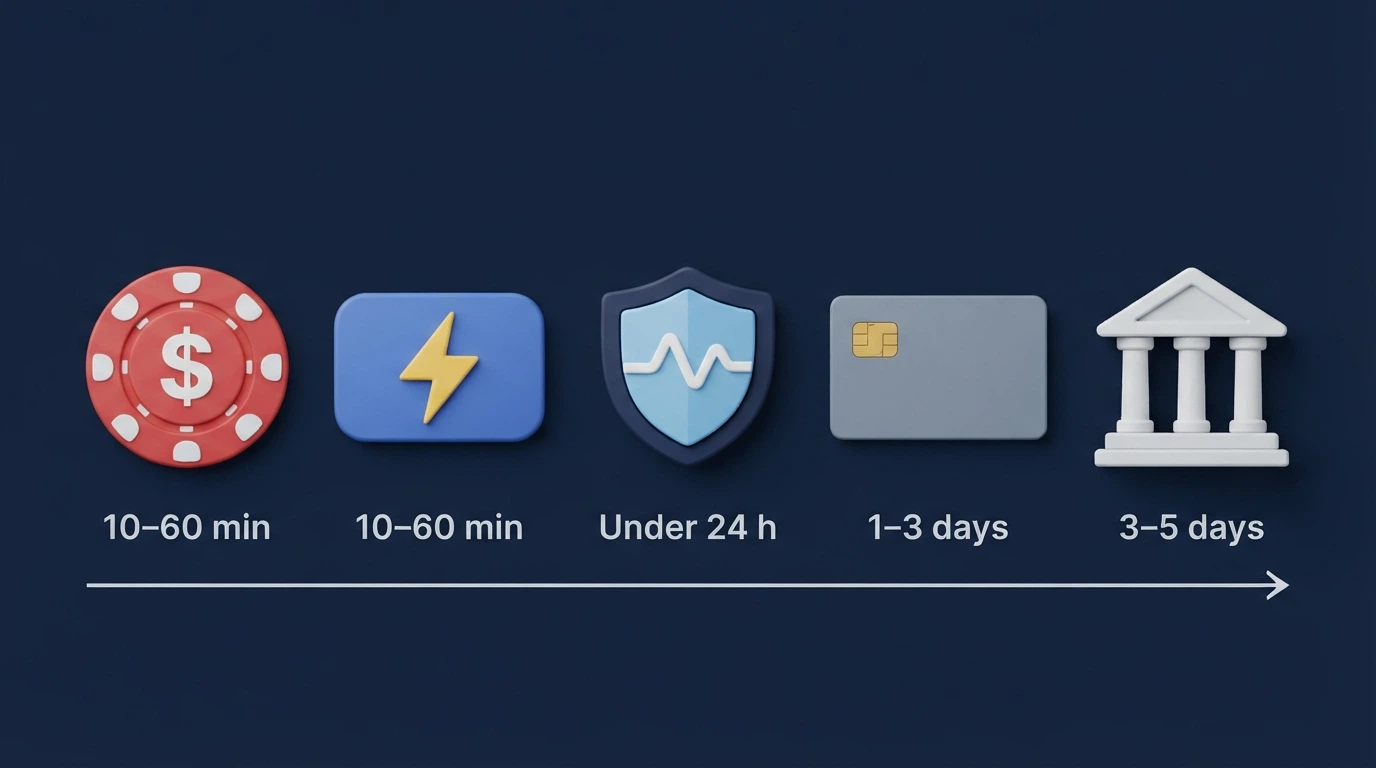
| Method | Typical Speed (Tested Median) | Casino-Side Processing | Availability at Featured Casinos | Notes |
|---|---|---|---|---|
| Crypto (BTC, LTC, USDT, SOL) | 10–60 min; median 42 min | 1–5 min (Stake) | Most featured operators incl. Stake, Rainbet, Skycrown, Rocket Play | Bitcoin adds 10–30 min network confirmation on top of casino time |
| PayID / Osko | 10–60 min; median 2 h | Operator-dependent | Variable; not surfaced at every featured brand | Replaced POLi, decommissioned 30 September 2023 |
| E-wallets (Neteller, Skrill, MiFinity) | Under 24 h; median 6 h | Operator-dependent | Variable; Bizzo cited Neteller at 0–24 h | Bizzo’s PayID–Neteller split is the cleanest published gap |
| Visa / Mastercard | 1–3 business days; median 2 days | Operator-dependent | Variable | Refunds-reversed direction; cross-border rules vary |
| Bank transfer | 3–5 business days; median 3 days | Long | Variable | Last-resort rail for large balances |
A credit card or crypto payment for online wagering in Australia has been banned since 11 June 2024 under the Interactive Gambling Amendment (Credit and Other Measures) Act 2023. The ban governs AU-licensed wagering services — not the offshore casinos on this page — but it is a regulatory signal about the risk profile of those routes. Penalties for the breach at licensed operators reach A$247,500.
POLi was decommissioned on 30 September 2023. AU players who remember POLi as their default deposit route are now routing through PayID, debit cards, and crypto. The page above treats PayID as the in-place substitute.
From Solana to Bank Transfer — The Real Method Hierarchy
Speed at the cashier runs from sub-five-minute crypto at one end to five-business-day bank transfer at the other.
Crypto tier. The fastest tested rail across the ranking is Solana at around four minutes, per a Stage and Cinema test at Moonbet. Bitcoin adds 10–30 minutes of network confirmation on top of operator-approved time. Litecoin and USDT sit in between, both with faster block times than Bitcoin and less network fee volatility. At the operator end, Stake’s 1–5 minute casino-side processing gives the cleanest published number on the page — once a player has topped up their crypto balance, the cash-out queues faster than any other rail and the network does the rest.
PayID / Osko tier. PayID runs on the New Payments Platform and clears in real time at the AU banking layer; the casino-side processing is what determines total time. Betsquare’s tested median was 2 hours, meaning most of that window is operator review rather than the rail. Mr Jones Casino’s verified PayID cash-out at around 2 hours, with unlimited max, is the cleanest published case. PayID is the in-place substitute for POLi and works for any AU player with a bank account; the constraint is whether the operator you picked actually supports it.
E-wallet tier. Neteller and Skrill run on internal e-wallet accounts that transfer to AU bank accounts separately. Operator-side processing varies — Bizzo’s Neteller tested at 0–24 hours per Ocean Road Magazine. E-wallets are useful for separating the gambling balance from the primary bank account; the speed is comparable to PayID once the operator’s queue clears.
Card tier. Visa and Mastercard refunds run one to three business days, with a 2-day median in the Betsquare test. They are a fallback for players whose other rails have failed, not a first choice for speed. Cross-border handling rules vary, and some AU banks treat a card refund from an offshore gaming merchant as a flagged transaction.
Bank transfer tier. Three to five business days, with a 3-day median. The slowest rail on the page, and the safest in the sense that every AU bank will accept the credit. Useful for large balances where the rails below cap out; useless for any reader who wants their money in the next 24 hours.
Withdrawal Limits — the Ceiling You Do Not See Until You Hit It
A fast rail means nothing if the casino caps you at A$2,500 a week. The figures below are the limits actually published by the operators on the page.
Fair Go’s structure is the most explicit: A$2,500 per transfer, A$7,500 weekly aggregate, A$30,000 monthly, A$100 minimum. A player who wins A$10,000 on a Saturday is withdrawing across four weeks, not in one go, and processing a separate 2-business-day window each time.
WinSpirit sits at USD 4,000 per day and USD 100,000 per month, with up to 72 hours pending before the rail engages. The daily figure is more generous than Fair Go’s; the per-transaction cap of A$2,000 means a larger win is sliced into multiple cash-outs anyway.
Rocket Play publishes daily ~A$3,750 / weekly ~A$7,500 / monthly ~A$22,500. The figures are estimates from the operator’s general tier structure rather than a single AUD-converted schedule; the ordering matches Fair Go’s weekly aggregate.
Rainbet is the no-maximum outlier. Minimum withdrawal USD 15, no maximum, crypto withdrawals 24–48 hours per the help centre. For a player withdrawing a 5-figure balance once a quarter, Rainbet’s policy is the cleanest on the page; for a player withdrawing A$200 twice a week, the minimums and processing time are the binding constraint rather than the cap.
For high-volume players, the offshore route has a different character. A A$100,000 win collected over six months at Fair Go would run into the monthly ceiling and the operator’s review discipline on every cash-out; the same win at WinSpirit would run into the daily ceiling and the 72-hour pending window on every cash-out; the same win at Rainbet would run into whatever the 24–48 hour help-centre window actually delivers on that day, without a hard ceiling. The shape of the experience, not the headline number, decides whether the experience is workable.
Which Pokies and Games Give You the Best Return
RTP is the percentage of total wagers a pokie returns to players, on average, over millions of spins. A 99% RTP pokie keeps 1 cent of every dollar wagered; a 94% pokie keeps 6 cents. During a bonus wagering run where a player must move thousands of dollars through a game before withdrawing, the difference between 99% and 94% is hundreds of dollars out of the player’s pocket before any win happens.

| Slot Title | Provider | RTP | Volatility |
|---|---|---|---|
| Mega Joker | NetEnt | 99.00% | — |
| 1429 Uncharted Seas | Thunderkick | 98.60% | Low |
| Blood Suckers | NetEnt | 98.00% | Low |
| Big Bass Bonanza | Pragmatic Play / Reel Kingdom | 96.71% | Medium-high |
| Gates of Olympus | Pragmatic Play | 96.5% | Extreme |
| Sweet Bonanza | Pragmatic Play | 96.51% | High |
| Aloha Cluster Pays | NetEnt | 96.42% | Low |
| Book of Dead | Play’n GO | 96.21% | High |
| Starburst | NetEnt | 96.09% | Low-medium |
RTP for those last six titles is not a guaranteed outcome on the page — Starburst, Aloha Cluster Pays and Blood Suckers are feasible placements because of their low volatility, which flattens the variance during a wagering run. Mega Joker requires maximum coin level for the 99% figure; below that, the slot runs closer to standard. The volatility column is filled only where research states it for the exact title; otherwise the em-dash stays.
Adjustable RTP is the wrinkle most players miss. Book of Dead ships at 96.21% in the standard build, but Play’n GO also offers 95%, 92%, and 91.2% versions — and an operator can serve any of them. Gates of Olympus carries the same risk: 96.5% in the top configuration, with 95.51% and 94.5% versions available at operator discretion. A player who assumes “Book of Dead” means 96.21% on every site is wrong, and the casino is not obligated to tell them which version they are playing. Big Bass Bonanza is similarly adjustable.
Pokies With the Highest RTP at AU-Accessible Offshore Casinos
Mega Joker at 99.00% is the standout. To hit that figure, the slot must be played at maximum coin level on the supermeter mode — sub-maximum play runs the slot closer to a standard 95–96% RTP. A wagering-runner treating Mega Joker as the default sees much better returns than a casual player spinning at minimum.
Blood Suckers at 98.00% on the standard build is the next-cleanest benchmark. Low volatility means small wins hit frequently, which is the right character for a bonus-clearing run: a player does not need a big multiplier, just a steady flow of small payouts that gradually approach the required turnover. The 98% RTP means roughly A$200 of expected house-edge loss across A$10,000 of turnover — compared to the A$600 expected loss at a 94% pokie on the same turnover.
1429 Uncharted Seas at 98.60% with low volatility sits in the same band. The Thunderkick release looks quieter than the NetEnt flagships, which is part of why the bonus-runner community values it — wins come more often, the bonus clears faster in real time, and the bankroll stays steadier through the run.
Starburst at 96.09% is the rollover workhorse. Low-to-medium volatility, simple mechanics, and a wide availability mean Starburst runs on essentially every featured operator’s wagering contribution list at 100% (the contribution a game makes to bonus clearing). A 96% pokie that contributes 100% to wagering clears the bonus about 4% slower than Blood Suckers at the same contribution rate; the difference is in the hours of real play rather than the multiplier itself.
The lower-RTP variants matter for the wagering-run calculus. A player clearing A$10,000 in turnover on Book of Dead at the 96.21% build loses roughly A$379. On the 91.2% build the same player loses A$880. The A$500 difference is the difference between keeping the bonus-derived win and losing most of it before the wagering gate opens.
Live Casino Tables and Game-Linked Withdrawal Rules
Live-dealer games — blackjack, roulette, baccarat — carry their own bonus-clearing conditions, and they are almost always worse for the player than pokies. The standard contribution structure at offshore operators sets pokies at 100% of wagered amount toward bonus clearing and live table games at 5% to 10%. A A$10 bet on live blackjack might contribute A$0.50–A$1.00 to the wagering requirement, not A$10.
The implications are mechanical. A player who clears a x40 wagering requirement on pokies at A$1 per spin must place A$8,000 of qualifying bets. A player who chooses to clear the same requirement on live blackjack at 10% contribution must place A$80,000 of qualifying bets to clear the same gate. The live game player is not playing against the house edge alone; they are playing a parallel timer where every dollar wagered contributes ten cents instead of a full dollar.
Live game RTP does not fix the contribution gap. Live blackjack at 99.5% RTP is excellent value, but at 10% contribution, the player would have to put A$80,000 onto tables to clear a standard x40 wagering requirement — versus A$8,000 on a 96% pokie at 100% contribution. The 99.5% RTP blackjack costs the player A$400 in house-edge on A$80,000 of wagers versus the 4% pokie’s A$320 on A$8,000 of wagers. The pokies run finishes first.
The wagering mechanics are set per operator and not standardised; specific contribution rates vary by brand and by promotion. A player intending to use live table games for bonus clearing should read the per-game contribution table on whichever offer they claim.
For withdrawal purposes (cleared funds, no bonus attached), live table games impose no special rules beyond the site-wide processing window. The contribution reduction is a bonus-only condition.
Mobile Casino Withdrawals on the Go
Mobile cashiers work. Every operator on this page runs a mobile-responsive site, and the in-app-versus-browser gap for withdrawals has narrowed enough that the difference does not materially affect the payout time. The PayID transaction that lands in 10 minutes on a desktop browser takes the same 10 minutes from a phone browser. The Bitcoin transaction that confirms in 12 minutes over a mobile wallet confirms at the same network speed regardless of which screen initiated it.
Where mobile differs is in friction. A phone screen on a casino app may hide the cashier behind a menu the desktop layout puts in plain view. A player who is mid-session and wants to set up a withdrawal may need to navigate an extra layer to reach the cash-out page. That friction does not affect payout time once the request is submitted; it affects how quickly the player gets around to submitting the request during a session.
Operator-specific mobile restrictions from research are absent on this run. None of the featured brands surfaced a mobile-only limit or a phone-app-withdrawal block. The right honest read is that the gap is a check the player should run themselves at the cashier, rather than a documented asymmetry that this page can warn about.
What No Casino Site Tells You About Your Withdrawal Rights in Australia
Every casino on this page is offshore. The reader should not have to chase that fact through the operator’s terms page; it sits as the foundation below everything else.

The Interactive Gambling Act 2001 makes it an offence to provide an online casino, online pokies or in-play sports betting to a person in Australia. No licence exists for those products anywhere in the country — not federally, not in any state or territory. The Australian Communications and Media Authority holds the enforcement role: investigating complaints, issuing formal warnings and civil penalty proceedings, referring operators to enforcement agencies, and directing ISPs to block illegal sites. Since November 2019, 1,564 illegal gambling and affiliate websites have been blocked at the Australian ISP level as of March 2026. More than 225 illegal services have withdrawn from the AU market since 2017.
The individual player is not prosecuted under the IGA. The Act targets the provider. What that does not give the player is recourse. There is no AU consumer protection for funds held by an offshore casino. There is no AU complaints body a player can bring a withdrawal dispute to. The ACMA cannot recover anyone’s money. A site blocked mid-balance still leaves that balance as a frozen ledger entry on the player’s account, recoverable only through whatever dispute path the operator’s own terms may or may not provide.
The shape of being unpaid at an offshore casino is that you are unpaid at an offshore casino. Those versions of the situation sit across every operator on this page.
Why No Online Casino Is Licensed in Australia — and What That Means for Your Withdrawal
The IGA 2001 prohibition is total for the products on this page. Online casino games, online pokies, and in-play sports betting are the prohibited services. What IS permitted and licensable is wagering on races and sport placed before the event begins, plus lotteries and keno, through operators licensed by a state or territory. The Northern Territory Racing and Wagering Commission, administered through Licensing NT, is the de facto national licensor for online wagering.
For an Australian player choosing to deposit at an offshore casino, the implication is structural. There is no domestic regulator a player can appeal to if an offshore operator refuses a withdrawal. The path that exists for licensed wagering — escalating to the state regulator, and through the regulator to dispute resolution — does not exist for casino play, because casino play is the prohibited product.
The 2026 reform widens the gap further. From 1 January 2027, banks and payment providers hold express authority to block transactions to illegal gambling operators. That authority applies to the AU side of the payment — the bank or ADI may decline the transaction at its own discretion. A player who had a working deposit-and-withdrawal cycle in 2026 may find the deposit leg blocked in 2027, and the operator’s offshore status means the operator has no AU-side legal pressure to maintain a withdrawal path.
Offshore Licences vs Australian Law — What Each One Actually Gives the Player
A Curacao or Anjouan licence is a corporate registration, not a consumer-protection framework.
- Curacao. A Curacao eGaming licence confirms the operator has paid a registration fee, filed corporate documents, and submitted to a basic code-of-conduct attestation. It does not require segregation of player funds, ombudsman-style dispute resolution, or monthly payout audits. The number of dispute cases that have been resolved through the Curacao regulator in favour of players is small enough to read as zero for most readers.
- Anjouan. The Anjouan licence framework operates under a lighter regulatory structure than some peer jurisdictions. The licence number is verifiable (Rainbet’s ALSI-152406029-FI2 issued 14 June 2024, expires 13 June 2027), but the consumer-protection overlay is comparable in scope to Curacao. None of the Anjouan-issued licence terms include a statutory Australian dispute path.
- No AU consumer protection. No Australian consumer protection law applies to funds held by an offshore casino. The Australian Consumer Law covers goods and services supplied in Australia; an offshore casino does not fit that definition. Section 18 of the ACL (misleading and deceptive conduct) does not reach operators outside Australian jurisdiction. A player lied to by an operator in a chat window has no Australian statutory path to dispute.
- No AU complaints body. BetStop, ACMA, state gambling regulators — none of these bodies has the authority to compel an offshore operator to pay a player’s withdrawal. ACMA can investigate and refer; the affected player benefits from the broader enforcement frame, not from any individual restitution path.
- The site can be blocked with a balance on it. ACMA blocks sites at the Australian ISP level. The site does not stop accepting money elsewhere, and the player does not lose the money locally, but their access to the casino cashier — for both deposit and withdrawal — can be cut at any moment. A player with A$5,000 sitting on an offshore brand on the morning of a blocking action sees that balance vanish behind a screen on their own ISP.
What the 2026 Reforms Change for Casino Payments
The Interactive Gambling Amendment (Gambling Reform) Bill 2026 passed Parliament on 19 August 2026; its measures commence on 1 January 2027. Three pieces of the reform affect the page directly.
Banks and payment providers gain express authority to block transactions to illegal gambling operators from 1 January 2027. The mechanism is at the AU payment side — an ADI or payment provider can decline a transaction to an offshore operator without the customer needing to opt in. The reform does not require the bank to block every transaction; it gives the bank permission to do so at its discretion.
Direct marketing of inducements is restricted from 1 January 2027: no targeting within 14 days of signup, no targeting for three months after BetStop deregistration, and indefinite exclusion for at-risk customers. Offshore casinos operating from outside Australia are not directly bound by AU advertising law, but AU affiliates, payment partners and marketing infrastructure become harder to use under the new framework.
Wagering advertising is capped at three ads per hour between 6:00 am and 8:30 pm, with a live-sport blackout from 15 minutes before to 5 minutes after live events. The cap applies to AU-facing advertising channels, not to the offshore operators’ direct marketing. The practical effect for offshore casinos is narrowed reach into AU channels, not a rewrite of their terms.
The credit-card and crypto payment ban has been in force since 11 June 2024 for AU-licensed wagering operators, with penalties of up to A$247,500 for non-compliance. The ban does not reach offshore casinos. The direction of the regulation is the same as where the 2027 reforms point — Australia is narrowing the payment routes to offshore operators rather than licensing them.
When Fast Withdrawals Become a Problem
The same speed that makes a casino attractive can make it dangerous for the player who needs a reflection gap. A withdrawal that clears in ten minutes is also a deposit that can clear in five — and the speed that returns winnings also removes the friction that might otherwise cool a hot streak.

About 2.1% of Australian adults — roughly 430,000 people — experience problem gambling, with high-risk gambling at 1.8% per the Australian Institute of Health and Welfare. The same speed, low friction and offshore nuance that this page recommends for the prepared player create the conditions that the BetStop register is built to interrupt.
BetStop, the National Self-Exclusion Register, has been live since August 2023. As at 31 July 2026, the register carried 67,480 registrations and 41,290 active exclusions. 78% of registrants were under 40; 38% chose lifetime exclusion. A BetStop registration excludes a player from every Australian-licensed online and phone wagering service in a single step.
The single concrete harm of the offshore route is this: BetStop binds AU-licensed wagering services only. An offshore casino is not connected to the register, and a player who has registered with BetStop can still deposit at any operator on this page.
Spotting the Warning Signs When Fast Cash-Outs Drive the Cycle
The behavioural red flag is the withdrawal request that is meant to fund the next deposit. A player who routinely withdraws winnings and immediately deposits them again is not cashing out; the operator is repackaging the same balance into a new session. The fast withdrawal makes the cycle shorter.
Offshore casinos are not bound by AU-mandated deposit limits or session-time reminders. The customer-set deposit limits that exist at AU-licensed wagering operators do not transfer to offshore brands. A player whose own discipline is the only brake on a runaway session will find the offshore route less restricted than any AU-licensed path they have used before.
The 2027 inducement ban speaks to the same dynamic. The 14-day post-signup freeze and 3-month post-BetStop deregistration freeze are built around the recognition that inducements accelerate play during vulnerable windows. AU-licensed operators will face those restrictions from January 2027; offshore operators will not.
Where to Get Help in Australia — Numbers, Sites and What BetStop Actually Covers
Three resources sit as the immediate help infrastructure for an Australian player who feels their gambling is moving faster than their decisions.
National Gambling Helpline: 1800 858 858. Free, confidential, staffed 24 hours a day. The line is operated by qualified counsellors and does not require a referral. Calls are anonymous to the operator; the only record is to the counselling service itself.
Gambling Help Online: gamblinghelponline.org.au. Online chat and email counselling, plus self-guided modules and information for family members affected by someone else’s gambling. The site runs alongside the 1800 number; either route reaches the same counsellor network.
BetStop: betstop.gov.au. The National Self-Exclusion Register. Registration is free and takes minutes; the exclusion applies to all Australian-licensed online and phone wagering services simultaneously. The minimum exclusion period is three months; longer periods and lifetime exclusion are also available. The critical limitation, again: BetStop reaches AU-licensed wagering only. A player who is using one of the offshore operators on this page will not be blocked from that operator’s cashier by BetStop.
If you or someone you know is worried about gambling, the helpline is the right next step at any hour.
How We Selected and Ranked the Casinos on This Page
The ranking uses four weights, in this order: tested withdrawal speed where independent data exists, withdrawal-limit generosity and structure, licence transparency as far as it can be verified, and bonus-term reasonableness as a tiebreaker only.
Where multiple data sources exist for the same operator, the higher-confidence source wins. Tested medians from Betsquare, CasinoWhizz and Stage and Cinema are preferred over operator-published figures because independent medians internalise both approval time and rail speed, while operator figures tend to publish only the second. Where two independents disagree, the slower figure is the one the table carries.
Operators whose withdrawal terms were not surfaced this run (Scream Casino, Royal Reels, Rocket Casino) sit below the threshold where licence verification and limit structure could move them. Their inclusion in the ranking reflects market presence, not payout quality — a brand with nine-figure revenue but no published processing window is harder to rank on this page’s terms than a brand with explicit tested speed data.
The research base assembled operator terms from operator websites, regulator and licence-register checks (where accessible), industry tested-medians from CasinoWhizz, Betsquare, and Stage and Cinema, regulatory and enforcement data from the Australian Communications and Media Authority, and harm-prevention reporting from the Australian Institute of Health and Welfare. KYC-specific guidance came from Gambling360. Where the round did not surface a figure, the gap is carried through as an em dash rather than bridged with an estimate.
No brand has been promoted above its evidence. No brand has been pushed down for personal reasons. The ranking is the best summary the inputs allow.
What Australian Players Should Actually Do About Fast Withdrawals
The verdict below is the same set of moves that anyone reading the previous sections would already have reached; it is collected here as a single itinerary so the reader does not have to retrace the page.
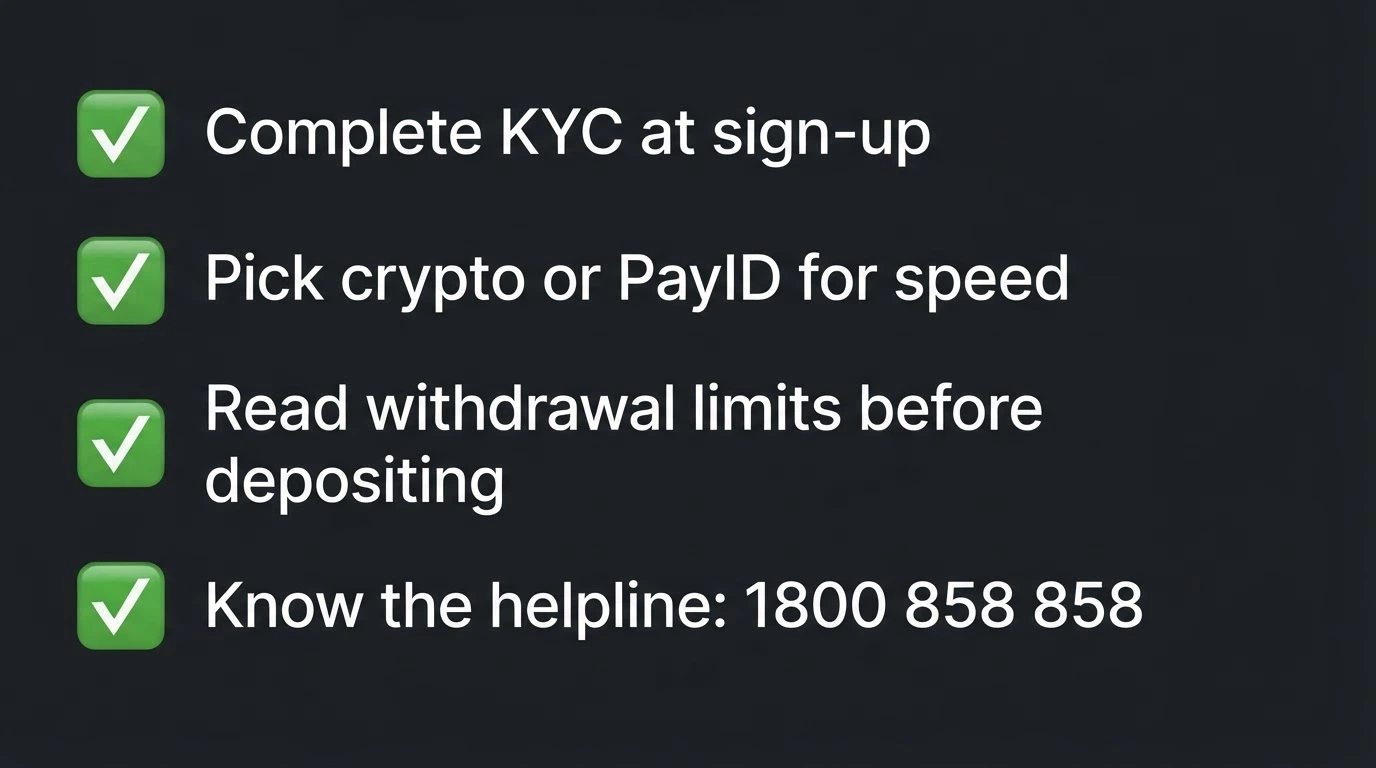
Complete KYC at sign-up. Upload ID, proof of address, and any source-of-funds documents the operator asks for at registration — not at withdrawal. The biggest delay a player can remove from their own first withdrawal is the queue they wait in while their KYC clears; that queue does not form if they finish verification before they hit the cashier.
Pick crypto or PayID for speed, AUD banking for limits. Crypto and PayID deliver the fastest end-to-end times in the tested data; AUD-native banking delivers the highest limits when a large balance needs to clear. The two routes are complementary rather than substitutable.
Read the withdrawal-limit schedule before depositing, not after. The A$2,500 weekly cap, the USD 100,000 monthly cap, the A$2,000 per-transaction cap — these numbers decide the experience at cash-out. A player who learns them only after a big win will be in a position of negotiating down, not planning up.
Treat any offshore casino balance as money you may lose to a site blockage. ACMA has blocked 1,564 illegal gambling and affiliate sites since November 2019. A balance on an offshore site on the morning of a blocking action is recoverable only on the operator’s terms, and “the operator’s terms” is not a path that produces reliable results.
Use BetStop for licensed wagering; know it does not reach the casinos on this page. A BetStop registration excludes from Australian-licensed wagering services in one step. It does not exclude from any operator above. If a player needs that exclusion, the offshore route is not safe alongside it.
Know the helpline number before anything else on this page. The National Gambling Helpline is 1800 858 858 — free, confidential, 24 hours a day. The number to keep is the number that does not require anything to be in motion before it is needed.
Every recommendation on this list follows from a figure the page has already established. There are no surprises in the closing, only the order of the moves.
Frequently Asked Questions
Are online casinos legal in Australia and can I get in trouble for playing?
No online casino holds an Australian licence, because no such licence can be issued. The Interactive Gambling Act 2001 makes it an offence to provide an online casino, online pokies or in-play sports betting to a person in Australia, with the Australian Communications and Media Authority as the enforcing regulator. The individual player is not prosecuted under the Act — it targets the provider, not the user. What an Australian player does not have, however, is recourse: no AU consumer protection covers funds held at an offshore casino, no AU complaints body can compel a payout, and the ACMA cannot recover balances on a player’s behalf.
Does BetStop cover offshore casino sites that accept Australian players?
No. BetStop, the National Self-Exclusion Register, binds Australian-licensed wagering services only. An offshore casino is not connected to the register. A player who has registered with BetStop can still deposit at any of the operators on this page, because the exclusion mechanism does not reach those brands. The 67,480 BetStop registrations as at 31 July 2026 cover AU-licensed wagering services and exclude from those services, not from the offshore brands outside the AU framework.
What is KYC verification and why does it slow down my first withdrawal?
KYC — “know your customer” — is the identity verification every legitimate operator runs before a first withdrawal. The casino requests a government ID, proof of address, and sometimes proof of source of funds, then reviews the documents before approving the cash-out. A first withdrawal request submitted before KYC has cleared goes into a longer queue; a first withdrawal request submitted after KYC has been completed at sign-up goes through pre-cleared, often with no wait. The biggest cause of a slow first payout is not the operator — it is the player’s own incomplete KYC.
Can I use PayID to withdraw winnings from an online casino in Australia?
PayID works at the offshore brands that support it as a withdrawal rail. Betsquare’s tested median for PayID at AU-aimed casinos is around 2 hours, including operator approval time — fast enough to sit alongside crypto on the leading tier. Not every operator on this page surfaces PayID for withdrawals; availability varies. POLi, the AU instant-deposit service many players previously used, was decommissioned on 30 September 2023, and PayID has filled that role for AU-aimed deposits and withdrawals at the operators that support it.
How do wagering requirements affect when I can withdraw bonus winnings?
Wagering requirements lock bonus-derived winnings behind a play-through wall until the multipled turnover has been met. An x40 wagering requirement on a A$200 bonus requires A$8,000 in qualifying bets before any bonus-derived withdrawal clears. Standard pokies contribute 100% of each wager to the requirement; live table games usually contribute 5–10%, which dramatically lengthens the time to clear the same bonus on the same playthrough. Bonus validity windows — typically 5 to 7 days across this ranking — add a hard time limit on top of the turnover requirement.
What happens if an offshore casino refuses to pay out my winnings in Australia?
Once an offshore casino refuses a withdrawal, the Australian player has no AU statutory path to dispute the decision. The Australian Communications and Media Authority can investigate the operator’s Australian-facing conduct but cannot compel an individual payout. The state and territory gambling regulators do not cover offshore casino operators. Curacao and Anjouan licences do not include the kind of dispute-resolution machinery a player might find at a UK-licensed brand. The realistic options are: negotiate directly with the operator, raise the dispute through whatever third-party process the operator advertises, and weigh the case for escalating through the payment provider — with the caveat that the new 2027 bank-blocking framework is more often a help to the bank than to the consumer.