
The Highest-RTP Pokies for Australian Players in 2026: Numbers, Operators and the Legal Picture
Current as of 22 November 2026 · Bonus and licence claims verified against the Curaçao Gaming Authority register, the ACMA enforcement register and operator terms pages where published.

Every online pokie an Australian spins in 2026 runs through an offshore casino. That is the single most important fact on this page, and almost every review site buries it. The Interactive Gambling Act 2001 makes it an offence to provide online casino games or online pokies to anyone in Australia. There is no licence for it. The Northern Territory licences wagering operators, and online pokies are a different product entirely. So when a punter searches for the best paying online pokies, the comparison they end up making is not between licensed Australian brands — there are none. It is between offshore operators that the Australian Communications and Media Authority is actively trying to block. That is the frame this page sits inside, and it shapes every number that follows.
This is not a “best casino” article. The page ranks the highest-RTP pokie titles research could verify, lays out the bonus terms and withdrawal speeds that the featured operators actually publish, and explains what the legal reality means for a punter who decides to play anyway. The reader picks the operator. The page just makes sure the decision is informed — by RTP, by wagering requirements, by the protection gap that opens the moment a deposit crosses to Curaçao or another offshore jurisdiction.
Table of Contents
- Why Your 2026 Pokie Payouts Are Smaller Than the RTP Advertises
- Which Online Casinos Actually Pay Out? 10 Ranked for Australian Players
- How Fast Can You Actually Get Your Money Out of an Online Casino?
- Online Pokies and Australian Law: The Rules Most Review Sites Skip
- The Help Most Pokie Players Never Find: Responsible Gambling in Australia
- How We Evaluated These Casinos
- What This Means for Your Next Pokie Session
- Frequently Asked Questions
Why Your 2026 Pokie Payouts Are Smaller Than the RTP Advertises
The return-to-player number a review site prints is usually not the number the casino loads. The gap between advertised RTP and the configuration the operator actually runs is the first thing a serious punter learns — and it is the reason a session can come in well below the figure the marketing promised.
What RTP Actually Means for Your Real-Money Play
Return-to-player is the share of every dollar wagered that the pokie returns to players, measured across millions of spins rather than one session. A 96% RTP pokie returns 96 cents for every dollar wagered in the long run; the remaining 4 cents is the house edge, the operator’s take built into every spin. The numbers are inverses: a 96% RTP means a 4% house edge, a 99% RTP means a 1% house edge, and so on.
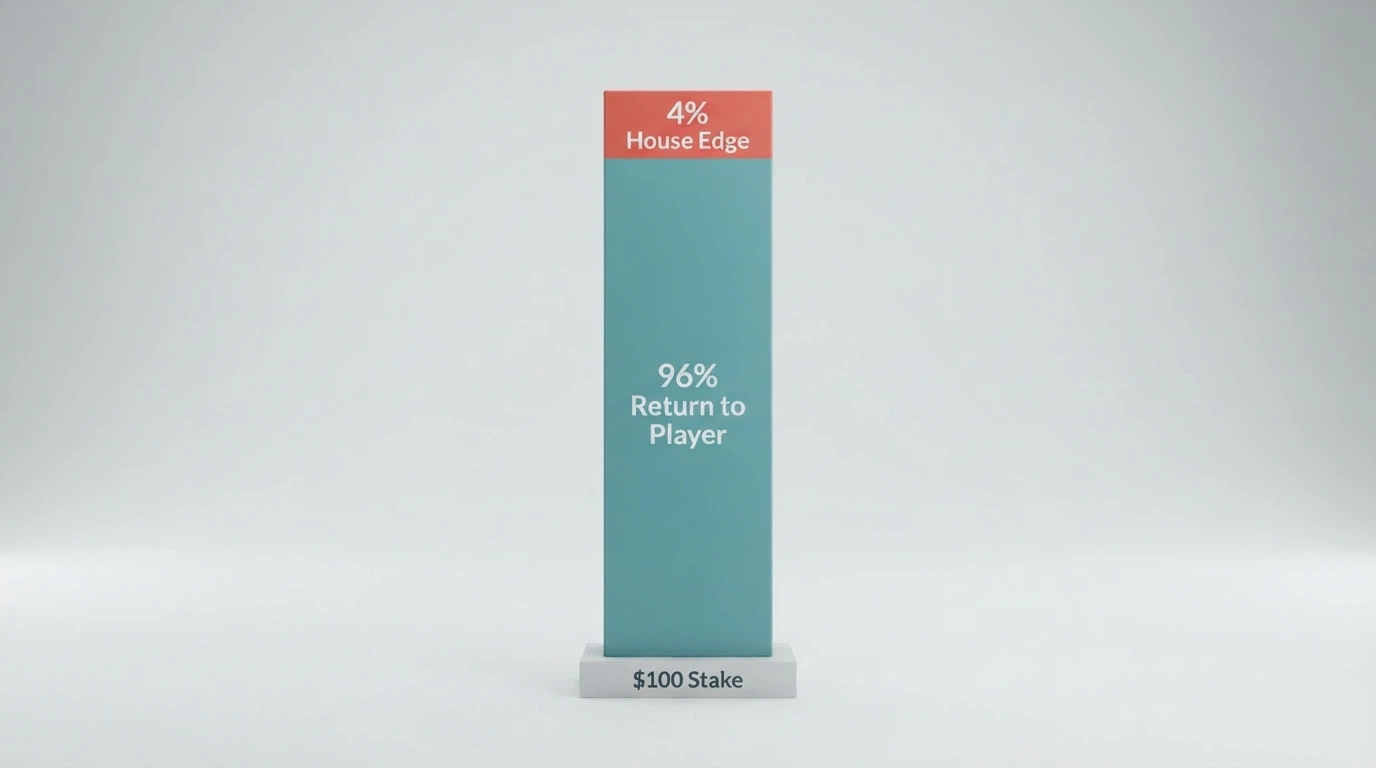
Over a thousand spins at A$1 each, a 96% pokie returns roughly A$960 on average — A$40 less than the punter put in. The figure averages out across the long run. In any single session, the punter can be hundreds of dollars ahead or behind that average. RTP is a statistical property of the game, not a forecast of the next hour.
The two configurations matter. Most modern pokies let the operator load more than one return-to-player version of the same title. Pragmatic Play’s Sweet Bonanza, for instance, runs at 96.48% in its base configuration but some operators load a reduced version at approximately 95.45%. The headline figure on the review site stays 96.48%; the figure on the casino’s server may not. Play’n GO’s Book of Dead is the same story: the headline RTP is 96.21%, but lower 94% and 92% versions exist. Big Bass Bonanza by Pragmatic Play / Reel Kingdom sits at 96.71% at its highest configuration and steps down to 95.67% or 94.78% on others.
Demo mode adds another wrinkle. Pokie demos almost always run at the highest available RTP configuration — the version that flatters the game’s reputation. Real-money play runs whatever configuration the operator has loaded. The 96.48% Sweet Bonanza a punter enjoyed in demo can be the 95.45% version the moment real money lands on the reels.
Highest RTP Pokies Available to Australian Players in 2026
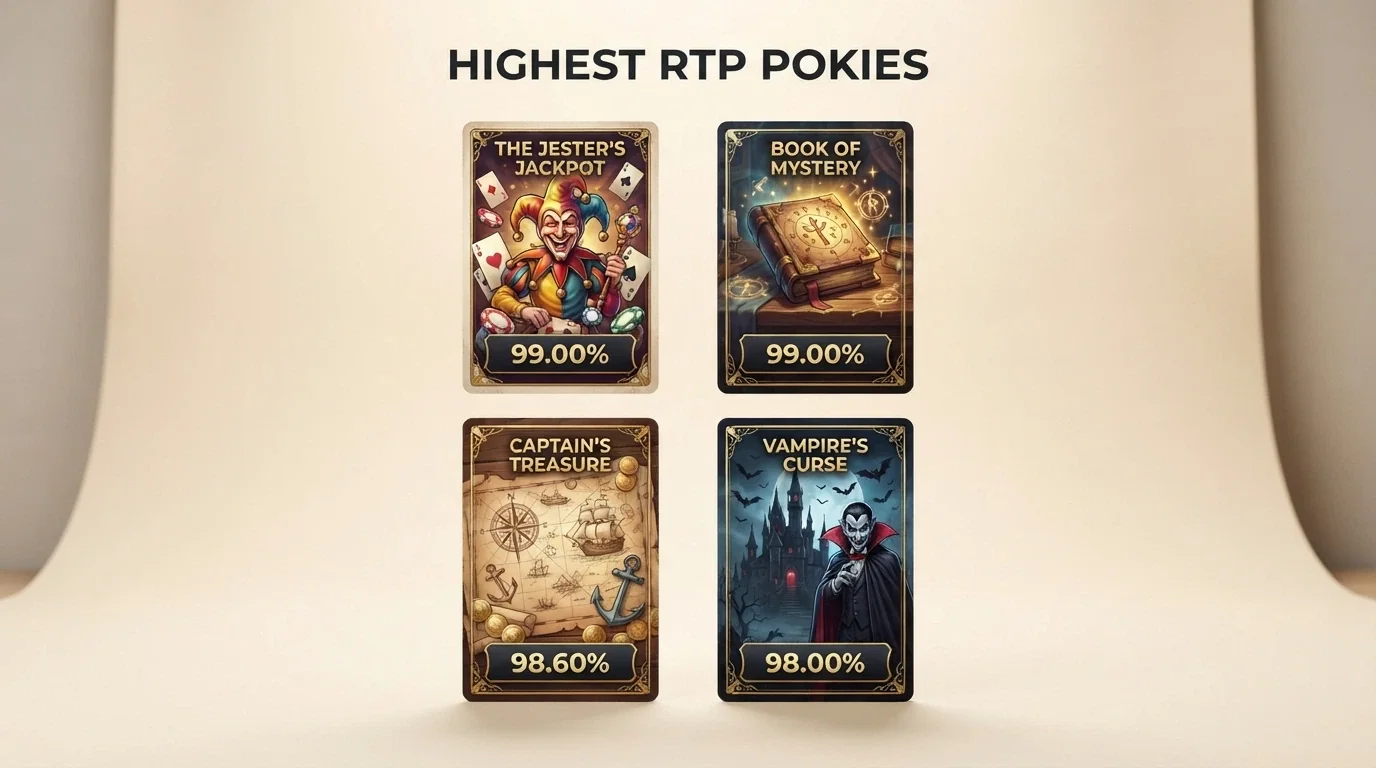
The table below ranks the pokie titles research carries a real RTP figure for, by that figure. The volatility and max-win columns are populated only where research confirms a specific value — anything research did not verify takes the no-data marker rather than a guess.
| Pokie | RTP | Provider | Volatility | Max Win |
|---|---|---|---|---|
| Mega Joker | 99.00% | NetEnt | Medium | 2,000x |
| Book of 99 | 99.00% | Relax Gaming | High | 12,075x |
| 1429 Uncharted Seas | 98.60% | Thunderkick | — | — |
| Blood Suckers | 98.00% | NetEnt | — | — |
| Big Bass Bonanza | 96.71% | Pragmatic Play / Reel Kingdom | Medium-High (4/5) | 2,100x |
| Gates of Olympus | 96.50% | Pragmatic Play | — | 5,000x |
| Sweet Bonanza | 96.48% | Pragmatic Play | High | 21,100x |
| Book of Dead | 96.21% | Play’n GO | High | 5,000x |
| Mega Moolah | ~88.12% | Games Global | — | — |
Three things to read off the table. First, the top end is a four-horse race: Mega Joker and Book of 99 at 99.00%, 1429 Uncharted Seas at 98.60%, and Blood Suckers at 98.00%. The first one carries medium volatility; the second runs hot. Second, Mega Moolah’s headline RTP sits around 88.12% — low by pokie standards — because a chunk of every spin feeds the progressive jackpot pool rather than the regular return. The trade is a chance at the Mega jackpot, which seeds at A$1,000,000. Third, the RTP-configuration warning applies to every Pragmatic Play and Play’n GO title in the middle of the table. The number printed is the ceiling, not a guarantee.
The dispersion in the table is real. The gap between Mega Joker’s 99.00% and Mega Moolah’s 88.12% is more than ten percentage points of house edge — roughly A$10 of every A$100 wagered over the long run, on top of the lower figure. Volatility decides how that dispersion shows up in a session, which is the next section’s point.
Volatility vs RTP: Two Numbers That Work Together
RTP is the average. Volatility is the shape of the road to that average. A high-RTP pokie with extreme volatility can drain a bankroll faster than a medium-RTP title with low variance, because high volatility concentrates payouts into rare, large wins and stretches the dry spells between them. On a 50-spin session, the high-volatility pokie may return less than the low-volatility one even though both have the same long-run RTP.
Of the titles research carries volatility data for, the spread is sharp. Mega Joker sits at medium volatility — frequent small wins, occasional Supermeter bonus rounds that push the RTP up to its 99.00% peak. Book of 99 runs hot; the headline 99.00% RTP is meaningful only across the volume of spins a serious bankroll supports. Book of Dead and Sweet Bonanza are both high volatility; the 21,175x max win on Sweet Bonanza is what the volatility buys. Big Bass Bonanza sits at Medium-High (4/5), closer to the middle.
For Blood Suckers, 1429 Uncharted Seas and Gates of Olympus the volatility class is not confirmed from a public source this review — the RTP figures research carries for those titles are reliable, but a volatility reading should come from a provider sheet rather than a guess. Mega Moolah’s volatility is broadly understood to be high given the progressive jackpot structure, but research did not pin a class to it this run.
A punter with a A$50 bankroll cares more about volatility than RTP. The 99% pokie that goes 200 spins without a feature round does not help anyone whose bankroll is gone by spin 80. The medium-volatility title with a 96% RTP — closer to the middle of the table — usually gives a session that lasts longer, with more small wins to extend the run. RTP dominates over months of play. Volatility dominates over an evening.
No-Deposit Bonus Offers: What They’re Really Worth
A no-deposit bonus sounds like free money. The wagering requirement and the maximum cashout cap decide whether it actually is. Royal Reels Casino is the only featured operator that publishes a no-deposit offer — A$10 free on sign-up, with 30–40x wagering attached. The arithmetic runs quickly.
At 40x, a A$10 no-deposit bonus requires A$400 of turnover before any winnings become withdrawable. At 30x, the figure drops to A$300. Either way, the punter is grinding through the requirement on bonus terms — typically with a maximum bet cap, a restricted game list and an expiry window attached. The “free” A$10 becomes the entry price for a constrained wagering task with no certainty of any return.
The maximum cashout cap is where the marketing collapses. Most no-deposit offers cap withdrawable winnings from the bonus at a small fixed figure, often A$50 to A$100. A punter who turns A$10 of bonus money into A$400 of winnings during the clearing window cannot withdraw A$400; the cap eats the surplus. The offer is, in practical terms, a small amount of risk-free pokie play with a hard ceiling on the upside. That can be worth taking for a punter who wants to test a casino before depositing. It is not a profit opportunity.
The other nine operators in this comparison do not advertise a deposit-free welcome. That is consistent with the offshore market in 2026: no-deposit offers cost the operator money on players who never convert, and most have moved to deposit-gated packages instead. The Royal Reels A$10 is the exception, and the maths above shows why most operators leave it out.
The Offshore Reality Every Australian Player Faces
The offshore status of every operator on this page is not a footnote. It is the headline. The Interactive Gambling Act 2001 prohibits providing online casino games and online pokies to persons in Australia, and the prohibition has no Australian licence attached. The Australian Communications and Media Authority enforces it. Since November 2019, the ACMA has directed Australian ISPs to block 1,788 illegal gambling and affiliate websites — a figure reported as of August 2026. Over 230 illegal gambling services have withdrawn from the Australian market since ACMA enforcement began in 2017.
These numbers do not make the offshore market disappear. They make it harder to reach. New sites appear faster than the ACMA can block them, and the operators that remain accessible through VPNs, mirror domains and aggregator sites are the ones this page covers. The licensed alternative — Sportsbet, TAB, bet365, Ladbrokes and the roughly 150 to 190 other NT-licensed wagering brands — is licensed for sports and racing wagering, not for online casino games. A punter looking for online pokies is not choosing between an Australian-licensed casino and an offshore one. There is no Australian-licensed casino.
The consequences of that fact are the subject of the legality section further down. For the operator ranking that follows, the practical point is this: a Curaçao licence number printed on a casino’s footer is a real registration in a foreign jurisdiction, and it is the strongest claim to oversight any operator in this comparison makes. Most operators in this comparison do not even publish that.
Which Online Casinos Actually Pay Out? 10 Ranked for Australian Players
Every operator in the table below is offshore. None holds an Australian casino licence, because no such licence exists. The ranking weighs what research could verify — a Curaçao registration number in a public register, a published bonus term with a wagering multiple, a withdrawal time tested by a third party, a game library a source has counted — and reflects honestly where those verifications stopped.

| Casino | Licensed in Australia |
|---|---|
| RocketPlay Casino | No (offshore) |
| SkyCrown Casino | No (offshore) |
| Royal Reels Casino | No (offshore) |
| WinSpirit Casino | No (offshore) |
| Stake Casino | No (offshore) |
| Rainbet Casino | No (offshore) |
| Scream Casino | No (offshore) |
| FairGO Casino | No (offshore) |
| Bizzo Casino | No (offshore) |
| Rocket Casino | No (offshore) |
The legal status row repeats for a reason: it is the single most important fact about every operator on the list, and a table is the clearest way to make it unmissable. The substantive differences between these operators live in the bonus terms, the withdrawal speed and the verifiable licence status — the subject of the sections that follow.
How We Rank Payout Strength
Payout strength is not one number. Five things go into the ranking this page applies, weighted toward what is verifiable rather than what is marketed.
The first is licence verifiability. A Curaçao licence number that resolves in the regulator’s public register is a thin but real check on an operator. An unverified licence claim — or no licence claim at all — is no check at all. RocketPlay publishes a Curaçao registration (OGL/2024/1307/0748 per one source, OGL/2023/174/0082 per another; both numbers appear in the wild, primary verification is not confirmed this run) and identifies its operator as Scores55 Tech B.V. Stake publishes its operator as Medium Rare N.V. under a Curaçao framework. The remaining eight operators in this comparison either do not publish a verifiable registration or the registration could not be confirmed from a primary source this review.
The second is bonus-term transparency. A welcome bonus with a clearly published wagering multiple, a maximum bet cap and a max cashout limit is auditable. A bonus with vague terms is not. Royal Reels publishes its welcome bonus terms clearly: 100% up to AUD 500 with 30–40x wagering, plus the AUD 10 no-deposit bonus described earlier. RocketPlay publishes 40x wagering on both bonus and free-spin winnings, with a maximum bet of approximately A$7.50 while clearing. SkyCrown publishes 40x wagering and an A$500 per-bonus maximum cashout. For the remaining seven operators, the bonus terms were either not confirmed from a primary source or were not surfaced at all.
The third is game-library depth, where verifiable. RocketPlay’s 3,000-plus pokies count was sourced from multiple reviews and is consistent with the operator’s own listing. Royal Reels’s 2,000-plus games from 30-plus providers, including Pragmatic Play, Evolution Gaming, Yggdrasil and Hacksaw Gaming, was confirmed from a third-party source. SkyCrown’s 300-plus game count sits well below the others — a smaller operation or a less complete catalogue.
The fourth is withdrawal-speed evidence. The clearest published test in this set is SkyCrown’s crypto cashout landing in under 15 minutes, with bank transfers taking 1–3 business days. General market data puts PayID withdrawals at offshore casinos serving AU players at 1–2 hours and crypto withdrawals at 5–15 minutes, but only SkyCrown had a published, named test result this review could cite. For the rest, withdrawal speed is an inference from category, not a measurement.
The fifth is operator-background clarity. Who runs the casino, where it is registered, what other brands the operator runs — these answers separate a known entity from an opaque one. RocketPlay and Stake are the two clearest on this front. The others sit at varying levels of opacity.
What the ranking does not weight is headline bonus size. SkyCrown’s A$4,000-plus-free-spins welcome package is the largest in the set on paper, but the A$500 per-bonus max cashout cap and the 40x wagering bring the real value back to the middle of the pack. Headline size without the conditions attached is marketing, not a payout.
A worked example makes the arithmetic concrete. RocketPlay’s A$2,000 welcome bonus at 40x wagering means A$80,000 of required turnover before any bonus winnings become withdrawable. If a punter clears that turnover exclusively on Mega Joker at its 99.00% RTP, the expected loss on the bonus alone is A$80,000 multiplied by the 1% house edge — A$800. That is the average cost of clearing the offer on the highest-RTP title available. It assumes only the bonus amount is wagered (not deposit plus bonus), and it is an estimate across many spins rather than a guaranteed outcome. Run the same arithmetic on Big Bass Bonanza at 96.71% and the expected loss rises to A$2,632. The headline bonus shrinks the further down the RTP table a punter plays.
RocketPlay Casino
RocketPlay is the most verifiable operator in the comparison. The Curaçao licence number is published, the operator entity — Scores55 Tech B.V. — is named on the site, and the game library is the largest in the set at more than 3,000 pokies, drawing from NetEnt, Pragmatic Play, Evolution and others.
The welcome bonus is 100% match up to approximately A$2,000 plus 100 free spins, with 40x wagering on both the bonus and the free-spin winnings. The free spins release in daily batches of 20 over five days, on Aztec Magic Deluxe. The maximum bet while clearing the bonus is around A$7.50 — a cap a serious punter will hit quickly on a high-variance title, which slows the clearing rate.
What is not confirmed from a primary source is the bonus validity window and the maximum cashout from the bonus. Those are the two numbers a serious punter wants to see before claiming. Without them, the offer is auditable on the wagering side and opaque on the time-and-cap side.
Verdict: RocketPlay is the most transparent operator in this set. The wagering requirements, betting caps, and game library are all verifiable. While bonus validity and cashout limits remain unconfirmed, the operator provides enough published information to allow for an informed decision before signing up.
SkyCrown Casino
SkyCrown leads the set on headline bonus size — up to A$4,000 plus 350–400 free spins across multiple deposits, with 40x wagering and a 10% crypto cashback. The crypto cashback is a differentiator: a punter who plays in Bitcoin or Ethereum gets a steady return on net losses that no other operator in this set publishes.
The cap cuts the headline down to size. The A$500 maximum cashout per bonus is the single most important number on SkyCrown’s welcome package. A punter who wins A$2,000 clearing the bonus cannot withdraw A$2,000 — A$500 is the ceiling. Across a multi-deposit package, the caps multiply per bonus, which can work in the punter’s favour if the wins are small or against them if the wins concentrate.
The crypto withdrawal speed is the cleanest verification in this set: published tests show cashouts landing in under 15 minutes. For a punter who funds in crypto and is happy to convert to AUD separately, SkyCrown is the fastest exit on this page. Bank transfers take 1–3 business days, which is the same as the offshore casino norm.
The gaps are substantial. SkyCrown’s licence, operator entity and licence date were not confirmed from a public register this review. The bonus slot title and its RTP for the free-spin portion of the package were not confirmed either. What is verifiable is the wagering multiple, the cashout cap, the crypto cashback and the withdrawal speed.
Verdict: SkyCrown is the right pick for a punter who values crypto payout speed over complete licence transparency, and who plays with stakes small enough that the A$500 cap does not bind. For anyone chasing the A$4,000 headline, the cashout cap is the number that does the work.
Royal Reels Casino
Royal Reels is the only featured operator with a confirmed no-deposit bonus — A$10 free on sign-up — and is one of three operators in the set with bonus terms verifiable from a third-party source.
The welcome bonus is 100% match up to AUD 500 with a minimum deposit of AUD 30, plus the A$10 no-deposit bonus. Wagering is 30–40x, with the exact figure varying by promotion. The game library is more than 2,000 titles from 30-plus providers, including Pragmatic Play, Evolution Gaming, Yggdrasil and Hacksaw Gaming. That is the second-largest catalogue in the set after RocketPlay, and the named provider list is the most varied.
The licence behind Royal Reels is opaque. No licence number, operator entity or jurisdiction was confirmed from a primary source this review. The A$10 no-deposit offer is verifiable, the game library is verifiable, and the bonus structure is verifiable. The regulatory foundation is not.
Verdict: Royal Reels is the operator in this set that gives a punter the most concrete terms to read before depositing — bonus amount, wagering range, minimum deposit, game library and provider list. What the licence page should say is the gap. The A$10 no-deposit is a free test of the platform if the punter treats the terms as published and does not assume any oversight beyond that.
WinSpirit Casino
WinSpirit appears in third-party listings with 40x wagering cited as industry standard. No confirmed welcome bonus amount, no confirmed free spins count, no confirmed licence, operator entity, game count or withdrawal data was surfaced from a primary source this review.
The 40x wagering figure is not an operator-specific term; it is the market norm this page applies to several operators. Citing it as WinSpirit’s wagering is closer to citing the weather than measuring the operator. Without a published welcome bonus to attach the 40x to, the figure says nothing about what a punter would actually clear.
Verdict: a single sentence, because the data does not warrant more. WinSpirit is an operator whose terms were not surfaced from a verifiable source this review, and a punter who chooses it is doing so on a brand name rather than on published conditions.
Stake Casino
Stake is a major international brand operated by Medium Rare N.V. under a Curaçao framework — verifiable from the operator’s own corporate disclosures. The brand recognition is real. The name carries weight in the offshore casino market that smaller operators do not.
What this review could not confirm from a primary source is the welcome bonus amount, the free spins count, the wagering multiple, the game library size and any pokies-specific terms. Stake’s promotional structure is unusual in that it leans heavily on ongoing rewards and sports betting offers rather than a headline casino welcome, which may explain the absence of a casino welcome package from the sources reviewed. The lack of confirmation is not the same as a lack of offer; it is the limit of what this review verified.
Verdict: Stake is a known name with a known operator behind it. The Curaçao framework is a real registration. The gap is the casino welcome offer, which a punter will need to check directly on the operator’s site before assuming this page’s silence on it means silence at the source.
Rainbet Casino
Rainbet is in the featured set, but research carries zero confirmed specifics — no licence, no operator entity, no bonus amount, no wagering multiple, no game count, no withdrawal data. That is not the same as saying the operator is bad. It is saying this review found nothing to verify.
For a punter, the practical meaning is straightforward: every comparison this page makes between Rainbet and the other nine operators is incomplete. The bonus terms, the withdrawal speed, the licence status — all unknown from a public source.
Verdict: a punter choosing Rainbet over an operator with verifiable terms is choosing on brand recognition alone. That is a legitimate choice for some punters, but it is a different choice from the one a comparison page can support.
Scream Casino
Scream sits in the same position as Rainbet in this comparison: zero confirmed specifics from a public source this review. No licence, no operator, no bonus, no wagering, no game count, no withdrawal data.
Verdict: until a primary source confirms the terms, Scream is merely a brand name in this list rather than an evaluated operator. Anyone arriving at Scream through an affiliate link should treat it as an unverified site and verify all terms directly on the operator’s platform before engaging.
FairGO Casino
FairGO’s name suggests an Australian-facing brand — and that is the entirety of what can be said about it from this review’s sources. No licence, no operator entity, no bonus amount, no wagering multiple, no game count and no withdrawal data was confirmed.
The name is not the regulatory status. A brand name that reads as Australian is not licensed in Australia. No online casino is.
Verdict: a brand name that signals “Australian” without the Australian licence — because there is no Australian online casino licence to hold. The mismatch between the name and the legal reality is the only verifiable fact about FairGO from this review’s sources.
Bizzo Casino
Bizzo is another operator in the set without verifiable specifics this run. No licence, no operator, no bonus, no wagering, no game count, no withdrawal data surfaced from a primary source.
Verdict: Bizzo is included in this comparison because it appears in the same affiliate sources as the verified brands, yet no data could be confirmed this review. Anyone interested in Bizzo should visit the operator’s own site to review its terms and licensing claims independently, as this comparison cannot attest to its transparency.
Rocket Casino
Rocket Casino is not RocketPlay. They are separate brands with similar names — easy to confuse in search results, easy to land on the wrong one through a mistyped URL or an aggregator redirect. RocketPlay has the verifiable Curaçao registration and the documented 3,000-plus game library. Rocket Casino has none of those confirmed from a public source this review.
Verdict: the name similarity is a navigation hazard, not a relationship. Anyone intending to visit RocketPlay should verify the operator entity (Scores55 Tech B.V.) on the site before depositing. Conversely, Rocket Casino remains an unverified unknown, and it should be approached with extreme caution.
Licensed Wagering vs Offshore Casinos: What the Comparison Actually Shows
The split inside the operator table is between the few with verifiable Curaçao licences — RocketPlay and Stake, with partial information elsewhere — and the majority whose regulatory foundation is opaque. The real comparison is not between Australian-licensed and offshore. There is no Australian online casino licence. The real comparison is between offshore operators that publish their terms and operators that do not.
A Curaçao licence is not equivalent to an Australian licence. The Curaçao Gaming Authority oversees its licensees to a foreign-jurisdiction standard, and an Australian punter cannot escalate a dispute to an Australian regulator. What a Curaçao registration does provide is a named operator entity, a public register entry and a thin layer of regulatory contact if a withdrawal is refused.
Licensed Australian wagering operators — Sportsbet, TAB, bet365, Ladbrokes and the rest — are licensed by the Northern Territory Racing and Wagering Commission. They cannot offer online casino games or online pokies, because the IGA prohibits those products. A punter who wants to bet on the Melbourne Cup or a Saturday arvo cricket multi is well served. A punter who wants to spin a pokie is not. BetStop, the National Self-Exclusion Register, binds only these licensed wagering providers. It does not cover a single offshore casino on this page.
How Fast Can You Actually Get Your Money Out of an Online Casino?
Payout speed is the most concrete operational test of an offshore casino. The marketing claims hours; the bank statement shows days. The gap between the two is the operator’s actual payment discipline, and it is what a serious punter learns to measure.
Payout Rate vs Payout Speed: Two Different Things
Payout rate and payout speed are not the same metric. Payout rate is the return-to-player across the games — the subject of the first half of this page. Payout speed is how long it takes a confirmed win to land in the punter’s bank account. A casino can have a high payout rate and slow payout processing, or fast withdrawals and low-RTP titles. The two should be checked separately.
For payout rate, the table earlier in this page is the source. For payout speed, the next subsection covers the methods.
Fastest Withdrawal Methods for Australian Players
The fastest rails come with their own trade-offs, and the method the casino offers is not always the method the punter’s bank supports.
PayID and Osko clear PayID withdrawals at offshore casinos serving Australian players in roughly 1–2 hours for AU bank accounts. PayID is the instant-payment rail that most Australian banks now support, and it is the fastest legitimate AUD route out of an offshore casino. The method is independent of the casino; the rail is the bank’s.
Crypto is faster by clock but harder by conversion. Crypto withdrawals clear in approximately 5–15 minutes, and SkyCrown’s published test shows crypto cashouts landing in under 15 minutes. The conversion to AUD happens off the casino’s balance sheet — the punter receives Bitcoin or Ethereum and converts through an exchange or wallet. The exchange adds its own fee, its own spread and its own delay on the AUD side.
Bank transfers are the slow method. A standard bank transfer from an offshore casino to an Australian account takes 1–3 business days. The processing time at the casino’s end is usually 24–48 hours; the rest is the bank clearing. For a punter who is not in a hurry, bank transfer is the cheapest route. For a punter who is, it is the slowest.
Card withdrawals are usually slower than bank transfers and rarely instant. The legacy method of refunding to the original deposit card has processing times that depend on the card issuer and can stretch to 5 business days.
POLi, an Australian direct-debit service that was widely used by AU-facing casinos, was decommissioned on 30 September 2023. AU deposits in 2026 run through PayID, cards or crypto.
One important caveat on the payment-method side: the credit-card and crypto payment ban that took effect on 11 June 2024 applies strictly to Australian-licensed wagering operators, not to offshore casinos serving Australian players. While a licensed operator accepting credit cards faces penalties of up to A$247,500, offshore casinos are not subject to these penalties because the IGA already prohibits the product entirely. Consequently, anyone funding an offshore casino account with a credit card does so outside the protection of Australian law.
Cash Payouts and AU Withdrawal Limits
Withdrawal caps at offshore casinos are common, and they are usually hidden in the bonus terms rather than the main cashier page. The SkyCrown A$500-per-bonus cap is the clearest example in this set — and it is the kind of cap that turns a headline win into a much smaller withdrawable figure.
Identity verification is the friction every punter hits on first withdrawal. Offshore casinos licensed under any reputable jurisdiction require KYC documentation: a government ID, a proof of address and often a proof of the deposit method. The verification can take 24–72 hours on first submission. Subsequent withdrawals usually clear faster, because the KYC file is on file.
The protection gap is the part no offshore casino page tells a punter about. The ACMA cannot recover player funds from an offshore operator. There is no Australian ombudsman to escalate a refused withdrawal to. The only recourse is the casino’s own internal dispute process, and then — if the operator holds a verifiable Curaçao registration — a complaint to the Curaçao Gaming Authority through its licensing portal. Both routes are slower, more expensive and less certain than escalating a complaint to an Australian regulator.
A withdrawal that is refused — for an alleged bonus-term breach, for a KYC failure, for any reason — leaves a punter with two options: pursue the operator through its own channels, or walk away. There is no third option backed by Australian law.
Online Pokies and Australian Law: The Rules Most Review Sites Skip
The legal frame is not a footnote at the end of the page. It is the condition every other section assumes. Most affiliate review sites treat offshore casinos as if the legal question were settled in the punter’s favour. It is not. The Interactive Gambling Act 2001, the ACMA’s enforcement record and the 2026 reform are the three pieces every Australian punter should understand before they deposit.

The Interactive Gambling Act: What It Actually Prohibits
The IGA 2001, strengthened by the Interactive Gambling Amendment Act 2017, makes it an offence to provide online casino games, online pokies and in-play sports betting to a person in Australia. The 2017 amendments closed the loopholes offshore operators had been using and gave the ACMA its enforcement and ISP-blocking powers.
What is prohibited is providing the service. Online casinos, online pokies and in-play betting on sporting events once started are all on the prohibited list. What is permitted and licensable is wagering on races and sport placed before the event begins, lotteries and keno. These products are licensed by state and territory regulators, with the Northern Territory Racing and Wagering Commission acting as the de facto national licensor for online wagering. Large bookmakers — Sportsbet, bet365, Ladbrokes and about fifty others — hold NT licences running for terms of up to 20 years.
The prohibition targets the provider, not the player. The IGA does not make it an offence for an Australian resident to gamble at an offshore casino. The player is not prosecuted. The provider is — when the ACMA can reach it, which is rarely when the operator is incorporated in Curaçao and runs its servers in another jurisdiction.
State and territory licensing is the parallel layer. The Northern Territory takes a 5% wagering tax on wagers minus payouts plus a 0.05% racing levy. State point-of-consumption taxes typically range from 10% to 15% of net wagering revenue. These are operator-side taxes, not player-side. For a punter, the tax side is simpler: gambling winnings are not assessable income for ordinary punters under section 6-5 of the ITAA 1997, and losses are not deductible under section 8-1. No Australian case has held ordinary punter winnings assessable.
ACMA Enforcement: 1,788 Sites Blocked and Counting
The ACMA is the federal regulator that enforces the online prohibition. It investigates complaints, issues formal warnings and civil penalty proceedings, and directs ISPs to block illegal services.
The blocking mechanism is the most visible enforcement tool. Since the ACMA made its first blocking request in November 2019, 1,788 illegal gambling and affiliate websites have been blocked by Australian ISPs as of August 2026. Over 230 illegal gambling services have withdrawn from the Australian market since ACMA enforcement began in 2017. The withdrawal numbers show operators deciding the Australian market is not worth the regulatory heat; the blocking numbers show the operators that stayed.
The Tabcorp case from January 2026 shows the ACMA will enforce even against large, licensed operators. The ACMA issued eight infringement notices totalling A$158,400 after finding Tabcorp had provided a prohibited in-play betting service in contravention of subsection 15(2A) of the IGA. The case is a reminder that the prohibition covers licensed wagering operators as well as offshore casinos, and the ACMA’s enforcement is not limited to the offshore end of the market.
For a punter with a balance on a blocked site, the practical consequence is severe. The casino domain stops resolving through Australian ISPs. The casino’s payment processors can be blocked too. Any balance the punter held at the time of blocking becomes very difficult to access. Offshore casinos do not have a customer-service phone number an Australian punter can call to recover funds, and the ACMA does not have a recovery mechanism for player money on offshore sites.
The 2026 Reform: What Changes From Next Year
The Interactive Gambling Amendment (Gambling Reform) Bill 2026 passed Parliament on 19 August 2026. Its measures commence on 1 January 2026. Four changes matter for anyone reading this page.
Advertising is capped. From 1 January 2026, wagering advertising on television and radio is limited to three ads per hour between 6:00 am and 8:30 pm, with a live-sport blackout from 15 minutes before a live event to 5 minutes after. The live-sport blackout is the sharper restriction — it cuts wagering advertising away from the moment a viewer is most likely to act on it.
Promotion is restricted. Athletes, celebrities and influencers are barred from promoting wagering products. Broadcasting sporting odds is banned outright. The intent is to reduce the social proof wagering advertising currently borrows from sporting culture.
Inducements are constrained. Direct marketing of inducements — bonus offers, free bets, “join now and get” — is prohibited for 14 days after a customer signs up with a wagering operator, and for three months after a customer deregisters from BetStop. The 14-day rule targets the immediate post-signup churn marketing that licensed operators currently rely on; the three-month rule closes the loophole that previously let recently self-excluded customers be re-targeted.
Banks gain new powers. From 1 January 2026, banks and payment providers gain express authority to block transactions to illegal gambling operators. The mechanism is not yet operational in detail — banks will need to identify illegal-operator transactions, which requires a list, which requires coordination with the ACMA. The statutory authority is the change; the operational rollout is the next phase.
The reform is a wagering-side reform. It does not legalise online casino. It does not create an Australian online casino licence. The offshore prohibition remains, and the ACMA’s blocking authority continues. What the reform does is reshape how licensed wagering operators reach Australian customers, and gives banks a new tool against the offshore market.
What Happens If You Play at an Offshore Casino
The player is not prosecuted. That much is clear under the IGA. What the player gives up is everything else.
There is no Australian consumer protection for offshore disputes. The Australian Competition and Consumer Commission does not have jurisdiction over an operator in Curaçao. The Australian Financial Complaints Authority does not handle gambling disputes. State and territory gambling regulators do not extend to offshore products. The ACMA can investigate the operator, but its remedies are enforcement actions against the operator, not recovery of player funds.
BetStop does not cover offshore casinos. A punter who self-excludes through BetStop has blocked themselves from approximately 150 to 190 Australian-licensed wagering providers. They have not blocked themselves from a single operator in the table above. The register is a wagering-side tool. The offshore casino does not check it.
The site can be blocked with a balance on it. The ACMA’s blocking mechanism works at the ISP level. When a casino domain goes onto the blocked list, the punter’s existing account is not automatically closed or refunded. The punter’s money stays with the operator, and the operator’s customer service becomes harder to reach because the domain no longer resolves.
Identity verification and data privacy are the quieter risks. Offshore casinos require KYC documentation — passport, driver’s licence, proof of address, sometimes a copy of the credit card used to deposit. That data is held by the operator under a foreign jurisdiction’s data-protection regime, which may not be equivalent to Australia’s Privacy Act. A punter who has submitted KYC documents to an offshore casino has shared identifying information with an entity outside Australian privacy law.
The protection gap is real and worth naming in plain terms. A licensed Australian wagering operator is bound by BetStop, by deposit-limit conditions, by state-level complaints mechanisms, by Australian privacy law and by an Australian regulator that can take enforcement action. An offshore casino is bound by none of those.
The Help Most Pokie Players Never Find: Responsible Gambling in Australia
Gambling harm in Australia is widespread. The tools exist. Offshore casinos sit outside most of them, and the gap is the story most comparison pages leave out.

BetStop and Self-Exclusion: The Protection Most Offshore Players Cannot Use
BetStop — the National Self-Exclusion Register — launched on 21 August 2023. As of 31 March 2026, the register had 59,830 registrations, of which 37,247 were active exclusions. Seventy-eight per cent of registrants were under 40 at the time of registration. Thirty-eight per cent chose a lifetime exclusion. Seventy-seven per cent of registrants surveyed reported a better quality of life after self-exclusion, and 96% had either completely stopped or decreased their betting.
The numbers are real. The protection is narrow. BetStop binds only Australian-licensed wagering services — approximately 150 to 190 providers. It does not bind offshore casinos. A punter who has registered with BetStop can open an account at every operator in the table above, deposit, play and withdraw without the register knowing.
That is the gap the register was not designed to close. BetStop is a wagering-side tool, and the wagering-side tool is what was politically available in 2023. The offshore gap is the next reform frontier, and it is the gap that matters most for the audience of this page.
Deposit Limits, Reality Checks and the Tools You Actually Have
Licensed wagering operators must offer customer-set deposit limits and activity statements under state and territory conditions. A punter with a Sportsbet, TAB, bet365 or Ladbrokes account can set a daily, weekly or monthly deposit limit; the operator must honour it. Activity statements summarise deposits, withdrawals and net position. Take-a-break and reality-check tools are standard.
Offshore casinos may offer none of these. Some offer deposit limits, but the limit is enforced by the operator’s own software rather than by an Australian regulator. Some offer reality-check pop-ups. The deepest verification the offshore side offers is the Curaçao Gaming Authority’s responsible-gambling code, which is a thinner requirement than the Australian state and territory framework.
The credit-card and crypto payment ban that took effect on 11 June 2024 is the clearest consumer-protection measure on the payment side. The ban applies to licensed wagering operators, not to offshore casinos. An operator that fails to enforce the ban faces penalties of up to A$247,500. For an offshore casino, the same ban does not apply — credit-card and crypto funding remain options. That is one of the few cases where an offshore casino offers more payment flexibility than a licensed Australian operator, and the reader should weigh that flexibility against the protections the licensed side provides.
The absence of a national deposit, loss or stake ceiling in Australia is a structural feature, not an oversight. Online casino is prohibited. There is no product to apply a ceiling to. What Australia caps is the payment method, and what the licensed operators offer is the customer-set deposit limit. Offshore casinos sit outside both layers.
Where to Get Help: Helplines, Chat and Counselling
Free, confidential help is available around the clock. The National Gambling Helpline is 1800 858 858 — free, confidential, staffed 24 hours a day. Online chat and counselling are available through Gambling Help Online at gamblinghelponline.org.au. The helpline and the web service are the two entry points a punter can use immediately, regardless of where they gamble or how much they have lost.
The harm numbers explain why this section exists on a page about RTP and offshore casinos. Approximately 3.32 million Australians — 15.1% of the adult population — are experiencing some form of gambling harm, according to Roy Morgan Research in July 2026. Of those, 13.0% (2,857,000) are affected by their own gambling and 5.4% (1,177,000) by someone else’s. Approximately 622,000 Australians (2.9% of the adult population) are classified as problem gamblers on the Problem Gambling Severity Index, up from 1.9% in 2022–23 and 2.4% in 2023–24. More than 500,000 high-risk gamblers are in Australia, two-thirds of whom experience financial hardship or mental health conditions.
Online gambling now accounts for 56.1% of Australians who gambled, according to a January 2025 survey by the ANU Centre for Social Policy Research. Overall gambling participation declined slightly to 58.8%, but risky gambling rose from 13.7% in 2024 to 19.4% in 2025. The trend line is the wrong way.
Fewer than 8% of affected others contact a GP for gambling-related concerns, according to a model published in the Journal of Gambling Studies. That is the help-seeking gap. The tools and the helplines exist; the path from “I should probably talk to someone” to “I am talking to someone” is the gap the system has not closed.
A GP visit is one of the three concrete steps a punter who is worried about their own gambling can take. The helpline is the second. The third is financial counselling, which several Australian states fund through community organisations and which can help a punter whose gambling has begun to affect their household finances. None of these steps requires the punter to be ready to stop gambling. The steps are available the moment the question “should I be worried about this?” arises.
How We Evaluated These Casinos
The ranking reflects what could be verified from public sources. Three layers fed into it.
The first layer was the sources themselves. Third-party casino reviews — casino.guru, Web3bet.com, Gamblcritic.com, pokies777.com, winpokieslots.com, esports.gg, cryptocasinos.cc, slotexpanse.com, Payoutverdict.com and others — provided most of the per-operator specifics. The Curaçao Gaming Authority register was checked for the two operators in the set that publish a registration. The ACMA’s official publications provided the enforcement, blocking and BetStop figures cited throughout this page. The Northern Territory Racing and Wagering Commission’s public materials informed the licensed wagering context.
The second layer was the evaluation criteria. Five criteria — licence verifiability, bonus-term transparency, game-library depth, withdrawal-speed evidence and operator-background clarity — were applied to every operator. Each criterion is binary at its core: verifiable from a primary source, or not. The ranking reflects the count.
The third layer was the gap. Research confirmed bonus terms for 3 of the 10 operators in the set — RocketPlay, SkyCrown and Royal Reels. The other seven had either partial or no confirmation from a primary source. The ranking does not penalise operators for the absence of confirmation; it weights the ones with confirmation more heavily. The fill-rate is part of the page’s honesty rather than a flaw to hide.
What the evaluation does not do is invent weightings or percentages. No operator in this set has a numeric score on this page, because the underlying data is not consistent enough across all ten to support one. A three-criteria-failed operator sits at the bottom of the table. A two-criteria-verified operator sits higher. The reader can reverse-engineer the position from the operator write-up.
What This Means for Your Next Pokie Session
Three things to carry off this page.

The first is the RTP table. The titles that return the most per dollar wagered are Mega Joker and Book of 99 at 99.00%, 1429 Uncharted Seas at 98.60% and Blood Suckers at 98.00%. The titles in the middle of the table — Big Bass Bonanza, Sweet Bonanza, Gates of Olympus and Book of Dead — return between 96% and 97% in their highest configurations. Mega Moolah returns around 88.12% in its base game, with the progressive jackpot pool offsetting the lower base figure. None of these titles is a guarantee. All of them are the ceiling the configuration allows.
The second is the operator ranking. Three operators in the set had verifiable terms from primary or strong secondary sources — RocketPlay, SkyCrown and Royal Reels. The remaining seven sit at varying levels of opacity. A punter who chooses a verified operator over an opaque one trades headline bonus size for published terms, and that trade is usually worth making.
The third is the legal reality. There is no Australian licence for online pokies. Every operator on this page is offshore. The IGA prohibits the product; the ACMA enforces the prohibition; the 2026 reform tightens the screws on the licensed side and gives banks new tools against the offshore side. A punter who reads the terms, checks the licence, sets a deposit limit before the first spin and keeps the session smaller than the bankroll they can afford to lose walks in with an edge the page’s numbers alone do not give.
The 15.1% of Australian adults experiencing gambling harm is the final number this page wants to leave with the reader. It is a Roy Morgan figure from July 2026, and it is the reason the responsible-gambling section is several hundred words long. The RTP table and the operator ranking are useful only to a punter who decides to play. The helpline — 1800 858 858, 24 hours, free, confidential — is useful to a punter who decides not to, or to a family member who is watching someone decide. Both pages are open at the same time.
Frequently Asked Questions
Can I use PayID to deposit at online casinos in Australia?
PayID and Osko are the legal deposit rails for Australian-licensed wagering operators. Offshore casinos serving Australian players often accept PayID withdrawals in 1–2 hours, but deposits through PayID are not uniformly supported across the offshore market. The credit-card and crypto payment ban of 11 June 2024 applies to licensed wagering only, not to offshore casinos, so PayID is the cleanest AUD route into and out of an offshore operator where the operator supports it.
Do online pokies pay real money in Australia?
Yes. Offshore casinos that accept Australian players pay real money on real-money pokies, in AUD or in crypto. The RTP figures on the highest-return titles run from 96% to 99% in their top configurations. The legal caveat is that providing online pokies to Australians is prohibited under the Interactive Gambling Act 2001, so the activity is permitted for the player but the operator is in violation of Australian law.
How do I know if an online casino will actually pay out my winnings?
Check five things before depositing. First, a verifiable licence number in a public register — Curaçao Gaming Authority is the most common in this set. Second, published bonus terms with a wagering multiple, a max bet cap, a bonus validity window and a max cashout limit. Third, a withdrawal time tested by a third party — crypto under 15 minutes at SkyCrown is the cleanest example this review verified. Fourth, an identifiable operator entity — Scores55 Tech B.V. for RocketPlay, Medium Rare N.V. for Stake. Fifth, a known game library size from a third-party source.
Are offshore online casinos safe for Australian players?
Offshore is not synonymous with unsafe, but the protection gap is real. A Curaçao-licensed operator is bound by Curaçao’s regulatory framework, not by Australian law. The ACMA cannot recover player funds from an offshore operator. BetStop does not cover offshore casinos. Identity verification data is held under a foreign privacy regime. A punter who chooses an offshore casino accepts these gaps in exchange for access to a product that is not available from an Australian-licensed provider.
What is the difference between volatility and RTP in pokies?
RTP is the long-run return to the player, expressed as a percentage of wagered amount. Volatility is the shape of the path to that return. A high-volatility pokie pays out less frequently but in larger amounts; a low-volatility pokie pays out more often in smaller amounts. Two pokies with the same 96% RTP can feel completely different over a session because of volatility. A punter with a small bankroll usually benefits from choosing a medium-volatility title over a high-volatility one, even when the latter has a higher RTP.
What is BetStop and how does self-exclusion work for online gambling?
BetStop is the National Self-Exclusion Register, run by the ACMA. It launched on 21 August 2023. A punter who registers selects an exclusion period — from three months to a lifetime — and is then blocked from approximately 150 to 190 Australian-licensed wagering operators. As of 31 March 2026, the register had 59,830 registrations, with 37,247 active. Seventy-seven per cent of registrants reported a better quality of life after self-exclusion. The limitation is scope: BetStop does not cover offshore casinos, so registration does not block access to the operators in this page’s comparison.