
Quick Withdrawal Casinos Australia — What “Fast” Actually Costs in 2026
Every casino on this page is offshore. That is the first thing an Australian reader needs to hear, because no online casino licence exists anywhere in Australia — the Interactive Gambling Act 2001 makes providing online casino games to anyone in Australia an offence, and no one, federal or state, hands a licence for casino play. The “fast payout” search is real, the speed gap between operators is real, and so is what an Australian player gives up by chasing it.

This page does both jobs. It ranks the ten offshore casinos Australian players turn to for fast withdrawals in 2026, breaks down the payment methods that determine whether money lands in five minutes or five days, and explains the legal frame so a reader can see the cost of the speed they came here for. If a reader walks away having chosen an operator, the page has done its work. If a reader walks away having chosen not to play, the page has done its job.
Currency and licence claims verified as of 22 November 2026 against the Interactive Gambling Act 2001 and the Australian Communications and Media Authority’s published enforcement data.
Table of Contents
- Fast Isn’t a Promise — What “Quick Withdrawal” Really Means at an Australian Online Casino
- Every Dollar’s Journey — Payment Methods Ranked by Real-World Payout Speed in 2026
- The Offshore Casinos Australians Turn to for Fast Payouts in 2026
- Online Casino Is Prohibited in Australia — Here’s What That Cost Your Withdrawal
- When the Pokies Stop Being Fun — Gambling Harm in Australia and Where to Get Help
- How We Evaluated Withdrawal Speed — Our Selection Process
- What to Actually Do Before You Deposit — Your Fast-Withdrawal Checklist
- Frequently Asked Questions
Fast Isn’t a Promise — What “Quick Withdrawal” Really Means at an Australian Online Casino
“Quick withdrawal” is a marketing word before it is anything else. The ranking pages that chase this search use it interchangeably with “instant,” “same-day” and “fast payout,” as if all four meant the same thing. They don’t. Once the marketing settles, what sits underneath is a small number of operational stages — casino approval, payment-rail processing, and identity verification — and how each one is configured by the operator a reader ends up at.

For an Australian player the picture is also framed by a fact none of those ranking pages state plainly: every casino a reader can actually sign up with is offshore. The market share data behind these brands does not come from Australia because an Australian online casino market does not exist. The “licensed Australian casino” promise in any affiliate review is, on inspection, a foreign licence rendered in a way that appeals to an Australian reader.
So the question becomes one of trade-off, not legality. A reader who decides to play at an offshore casino will see their money faster on some sites than others. That part of the search has real answers. They will also play outside every Australian safeguard. That part of the search has real costs, and it is the cost part this page puts front of the rest.
The Offshore Reality: Why No “Australian Casino” Is Actually Licensed Here
Australia’s gambling regime draws a sharp line between licensed products and prohibited products. Wagering on horse races and pre-event sport is licensed — the Northern Territory Racing and Wagering Commission, administered through Licensing NT, holds the bulk of online bookmaker licences, with terms that run up to twenty years. Lotteries and keno are licensed at state level. Land-based casinos in Melbourne, Sydney, Perth and elsewhere hold state licences. Online casino games, online pokies and in-play sports betting are prohibited — the Interactive Gambling Act 2001 makes it an offence to provide any of them to a person in Australia.
That line is the reason no “Australian casino” exists in the way the search query implies. The licence a reader might assume is sitting behind a fast-payout brand does not exist because no such licence can be issued. The Australian Communications and Media Authority enforces the prohibition and has had 1,564 illegal gambling and affiliate websites blocked at the DNS level since November 2019; more than 225 illegal services have withdrawn from the Australian market entirely since 2017.
The law targets the provider, not the player. The individual using an offshore casino is not prosecuted under the IGA — that is one of the more misread facts in online gambling commentary, because it sits next to real harms. Saying the player is not prosecuted is not the same as saying the player is protected. There is no Australian consumer-protection body to complain to. There is no Australian regulator who will chase a refused withdrawal. There is no Australian complaints process if an offshore operator voids a win or closes an account. The speed a reader came here to find is delivered by someone who answers to no Australian authority.
Same-Day, Instant or Under an Hour — What Payout Speed Claims Actually Deliver
Three terms cover most of what the marketing claims on this page. They describe different things.
Same-day payout is the broadest. A site commits to processing the withdrawal inside 24 hours; the actual money may still take longer depending on the payment rail, because the rail runs after the approval step. A fast withdrawal casino is broadly defined as one that processes cashouts in under 24 hours from a player’s point of view; the better sites on the AU-facing market aim for under one hour, particularly when the payout is in crypto or PayID.
Instant withdrawal carries a narrower meaning. It implies auto-approval with no manual review — the casino’s internal queue either does not exist or runs in seconds. In practice, an instant claim on an offshore site is a promise about the casino’s side of the clock, not the payment rail. If the slot is crypto on a permissive rail, the two stages collapse and the player sees money in minutes. If the slot is a bank transfer, instant at the casino still means days at the bank.
Sub-one-hour, the strictest claim, requires both stages to line up. Tested AU payout times cluster around crypto clearing in 42 minutes (worst case four hours) and PayID in two hours (worst case eight hours). The fastest PayID times recorded for offshore casinos accepting AU players run between 25 and 35 minutes. The most aggressive times — USDT TRC-20 and Solana under five minutes, often quoted as “instant” — happen when the casino is configured for crypto and the player’s wallet is already verified.
A reader reading two of those terms in the same paragraph can be forgiven for thinking them interchangeable. They aren’t. Same-day covers everything under 24 hours. Instant covers everything that hits no manual review. Sub-one-hour only covers the small group of payment methods — PayID and crypto — for which both the casino approval and the rail can run inside that window. The reading has to be that granular to mean anything.
Beyond the Headline — What a Casino’s Withdrawal Speed Actually Tells You
The headline speed tells a reader what the casino wants them to know. Three other factors determine whether the reader sees that speed on withdrawal day one.
The pending period is the delay between a player pressing “withdraw” and the casino starting to move the money. It is the part of the clock the marketing copy is least likely to name. At AU-facing offshore casinos, the pending period ranges from two minutes at the automated end to forty-eight hours where a manual compliance review is triggered — and the operator, the amount and KYC status together determine where a given withdrawal lands on that range. A casino promising “instant payouts” is promising a smooth run through that queue, not its elimination.
Incomplete KYC is the single most common reason the queue gets crowded. Document verification, address verification and payment-method ownership checks are all gathered from the player before a withdrawal starts to move, and any shortfall extends the pending period into a manual review. The procedure can take hours of paperwork and resubmission that the player was not expecting at the cash-out point. It is the failure mode that reads as “the casino is withholding my money” when the underlying issue is that the casino could not verify who it was paying.
Payment method availability is the next chime. The rail a player can use to fund the account may not be the rail they can use to cash out — POLi works for deposits only, so a player funding the account through POLi has to nominate a different method for withdrawal, and that method may be slower than the deposit they just made. Crypto is an option at some casinos and not at others. PayID availability on the AU-facing market is narrower than its deposit-side dominance suggests.
Withdrawal limits are the cap. Fast payout casinos in Australia typically work inside a band of AUD $10 to $20 at the minimum end, up to $5,000 per PayID transaction at the typical cap and over $50,000 per crypto withdrawal where crypto is supported. Limits below the player’s balance force a sequence of smaller withdrawals, each of which sits in its own pending period.
When a reader looks at a fast-payout claim, the four pieces that follow are pending period, KYC, rail availability and cashout cap. The claim itself is one data point. The four behind it are everything else.
Every Dollar’s Journey — Payment Methods Ranked by Real-World Payout Speed in 2026
The payment rail sets the floor. Every Australian-facing offshore casino uses one or more of six rails — crypto, PayID, e-wallets, MiFinity, bank transfer, and card — and each one moves money at a fundamentally different speed after the casino’s own approval step has finished.
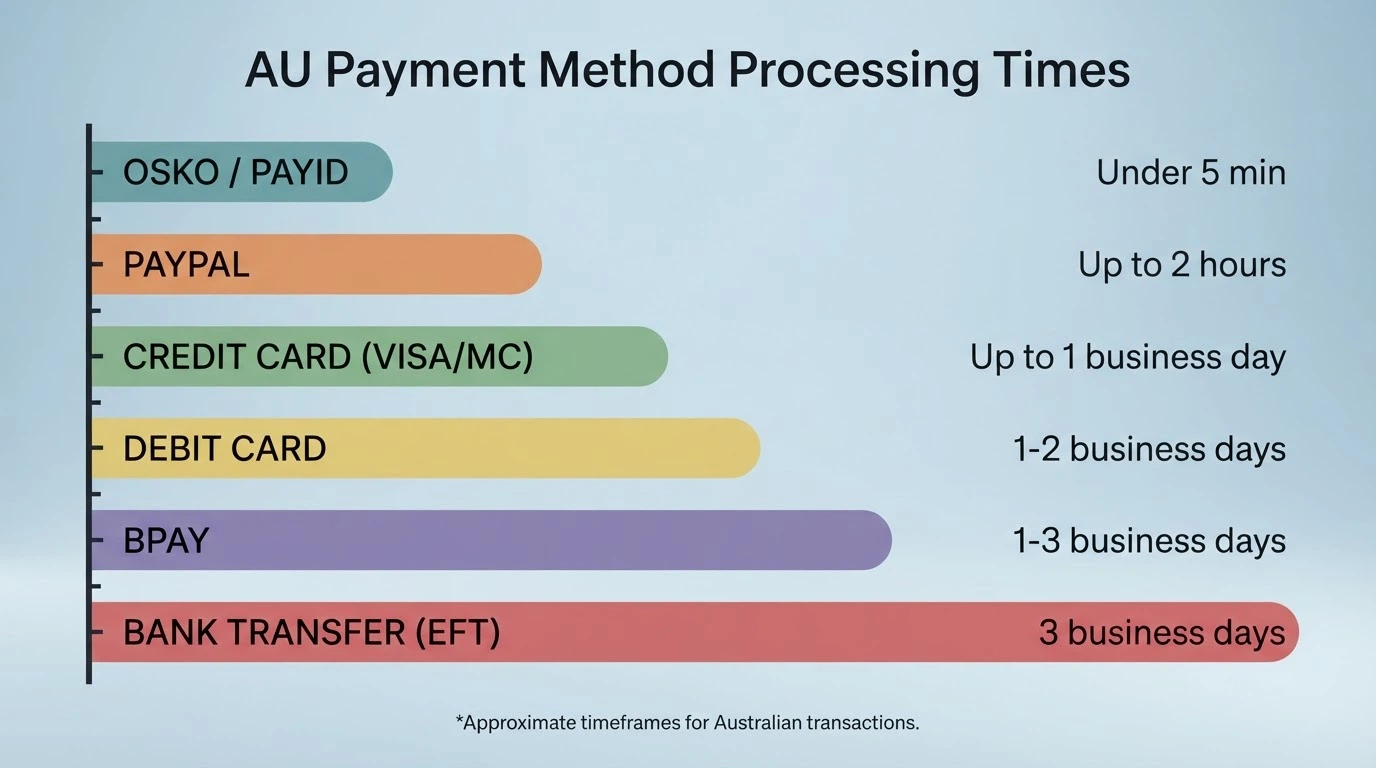
What this ranking does is straightforward: it lines the rails up against each other, names what each one actually delivers after approval, and shows the worst case a tested AU player has hit on each one. None of this is theoretical. The medians and worst cases are drawn from independent testing across the AU-facing market.
| Payment Method | Typical Speed After Casino Approval | Best Case | Worst Case Tested |
|---|---|---|---|
| Crypto (USDT TRC-20, Solana) | Under 5 minutes | Under 5 minutes | 4 hours |
| Crypto (ETH, Litecoin) | 5–30 minutes | Within 30 minutes | 4 hours |
| Crypto (Bitcoin) | 30–60+ minutes | 30 minutes | 4 hours |
| PayID (Osko / NPP) | 1–60 minutes | 25 minutes | 8 hours |
| E-wallets (Skrill, Neteller) | 1–6 hours | 1 hour | 18 hours |
| MiFinity | Up to 24 hours | Within 24 hours | Within 24 hours |
| Bank Transfer | 1–3 business days | 1 working day | 7 working days |
| Visa / Mastercard | 2–5 business days | 2 working days | 5 working days |
The pattern is not complicated. Crypto at its fastest ends the question in the time it takes to read this paragraph. PayID comes next, with the speed determined mostly by how quickly the casino approves the transfer rather than the rail itself. Everything below that band has a floor in hours, not minutes, and the gap from PayID to bank transfer is the sharpest drop on the table.
What the table does not say is what matters as much as what it does. Each rail requires the casino’s pending period to clear first, and that pending period is rare to find shorter than 48 hours at the worst end of AU-facing offshore operators. A sub-five-minute crypto withdrawal requires both stages to be quick. A 24-hour MiFinity withdrawal can clear in 24 hours only if the casino’s own clock was already there. So a reader looking at the table should be reading two numbers at once: how fast the rail moves once it starts, and how fast the casino lets it start.
PayID and Crypto — The Withdrawal Routes That Land in Under an Hour
For an Australian player who cares about speed specifically, the practical menu narrows quickly. PayID via Osko and a small group of crypto networks are the only methods that regularly deliver sub-one-hour withdrawals at AU-facing offshore casinos. Both have trade-offs.
PayID via Osko on the New Payments Platform is the rail most readers will already know — the instant-transfer layer on the Australian banking system. Once the casino pushes the PayID instruction into Osko, the transfer itself is instant. The variable is the casino’s approval window. Tested AU payout times through PayID have run at 25 minutes at the fastest end (Hell Spin), 28 minutes at Goldenbet, 35 minutes at Lucky7 and within one hour at LuckyVibe. The median for PayID across tested AU casinos is two hours; the worst case is eight hours. Practically, PayID is the best fit for an AU player because it lands in a domestic bank account a player already has, with no exchange step.
Crypto is the speed leader but is its own beast. USDT TRC-20 and Solana settle in under five minutes after casino approval. ETH and Litecoin take 5–30 minutes. Bitcoin, the rail most readers have heard of first, is actually the slower crypto option at 30 to 60-plus minutes because it requires three to six network confirmations before a casino will credit the wallet. The fast crypto claims a reader usually meets in marketing copy are not Bitcoin — they are the cheaper and lower-fee tokens running on faster rails.
The other piece of crypto is that an Australian player using it crosses the same line the licensed-wagering credit-card ban drew. Since 11 June 2024, crypto has been banned as a payment method for licensed online wagering in Australia. The licensed bookmakers do not accept it. The offshore casinos do. Using crypto to fund the account is, on its own, a confirmation that the operator sits outside the Australian regulatory frame.
E-Wallets, Bank Transfers and Cards — The Slower but Widely Available Alternatives
The next band of methods is not slow in absolute terms. They are slow relative to PayID and crypto, and they are slow on a clock most Australian players care about. The difference between a one-hour and a five-day withdrawal matters at the point the player is waiting, not on a poster.
Skrill and Neteller were the e-wallet leaders before PayID became widely available. Both still process casino withdrawals in one to six hours after approval, with a median of six hours across tested AU casinos and a worst case of eighteen. For an AU player, e-wallets add an extra step — the wallet has to be funded from an Australian bank account before withdrawal day — but for players who already hold a balance in Skrill or Neteller, that step has been taken.
MiFinity runs a touch slower at up to 24 hours after approval. The e-wallet’s positioning is cost-tier access to a similar instant-clearing layer; for AU players at offshore sites, it is a middle path between PayID and the slower rails.
Bank transfer is the slowest rail still in regular use at fast-payout casinos. A standard bank transfer (domestic or international SWIFT) takes one to three business days. The actual median across tested AU-facing operators is three working days; the worst case is seven. For high-value withdrawals, bank transfer sits alongside crypto as one of two methods with high caps, but the time cost is steep.
Visa and Mastercard withdrawals are the slowest of the standard rails at two to five business days after approval, with a worst case of five working days. The rail matters less for a casino withdrawal than it does for a deposit; the cards’ chargeback framework also gives a player some recourse if a withdrawal is contested, though at an offshore site that recourse is effectively theoretical.
The practical read: pay by PayID or crypto if speed matters and the casino accepts both. Use an e-wallet when PayID is not available and the player already has one funded. Treat bank transfer and card withdrawals as a fallback for high-value or rails-locked situations — they will arrive, but they will arrive slowly.
The Pending Period — Why Casino Approval Matters More Than the Payment Rail
The fastest payment rail on Earth still loses to a slow approval queue. The pending period — the gap between a player pressing withdraw and the casino starting to move the money — is the real arbiter of when money lands. At AU-facing offshore casinos, it runs from two minutes at the automated end to forty-eight hours where manual compliance review kicks in. The operator, the amount, the player’s KYC status and the withdrawal method together set where a given cashout lands.
The pending period is not the casino being slow. It is the casino being careful, and that care is built into the process for regulatory reasons — even at an offshore site, the operator is expected by its own licence to verify who is being paid and that the funds are not being laundered. The pending period is the time that process takes, and the operator decides how long that process takes.
For a reader of this page, the implication is direct. A 24-hour pending window silently turns the five-minute crypto claim into a 24-hour-plus five-minute cashout. A forty-eight-hour window in a manual review queue turns it into two days. Where a casino is honest about its pending window, the reader gets to plan around it. Where it is not, the “instant withdrawal” headline reads as a smaller promise than it looked.
KYC Verification — Why Unverified Accounts Are the Biggest Withdrawal Roadblock
Incomplete KYC is the number one cause of withdrawal delays at AU-facing fast-payout casinos. That is not opinion; the figure recurs across the testing data and is the single most common player complaint in published industry coverage. The procedure asks for ID, proof of address and payment-method ownership — a passport, a utility bill, a photo of the card the player funded the account with. None of these are optional, and any that are missing will pull a withdrawal into a manual review.
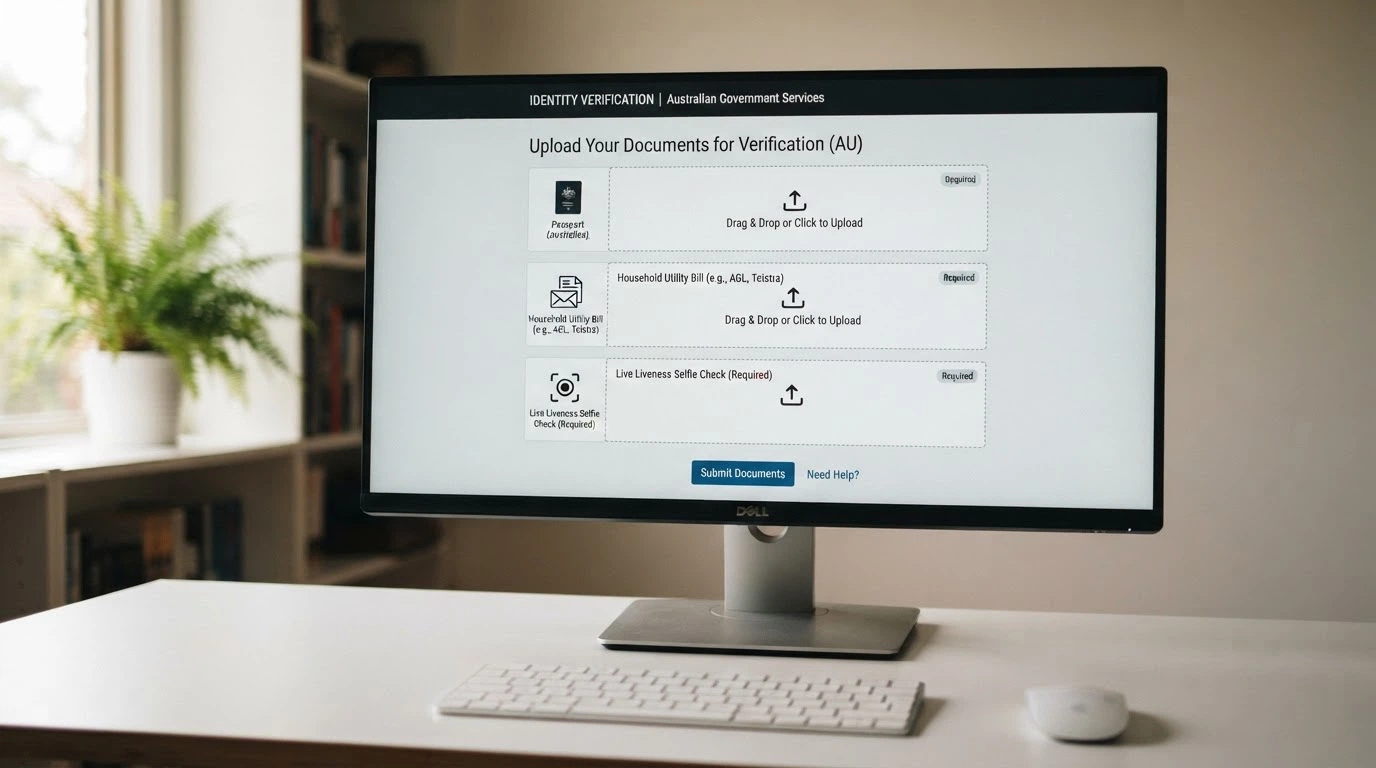
The cost is real. A player who verifies in full before depositing sees the pending window shrink. A player who verifies only when the first withdrawal is requested sits through the review queue. The hangtime depends on how long the player takes to provide the missing documents, which on a 48-hour queue can stretch a five-minute crypto cashout into a several-day cashout for no reason other than the verification step was left.
The best practice is unglamorous: complete the document upload and selfie/check step before the first deposit. The casino’s verification requirements are not arbitrary — they exist for the same reason the operator’s licence imposes them on the casino. Whatever speed the casino otherwise offers, the player who shows up unverified will not see it.
Withdrawal Limits and Cashout Caps — What You Can Actually Take Out Per Transaction
Speed is one constraint. The next is how much. The minimum a player can withdraw at a fast-payout AU-facing casino usually sits at AUD $10 to $20 — low enough that any small balance can be cleared. The maximum is the part that matters.
PayID tops out at around AUD $5,000 per transaction at most AU-facing offshore operators, with the representative Neospin figure sitting at A$50 to A$5,000 per request. Bank transfer widens the ceiling to A$200 to A$10,000 per request. MiFinity-style eZeeWallet sits at A$20 to A$4,000 per request. Crypto at the same operator runs at the A$100 equivalent floor with no firm published ceiling — practical withdrawals at $50,000-plus are routine. These are not minimums a reader can engineer around. They are the casino’s own per-transaction caps, and a balance above the cap has to be split into a sequence of smaller withdrawals, each of which sits in its own pending period and bears its own processing window.
For a high-balance player, that sequence takes longer to clear than the headline speed suggests. A player with AUD $30,000 to cash out through PayID at a $5,000 cap runs six transactions of six pending periods. At the operator’s median pending window of a few hours, that takes most of a working day. Even at the best end of PayID, a six-transaction sequence at 25 minutes per transaction runs north of two hours.
POLi and the Deposit-Only Trap — Why Your Fastest Deposit Method Won’t Help You Cash Out
POLi is the deposit rail Australian players already trust. It links to a domestic bank account, processes in seconds, and feels like the obvious choice for funding an offshore casino account. It also does not support withdrawals. A POLi-funded player is using a deposit-only rail, which means the withdrawal has to go somewhere else — and somewhere else might mean a slower rail than the deposit player was anticipating.
The deposit side is engineered for POLi because the rail was designed for moving money in. The withdrawal side has to be funded by the casino, and POLi has not built a payout product for the gambling sector. The same situation applies to a smaller set of prepaid and cash-based deposit methods at some operators. None of those rails help on a withdrawal day.
The practical move is to fund the account through the same rail a player intends to withdraw through, where possible. PayID on a PayID-supporting casino. Bitcoin on a Bitcoin-supporting casino. Anything else that round-trips into the same account in one piece. The deposit speed is wasted if the withdrawal rail is slower.
The Offshore Casinos Australians Turn to for Fast Payouts in 2026
The ten operators below are the ones Australian players actually use for fast withdrawals. Every one is offshore. Every one is unlicensed in Australia, and not in the technical sense where the licence is held but inactive — in the literal sense that no licence can be held. The “Australian licence” column reads No for every row because no row can read otherwise.
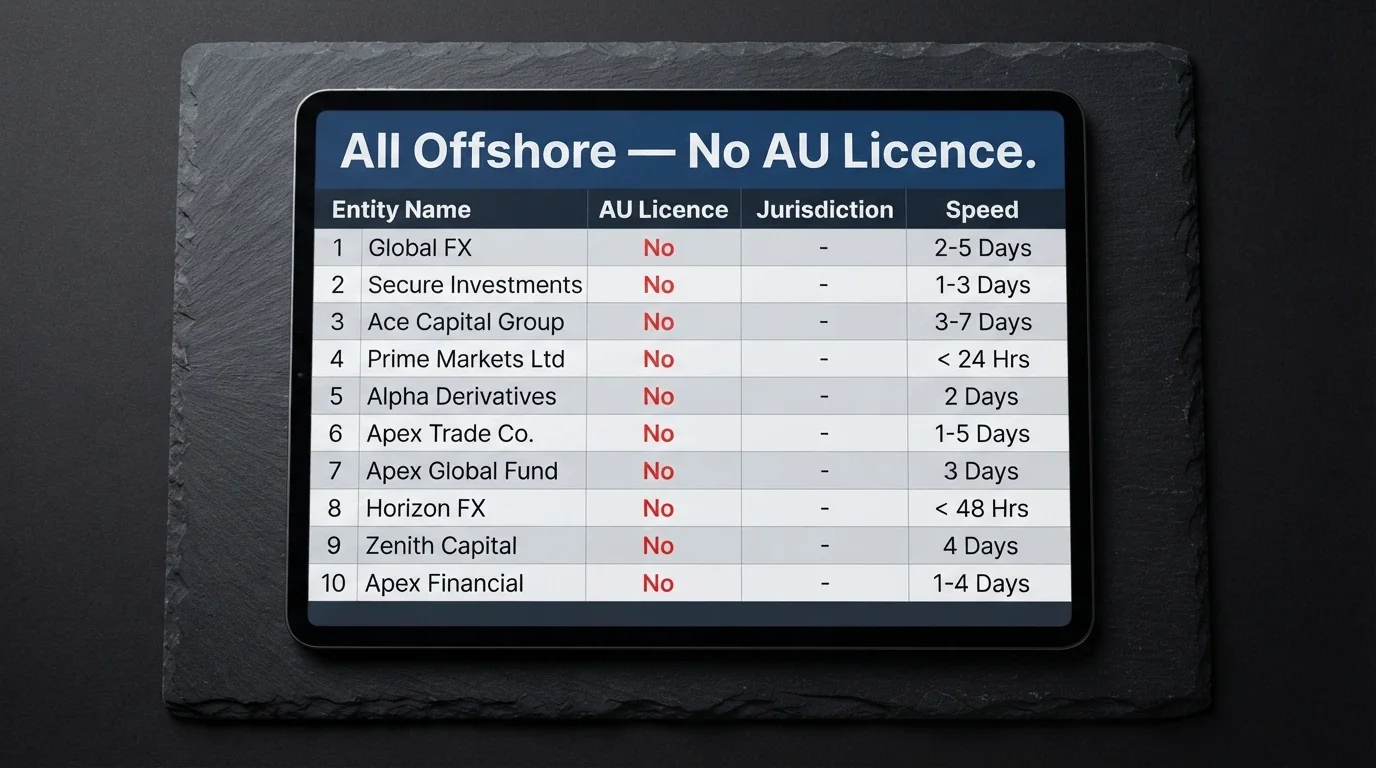
| Casino | Licensed in Australia? | Offshore Licence Jurisdiction | Confirmed Speed |
|---|---|---|---|
| Skycrown | No | — | Crypto ~10 minutes |
| Rocket Play | No | — | — |
| Royal Reels | No | — | — |
| Stake | No | — | — |
| FairGO | No | — | — |
| WinSpirit | No | — | — |
| Rainbet | No | — | — |
| Scream Casino | No | — | — |
| Bizzo Casino | No | — | — |
| Rocket Casino | No | — | — |
Where the issuing jurisdiction is not publicly confirmed by the operator, this table records no data. Where the confirmation has not been independently verified, the speed column also records no data. The table is not a ranking of fastest to slowest — it is the full set, ordered so the only operator with an independently confirmed speed sits first and the rest are lined up ranked by AU market share. The reader scanning the table is supposed to notice that ten rows can show what one row can show, with one exception.
The offshore reality applies to every row. The same trade-off applies to every row. The rest of this section goes brand by brand and records what each one offers and what each one costs.
Skycrown — Crypto Withdrawals Verified at 10 Minutes Across 10+ Networks
Skycrown is the only operator in this set with independently confirmed withdrawal speed. Crypto payouts land in approximately ten minutes after the player presses withdraw, and the casino supports more than ten cryptocurrency networks, including Cardano, Tether, Tron, Bitcoin, Ethereum and Litecoin. PayID and bank transfer are also available for players who prefer fiat rails.
The supporting crypto-net is the reason Skycrown reads as the speed leader of this set. A player who can fund and withdraw in USDT TRC-20 sees the floor of the table above. A player who chooses Bitcoin takes the slower crypto option at the same casino and sees the slower crypto figure on the same table. The choice within one operator is the same choice the rest of the market makes by rail.
The casino is offshore. Like every other row in the table, Skycrown is not licensed in Australia because no Australian licence exists. There is no Australian consumer-protection body to complain to if a withdrawal is delayed beyond ten minutes, and a reader who has the operator’s word for the speed has nothing else. That is the position Skycrown sits in. For an Australian player who wants independently confirmed crypto speed and is willing to take the rest of the trade-off on those terms, Skycrown is the most legible answer on this page.
Rocket Play — Offshore Casino Available to Australian Players
Rocket Play sits in the same licensing frame as every operator on this page — offshore, unlicensed in Australia, no Australian consumer protection. The brand runs a welcome offer for new players and contests the AU-facing market on payment speed and bonus aggressiveness. This operator does not provide verified speed data, so the casino’s claims should be assessed by the player directly.
That is not a reason to write the brand off. It is a reason to take the brand’s claims at the value of what the player can independently check before depositing. Where the operator’s own terms set out a pending period and a per-method cashout cap, the player reads those terms. Where the operator’s terms do not set those out — or where they are written without numbers — the player deposits knowing they have no leverage if the withdrawal stalls.
Rocket Play suits a player looking for a competitive welcome offer at an offshore site who is willing to verify the speed claim themselves before relying on it. The operator does not provide verified speed data, so take the claims at the value of what you can check.
Royal Reels — Offshore Operator With an Australian Player Focus
Royal Reels is one of the more visibly Australia-targeting brands on this page. The marketing positions the operator for AU players, which is a real thing on this market — a number of offshore operators lean into Australian themes, payment methods and support hours in a way that generic international brands do not. The trade-off is that the AU positioning does not change the licence reality. Royal Reels is still offshore, still unlicensed in Australia, still outside every Australian safeguard.
The welcome offer is a real offer at a competitive rate for the segment. The payout speed is not independently confirmed here. Royal Reels is an option for players focusing on welcome-offer aggressiveness and an AU-tailored experience, though it lacks the independent testing results of the page’s top-ranked operators.
Stake — A Crypto-Native Casino Where Every Transaction Routes Through the Blockchain
Stake is built around crypto. Deposits and withdrawals move on-chain. Transaction speed is determined by network confirmation times — for Stake that means Bitcoin, Ethereum, Litecoin, USDT and the wider alt-coin list, each at the rail’s own speed. The casino does not run a fiat settlement layer that competes with the bank rails; it runs a wallet-to-wallet model where the rail is whatever crypto network the player brings.
For an Australian player this also means crossing a line drawn by the licensed-wagering market. Since 11 June 2024, crypto has been banned as a payment method for licensed online wagering in Australia. The licensed bookmakers cannot take it. Stake can, because Stake is not licensed under Australian rules. The credit-card and crypto ban exists precisely to draw the line Stake operates on the other side of.
For an Australian player choosing Stake, the speed argument is genuine — on-chain settlement is the fastest rail in the operator table — and so is the regulatory trade-off. There is no Australian consumer protection. There is no BetStop coverage. There is no recourse at an Australian regulator if a withdrawal is refused. Stake is a wallet-to-wallet casino on crypto rails, and that is exactly what it advertises as. The reader who wants that gets that; the reader who wants an operator answerable in Australia finds no such operator on this page.
FairGO — Australia-Targeted Offshore Casino Brand
FairGO brands itself explicitly for the Australian market. The visual identity leans into Australian iconography; the support team appears to work AU-friendly hours; the welcome offer is competitive at the segment. Like the other Australia-targeting brands on this page, the licence reality does not change. FairGO is offshore, unlicensed in Australia, and outside the registered Australian framework.
The welcome offer is a real offer. The payout speed claim is not independently confirmed here. For a player looking for an AU-positioning offshore brand and willing to verify speed claims themselves, FairGO is in that bracket. For anyone choosing on independently confirmed payout speed as the sole criterion, the brand is not in the top of the table — but the table itself shows how few brands occupy that position.
WinSpirit — International Offshore Casino Accepting Australians
WinSpirit is an internationally focused brand that accepts AU players. The marketing does not lean into AU-targeted positioning the way FairGO and Royal Reels do; the welcome offer is broadly competitive. Independent payout speed data was not confirmed at the time of review.
For a player seeking an internationally run offshore casino and willing to verify speed claims themselves, WinSpirit is a valid alternative. However, it does not occupy the same category as the independently tested operators featured earlier in the table.
Rainbet — Offshore Operator Competing for the Australian Market
Rainbet is a more recent entrant to the AU-facing offshore market. The brand competes on withdrawal speed, welcome-offer aggressiveness, and a payment-method menu that closely mirrors what AU players have come to expect from the segment. Like the others, the licence reality does not change. Rainbet is offshore, unlicensed in Australia, and outside the registered Australian framework.
The welcome offer is real. The payout speed claim is not independently confirmed here. For a player who wants a recent entrant on the offshore market and is willing to verify speed claims themselves, Rainbet is in that bracket. The speed the brand advertises is consistent with what the AU-facing offshore market can deliver; the speed the brand actually delivers is what testing — either the player’s own or an independent third party’s — has to confirm.
Scream Casino — Offshore Casino Available to Players Down Under
Scream Casino accepts Australian players and positions as an international offshore brand. The welcome offer is competitive for the segment. Independent payout speed data was not confirmed at the time of review.
For a player choosing on welcome-offer aggressiveness at an offshore site and willing to verify speed claims themselves, Scream Casino is a competitive option. Those focused solely on independently confirmed payout speed should look to the top of the table instead.
Bizzo Casino — Established Offshore Name Among Australian Casino Players
Bizzo is one of the more recognised offshore brands on the AU-facing market. The marketing and product positioning have aged into a familiar presence; the welcome offer is competitive at the segment; the payment-method menu is the standard offshore offering. Independent payout speed data was not confirmed at the time of review.
For a player choosing a brand that has run on the segment long enough to feel familiar, Bizzo is a common choice. Those prioritising independently confirmed speed will find other operators more suitable.
Rocket Casino — Speed-Branded Offshore Casino Welcoming Australians
The name signals speed. The brand does not deliver speed in any independently confirmed sense here, and the licence reality is the same as every other row on the table — offshore, unlicensed in Australia, outside the registered Australian framework, with no Australian consumer protection or recourse. The welcome offer is competitive at the segment.
For a player who reads the brand name as a signal and is comfortable verifying the speed claim themselves, Rocket Casino is in that bracket. For a player choosing on independently confirmed payout speed, the brand is not in the top of the table. The signal the name sends is not the evidence the page has.
Online Casino Is Prohibited in Australia — Here’s What That Cost Your Withdrawal
The offshore ranking in the section above is the practical answer to the search the reader came in with. This section is the cost of that answer.
None of the operators above sit inside the Australian regulatory frame. None can. The Interactive Gambling Act 2001 prohibits the provision of online casino games, online pokies and in-play sports betting to a person in Australia, and the 2017 amendment closed the loopholes offshore operators had been using to define their offer as something other than a casino product. The Australian Communications and Media Authority, the regulator with enforcement power under the Act, has been blocking offshore gambling sites at the DNS level since 2019. By March 2026 it had referred 1,564 websites for blocking; more than 225 illegal services have withdrawn from the Australian market entirely since 2017.
The law does not prosecute the player. Playing at an offshore casino is not a criminal offence for the individual. That is one of the facts of this market that does not get quoted enough, and quoting it alone is misleading. What the law does not do, the regulator also cannot do. There is no Australian consumer-protection body that will pursue a refused withdrawal on a player’s behalf. There is no Australian dispute-resolution process. The casino answerable to an Australian player is, by definition, not a casino operating in Australia.
The cost of that is exactly the cost of the speed the reader is shopping for. The same structure that allows a fast payout — a casino operating on its own terms, outside the AU framework — is the structure that forecloses on a recourse if the speed does not materialise.
No Australian Casino Licence Exists — The IGA Prohibition Explained
The Interactive Gambling Act 2001 is the framework that decides every other question on this page. It prohibits the provision of online casino games, online pokies and in-play sports betting. It does not prohibit wagering on horse racing or pre-event sport, which are licensed at state and territory level — principally through the Northern Territory Racing and Wagering Commission, administered via Licensing NT, where the large online bookmakers hold terms that run up to twenty years. The Act also does not prohibit lotteries, keno or land-based casinos, which are state-licensed and operate separately.
There is, consequently, no federal or state licence that an online casino can hold. A reader who sees “licensed” attached to an offshore casino brand on a review page is reading a foreign licence jurisdiction — Curaçao, Malta, the Isle of Man and others — rendered in language that obscures which country issued it. None of those jurisdictions are Australia. None of those licences protect an Australian consumer under Australian law.
The minimum age for any commercial gambling activity in Australia, including at an offshore casino accessed from inside the country, is 18. That is the only Australian threshold that does reach the player, and it is the player’s responsibility to honour it regardless of where the operator is licensed.
ACMA Enforcement — 1,564 Sites Blocked and the Operators That Withdrew From the Market
The Australian Communications and Media Authority is the regulator that handles the prohibition end of this market. Its enforcement powers came with the Interactive Gambling Amendment Act 2017, which closed the loopholes the offshore sector had been using and gave the ACMA the ability to direct Australian internet service providers to block illegal sites. The first blocking request went out in November 2019.
By March 2026, the ACMA has had 1,564 illegal gambling and affiliate websites blocked. In the October–December 2025 quarter alone, the regulator completed 23 investigations into 45 gambling sites, found 69 breaches of the Interactive Gambling Act, issued 10 formal warnings, and referred 133 websites to ISPs for blocking. The April–June 2025 quarter ran 20 investigations, 30 breaches, 10 formal warnings and 73 blocking referrals. The pace is not slowing.
For an AU player, the operational consequence is straightforward: any offshore casino that gains attention from the regulator can be blocked at any time. A balance sitting on deposit is, depending on the operator, recoverable or unrecoverable. Of the 225 services that have withdrawn from the Australian market since 2017, a meaningful number were in that withdrawing state on terms that did not favour the player. The block can fall mid-session, mid-withdrawal, mid-balance.
BetStop Cannot Protect You at an Offshore Casino
BetStop launched in August 2023 as Australia’s National Self-Exclusion Register. One registration excludes a person from every Australian-licensed online and phone wagering service. As at 31 July 2026, the register held 67,480 registrations, of which 41,290 exclusions were still active. Seventy-eight per cent of registrants were under 40; thirty-eight per cent had chosen lifetime exclusion.

BetStop is a real protection for anyone using a licensed wagering service in Australia. The coverage is comprehensive on that side of the line. It is also, by construction, a protection that stops at that line. An offshore casino is not licensed in Australia; it is not connected to the register; it will continue to accept a self-excluded person’s deposit and play. The most concrete single harm of the offshore route is this one. The same register that excludes a person from every licensed AU bookmaker cannot exclude them from the offshore casino they are also playing at.
The reform bill that commenced on 1 January 2027 strengthens register operations and bans direct marketing of inducements for three months after a BetStop deregistration. None of that reaches the offshore casino. The protection will continue to stop where it has always stopped.
Credit Cards, Crypto and the Payment-Method Tell — What Australia Actually Bans
Australia draws its line on payment method, not on deposit size. Credit cards, credit-related products and digital currency are banned as payment for licensed online wagering in Australia — a prohibition that commenced on 11 June 2024 under the Interactive Gambling Amendment (Credit and Other Measures) Act 2023. An operator that fails to enforce the ban faces penalties of up to $247,500 per breach.
The practical tell that follows is important enough to repeat. An Australian who is asked for a credit card or a crypto deposit by a gambling site is being served by someone outside the Australian rules. The licensed wagering market cannot take a credit card; the licensed wagering market cannot take crypto; an offshore casino that does take both is on the offshore side of the line, with everything else that implies about consumer protection, recourse and complaint channels.
The licensed deposit rails remain debit card, bank transfer, PayID/Osko and BPAY. An offshore casino that is using any of these does so while sitting outside the Australian framework. The rail a player uses does not change the licence reality of the operator that takes the deposit.
What the Gambling Reform Changes From January 2027
The Interactive Gambling Amendment (Gambling Reform) Bill 2026 passed Parliament on 19 August 2026. Its measures commence on 1 January 2027. The provisions that most affect this page are bank-payment-blocking authority and tightened advertising restrictions.
From 1 January 2027, banks and payment providers gain express authority to block transactions to illegal gambling operators. The change closes part of the gap a player could previously exploit — a domestic bank account used to fund an offshore casino could rely on the bank’s inability to refuse the transaction. That refusal is now express.
The advertising restrictions also bite from the same date. Wagering television advertising is capped at three ads per hour between 6:00 am and 8:30 pm, with a live-sport blackout from 15 minutes before a live event until five minutes after it ends. Radio ads are barred during school drop-off and pick-up times. Broadcasting of sporting odds is banned outright. Online wagering ads are restricted to logged-in, age-verified users with an opt-out option. Wagering ads are banned inside sports venues and on player and official uniforms. Athletes, celebrities and influencers are barred from promoting wagering.
On the inducement side, direct marketing of inducements is banned for 14 days after sign-up, for three months after a BetStop deregistration, and indefinitely for customers identified as at risk of gambling-related harm. AdStop — a national wagering advertising opt-out register administered by ACMA — sits in the same package.
None of this reaches the offshore casino, and that is the relevant point. The 2027 reform tightens the licensed wagering market’s conduct and gives banks the tool to refuse transactions into the illegal market. The cost of the offshore route does not soften. The ability to access the offshore route does.
When the Pokies Stop Being Fun — Gambling Harm in Australia and Where to Get Help
The page has spent its middle sections explaining how the offshore route works for cashouts. This section is about the broader picture of why the offshore route is also the most expensive to gamble at without a safeguard.

Gambling harm in Australia is rising even as overall participation is falling. The ANU’s 2025 study (n=3,387) recorded overall gambling participation at 58.8%, down from previous years, but risky gambling (PGSI) at 19.4% — up from 13.7% in 2024 and almost double the pre-COVID baseline. The Roy Morgan figures for the year to mid-2025 record problem gambling at 2.9% of Australians and total problem and at-risk gamblers at 16.2% — about 3,492,000 people. The NSW Gambling Survey 2024 found 21% of adults in NSW experience gambling harm, with gaming machines as the source of 54.8% of that harm and wagering as the source of another 16.5%.
Online gambling is now the dominant mode for those who gamble. The same ANU data records that more than half (56.1%) of gamblers mainly participated online in the past 12 months, with online gambling associated with male gender, younger age, higher income, frequent play, psychological distress and loneliness. Counselling demand has surged. Gambling Help Online received almost 13,000 counselling requests in 2023-24 — up 67% on the prior year, with no single previous year exceeding 7,700. Half those requests now relate to online gambling. Most callers are aged 20-34; 70% are men.
The harm data is what justifies the cost framing this page has put on the offshore route. The reader who lands here for a quick answer on PayID vs crypto has landed on a market where offshore casinos draw a disproportionate share of the harm data and where Australian safeguards do not reach the offshore site.
The Numbers — Gambling Harm Is Rising Even as Participation Falls
The ANU 2025 study is the most direct read. Gambling participation at the population level has gone down to 58.8% from prior-year figures, but risky gambling has gone up to 19.4% from 13.7% — an increase of more than five percentage points in twelve months, and close to double the pre-COVID figure. The gap between what people do and what risk that behaviour carries is widening.
The demographic profile compounds the concern. Online gambling is associated with male gender, younger age, higher income, frequent play, psychological distress and loneliness. Half of all gambling in Australia now happens online. The age profile of counselling demand — most callers 20-34, 70% men — matches the demographic profile of online gambling itself.
Only 13.5% of people experiencing moderate or high-risk gambling in the NSW data sought help. The population that experiences harm is materially larger than the population that reaches help. The remainder is gambling without any contact with the support infrastructure, offshore or otherwise.
Tools That Help — and the Limits of Help When You’re Playing Offshore
Australia runs a strong responsible-gambling infrastructure. The National Gambling Helpline is 1800 858 858 — free, confidential, staffed around the clock, with online chat and email counselling routed through Gambling Help Online at gamblinghelponline.org.au. BetStop is a one-step registration that excludes a person from every Australian-licensed wagering service. Each state runs its own complementary service — GambleAware in NSW, Gambling Help in Queensland, and equivalents elsewhere.
All of this is real and all of it works inside its lane. Helpline callers get the support they ask for. Gambling Help Online chat sessions run on the platform the player chooses. BetStop registrations are honoured by every AU-licensed wagering operator on the day of registration. State services run face-to-face and online counselling across their populations.
What none of this can do is reach the offshore casino. BetStop’s coverage is licensed-AU-only, and the register sits behind the same line the offshore casino sits outside. The same player who registers with BetStop and then plays at an offshore casino will continue to be served. The helpline number is worth saving because the service is real, but it does not protect the player against the offshore operator; it supports the player who has decided, for whatever reason, to test that gap.
For anyone reading this part of the page and recognising the pattern — a withdrawal queue growing, a session stretching later than it should, a balance being chased — the rest is the same advice the helpline gives. The number is 1800 858 858. It is free and it is staffed.
How We Evaluated Withdrawal Speed — Our Selection Process
The rankings on this page are based on three categories of source. The first is the ACMA’s public enforcement records, which establish that every operator on this page is offshore and unlicensed in Australia. The second is the operators’ own published terms and payment-method menus, which establish what each operator accepts as a cashout method and at what published minimum and maximum. The third is independent casino review platforms covering the AU-facing market — Cardplayer.com AU, Pokiesaustralia.com, instant-withdrawal-casinos-au.com, Betsquare.org, GamblingInsider.com AU, Esports.gg AU, Casinowhizz.com — for tested payout times per operator and per payment method.
The criteria used to build the list were: confirmed withdrawal speed where available, the breadth of the payment-method menu, licence transparency (whether the operator clearly names its foreign licence jurisdiction rather than obscuring it), and the honest legal frame under Australian law. Every operator listed has been checked against the ACMA’s blocking record; none appear there by name at the time of writing, but the registry grows every quarter and the prohibition extends to the unlicensed market as a whole.
Where operator-specific data was not independently verifiable in this round — the welcome-offer details, the bonus terms, the wagering multipliers, the maximum cashout caps — the operator write-up says so rather than filling the gap with marketing copy. The set of audited independent speed tests is smaller than the set of operators in the ranking, and that is why the comparison table records “—” in many cells. No row claims a speed it has not been independently confirmed at.
The page’s first job is to be honest about how fast speed is, and the second job is to be honest about what readers cannot check. Where the second condition is not met, the row is empty.
What to Actually Do Before You Deposit — Your Fast-Withdrawal Checklist
The page has covered speeds, methods, operators, legality and the harm data. Closing without a short list of what the reader should do with all of it would leave the reader where they started — at the search bar, ready to type the next query.
Verify your account before depositing. KYC is the most common reason the pending period at a fast-payout casino extends from minutes into days. Upload the documents, complete the selfie check, and confirm payment-method ownership before the first deposit. A verified account means the pending window the player sees is the pending window the operator actually offers. An unverified account means the player has not earned the speed yet.
Choose PayID or crypto where speed matters. PayID via Osko on the New Payments Platform clears in 1-60 minutes after casino approval, with the rail itself instant. Crypto at USDT TRC-20 or Solana settles in under five minutes after approval. The two rails will dominate the table above and dominate the real-world outcome. A reader who has not specifically chosen them has not yet chosen a speed.
Check the operator’s withdrawal limits before committing. The fastest casino in the world cannot move $30,000 through a $5,000 PayID cap on a single transaction. The cap dictates how many transactions the player needs, which dictates how many pending windows the player waits through, which dictates when the balance clears. Read the published minimum and maximum for the rail being chosen, and pick a rail that fits the balance.
Save the National Gambling Helpline number before doing anything. The number is 1800 858 858. The service is free, confidential, and staffed 24 hours a day. Anyone who thinks they might call it is in the group that should call it — and not after the deposit has already moved.
Remember what the offshore route does not give. No Australian consumer protection. No BetStop coverage. No recourse at an Australian regulator. No guarantee the site will still be accessible in a month’s time. The speed on this page is real; the protection that normally sits alongside it is not. The line between a five-minute withdrawal and a five-day complaint process is not in the page — it is in the structure the player is choosing to use.
Speed at a casino is one data point among several. The operator is a second. The payment method is a third. Whether the operator is one a player has independently verified is a fourth. Each row on the table is a real offer at a real speed; the reader’s job is to decide whether that offer is the right trade-off.
Frequently Asked Questions
Which online casino has the fastest withdrawal time in Australia?
No Australian-licensed online casino exists — the Interactive Gambling Act 2001 prohibits the provision of online casino games in Australia. Of the offshore casinos Australians use, Skycrown’s crypto withdrawals are independently verified at approximately 10 minutes across 10+ networks including Cardano, Tether and Tron. PayID across other operators tested at 25 to 35 minutes; USDT TRC-20 and Solana clear in under 5 minutes at crypto-supporting sites.
How long does a PayID withdrawal take at an Australian online casino?
PayID withdrawals across offshore casinos accepting AU players have been independently measured at 25 to 35 minutes at the fastest end and up to one hour at LuckyVibe. The transfer itself is instant once it leaves the casino via Osko on the New Payments Platform; the variable is the casino’s approval period, which runs from two minutes to 48 hours. Complete KYC verification before depositing to keep the approval period short.
What is the fastest payment method for casino withdrawals in Australia?
USDT TRC-20 and Solana settle in under 5 minutes once the casino approves the withdrawal. PayID via Osko clears in 1-60 minutes. Crypto on Ethereum or Litecoin takes 5-30 minutes; Bitcoin takes 30-60 minutes because it requires three to six network confirmations. E-wallets and cards run slower at one to six hours and two to five business days respectively.
Are instant withdrawal casinos legal for Australian players?
Playing at an offshore casino is not a criminal offence for the individual — the Interactive Gambling Act 2001 targets the provider, not the player. However, no online casino is licensed in Australia, so every casino an Australian can use is offshore and outside every Australian safeguard. There is no consumer protection, no BetStop coverage, and no Australian recourse if a withdrawal is refused or a site is blocked.
What happens if an offshore casino refuses to pay out my winnings?
The Australian Communications and Media Authority cannot recover a player’s funds from an offshore operator, and no Australian consumer-protection body has jurisdiction over the casino’s licence. The recourse a player has is whatever the casino’s own regulator (in Curaçao, Malta or wherever the licence was issued) provides through its own complaint channels, and what credit-card chargeback rights the payment method offers. BetStop, the National Self-Exclusion Register, does not apply to offshore casinos and cannot protect a balance.
What is the minimum withdrawal amount at fast payout casinos in Australia?
AUD $10 to $20 is the typical minimum at AU-facing fast payout casinos. Maximums run higher — PayID tops out around AUD $5,000 per transaction, bank transfers up to A$10,000, and crypto carries no firm published ceiling with practical withdrawals of A$50,000-plus. Where a balance exceeds the cap, the player runs a sequence of smaller withdrawals, each with its own pending period.