
Instant Withdrawal Casinos in Australia: What “Instant” Means in 2026 and What It Costs the Player
The term “instant withdrawal casino” promises a button-press and a payout, and most of the offshore brands that serve Australian players lean on it heavily. The promise has a shape: a PayID or crypto screen, a timer, a satisfied customer. The reality in 2026 is a queue, a Know Your Customer (KYC) check, and a bank rail whose speed the casino does not control. Closing that gap is what this page is for. Not by endorsing any operator — no operator on this page holds an Australian licence because none exists — but by ranking the ten offshore brands Australians actually access, comparing their tested and claimed payout speeds side by side, and laying out exactly what the player forfeits when no Australian regulator has the operator’s back.

This comparison is current as of 22 November 2026, verified against the Australian Communications and Media Authority’s published enforcement totals and against independent tested payout reviews from 2026.
Table of Contents
- What “Instant Withdrawal” Actually Means at an Australian Online Casino in 2026
- Ten Offshore Casinos Ranked by Real Payout Speed: 2026 Tested and Compared
- Wild Fortune
- Stake
- Bitstarz
- Wild Tokyo
- FairGO
- Bizzo Casino
- Caswino
- Rocket Play
- Skycrown
- Royal Reels
- Your Money, Faster: Which Withdrawal Method Actually Delivers in 2026
- Pokies That Pay Out Fast: What Australians Are Actually Playing in 2026
- Why Your 2026 Bonus Takes Longer to Withdraw Than You Think
- The Legal Reality: Every Instant-Withdrawal Casino Is Offshore and Unlicensed in Australia
- Playing Within Reach: Responsible Gambling When Withdrawals Are Instant
- How We Evaluated These Casinos: Our Testing and Ranking Criteria for 2026
- What You Should Actually Do: Playing Smart in an Unregulated Market
- Frequently Asked Questions
What “Instant Withdrawal” Actually Means at an Australian Online Casino in 2026
“Instant” in this market is a marketing word that does three different jobs. Some operators use it to describe the bank-side rail — PayID/Osko transfers clear in seconds once released, and a crypto payment can land in a wallet in under five minutes. Others use it to describe their own internal approval queue, which is a softer promise: the casino will process your withdrawal “instantly” once the KYC paperwork is done. The strongest version is the third — an operator that has cut the approval queue short enough that the only delay is the rail, not the cashier. The real question is which ones get closest to true instant withdrawals in 2026.
The bank-side rail is the easy part. PayID through the New Payments Platform (Osko) is instant by design — the Reserve Bank built it that way. Crypto is the same on its own rail: a USDT TRC20 transaction settles when the blockchain confirms, often in under a minute. What sits between the player and that rail is the casino-side processing window, and that window dominates the total time. Incomplete KYC verification is the number one cause of withdrawal delays — a player who skipped identity checks at deposit often meets them at withdrawal, and the “instant” clock does not start until that paperwork is signed off.
This page ranks ten offshore casinos serving Australian players, ordered by how close each comes to that ideal: a queue short enough that the rail sets the speed. None of them is licensed in Australia. The product is prohibited under the Interactive Gambling Act 2001, and every brand on this list is an offshore entity. The page describes them; it does not recommend them as a place to play.
The Offshore Reality: Where Every Casino on This Page Actually Operates
The Interactive Gambling Act 2001 makes it an offence to provide an online casino, online pokies or in-play sports betting to a person physically in Australia. The Interactive Gambling Amendment Act 2017 closed the offshore loopholes the industry had used for fifteen years and gave the Australian Communications and Media Authority (ACMA) the power to investigate, warn, issue civil penalties and direct Australian internet service providers to block illegal sites. There is no licence for online casino anywhere in the country — not federally, not in any state or territory.
The scale of enforcement is large enough that it cannot be brushed off as a paper tiger. The ACMA has directed ISPs to block 1,564 illegal gambling and affiliate websites as at March 2026, with the first blocking request issued in November 2019. More than 225 illegal services have withdrawn from the Australian market entirely since the 2017 strengthening — a measure of how many operators decided the ACMA’s enforcement reach was not worth contesting. DNS-level blocking is the mechanism: when the ACMA moves, the operator’s domain stops resolving for Australian customers, often with balances still on the platform.
What the player forfeits is the entire Australian safety net. There is no Australian consumer protection. There is no complaints body with the power to recover money. BetStop, the National Self-Exclusion Register, binds only Australian-licensed wagering services and reaches none of the offshore operators on this page. If an offshore operator refuses a withdrawal, closes an account, or vanishes overnight, the ACMA cannot retrieve a player’s funds and the Australian Competition and Consumer Commission has no jurisdiction. The site itself can be blocked at any time with the player’s balance still sitting on it.
The individual player is not prosecuted. The IGA targets the provider, not the person placing the bet. Australians who play at these offshore operators do so in a legal grey area — it is illegal to provide the product to them, but the consumer who accesses it carries no criminal exposure under the Act. What they do carry is the loss of every protection that exists for punters who stick to Australian-licensed wagering.
What is licensed in Australia is a smaller set of products: wagering on horse and greyhound races and on sport placed before the event begins, lotteries, and keno, offered through operators licensed by a state or territory. Licensing for online wagering concentrates in the Northern Territory through the NTRWC and Licensing NT, which is the de facto national licensor for major bookmakers such as Sportsbet, bet365 and Ladbrokes. There is no Australian analogue for online casino games, online pokies or in-play betting — those are prohibited, not regulated.
The Real Speed Test: Claimed vs Actual Payout Times in 2026
The gap between an operator’s marketing claim and what a tested player actually waits is where the comparison lives. A 2026 review round on independent tested sites produced a benchmark that cuts through the marketing: a PayID withdrawal returned A$920 to a Commonwealth Bank account in 11 minutes from button-press to receipt — a clean example of what “instant” looks like when the rail is fast and the queue is short. Crypto performed even faster on its own rail, with USDT TRC20 and Solana transactions clearing in under five minutes after the casino released the funds.
The casino-side processing window dominates total withdrawal time. The bank-side rail (PayID/Osko) is fast once the casino releases funds. As noted, verification remains the main delay factor. That single sentence is what the table on this page ranks operators against: not how fast a rail can move, but how fast the operator’s own queue hands the rail the money.
The hierarchy that emerged from the 2026 testing looks like this. Crypto leads on speed once approved, with USDT TRC20 and Solana under five minutes. PayID follows in 1–60 minutes, with the transfer itself instant via Osko and the rest spent in the casino’s approval queue. Skrill and Neteller sit in the 1–6 hour window. Bank transfers take 1–3 business days. Visa and Mastercard are the slowest at 2–5 business days, with the chargeback window and intermediary correspondent banks adding time the player does not see.
No casino is truly instant once KYC is involved. The player who deposits without verifying identity and then requests a large withdrawal will meet the KYC step exactly when speed matters most. The cleanest route is to complete verification before the first deposit, so the withdrawal queue is the only queue standing between button-press and payout.
Ten Offshore Casinos Ranked by Real Payout Speed: 2026 Tested and Compared
The ten operators below are the offshore casinos that surface most often in 2026 review data and market-share tracking for Australian players. Each row pairs the operator with the regulator that issues its licence (where one could be verified), the welcome package as published, the fastest payout method the operator supports, and either an independently tested payout speed or the operator’s own claim. Where a regulator could not be independently verified, the row states that plainly. Where payout speed could not be confirmed by independent testing, the row ranks on market presence, not on performance. Every operator on this list is offshore. None is licensed in Australia.
| Operator | Licence & Regulator | Welcome Bonus | Fastest Payout Method | Tested/Claimed Payout Speed |
|---|---|---|---|---|
| Wild Fortune | Offshore — Tobique Gaming Commission (licence #0000064, operated by Metlait SRL) | A$7,500 + 250 free spins (0x wagering on free spins) | Crypto (Bitcoin) | Tested average 5h 24m |
| Stake | Offshore — Curaçao | — | Crypto | Tested sub-2h |
| Bitstarz | Offshore — Curaçao | — (free spins welcome, 0x wagering on free spins) | Crypto (BTC, LTC) | Tested average 4h 18m |
| Wild Tokyo | Offshore — licensing regulator not independently verified | Up to A$5,300 + 620 free spins | Crypto (USDT/USDC) | Claimed 5–20 min |
| FairGO | Offshore — Curaçao eGaming (Deckmedia N.V.) | A$1,000 (five-tier package) | Crypto (BTC, ETH, LTC) | Minutes (claimed) |
| Bizzo Casino | Offshore — licensing regulator not independently verified | Up to A$5,000 + 150 free spins | Bitcoin / Neteller | Claimed 0–24h |
| Caswino | Offshore — Anjouan | 600% up to A$15,000 across four deposits | PayID / Crypto | PayID 1–2h; crypto ~5 min |
| Rocket Play | Offshore — licensing regulator not independently verified | — | — | Not independently verified |
| Skycrown | Offshore — licensing regulator not independently verified | — | — | Not independently verified |
| Royal Reels | Offshore — licensing regulator not independently verified | — | — | Not independently verified |
An em dash in a cell means research did not surface a confirmed figure for that operator on that point. A note on the licence column: the seven regulators named (Curaçao, Curaçao eGaming, Tobique, Anjouan, plus three that could not be independently verified) sit outside Australia. No online casino licence exists in this country, so a row showing “Offshore — regulator” is the truth, not a hedge.
How We Tested: Payout Speed, Payment Methods and Licence Verification
Two kinds of speed appear in this ranking. Tested speeds come from independent 2026 review rounds that timed withdrawals from button-press to receipt, with the payment method, the casino’s KYC posture and the receiving bank or wallet all recorded. Claimed speeds come from the operator’s own published processing windows, which are best-case numbers that assume an already-verified account and an instant rail.
The casino-side processing window dominates total withdrawal time. That is the methodology input the ranking is built on: the test was not how fast PayID can move, which is known, but how long each operator takes to release funds to PayID or to a crypto wallet once the player presses the button.
Payment-method coverage was checked per operator against the cashier page or the published terms, with the fastest method noted in the table. Where an operator lists several methods, the table carries the one most likely to deliver the smallest end-to-end time for an Australian player using AUD or a stablecoin.
Licence verification worked against two layers. The first was the IGA itself: every operator on this list is offshore and unlicensed in Australia by definition, because no online casino licence exists in this country. The second was the offshore regulator’s own register. For several operators (Wild Tokyo, Bizzo Casino, Rocket Play, Skycrown, Royal Reels), the search did not return sufficient detail to confirm a licensing jurisdiction from the regulator’s register. Those rows carry that gap plainly rather than naming a regulator that could not be verified. They remain in the ranking because market-share data confirms significant Australian usage, and a comparison that drops the brands Australians actually access would mislead the reader about the real shape of the market.
Offshore Licensing: The Real Status of Every Operator on This List
The licence mix on this list runs through four jurisdictions. Curaçao eGaming covers Stake, Bitstarz and FairGO, with FairGO managed by Deckmedia N.V. The Tobique Gaming Commission, a newer Caribbean regulator, issued Wild Fortune’s licence (#0000064, operated by Metlait SRL). Caswino is licensed in Anjouan. For Wild Tokyo, Bizzo Casino, Rocket Play, Skycrown and Royal Reels, the licensing regulator could not be independently verified from the regulator’s own register — the operators may hold licences, but a reader cannot confirm the regulator from public sources surfaced this run. Each of those six brands sits offshore and unlicensed in Australia by definition, regardless of what the offshore register shows.
The critical distinction the player needs is not whether the offshore licence is “real” — most offshore licences are real, in the sense that the regulator exists and the operator pays its fees. The distinction is what that licence does for an Australian player. It does nothing for Australian consumer protection. It does not bind the operator to ACMA direction. It does not connect the operator to BetStop. It does not give the player a complaints body with the power to recover funds. The player is not prosecuted under the IGA — the Act targets the provider — but the player also has no recourse if the operator withholds a withdrawal or closes the account.
What this means in practice is that the licence column in the table above is a signal of where the operator’s home regulator is, not a guarantee that the player has any protection beyond the operator’s own terms. Reading it as a quality grade is the wrong read; reading it as a jurisdictional fact is the right one.
Wild Fortune
Wild Fortune sits at the top of the tested-speed ranking with an independently measured average of 5 hours 24 minutes for crypto withdrawals. The licence is Tobique Gaming Commission #0000064, operated by Metlait SRL. The welcome package totals A$7,500 plus 250 free spins, and the wagering on the free spins is 0x — a clean structure that puts the free-spin winnings into the withdrawable column as soon as they are credited. The game library is one of the larger ones on this list: 3,800+ pokies from 90+ providers, with the breadth that comes from a multi-studio aggregation setup rather than a single supplier.
The operator triggers KYC above a USD$2,000 withdrawal threshold, which means small payouts clear faster than large ones if verification has been completed at deposit. A player who deposits, verifies, plays and cashes out below that line should see the tested average. A player who skips verification at deposit and then requests a payout above the line will meet KYC exactly when speed matters, which is the failure mode the rest of the page warns against.
The verdict: Wild Fortune is the strongest tested crypto payout on the list among operators whose licence could be verified from the regulator’s register, and the 0x wagering on free spins is the cleanest bonus structure among the featured set. The KYC threshold is a feature, not a bug, for the player who plans ahead.
Stake
Stake tested at sub-2-hour crypto payouts in the same 2026 review round, putting it ahead of Wild Fortune on speed. The licence is Curaçao. Stake carries the strongest reputation among Australian crypto-first players and offers a deeper sportsbook than most operators on this list. The catch is in the KYC posture: Stake triggered KYC re-verification twice during the testing, meaning a player who returns after a break or who requests a withdrawal large enough to flag a transaction-monitoring rule will meet the verification step mid-flight.
What repeated KYC friction means for a player expecting instant access is that the sub-2-hour figure holds for already-verified accounts and small-to-medium withdrawals, but a player who is new to the operator, or who has not logged in for a while, will see the queue stretch while the compliance team re-checks documents. This is the casino-side processing window doing its job; it is also the gap between a tested number and a real-world worst case.
The verdict: Stake is the fastest tested crypto payout on this list among operators with verifiable licences, and it carries the deepest product range for the player who also wagers on sport. The KYC re-verification trigger is the trade-off — the player who completes verification once and keeps activity regular will see the speed; the player who goes quiet and returns will not.
Bitstarz
Bitstarz tested at an average of 4 hours 18 minutes for crypto withdrawals, in the same range as Wild Fortune and a step slower than Stake. The licence is Curaçao. The bonus structure is the most interesting on the list: 0x wagering on the welcome free spins, paired with 40x wagering on bonus funds. The free spins are the cleanest free-spin offer among the tested operators — winnings land in the withdrawable column with no turnover gate. The bonus funds carry a heavy load, and a player who treats the package as a free-spins offer with a side of bonus cash will get more out of it than a player who chases the headline bonus number.
The split is the read. The free spins are genuinely free in the sense that matters for withdrawal speed. The bonus funds are heavy in the way most bonus funds are — 40x the bonus amount in turnover before the bonus balance becomes withdrawable, and the wagering requirement is a gate that sits on top of whatever KYC and approval queue applies.
The verdict: Bitstarz is the cleanest free-spin offer on this list, and the player who keeps the wagering load on the free spins rather than the bonus funds is the player who gets the most out of the package. The 40x on bonus funds is heavy enough to read as the operator’s main ask, and the welcome structure rewards the player who understands that.
Wild Tokyo
Wild Tokyo claims the fastest crypto speeds in the category: USDT and USDC in 5–20 minutes, Bitcoin in 10–30 minutes, Ethereum in 10–25 minutes, and PayID around one hour. The game library is 7,000+ titles including pokies and live casino. The welcome package is up to A$5,300 plus 620 free spins, which is large by industry standards.
The licensing position needs to be stated plainly. The licensing regulator for Wild Tokyo could not be independently verified this run from the regulator’s own register. The operator may hold a licence, but a reader checking it from public sources surfaced this round will not find a regulator name to confirm against. That gap is why the row in the comparison table reads “licensing regulator not independently verified” rather than naming a jurisdiction. The claimed payout speeds are what they are — the operator’s own published windows — and the independently tested operators on this list do better on verification, even where Wild Tokyo’s claimed windows look faster.
The verdict: Wild Tokyo is the strongest claimed payout speed on the list, but the operator sits behind the tested set on licence transparency, and the player who weights verification heavily will weigh Wild Tokyo accordingly. For the player who accepts the verification gap in exchange for the claimed five-minute crypto window, the offer is competitive.
FairGO
FairGO is the most Australian-branded operator on this list — the name, the AUD default, the Real Time Gaming (RTG) catalogue of 280 titles and the five-tier A$1,000 welcome package all point at a brand that built itself for the Australian market. The licence is Curaçao eGaming, managed by Deckmedia N.V. Crypto withdrawals process in minutes by the operator’s own claim, and the minimum withdrawal is A$100.
The no-deposit offer is the feature that distinguishes FairGO from the rest of the set: 30 free spins on Fu Long Treasures with a A$180 maximum cashout, no deposit required. That cap is the read — a no-deposit bonus is a taste, not a payout, and the player who treats it as a chance to test the cashier rather than as a route to a four-figure withdrawal is the player who understands the structure.
The verdict: FairGO is the operator an Australian player who values brand familiarity and AUD-by-default will recognise first. The no-deposit offer is a useful test of the cashier, and the A$180 cap is the real ceiling on what comes out of it.
Bizzo Casino
Bizzo’s welcome offer runs to A$5,000 plus 150 free spins across the package, with the first deposit at 125% up to A$2,500 plus 125 free spins. The payout-speed profile is the wide gap that defines this operator: Bitcoin and Neteller at 0–24 hours, and PayID at 2–5 business days. That is a one-to-five-day spread across methods that the marketing material does not foreground.
The PayID speed is the read. PayID is fast by rail — Osko settles in seconds — but the casino’s processing window is what sets the player-facing time, and Bizzo’s PayID window runs to multi-day territory. A player who picks PayID because it is the fastest AUD-native rail elsewhere on this list will be surprised at Bizzo, and the surprise is the gap between “PayID is fast” as a rail fact and “PayID at Bizzo is fast” as an operator fact. The latter is what matters.
The licensing position is the same as Wild Tokyo’s: the licensing regulator could not be independently verified this run. Bizzo sits offshore and unlicensed in Australia by definition.
The verdict: Bizzo’s welcome package is generous by the standards of this list, and the crypto rail is competitive. The PayID window is the gap to watch, and the player who weights PayID speed heavily should weigh Bizzo accordingly.
Caswino
Caswino launched in 2024 with the largest game library on this list: 12,000+ titles from 70+ studios. The licence is Anjouan. The welcome bonus is 600% up to A$15,000 across four deposits, with 255 free spins plus 20 free spins no-deposit on top. PayID withdrawals clear in 1–2 hours, crypto at around five minutes after approval. Rakeback starts from the Bronze VIP tier, which is a lower entry threshold than most rakeback structures in this segment.
The package size is the feature and the risk. A 600% bonus across four deposits means a large headline figure and a large turnover requirement behind it. A player who reads the bonus as a one-off rather than as a four-deposit commitment will underestimate the load. The 1–2-hour PayID is competitive on this list, and the crypto rail is fast on the same five-minute standard as the rest of the top tier.
The verdict: Caswino is the operator for the player who wants the largest library on this list and a competitive PayID window. The 600% bonus is a four-deposit commitment and should be read as one; the player who treats it as a single deposit’s headline figure will misjudge the wagering load.
Rocket Play
Rocket Play is the largest of the tracked offshore operators by market share, at 9.4% of the segment and A$632.69M in tracked revenue. That figure sits ahead of every other operator on this list on the market-share measure, which is the only measure research surfaced for it.
The licensing regulator and the payout-speed profile could not be independently verified this run. Rocket Play sits offshore and unlicensed in Australia by definition. No detailed payout-speed review surfaced, so the row in the comparison table does not carry a tested or claimed speed. The operator appears in this ranking on market presence — the fact that a meaningful share of the offshore segment routes through it — rather than on confirmed payout performance.
The verdict: Rocket Play is the operator Australians access at the highest volume on this list, and the market-share figure is the strongest signal of Australian usage on the page. The absence of confirmed payout-speed data is the gap; the player who weights verification heavily will read the absence accordingly.
Skycrown
Skycrown runs at 8.55% market share and A$436.07M in tracked revenue, which puts it second among the tracked offshore operators on the segment measure. The same gap applies: the licensing regulator could not be independently verified from the regulator’s register, and no detailed payout-speed review surfaced this run.
The market-share figure is the strongest signal of Australian usage that research carries for this brand, and it is the reason Skycrown stays in the ranking rather than being dropped for lack of verified data. A comparison that excluded the brands Australians actually access would be a clean-looking list that did not describe the real market.
The verdict: Skycrown is a high-traffic offshore brand with no confirmed payout-speed or licence-jurisdiction data surfaced this round. The market-share figure is the read, and the verification gaps should be weighted accordingly.
Royal Reels
Royal Reels is the smallest of the tracked offshore operators on this list by market share, at 2.51% and A$243.99M in revenue. The same verification gaps apply: the licensing regulator could not be independently verified, and no detailed payout-speed review surfaced.
The brand is a known one among Australian players — 2.51% of the segment is meaningful volume, even at the bottom of the tracked set — but the absence of confirmed payout data is the absence. The comparison table’s row for Royal Reels carries no tested or claimed speed for that reason.
The verdict: Royal Reels is a recognised offshore brand with limited public review data, ranked on market presence rather than on confirmed payout performance. The player who reads the table will see the gap, and the gap is the read.
Your Money, Faster: Which Withdrawal Method Actually Delivers in 2026
The withdrawal method is the single biggest determinant of how fast money moves. The casino’s approval queue sets a floor; the rail sets the ceiling; and the gap between the fastest and slowest options is measured in days, not minutes.
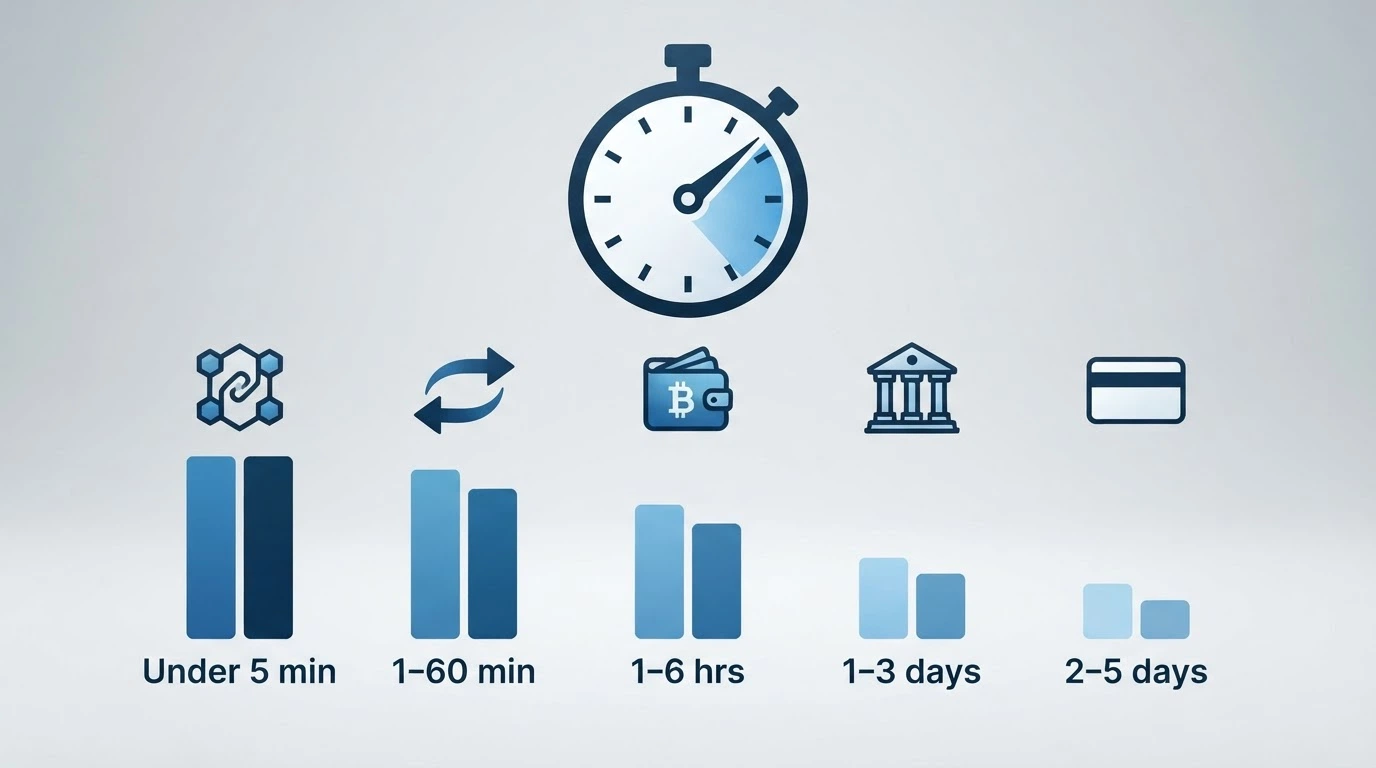
| Method | Typical Payout Speed | Best For | What to Watch Out For |
|---|---|---|---|
| Crypto (USDT TRC20, Solana) | Under 5 minutes after approval | Players who already use a wallet and want the fastest rail | AUSTRAC Travel Rule at A$10,000; bank-to-exchange friction in AU |
| PayID / Osko | 1–60 minutes after approval | AUD-native players who want bank-to-bank speed | Operator queue variance: 1–2h at Caswino, ~1h at Wild Tokyo, 2–5 business days at Bizzo |
| Skrill / Neteller | 1–6 hours | Players with an existing e-wallet | E-wallet fees; not all operators support both |
| Bank Transfer | 1–3 business days | Large payouts where the rail is not the bottleneck | Multi-day processing; intermediary bank delays |
| Visa / Mastercard | 2–5 business days | Players who do not have a wallet or PayID set up | Slowest option; chargeback window adds friction |
The hierarchy is the headline: crypto first, PayID second, e-wallets third, bank transfer fourth, cards last. What the table cannot carry is why the spread looks the way it does. The bank-side rail is fast — PayID through Osko settles in seconds, and crypto is the same on its own rail. The casino-side processing window is what dominates, and that window is operator-dependent. Bizzo’s PayID at 2–5 business days and Caswino’s PayID at 1–2 hours are both PayID; the rail is identical. The queue is the difference.
PayID: The Fastest AUD-Native Payout Rail
PayID through Osko is the best fiat option for an Australian player who wants the money in a bank account rather than a crypto wallet. The transfer itself is instant by design — the Reserve Bank built the New Payments Platform that way — and the practical upper bound is the casino’s approval queue, not the rail.
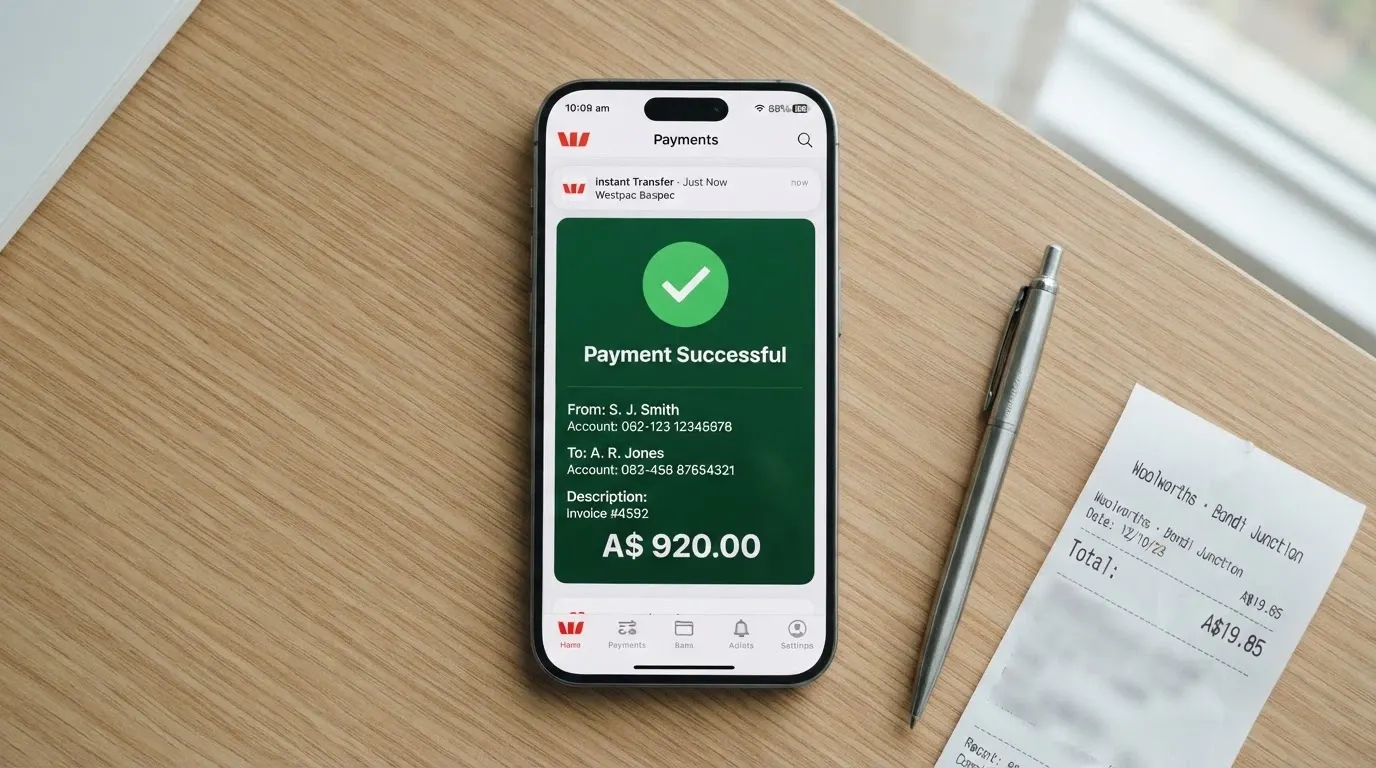
A 2026 review round tested a PayID withdrawal that returned A$920 to a Commonwealth Bank account in 11 minutes from button-press to receipt, which is what “instant” looks like when both the rail and the queue are cooperating. That figure is the benchmark for what a clean PayID withdrawal should look like at an operator whose queue is short.
PayID speed varies across operators on this list because the casino-side queue varies, not because the rail does. Caswino clears PayID in 1–2 hours; Wild Tokyo at around one hour; Bizzo at 2–5 business days. The same PayID, three different player-facing times. A player who picks PayID because it is the fastest AUD-native rail elsewhere on this list and lands at Bizzo will be surprised, and the surprise is the gap between “PayID is fast” as a rail fact and “PayID at this operator is fast” as the fact that matters.
The verdict: PayID is the right rail for an AUD-native withdrawal, and the operator is the deciding factor on player-facing speed. The 11-minute benchmark is the standard; operators on the multi-day end of the spread are not meeting it.
Crypto Withdrawals: Bitcoin, USDT and the Sub-5-Minute Payout
Crypto is the fastest rail on this list once the casino has approved the withdrawal. USDT TRC20 and Solana are the cleanest options, clearing in under five minutes after approval. Bitcoin and Ethereum are a step slower at 10–30 minutes on the operators that publish those numbers, but the gap is rail-level — blockchain confirmation time — rather than operator-level.
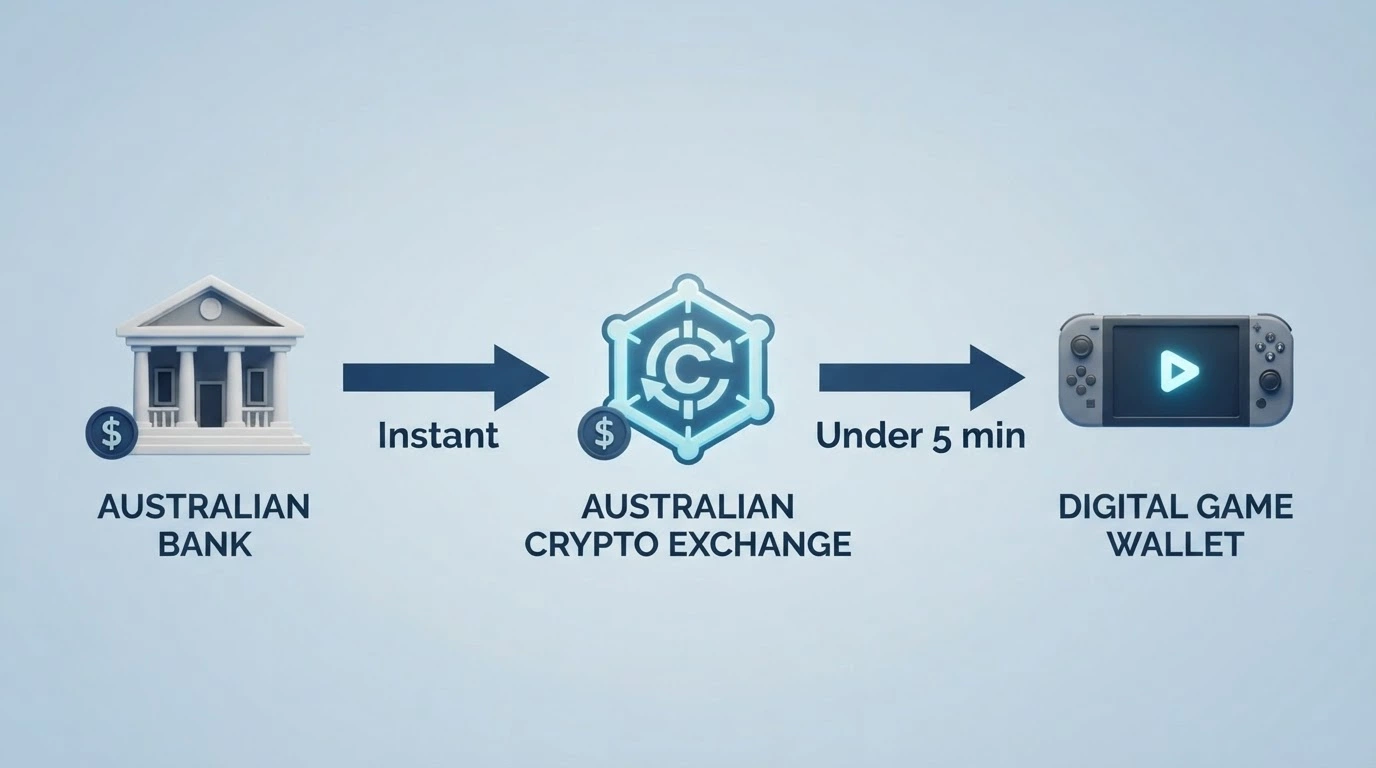
Australian players face two friction points at the bank end. The first is AUSTRAC’s Travel Rule, which kicks in at A$10,000 for crypto transactions and requires identity information to accompany the transfer. Below that threshold the rule does not apply, and the player moves money through a crypto exchange with the same friction as any other retail transfer. Above it, the exchange will collect identifying information on both ends of the transfer, and the player should expect that step.
The second friction is bank attitudes to outbound crypto-exchange transfers. Commonwealth Bank and Westpac restrict large outbound transfers to crypto exchanges; ANZ and NAB flag without fully blocking; ING and Macquarie are the most permissive. The cleanest crypto-to-AU-bank route in 2026 is the chain AU bank → CoinSpot or Independent Reserve → USDT TRC20 → offshore casino, and the reverse to cash out. The exchange in the middle is the buffer that keeps the bank on the player’s side of the transaction.
The verdict: Crypto is the fastest rail, USDT TRC20 is the cleanest option for the AU dollar equivalent, and the bank end of the chain is where the friction lives. ING and Macquarie are the most permissive banks for crypto transfers; CommBank and Westpac the least.
E-Wallets: Skrill, Neteller and the 1–6 Hour Window
Skrill and Neteller sit between crypto and cards in the speed hierarchy — faster than bank transfers, slower than PayID. The typical payout window is 1–6 hours after approval. Among the featured operators, Bizzo lists Neteller at the faster end of that range.
The comparison with PayID is the read. PayID clears in minutes once the casino releases funds, while an e-wallet clears in hours. For an Australian player who has a PayID set up on a bank account, PayID is the faster AUD-native option, and an e-wallet is the right rail only when PayID is not available or when the operator’s PayID queue is the long end of the spread.
E-wallet fees vary by operator and by e-wallet. The data surfaced this run does not carry per-operator e-wallet fee details, and the player should check the cashier page for the fee line before requesting a withdrawal.
The verdict: E-wallets are the third rail in the hierarchy, behind crypto and PayID for Australian players. The player with a PayID set up should default to PayID; the e-wallet is the fallback.
Cards and Bank Transfers: Why They Are the Slowest Options
Visa and Mastercard withdrawals take 2–5 business days, and bank transfers take 1–3. The traditional rails are slow for two reasons: the chargeback window on cards, which the operator’s payment processor has to plan around, and intermediary correspondent banks on wire transfers, which add time the player does not see.
The trade-off is familiarity. Cards and bank transfers are the rails every Australian already has, and the player who does not want to set up a PayID or a crypto wallet will use them by default. The cost of that default is multi-day payout times, and the cost is real — a player waiting five business days for a payout is a player whose money is in the operator’s hands for that entire window.
The verdict: Cards and bank transfers are the slowest rails and the most familiar. The player who wants speed sets up PayID or crypto; the player who stays on cards accepts the multi-day window as the price of the default rail.
Pokies That Pay Out Fast: What Australians Are Actually Playing in 2026
The game library at the featured operators runs from 280 RTG titles at FairGO to 12,000+ at Caswino, with Wild Fortune at 3,800+ from 90+ providers and Wild Tokyo at 7,000+. The provider mix tells the story: FairGO is a single-studio catalogue tuned for the Australian market, Caswino is a multi-studio aggregation that pulls from 70+ suppliers, and Wild Fortune sits between with the breadth of a multi-studio setup but a smaller curated count.

What the game choice does not affect is the withdrawal speed. The pokies are what the player plays; the rail is how the player gets paid. The game does not change the cashier’s queue, does not change the PayID window, and does not change the crypto confirmation time. A player spinning a pokie at one of the featured operators is paid out through the same PayID or crypto rail the cashier offers regardless of which game generated the win.
Australian pokies terminology runs through “pokies” rather than “slots”, “real money” rather than “cash play”, and “no deposit bonus” for the small free-spin packages. The featured operators carry the full Australian-flavoured library, with the broader aggregators at Caswino and Wild Tokyo pulling in the international multi-studio catalogue and FairGO carrying the RTG-specific games that have built a long presence in the Australian market.
PayID Pokies: Playing in AUD and Cashing Out to an Australian Bank Account
For pokies players who want PayID payouts, Caswino and Wild Tokyo are the two operators that combine a large pokie library with a fast PayID window — 1–2 hours at Caswino, around one hour at Wild Tokyo. Bizzo carries pokies and PayID, but the PayID window is the multi-day end of the spread at 2–5 business days.
The PayID pokies experience is the same as any other AUD-native play: deposit in AUD through PayID, play pokies, withdraw in AUD through PayID to an Australian bank account. The currency stays AUD throughout, the bank account on the receiving end is the same one the player pays from, and the rail is the same PayID/Osko network the rest of the Australian banking system uses.
The speed spread is the operator story rather than the rail story. Caswino at 1–2 hours and Bizzo at 2–5 business days are both PayID; the difference is the casino’s queue. The player who wants PayID pokies with the fastest payout picks Caswino or Wild Tokyo. The player who values the Bizzo welcome package and is willing to wait pays the multi-day price.
The verdict: PayID pokies are an AUD-native experience, and Caswino and Wild Tokyo are the two operators that deliver it at speed. Bizzo’s PayID window is the gap that should set the player’s expectation.
Why Your 2026 Bonus Takes Longer to Withdraw Than You Think
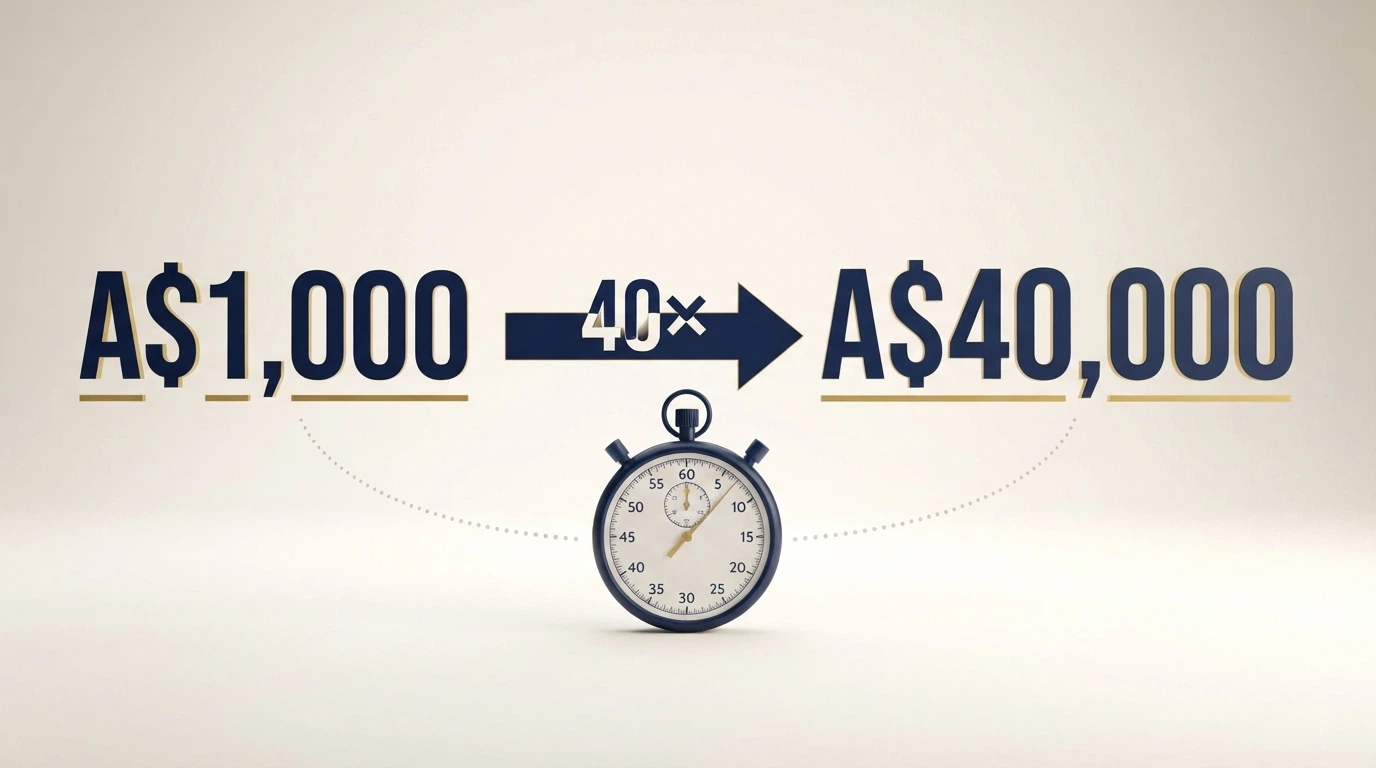
A welcome bonus looks generous at the headline. What sits behind the headline is a turnover requirement that runs from a clean 0x on free spins at Wild Fortune and Bitstarz up to 40x on bonus funds at Bitstarz. The arithmetic is straightforward: bonus × wagering multiple = turnover required before the bonus balance becomes withdrawable. A A$1,000 bonus at 40x is A$40,000 of turnover before a cent of bonus money moves to the withdrawable column.
The “instant” withdrawal promise stops at the bonus terms. A player who has not met the wagering requirement cannot withdraw the bonus balance, regardless of how fast the rail would otherwise be. The clock does not start until the turnover is met, and the turnover is the gate that the rail sits behind.
The range across the featured set runs from 0x on free spins at Wild Fortune and Bitstarz (the cleanest structure on the list, with free-spin winnings landing in the withdrawable column as soon as credited) through 35x at Jet4bet up to 40x on bonus funds at Bitstarz (the heaviest load on the list). The cleanest bonus structure is 0x on free spins: no turnover gate, no expiry risk on the bonus itself, no max cashout cap on the free-spin winnings beyond what the operator’s terms set.
The bonus validity window is the second gate. Research did not return validity periods for most operators, and a bonus that expires before wagering is met is lost. The player who claims a bonus should check the validity window before the first deposit, not after the wagering is half-done.
Max cashout caps on bonus winnings are the third gate. FairGO’s 30 no-deposit free spins on Fu Long Treasures carry an A$180 maximum cashout — a cap that defines the upside of the offer before the player spins. Caps are common on no-deposit offers and rarer on deposit bonuses, and the player should read the cashier page for the cap before treating the bonus as a route to a four-figure withdrawal.
No-Deposit Offers: Free Spins With Strings Attached
A no-deposit bonus is free spins or bonus credit with no deposit required, and the offer is a taste of the cashier rather than a route to a payout. FairGO’s 30 free spins no-deposit on Fu Long Treasures carry an A$180 maximum cashout, and Caswino carries 20 free spins no-deposit on top of its deposit package.
The real withdrawable value is small because the cap is small. A$180 from FairGO is the ceiling on what the no-deposit free spins can produce, regardless of what the spins actually return. A player who treats the offer as a way to test the cashier — verify the KYC flow, test a small withdrawal, see how the rail behaves with a small balance — gets the value the offer is designed to deliver. A player who treats it as a route to a four-figure payout is reading the wrong number.
Only two of the ten featured operators carry a no-deposit offer at all. FairGO and Caswino are the two. The other eight on this list do not publish no-deposit bonuses in the data surfaced this run, which is itself a fact about the segment: most offshore casinos serving Australians lead with deposit packages rather than no-deposit offers, and the player who wants a no-deposit taste is looking at a narrow subset of the market.
The verdict: No-deposit offers are a taste, not a payout. The max cashout cap is the real ceiling, and the player who treats the offer as a cashier test gets the value it is designed to deliver.
Wagering Requirements: The Real Gatekeeper Between You and Your Money
A 40x wagering requirement on bonus funds means betting 40 times the bonus amount before the bonus balance is withdrawable. The arithmetic is the gate: bonus amount × wagering multiple = turnover required.
Across the featured set the spread runs from 0x on free spins at Wild Fortune and Bitstarz (no turnover gate on free-spin winnings), through 35x at Jet4bet (a moderate load), to 40x on bonus funds at Bitstarz (the heaviest load). The cleanest bonus structure on the list is 0x on free spins: free-spin winnings land in the withdrawable column with no turnover requirement, and the player is not racing an expiry clock on the bonus itself.
How wagering interacts with withdrawal speed is the practical read. The “instant” clock does not start until turnover is met. A player who has wagering left on a bonus cannot withdraw the bonus balance, regardless of how fast PayID or crypto would otherwise be. The rail waits behind the gate, and the gate is the wagering requirement.
A worked calculation makes the load concrete. Taking an illustrative A$1,000 first-deposit bonus with 40x wagering on bonus funds at a 96% return-to-player (RTP, the percentage of wagered money a game is designed to return to players over the long run), betting A$1 per spin on a five-second spin cycle: required turnover is A$1,000 × 40 = A$40,000. At A$1 per spin, that is 40,000 spins. At five seconds per spin, that is 200,000 seconds, or roughly 55.6 hours of continuous play. The expected loss on A$40,000 of wagering at 96% RTP is A$40,000 × (1 − 0.96) = A$1,600 — the cost of clearing the bonus in statistical terms. The 55.6 hours is how long the “instant” clock waits.
These numbers are an estimate: an average across many spins under the stated assumptions, not a guaranteed outcome for any single player. The wagering requirement is the gate; the play time is how long the gate takes to open.
The verdict: Wagering requirements are the gate between bonus balance and withdrawable cash. 0x on free spins is the cleanest structure on the list; 40x on bonus funds is the heaviest. The “instant” clock waits behind the gate, and the gate is what the bonus terms set.
The Legal Reality: Every Instant-Withdrawal Casino Is Offshore and Unlicensed in Australia
The Interactive Gambling Act 2001 makes providing an online casino to a person in Australia an offence. There is no online casino licence anywhere in the country — not federally, not in any state or territory. Every operator on this page is offshore and unlicensed in Australia, and the player who deposits at any of them is accessing a product that cannot be legally provided to them.
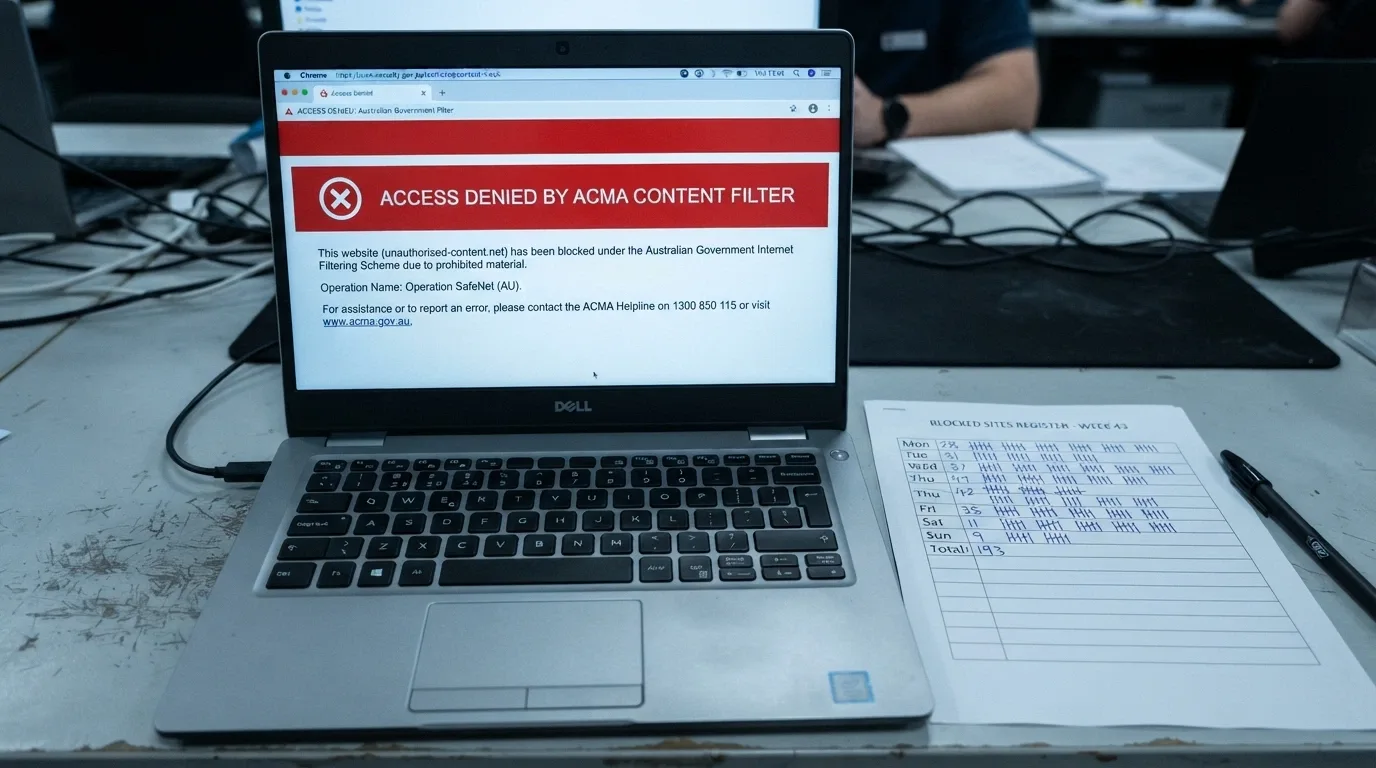
The ACMA’s enforcement reach is the operational consequence. Since the first blocking request in November 2019, the ACMA has directed Australian ISPs to block 1,564 illegal gambling and affiliate websites as at March 2026. More than 225 illegal services have withdrawn from the Australian market since the 2017 strengthening — a measure of how many operators decided the ACMA’s blocking authority was not worth contesting.
What the player loses is the entire Australian safety net. There is no Australian consumer protection. There is no complaints body with the power to recover money. BetStop, the National Self-Exclusion Register, binds only Australian-licensed wagering services and reaches none of the operators on this page. If an offshore operator refuses a withdrawal, closes an account or vanishes, the ACMA cannot retrieve the funds and the Australian Competition and Consumer Commission has no jurisdiction. The site itself can be blocked at any time with a player’s balance still on it — DNS-level blocking, and the operator’s domain stops resolving for Australian customers.
The individual player is not prosecuted under the IGA — the Act targets the provider, not the punter. The player carries no criminal exposure. What the player carries is the loss of every protection that exists for Australian-licensed wagering customers.
The payment method is itself a tell. An Australian who is asked for a credit card or a crypto deposit by a gambling site is being served by someone outside the Australian rules. Credit cards, credit-related products and digital currency are banned as payment for online wagering from 11 June 2024 under the Interactive Gambling Amendment (Credit and Other Measures) Act 2023, with penalties of up to A$247,500 for licensed operators that fail to enforce it. The fact that an offshore casino is asking for one of those payment methods means the operator is outside the regime that enforces the ban.
“No Verification” Casinos: What No-KYC Really Means in Australia
A casino advertising “no KYC” or “no verification” is signalling that it operates outside the regulatory framework that exists to protect the player, not offering a convenience. KYC verification is the operator’s compliance with anti-money-laundering and counter-terrorism-financing (AML/CTF) obligations — it is the identity check, the source-of-funds verification, the transaction-monitoring screen that licensed operators run by law.
AUSTRAC’s Travel Rule adds another layer. For crypto transactions at A$10,000 and above, identity information must accompany the transfer — a regulatory requirement that licensed Australian exchanges enforce. An offshore casino advertising “no verification” is choosing not to run those checks, and the choice is a red flag for the player who wants the operator inside the AML perimeter.
The irony at the withdrawal end is the failure mode. A player who avoids KYC at deposit to keep the signup fast often meets KYC at withdrawal, triggered by a large payout or a transaction-monitoring rule. Verification issues often cause these delays. The “instant” promise collapses into the verification queue exactly when speed matters, and the player who tried to skip the step at deposit pays for it at withdrawal.
Licensed Australian wagering operators must verify identity at signup. An offshore casino that does not is operating outside the regulatory perimeter by choice. The choice is not a feature for the player; it is a gap in the protection that licensed operators are required to provide.
The 2026 Reform: What Changes on 1 January 2027
The Interactive Gambling Amendment (Gambling Reform) Bill 2026 passed both Houses of Parliament on 19 August 2026. Its measures commence on 1 January 2027, and the most consequential provision for offshore casinos serving Australians is the bank and payment-provider authority to block transactions to illegal gambling operators. From 1 January 2027, an Australian bank may decline a deposit to an offshore casino or block the transaction at the payment-processor level. The deposit route that has worked for years may close, and the operator on the other end has no Australian regulator to appeal to.
The advertising restrictions are the most visible part of the reform. Wagering advertising is banned from 15 minutes before until 5 minutes after a live sporting event, and capped at no more than three ads per hour between 6:00 am and 8:30 pm on television. Radio wagering ads are barred during school drop-off and pick-up times. Broadcasting sporting odds is banned outright. Athletes, celebrities and influencers are barred from promoting wagering products. Wagering ads are banned inside sports venues and on player and official uniforms. Online wagering ads may be shown only to verified, logged-in, over-18 users who have not opted out.
AdStop is the national wagering advertising opt-out register, administered by the ACMA. It sits beside BetStop as the second national register, and it gives Australians a single opt-out that applies across wagering advertising rather than across wagering services.
The inducement cooling-off provisions are the third leg. Direct marketing of inducements — bonus offers, free bets, “join now” prompts — is prohibited for 14 days after a customer signs up with a licensed wagering operator, for 3 months after a person deregisters from BetStop, and indefinitely for customers identified as at-risk of gambling-related harm. The cooling-off binds licensed Australian operators; offshore casinos are not bound by it.
The net benefit of the advertising reform is estimated at A$107.1 million per annum, primarily through reductions in gambling-related harm. That is the Office of Impact Analysis’s estimate of what the reform is worth in harm-reduction terms, and the scale of the figure is itself a measure of the harm the reform is designed to reduce.
What the reform means for offshore casino access is the bank-blocking authority. The advertising restrictions tighten what licensed operators can say; the bank-blocking authority tightens what Australians can do at unlicensed operators. The deposit route is the most direct mechanism, and from 1 January 2027 an Australian bank may close it.
Playing Within Reach: Responsible Gambling When Withdrawals Are Instant
Instant withdrawals remove a natural friction point that once slowed the cycle of deposit-play-withdraw. The faster the money returns, the faster it can be re-deposited, and the player who is managing a problematic pattern needs the friction that licensed operators are required to provide.
About 2.1% of Australian adults — roughly 430,000 people — experience problem gambling, with the Australian Institute of Health and Welfare putting high-risk gambling at 1.8% in 2022. Those are the population-scale numbers behind the operator-level tools, and the reason those tools exist.
The National Gambling Helpline is 1800 858 858 — free, confidential, staffed 24 hours a day, seven days a week, across Australia. Gambling Help Online, at gamblinghelponline.org.au, offers online chat and counselling for players who prefer text to voice. Both are free, both are confidential, both are staffed by people whose job is to help.
The tools Australian-licensed wagering operators must offer include deposit limits, session time limits, take-a-break features and activity statements. Offshore casinos are not bound by Australian responsible-gambling (RG) requirements, and the tools they offer vary. A player who wants RG controls should set personal deposit and session limits before playing, regardless of what the operator offers.
BetStop and the Offshore Gap: Self-Exclusion That Does Not Reach
BetStop has been live since August 2023 as the National Self-Exclusion Register. One registration excludes a person from every Australian-licensed online and phone wagering service in a single step. As at 31 July 2026, BetStop had 67,480 registrations, of which 41,290 exclusions were still active — more than 60% of everyone who ever registered. 78% of registrants were under 40, and 38% chose lifetime exclusion.
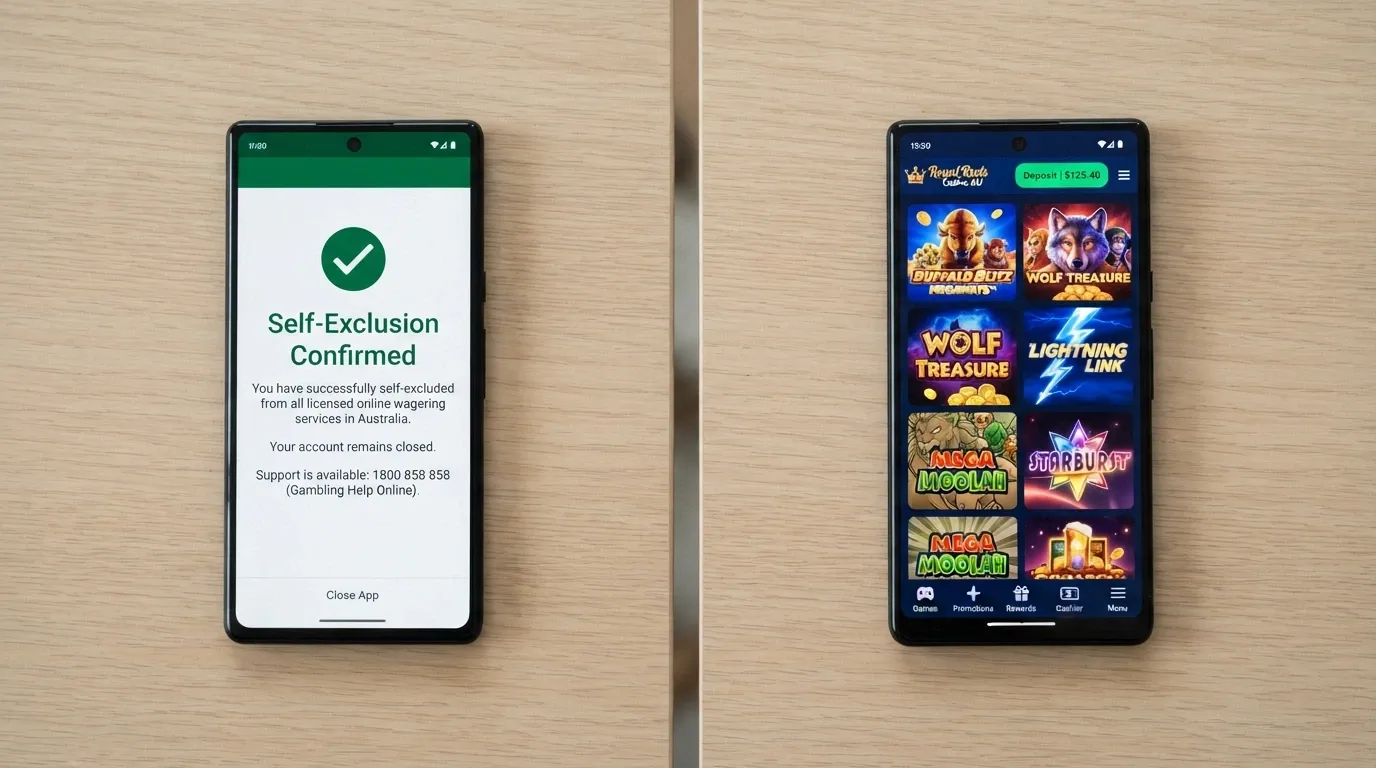
BetStop binds only Australian-licensed wagering services. An offshore casino is not licensed in Australia, is not connected to the register, and will continue accepting a self-excluded person’s money. The gap is the most concrete harm of the offshore route: a person who has registered with BetStop because they recognise a problem is still able to deposit and play at every operator on this page.
The practical read for a person who has registered with BetStop is that the offshore route is exactly the gap the registration does not close. Self-exclusion is a tool, and the tool works on the licensed market. The unlicensed market is where the tool does not reach.
Deposit Limits and Session Controls: What the Licensed Market Requires and Offshore Casinos May Not Offer
Licensed Australian wagering operators must offer deposit limits, session time limits, take-a-break features and activity statements. The 2026 reform adds inducement cooling-off — 14 days post sign-up, 3 months post BetStop deregistration, indefinitely for at-risk customers — but those provisions bind licensed operators only.
Offshore casinos are not bound by Australian RG requirements. The tools they offer vary by operator, and the data surfaced this run does not carry per-operator RG tool detail. A player who wants RG controls cannot rely on the offshore operator to provide them and should set personal deposit and session limits before playing.
The Australian paradox is that there is no federal deposit, loss or stake ceiling — because the product those ceilings would govern is banned outright. The government cannot cap deposits at offshore casinos because it cannot regulate them; the ban is the regulatory tool, and the offshore route is the gap in the ban. The 1 January 2027 payment-blocking authority is the first mechanism designed to close the deposit side of that gap.
How We Evaluated These Casinos: Our Testing and Ranking Criteria for 2026
The ranking is built on three layers of evidence. The first is independently tested payout reviews from 2026, which timed withdrawals from button-press to receipt and recorded the operator, the payment method, the KYC posture and the receiving bank or wallet. The second is operator-published information — claimed processing windows, payment-method coverage, welcome-package terms — which is best-case and assumes an already-verified account. The third is the ACMA’s published enforcement data and the Interactive Gambling Act 2001 framework, which sets the regulatory baseline.
What was measured is the casino-side processing window. The bank-side rail (PayID/Osko) is known to be fast once funds are released. Crypto rail speed is known. The variable is how long the operator’s queue takes to release the funds, and that variable is what the ranking sorts on.
Licence verification worked against two layers. The first was the IGA: every operator on this list is offshore and unlicensed in Australia by definition, because no online casino licence exists in this country. The second was the offshore regulator’s own register. For several operators (Wild Tokyo, Bizzo Casino, Rocket Play, Skycrown, Royal Reels), the regulator could not be confirmed from public sources this run. Those rows state the gap plainly rather than naming a regulator that could not be verified. They remain in the ranking because market-share data confirms significant Australian usage, and a comparison that dropped them would misdescribe the real shape of the market.
Game library size and payment-method coverage were recorded from operator pages and review data. The ranking does not weight those factors above payout speed; they are secondary axes, surfaced in the operator write-ups but not driving the order of the list.
What the “licensing regulator could not be independently verified” note means is that the search did not return sufficient detail to confirm a regulatory jurisdiction from the regulator’s own register. The operators may hold licences — the absence of confirmation is a gap in the public data, not a finding of fact against the operator. The gap stays in the table because a reader comparing operators needs to see it.
What You Should Actually Do: Playing Smart in an Unregulated Market
The verdict on this market is the same as the verdict the IGA has carried since 2001: every instant-withdrawal casino serving Australians is offshore and unlicensed in Australia, and the player has no Australian safety net. The trade-off is speed and game variety against zero Australian consumer protection, and the player who understands that trade-off is the player who can decide whether to take it.
The payment method is itself a tell. An Australian asked for a credit card or a crypto deposit by a gambling site is being served by someone outside the Australian rules — the credit-card and crypto ban for licensed wagering since 11 June 2024 means that an operator asking for either is, by definition, outside the regime that enforces the ban. The payment method is the clearest single signal a player gets.
BetStop does not reach offshore casinos. A person who has registered with BetStop — 67,480 Australians as at 31 July 2026 — has closed the licensed route, and the offshore route is exactly the gap that remains open. Self-exclusion works on the licensed market. The unlicensed market is where the tool does not reach.
The tax reality is favourable on the surface: recreational gambling winnings are not assessable income under section 6-5 of the ITAA 1997, and no Australian case has held an ordinary punter’s winnings assessable. The recovery reality is the same as for any other offshore dispute: the ATO cannot retrieve money an offshore operator withholds, and neither can the ACMA.
The concrete steps a player should take before depositing are five. Verify the operator’s licence against the regulator’s own register, not against the operator’s homepage. Complete KYC before the first deposit, not after a win — the verification queue at withdrawal is the failure mode the “instant” promise collapses into. Use PayID or crypto for the fastest payout at AUD-native or stablecoin-native speed, and accept that PayID at Bizzo and PayID at Caswino are different products despite the same rail. Never deposit more than the player can afford to lose to an ACMA block — DNS-level blocking can close the site overnight with a balance still on it. Know the National Gambling Helpline number: 1800 858 858, free, confidential, 24/7, across Australia.
This page is a factual comparison of offshore operators Australians access. It is not an endorsement of any operator, and no operator on this page is licensed in Australia. The ranking ranks on payout speed and on what the public record carries; the trade-off the player accepts is the player’s to make.
Frequently Asked Questions
What is the difference between an instant withdrawal casino and a same-day payout casino?
An instant withdrawal casino commits to releasing funds to the rail within minutes, with PayID or crypto clearing once approved. A same-day payout casino commits to releasing funds within the same business day, with the rail (typically cards or bank transfer) adding further time. The difference is the queue length, not the rail speed, and the player-facing gap between the two can run from minutes to days depending on the operator and the method.
Why does my casino withdrawal keep getting delayed even though the site says “instant”?
The most common cause is incomplete KYC verification. A player who skipped identity checks at deposit will meet them at withdrawal, triggered by a large payout or a transaction-monitoring rule. The “instant” clock does not start until the verification step is signed off, and the queue at that step is what delays the payout. Completing KYC before the first deposit is the cleanest route to the instant time the operator promises.
What happens to my money if an offshore casino is blocked by the ACMA?
The ACMA can direct Australian ISPs to block an offshore casino at any time, and the block is DNS-level — the operator’s domain stops resolving for Australian customers. A player’s balance on the blocked site is not automatically retrievable. The ACMA cannot recover the funds, the Australian Competition and Consumer Commission has no jurisdiction, and the player has no Australian complaints body to approach. This is the most concrete risk of the offshore route: the site can close overnight with a balance still on it.
Do I need to complete KYC verification before I can withdraw from an online casino?
At a licensed Australian wagering operator, yes — KYC is required by law. At an offshore casino, the requirement is operator-dependent, but the practical answer is that large withdrawals will trigger KYC regardless of what the operator advertised at signup. This verification remains the primary cause of delays. Completing verification before the first deposit is the cleanest route to fast payouts.
Does BetStop self-exclusion apply to offshore online casinos?
No. BetStop binds only Australian-licensed wagering services. An offshore casino is not licensed in Australia, is not connected to the register, and will continue accepting a self-excluded person’s deposits and play. A person who has registered with BetStop has closed the licensed route; the offshore route is the gap that remains open.
How long does a PayID casino withdrawal actually take in Australia?
PayID through Osko is instant by rail — the transfer settles in seconds once the casino releases the funds. The player-facing time is the casino-side queue on top of the rail. The 2026 benchmark is 11 minutes from button-press to receipt for a A$920 PayID withdrawal at one operator. Across the featured set, PayID runs from around one hour at Wild Tokyo, to 1–2 hours at Caswino, to 2–5 business days at Bizzo. The rail is the same; the queue is the difference.
Mobile, Apps and Real-Money Play: Does the Device Change the Payout Speed?
It does not. The withdrawal rail is the same whether the player plays on a phone app, a mobile browser or a desktop. The casino’s cashier hands funds to PayID, to a blockchain, to a card processor or to a bank, and none of those endpoints is faster or slower because of the device that initiated the request. The screen the player is looking at when they press “withdraw” does not change how long the money takes to arrive.
The same is true of real-money versus demo or fun-mode play. Demo mode has no withdrawal at all — it is practice only, with no real-money balance to cash out. Real-money play is the only mode in which withdrawals exist, and the rail is the rail regardless of whether the player was spinning on an iPhone app moments before.
AUD is the deposit and withdrawal currency at every featured operator on this page, with PayID and crypto as the cleanest routes in and out. The device and the game mode are not factors in payout speed. The payment method is, and the table later in this page ranks them.
Your Money and the Tax Office: Are Offshore Casino Winnings Taxable?
Recreational gambling winnings are not assessable income under Australian tax law. Section 6-5 of the Income Tax Assessment Act 1997 (ITAA 1997) treats betting and gambling winnings as non-assessable, and section 8-1 treats gambling losses as non-deductible — unless the person is carrying on a business of betting or gambling. No Australian case has held the winnings of an ordinary punter assessable.
The line between punter and professional matters. A person who carries on a business of gambling — systematic betting activity, a profit-seeking operation, a level of organisation that goes beyond recreational play — may have winnings treated as business income. For the player who deposits, plays and withdraws at an offshore casino as a recreational activity, the winnings are not taxable. For the player whose activity crosses into a business operation, the analysis changes.
What this means for the offshore casino player is that the Australian Taxation Office (ATO) will not assess recreational winnings, but the ATO also cannot help if the operator withholds the winnings or closes the account. The tax treatment is favourable; the recovery options are the same as for any other offshore dispute — that is, limited.
The verdict: Recreational gambling winnings are not taxable in Australia. The ATO does not assess them, and no Australian case has held an ordinary punter’s winnings assessable. The protection stops at tax; the offshore recovery gap is unchanged.