
A A$10 Deposit at Offshore Pokies Sites in Australia — 2026
A A$10 deposit at an offshore pokies site buys entry. It buys roughly 50 to 100 spins at the bottom of a pokie’s stake range. It does not buy a guarantee, an Australian licence, or a safety net — online pokies are prohibited under the Interactive Gambling Act 2001, and the operators that take a A$10 deposit run outside Australia. What the marketing copy calls a “A$10 deposit casino” is, in plain English, an unlicensed site accessible to Australians through offshore corporate structures. What follows is an account of what a A$10 deposit actually buys in 2026, which operators take it, what the player trades away for the entry, and what the responsible-gambling infrastructure looks like regardless of where the player ends up.
Current as of 29 October 2026 — checked against Curaçao regulator records and the ACMA register of blocked services.
Table of Contents
- Why Your 2026 $10 Pokies Deposit Buys Less Than the Advertised Figure
- The 10 Offshore Pokies Sites Australians Are Actually Using in 2026
- Getting $10 onto an Offshore Pokies Site: Every Payment Method That Works
- Your Phone, a $10 Deposit, and an Unlicensed Pokies Site
- The IGA Reality: Online Pokies Are Prohibited in Australia
- When a $10 Deposit Floor Becomes a Trap Door
- How We Evaluated These $10 Deposit Pokies Sites
- What Your $10 Pokies Deposit Should Actually Buy You
- Frequently Asked Questions
Why Your 2026 $10 Pokies Deposit Buys Less Than the Advertised Figure
The marketing line is “A$10 deposit casino.” The product is something smaller. A A$10 deposit clears the cashier, hits the lobby, and disappears into the house edge at the rate the arithmetic dictates — not the rate the welcome page implies. At a 96.5% return-to-player — the midpoint for the major pokies the Australian-facing sites stock — the house edge is 3.5%. The arithmetic: spins multiplied by stake multiplied by 3.5% gives the expected loss for a session. For a 50-spin session at A$0.10 per spin, the expected loss works out to about A$0.18. For 100 spins at A$0.20, it climbs to around A$0.70. Most sessions land somewhere between the two. The figure is the average over many spins, not a guaranteed outcome for any single player, but it gives a sense of what the edge will quietly take.
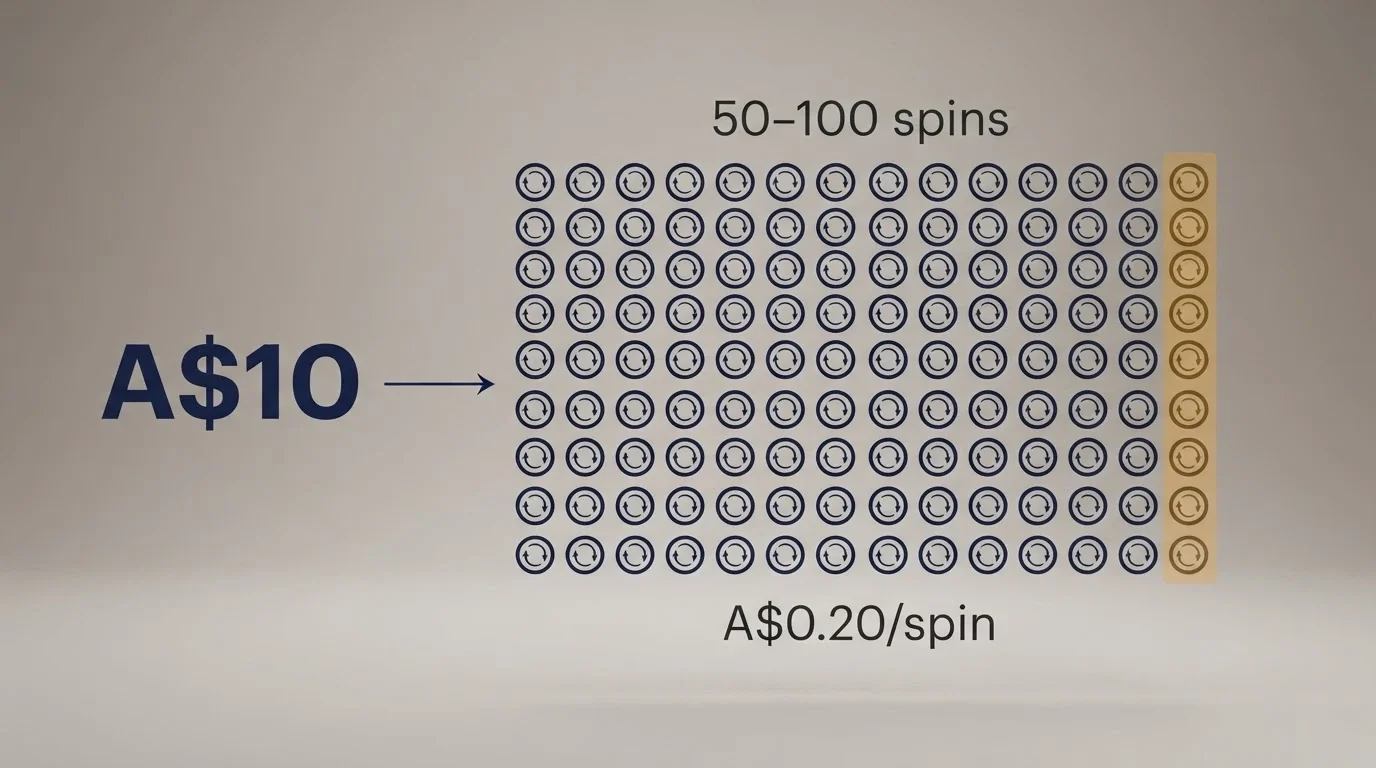
The advertised figure survives the marketing meeting because it sounds generous. The real figure — what the bankroll buys in spins, what survives the wagering requirements, what the player can pull back out — is what the rest of this section unpacks.
What “$10 Minimum Deposit” Means on an Offshore Pokies Site
“Minimum deposit” is a funding floor, not a bankroll guarantee. The phrase appears in a cashier field and means the smallest single transaction the operator will accept on a payment rail. Below that floor, the deposit button rejects the request. Above it, the player has whatever they sent — minus any conversion fee if the AUD figure turned into something else, minus any processing hold the operator imposes, and minus the house edge that starts reshaping the balance on the first spin.
A A$10 floor is the figure the market quietly settles on. As one Australian-facing operator publication put it, when people ask which casinos have a A$10 minimum deposit, the truthful answer is “most of the credible offshore ones” — A$10 is the figure the market settles on. Lower figures — A$1, A$5 — turn up on edge cases that the same sites do not always honour at the cashier. The deposit is the smallest commitment the operator will take, not the smallest balance a session can run on. Reading the term as a bankroll promise is the first mistake the marketing copy encourages.
From Sign-Up to First Spin: How a $10 Deposit Works in Practice
The path from a desktop or phone screen to a spinning reel runs through four steps. First, account creation: email, password, country set to Australia, currency set to AUD. The cashier accepts the AUD designation without flagging anything, because the site operates outside Australia and does not run on the Australian banking compliance list. Second, identity verification: a driver licence or passport scan, plus a proof of address. Offshore sites vary on when KYC fires — some ask before the first deposit, others wait until the player requests a withdrawal. Third, the deposit: PayID, Neosurf voucher code, or crypto wallet transfer. PayID clears in under 30 seconds at zero cost. Neosurf is a code from a 16-digit voucher. Crypto varies with the chain and the fee market. Fourth, the lobby: A$10 appears as the balance, and the player selects a pokie at A$0.10 to A$0.20 per spin.
At that stake range, A$10 buys 50 to 100 spins. That is a real session — enough to feel the rhythm of the game and to take a few bonus features through their paces. It is not enough to absorb a long cold streak, and it is not enough to make the bonus terms at most operators work in the player’s favour. The deposit is the smallest size the operator will accept; it is also the smallest size where the player should expect to lose the whole thing before any welcome bonus converts into withdrawable cash.
First Deposit vs Ongoing Deposit: Why the Welcome Minimum Is Not the Everyday Minimum
Most operators in the featured set split their deposit floors. The “minimum deposit” figure on a marketing page is often the floor for the welcome bonus — and that figure usually sits higher than the bare funding minimum. SkyCrown’s first-deposit bonus starts at A$30. RocketPlay’s first deposit requires A$30, and the second A$75. Royal Reels’ matched welcome bonus is gated at A$30. The bare A$10 floor is what works for a plain top-up or a no-deposit bonus where one exists; the welcome-package floor is a different number, and a A$10 deposit is usually the wrong size to claim it.
Reload floors are less consistent across the featured set. Where a site has not published its reload terms, a player should check the cashier before assuming a A$10 top-up is fine on the second deposit. The pattern at most operators in this set is to keep one floor for the first bonus and another for what comes after — sometimes higher, sometimes the same. A player who wants the welcome offer deposits the welcome minimum. A player who wants a quiet reload deposits whatever the cashier takes.
AUD Amounts and the Dollar-Sign Trap
The currency toggle is the single most under-checked control on a pokies cashier. A player who deposits in USD against an AUD bank account loses roughly 30% on the conversion rate before any spin happens, and pays the same 30% friction again on the way out. The dollar sign on the cashier is not a guarantee of AUD — some offshore sites default to USD or EUR and only switch to AUD if the player actively selects it. A player who skips the toggle and sees “$10” in the cashier has paid more than A$10, in a currency the Australian bank will charge again to convert back.
The opposite trap is a player who sees “A$10” on a marketing page, deposits A$10, and finds the bonus terms denominated in a different currency. The bonus math still works, but the player has paid the conversion cost twice — once on the way in, once on the way out. A AUD toggle is the first check, not an afterthought.
The 10 Offshore Pokies Sites Australians Are Actually Using in 2026
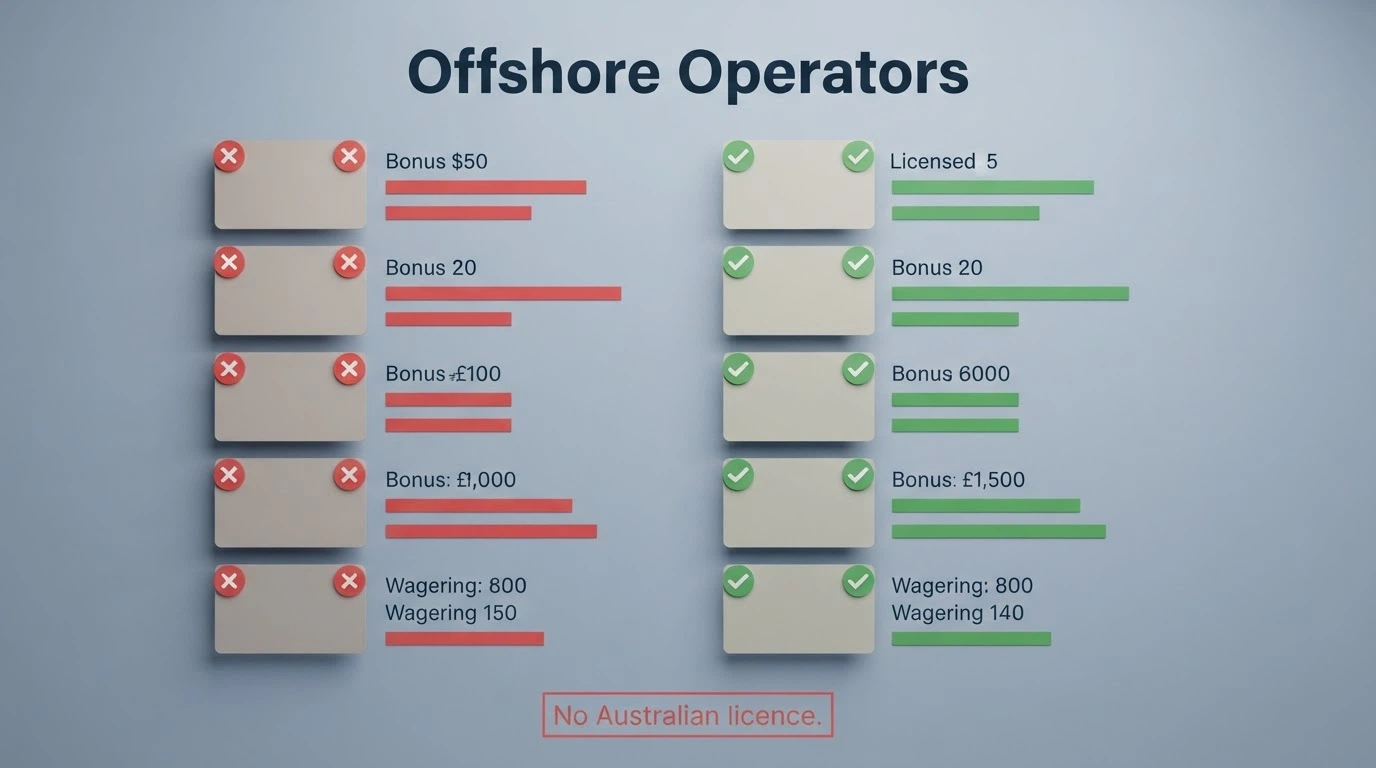
Online pokies are prohibited in Australia under the Interactive Gambling Act 2001. There is no Australian licence for this product — not federally, not in any state or territory. The legal details — the ACMA enforcement record, the 2026 reform and the credit-card-and-crypto payment ban — live in the IGA section below. The 10 operators in the table are offshore brands, the Curaçao-licensed majority of which Australians reach at the A$10 deposit tier. None of them is licensed here. None of them is connected to BetStop. None of them gives the player the recourse Australian-licensed wagering operators do. The table is presented with that reality stated, not softened.
| Operator | Licence Status | Welcome Offer | Wagering Requirement | Game Providers | BetStop Connected |
|---|---|---|---|---|---|
| SkyCrown | Offshore (Curaçao, Hollycorn N.V.) | Up to A$8,000 + 400 FS over 4 deposits | 40x (bonus + FS) | Evolution, Pragmatic Play Live | No |
| RocketPlay | Offshore (Curaçao, Dama N.V.) | 100% up to A$1,000 + 100 FS (1st); 200% up to A$1,000 (2nd) | 40x (bonus only) | Multiple (BGaming for FS) | No |
| Royal Reels | Offshore (Curaçao) | 100% up to A$500 + A$10 no-deposit | 30–40x | Pragmatic Play, Evolution, Yggdrasil, 30+ providers, 2,000+ games | No |
| WinSpirit | Offshore (Curaçao) | 200% + 25 FS | 40x | — | No |
| Fair Go | Offshore (Curaçao, Deckmedia N.V.) | 100% up to A$200 × 5 deposits (A$1,000 total) | 30–40x | RTG, 280 games | No |
| Stake | Offshore (Curaçao #8048/JAZ) | 200% up to $2,000 | 40x (deposit + bonus) | 3,000+ games, provably fair | No |
| Bizzo Casino | Offshore (Curaçao) | Unconfirmed | 40x | Multiple (adjustable RTP noted) | No |
| Rainbet | Offshore (Curaçao) | No traditional welcome bonus | N/A | 4,000+ games, provably fair | No |
| Scream Casino | Offshore (Curaçao) | — | — | — | No |
| Rocket Casino | Offshore (Curaçao) | — | — | — | No |
SkyCrown: A$8,000 Welcome Package with a A$30 Entry Ticket
SkyCrown advertises the largest welcome package in the featured set: up to A$8,000 plus 400 free spins across four deposits. The structure runs 120% up to A$1,200 and 125 free spins on the first deposit, then three more tiers stepping down. The catch sits in the qualifying minimum: the first deposit must be A$30 or higher, and the fourth tier requires A$50. Wagering is 40x on both the bonus money and the free spins, with a 14-day validity window and a A$300 free-spin win cap per tier.
For a player who arrives with a A$10 bankroll, SkyCrown is the wrong door. The advertised headline rewards are real, but the floor to claim any of them is ten times the player’s intended deposit. A player who deposits A$10 at SkyCrown has funded a real-money account, not a bonus-eligible one. The Curaçao licence sits under Hollycorn N.V., a known operator in the offshore space; that licence is not an Australian licence, and the operator is not connected to BetStop. Where it sits in the set: at the top end for matched-deposit value, but the welcome-package floor alone disqualifies it for a A$10 player.
RocketPlay: Two-Part Bonus with a 5-Day Clock
RocketPlay offers a two-deposit welcome that runs 100% up to A$1,000 plus 100 free spins on the first deposit (minimum A$30), and 200% up to A$1,000 on the second (minimum A$75). Wagering is 40x on the bonus amount only, which is the friendlier construction — the player’s own deposit does not need to be re-wagered. The window is tight: 5 days from credit to clear.
At A$1,000 matched on a A$1,000 deposit, the player has A$2,000 of bonus-eligible balance. The 40x wagering on the bonus alone is A$40,000 of turnover required inside 5 days. At A$1 per spin, that is 40,000 spins, or roughly 56 hours of continuous play at the standard 5-second spin interval. That is not a session; it is a job. The free-spin winnings are capped at A$300, and the maximum bonus winnings the player can withdraw are capped at A$5,000. Curaçao-licensed under Dama N.V., no Australian registration, no BetStop coverage. The verdict: a competitive headline number ruined by a clock that nobody clears in five days.
Royal Reels: The A$10 No-Deposit Bonus and a 2,000+ Game Lobby
Royal Reels is the only operator in the featured set with a true A$10 no-deposit entry point. A player who signs up gets A$10 in bonus money to test the lobby without funding an account. Once a deposit is made, the matched welcome runs 100% up to A$500 on a A$30 minimum. Wagering is 30–40x. The catalogue is the largest in the set: more than 2,000 games from 30+ providers, including Pragmatic Play, Evolution and Yggdrasil.
The A$10 no-deposit is the hook. It lets a player see the cashier, the lobby and the game pace without committing real funds. The matched bonus is a different beast: a A$30 floor puts it out of reach for a player who arrived planning to deposit ten. Where this operator earns its place: the no-deposit bonus gives the cautious player a way to test the waters, and the catalogue is the deepest in the set. The verdict: the A$10 no-deposit is real; the matched bonus is the part that costs A$30 to access.
WinSpirit: 200% Match with a Modest Free-Spin Sweetener
WinSpirit runs a 200% match with 25 free spins and a 40x wagering requirement. The match percentage is the highest in the set — a A$100 deposit becomes A$300 of bonus-eligible balance — but the free-spin sweetener is lean against operators offering 100 or more, and the bonus validity window, provider list and game catalogue were not surfaced in the public-facing terms pages reviewed here.
The thin data is the issue. A player who wants to claim a 200% match is committing on terms that the marketing pages cannot fully verify beyond the headline figure. Bonus validity windows vary widely across the offshore space, and a 40x requirement on a A$200 bonus means A$8,000 of turnover before any win becomes withdrawable. Curaçao-licensed, no Australian registration, no BetStop coverage. The 200% match is aggressive, but the lack of public detail on game terms makes it a riskier choice compared to providers with fully transparent catalogues.
Fair Go: Five Deposits, One RTG Lobby, and a Curaçao Anchor
Fair Go runs the flattest welcome structure in the featured set: 100% up to A$200 on each of the first five deposits, totalling A$1,000 in matched bonus cash. The catalogue is RTG-only, with 280 games. AUD is accepted directly. The Curaçao licence sits under Deckmedia N.V., and the operator has been live since 2017.
The flat structure is the appeal. Five equal deposits at A$200 each means a player who plans to deposit the same amount five times in a row knows exactly what they are getting — no climbing tiers, no cliff edges. The catalogue is the constraint: 280 RTG games is a real lobby, but it is not the 2,000+ titles Royal Reels runs or the 4,000 Rainbet runs. A player who likes the RTG catalogue will find Fair Go predictable in the right way. It lacks the flashy, high-tier bonuses of its competitors, but it offers a predictable, steady experience for players who value simplicity.
Stake: A$2,000 Bonus Behind a $100 Gate and KYC Level 2
Stake offers the largest single-deposit bonus in the set: 200% up to $2,000. The wagering is 40x on deposit plus bonus — meaning the full A$2,000 balance, not just the bonus portion, must be re-wagered before any win is withdrawable. The minimum qualifying deposit is $100, and the bonus must be requested via support after completing KYC Level 2. Stake holds a Curaçao licence (#8048/JAZ) and operates a catalogue of 3,000+ games with provably fair titles, against a reported gaming volume above A$1.86 billion.
The $100 minimum disqualifies Stake from being a A$10 deposit operator. A player who arrives planning to deposit A$10 is in the wrong lobby. A player who plans to deposit $100 and complete KYC Level 2 before requesting the bonus is in the right one — at which point the wagering arithmetic is the constraint. A $1,000 deposit triggers a $2,000 bonus and a $3,000 balance; the 40x on deposit plus bonus is $120,000 of turnover. That is not a casual session. The headline bonus is massive, but the stringent $100 entry requirement and KYC-level-two gate exclude the casual low-deposit player from accessing it.
Bizzo Casino: Adjustable RTP and the Fine Print Players Miss
Bizzo’s headline figure sits in the standard 40x wagering range. The catalogue runs multiple providers, and the operator is Curaçao-licensed. The detail that matters is elsewhere: some providers on Bizzo may run adjustable RTP versions, meaning a familiar pokie can be set to 94.5% instead of the 96.5% the player expects from the same title at a different site.
A 2% RTP difference does not sound like much. Over a A$10 session of 50 to 100 spins, it shifts the expected loss from roughly A$0.18–A$0.70 at 96.5% RTP to A$0.28–A$1.10 at 94.5%. The session still ends in expected loss either way, but the higher-RTP version stretches the bankroll further. The welcome package specifics were not confirmed against the operator’s current terms page, and the bonus details a player sees at signup should be verified independently. The verdict: a familiar catalogue with a fine-print variable that changes what a A$10 deposit is worth, and a thin evidence base to fill in the bonus details.
Rainbet: No Welcome Bonus, No Wagering, No KYC
Rainbet drops the bonus model entirely. No traditional welcome offer, no wagering requirements, no KYC at signup, and instant withdrawals against a catalogue of 4,000+ games with provably fair titles. The Curaçao licence sits behind an operator with a reported average deposit of $324 and a gaming volume around $301 million.
This is the operator for the player who is not interested in a matched-deposit package and the wagering that comes with it. The instant-withdrawal model means the player deposits A$10, plays, and can pull the balance out without the KYC delay that offshore competitors impose at first withdrawal. The trade-off is the absence of the bonus credit that a matched-deposit player at SkyCrown or Royal Reels would chase. For a player who treats the A$10 as a session rather than a bonus hunt, Rainbet’s model is the cleaner fit. By eschewing the traditional bonus model, Rainbet avoids the wagering-requirement trap entirely — a cleaner approach for players who value simplicity and instant withdrawals.
Scream Casino
Scream Casino is Curaçao-licensed. No specific welcome bonus, wagering requirement, or deposit-floor details surfaced in the public-facing terms pages reviewed here. The catalogue, the bonus structure, and the withdrawal terms are all gaps. The pattern in the set is that thin-data operators require more due diligence from the player, not less.
A player who arrives at Scream Casino should not assume the welcome package is generous, the wagering is standard, or the withdrawal floor is A$25. The terms a player sees in the cashier may say something different from what a competitor’s marketing implies. The right move is the same one a player makes at any unlicensed site: read the bonus terms, the withdrawal terms and the KYC requirements before the first deposit. The verdict: thin data is itself information — verify before depositing.
Rocket Casino
Rocket Casino is Curaçao-licensed. No welcome bonus, wagering or deposit details surfaced in the public-facing terms pages reviewed here. The operator joins Scream Casino as a thin-data entry in the set, and the pattern is worth naming: where an operator does not surface its bonus terms in a way the marketing pages can verify, the player is the one bearing the verification cost.
The same advice applies. A player should check the current terms page, the withdrawal floor, the KYC requirements and the bonus validity window before depositing a single dollar. Where the operator does not publish the figure the player needs, the player should not fund the account on the assumption that the figure is the same as the rest of the set. The verdict: thin-data entries are a pattern in this part of the market, not a coincidence, and the player’s caution is the response that fits.
Getting $10 onto an Offshore Pokies Site: Every Payment Method That Works
Four payment rails cover most A$10 deposits at the offshore pokies sites Australians reach: PayID, Neosurf, crypto, and the bank-transfer or debit-card fallback. Each has a different speed, fee profile, and withdrawal story. The table below summarises the four; the sections that follow unpack why each works the way it does and where the trap doors sit.
| Payment Method | Minimum Deposit | Clearance Speed | Transfer Fees | Withdrawal Available |
|---|---|---|---|---|
| PayID / Osko | A$10 | Under 30 seconds | None | Yes (operator-dependent) |
| Neosurf voucher | A$10 | Instant (code entry) | None | No |
| Bitcoin / Litecoin | A$10–A$20 equivalent | 10–60 minutes | Network fee (variable) | Yes (under 1 hour) |
| Debit card / bank transfer | A$10–A$30 | 1–3 business days | Possible bank fee | Yes (operator-dependent) |
PayID: Under 30 Seconds, Zero Fees, and A$10 Accepted
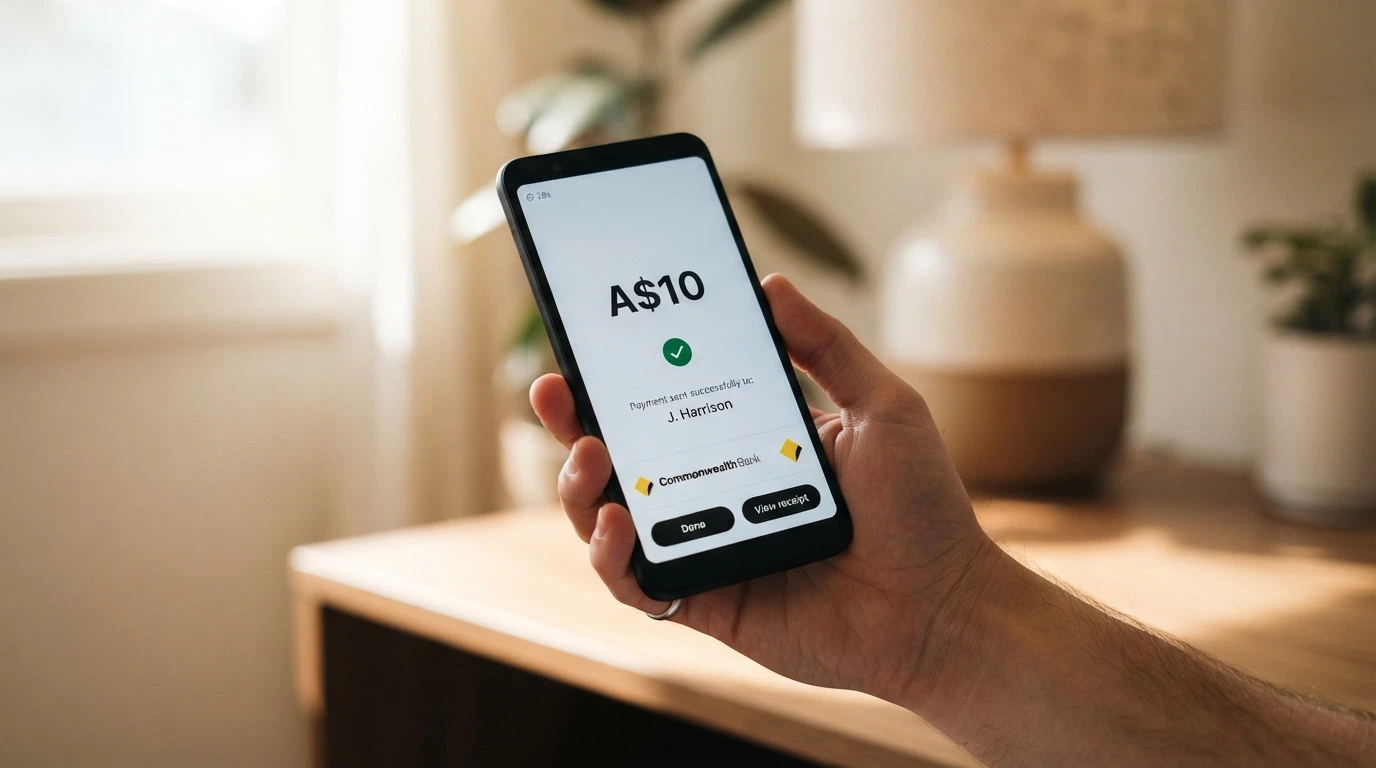
PayID and Osko are the rails Australians reach for at the A$10 tier. Deposits clear in under 30 seconds at zero transfer fee, with no intermediary and no currency conversion when both ends are denominated in AUD. The A$10 floor matches the Neosurf voucher minimum and the practical offshore cashier minimum, so the rail sits where the rest of the market already is.
PayID replaced POLi when POLi was shut down at the end of September 2023. The shift was not just a rebrand — POLi carried a different fee structure and a different risk profile for the player. PayID and Osko are the standard bank-to-bank instant rails; they are what Australians use for everyday transfers, and they are what the offshore cashier integrates. Where PayID pays off: speed, zero fee, no currency friction. The constraint: not every operator routes withdrawals back through PayID, and a player who deposits via PayID may still need a different rail to pull a balance out.
Neosurf: A Prepaid Voucher from the Newsagent — Deposit Only
Neosurf is a 16-digit prepaid voucher available at newsagents and servos from A$10 upward. The player buys the voucher with cash, enters the code at the cashier, and the deposit appears instantly. There is no fee on the deposit side. The withdrawal story is the catch: Neosurf is deposit-only. A player who funds the account with Neosurf cannot route a withdrawal back to the same voucher — there is no Neosurf withdrawal rail, only the deposit leg.
For a player without a bank card or a crypto wallet, Neosurf is the way in. The A$10 floor matches the newsagent shelf. The deposit-only design means the player needs a separate rail for the way out — bank transfer, debit card or crypto — and the operator’s withdrawal minimum applies on top of that. Neosurf is also the rail that keeps the bank out of the transaction entirely, which some players prefer and some operators handle without friction. The constraint is structural, not operational: the deposit leg works; the withdrawal leg does not.
Crypto Deposits: Fast Withdrawals, Unpredictable Fees
Bitcoin and Litecoin are accepted at most offshore casinos targeting Australians, and crypto withdrawals are the fastest rail — typically under an hour, often minutes. The constraint on a small deposit is the network fee. A Bitcoin transaction fee that costs A$5 on a A$10 deposit erases half the bankroll before any spin happens. Litecoin fees are lower, but the chain is less universally supported.
A A$10 deposit via crypto on the wrong day can land in the player’s account as A$9.50 or less, after the network fee. The same rail on the way out is the fastest, and the fee is amortised against a larger balance — so crypto works better as a withdrawal rail than a deposit rail at the A$10 tier. The other tell: a site that accepts crypto for Australians is declaring itself outside the Australian rules. Since 11 June 2024, credit cards and crypto have been banned for licensed online wagering in Australia; an operator that asks for either is operating offshore, and that is the entire diagnostic.
The Withdrawal-Floor Trap: A$10 In, A$50–A$100 Out
The asymmetry between deposit and withdrawal minimums is the single most important number a low-deposit player checks. The minimum deposit at most offshore casinos sits at A$5 to A$10 via PayID or a bank rail. The minimum withdrawal at the same operators sits at A$25 to A$100 — sometimes A$50 to A$100. A player who deposits A$10, plays, and ends the session with A$15 may not be able to withdraw that A$15. The operator will hold it until the balance crosses the withdrawal floor, or it sits in the account until the player tops up enough to clear the threshold.
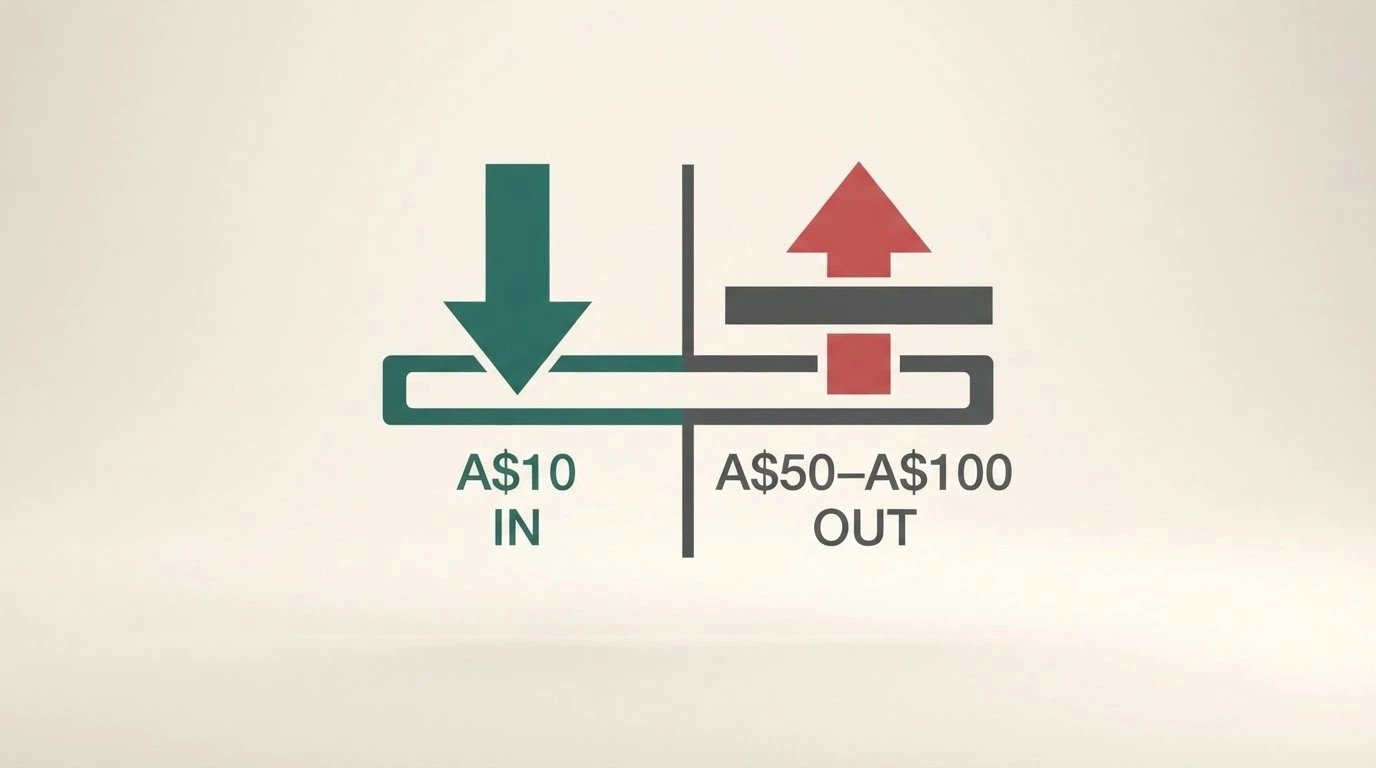
The floor exists because payment processors charge the operator per transaction, and a A$10 withdrawal is uneconomic for the operator to process. The cost is real, and it is passed to the player in the form of a floor. The right check before the first deposit is the operator’s withdrawal page — not the marketing line. Where the floor is A$50 and the deposit was A$10, the player needs to either grow the balance past A$50, deposit again to cross the floor, or leave the money trapped in the account. None of those outcomes is the one the marketing page suggests.
Your Phone, a $10 Deposit, and an Unlicensed Pokies Site
Most Australian players reach offshore pokies sites from a phone. The mobile experience is browser-first — every major offshore casino in the featured set works in a mobile browser without an app download — and the deposit floor is the same A$10 the desktop cashier accepts. The offshore status follows the player onto the small screen: a browser session at an unlicensed site is no closer to Australian regulatory coverage than the desktop version.
Browser vs App: What Changes When You Play from a Phone
The mobile browser delivers the same lobby, the same deposit rail, and the same game selection as the desktop version. Native apps are the exception rather than the rule — DeeSpin Casino runs one with 3,500+ pokies, Touch ID and Face ID login, and the same 35x wagering its desktop carries. A Progressive Web App (PWA) sits in between: installed to the phone’s home screen via the browser, no app store listing, low storage footprint and fast load times.
The browser is the safer default for a player who is checking an offshore operator for the first time. An app listed in a non-curated app store, downloaded from a third-party source, or installed via a PWA prompt is a different risk profile from a browser session. The game catalogue is the same; the trust chain around the download is not. A player who wants the smallest possible footprint on the phone should keep the browser session and clear the cookies afterwards. A player who wants Touch ID login and faster launch times should weigh the trade-off.
Mobile Deposit Minimums: Same Floor, Faster Funnel
The A$10 deposit minimum does not change on mobile. PayID clears in under 30 seconds on the cashier app, Neosurf is a code entry either way, and crypto works through the same wallet interface. What changes is the funnel: the saved payment details, the one-tap confirm, the deposit button sitting two screens away from the spinning reels.
The behavioural risk is real. A A$10 deposit takes longer to walk away from when the deposit button is two taps from the game. A player who sets a session budget before opening the cashier is the player who keeps the budget; a player who opens the app and decides in the moment tends not to. The A$10 floor is the same on mobile as it is on desktop, but the speed at which it can be redeposited is not.
The IGA Reality: Online Pokies Are Prohibited in Australia
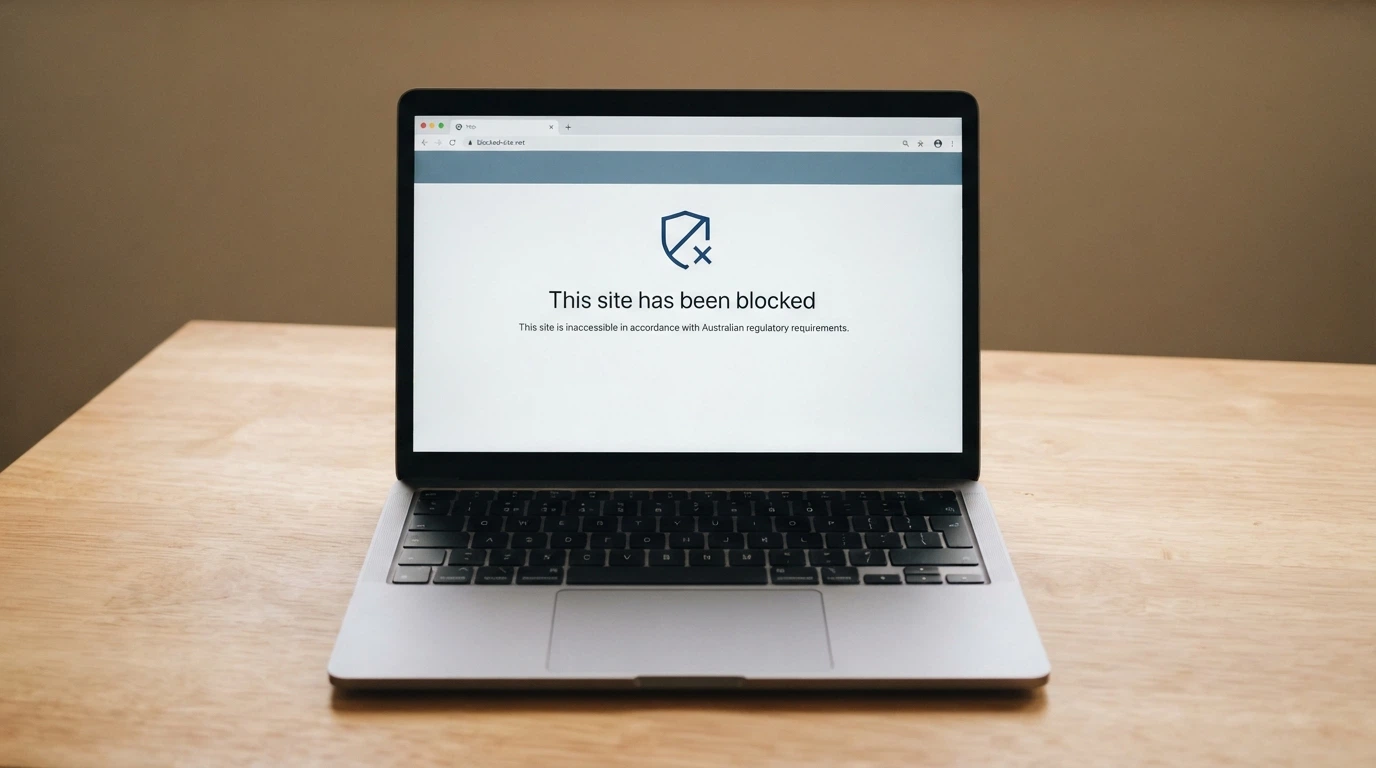
Online pokies are prohibited in Australia. The Interactive Gambling Act 2001 makes it an offence to provide an online casino, online pokies or in-play sports betting to a person in Australia. There is no Australian licence for this product — not federally, not in any state or territory. The ACMA, the federal regulator enforcing the prohibition, has had 1,564 illegal gambling and affiliate websites blocked by Australian ISPs since November 2019; more than 225 illegal services have withdrawn from the Australian market since 2017. The rest of this section unpacks what the statute says, what the regulator does, what the 2026 reform changes, and what the absence of Australian consumer protection looks like in practice.
The IGA 2001 and the ACMA: What the Law Actually Says
The Interactive Gambling Act 2001 prohibits the provision of online casino games, online pokies and in-play sports betting to a person in Australia. The 2017 amendment closed the loopholes offshore operators had been using and gave the ACMA formal enforcement and blocking powers. The ACMA investigates complaints, issues formal warnings and civil penalty proceedings, refers operators for enforcement action, and directs Australian ISPs to block illegal services at the DNS level.
The individual player is not prosecuted under the IGA — the Act targets the provider. That distinction matters: a player who deposits at an offshore pokies site is not committing an offence. The player is, however, outside the Australian consumer-protection framework. There is no Australian recourse if the operator refuses a withdrawal, closes the account or blocks the site while a balance is still on it. Blocking is DNS-level, which means the site simply stops resolving on Australian internet connections — the player’s balance sits in an account the player can no longer reach.
The 2026 Reform: Advertising Caps, a Payment-Provider Block, and What Changes on 1 January 2027
The Interactive Gambling Amendment (Gambling Reform) Bill 2026 passed Parliament on 19 August 2026. Its measures commence on 1 January 2027 and rewrite how offshore operators can reach Australians. The headline restrictions: no more than three wagering ads per hour between 6:00 am and 8:30 pm, a live-sport blackout from 15 minutes before until 5 minutes after the event, radio ads barred during school times, broadcasting sporting odds banned outright, online ads only to verified 18+ users with opt-out, no ads inside sports venues or on uniforms, and a ban on athletes, celebrities and influencers promoting wagering products.
The reform also gives banks and payment providers express authority to block transactions to illegal gambling operators. From 1 January 2027, a bank that sees a transaction heading to an offshore casino can decline it at the payment-processor level. That is a different lever from the ACMA’s DNS blocks — it operates on the money, not the address. Direct marketing of inducements will also be prohibited for 14 days after sign-up, for three months after BetStop deregistration, and indefinitely for at-risk customers. The reform does not legalise offshore pokies for Australians; it tightens the surrounding rails so the offshore product is harder to reach, advertise, and pay for.
BetStop, Credit Cards and Crypto: The Three Tells an Operator Is Offshore
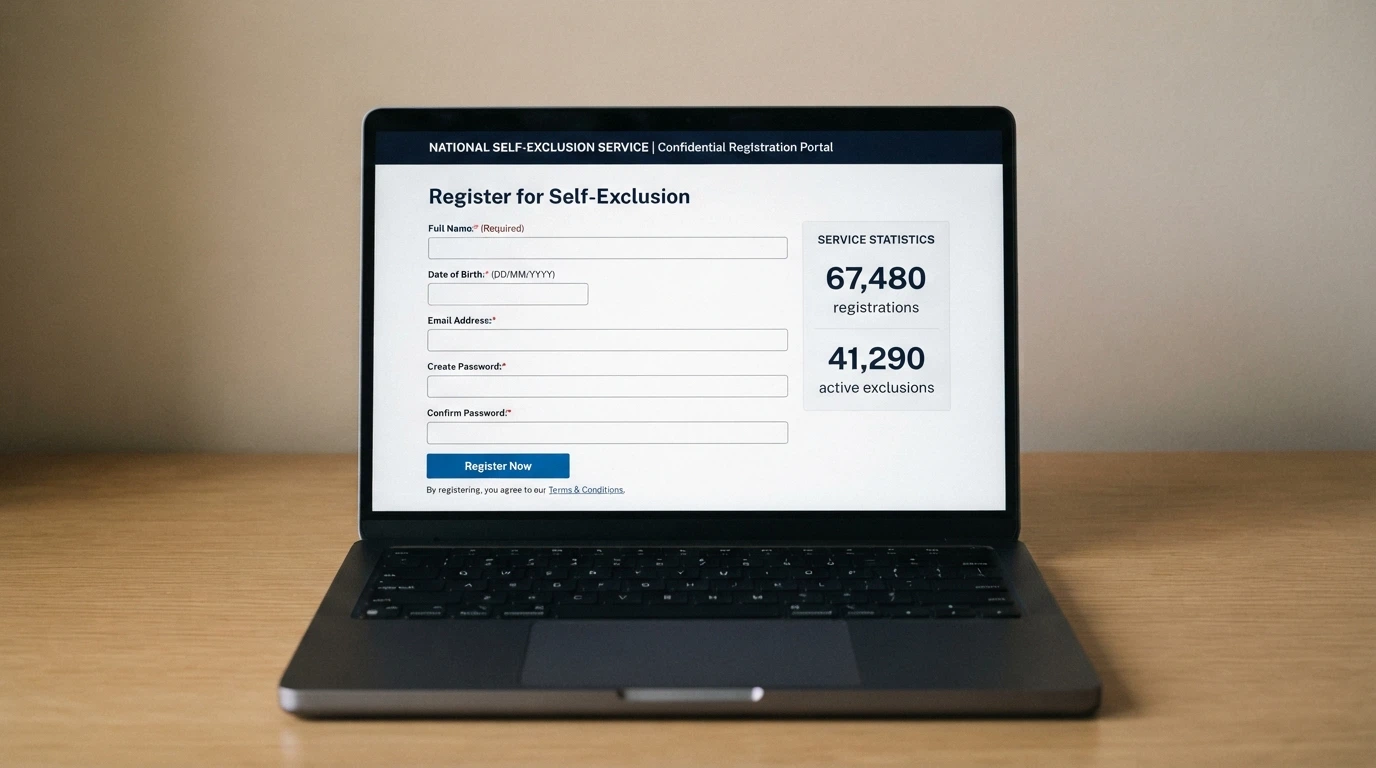
Three Australian consumer protections sit outside the offshore route. BetStop, the National Self-Exclusion Register, had 67,480 registrations as at 31 July 2026 — of which 41,290 exclusions were still active. One registration excludes a person from every Australian-licensed online and phone wagering service. Offshore casinos are not connected to the register. A player who has self-excluded via BetStop can still deposit, play and lose at an offshore site; the protection stops at the border.
The credit-card and crypto ban, in force since 11 June 2024, is the second tell. Credit cards, credit-related products and digital currency are banned as payment for online wagering in Australia; an operator that fails to enforce the ban faces penalties of up to A$247,500. A player who lands on a pokies site and is asked for a credit card or a crypto wallet deposit is being served by someone outside the Australian rules. The legal deposit routes for licensed wagering are debit card, bank transfer, PayID/Osko and BPAY. A site that fails all three of BetStop, the payment-method test and the offshore-exclusion test is not licensed in Australia. A site that fails any one of them is operating outside the rules the player might assume apply.
When a $10 Deposit Floor Becomes a Trap Door
The responsible-gambling infrastructure Australia built does not follow the player offshore. BetStop does not cover an offshore casino. The National Consumer Protection Framework’s measures — strong ID verification, deposit limits, monthly activity statements, easy account closing, trained staff, consistent risk messaging, restricted inducements, no credit for gambling, and self-exclusion — are the licensed baseline. An offshore site is not on that baseline. The player at an offshore pokies site is, in practical terms, building their own guardrails.
The harm statistics frame the risk. About 2.1% of Australian adults — roughly 430,000 people — experience problem gambling. Those at risk of gambling harm increased from 11% to 15% of Australians between 2019 and 2024. Of Australian adults who regularly bet online on sports or races, more than 70% are experiencing or at risk of experiencing gambling harm — and only 5% of that at-risk group sought help in the past 12 months. 34% of the total dollars spent on sports betting in Australia comes from people experiencing gambling harm, despite them representing only 10% of the player base. None of this is specific to offshore pokies, but it is the population the A$10 deposit sits inside.
Setting a Deposit Limit When the Site Does Not Offer One
The licensed Australian baseline gives the player deposit limits, activity statements, easy account closing and a self-exclusion register. An offshore site typically offers none of these. A player who deposits A$10 has no operator-side tool that says “stop me at A$50” or “send me a monthly statement” — those are licensed-operator obligations that do not travel offshore.
The self-imposed limit is the one the player builds. A session budget set before opening the cashier, a hard stop at the figure regardless of the result, and a deliberate log-out at session end are the tools that replace the licensed baseline. A bankroll limit — a fixed amount the player is willing to lose across a week or a month — is the second layer. The third is the deposit floor itself: A$10 sets the smallest possible loss, which is also the smallest possible trap when the withdrawal minimum sits at A$50. A player who treats the A$10 deposit as a session with a hard end is the player who keeps the budget intact.
Where to Get Help: The Numbers Every Australian Player Should Have
The free, confidential services exist regardless of where the player gambles. The National Gambling Helpline — 1800 858 858 — is staffed 24 hours a day, 7 days a week. Gambling Help Online runs online chat and counselling. BetStop registration is a one-form process that excludes a person from every Australian-licensed online and phone wagering service.
The numbers are not a last resort. Only 5% of at-risk monthly bettors sought help in the past 12 months — that is the gap the services exist to close. A player who finds themselves depositing more often than planned, chasing a loss, or hiding gambling spend from someone close is a player for whom the helpline is the right next call. The offshore site does not change the help-seeking infrastructure; it changes the help the operator will offer, which is none.
How We Evaluated These $10 Deposit Pokies Sites
The operators in this ranking are the offshore brands Australians reach at the A$10 deposit tier. They are not a list of licensed Australian casinos, because no such licence exists. The evaluation criteria were licence status, the bonus terms at the A$10–A$30 deposit tier, wagering requirements, payment-method availability and withdrawal floors, game-provider transparency, and the presence or absence of adjustable RTP. Each operator was checked against the ACMA register of blocked services and against the Curaçao Gaming Control Board’s licence records where the licence number was available.
The IGA 2001 prohibition is the baseline. The credit-card and crypto ban since 11 June 2024 is a diagnostic, not a ranking factor: an operator that asks Australians for either is offshore, and the offshore status is stated in the licence column rather than buried in a footnote. Where a figure was not surfaced against the public-facing terms pages reviewed here, the gap is named in the operator’s write-up rather than papered over with an estimated number. The withdrawal-floor asymmetry between the A$10 deposit minimum and the A$25–A$100 withdrawal minimum is treated as the most concrete risk for a low-deposit player and is given its own section.
No invented percentages, no scoring matrix, no editorial weights. The operators appear in the order they were placed, and the honest gaps in that record are stated as gaps rather than smoothed into a false completeness.
What Your $10 Pokies Deposit Should Actually Buy You
A A$10 deposit at an offshore pokies site buys a session on an unlicensed product with no Australian consumer protection. The session runs 50 to 100 spins at the bottom of a pokie’s stake range; the expected loss over that session at a 96.5% RTP sits between roughly A$0.18 and A$0.70, on average. The marketing copy frames the deposit as an entry point to a bonus. The arithmetic frames it as the smallest loss the player is most likely to take.
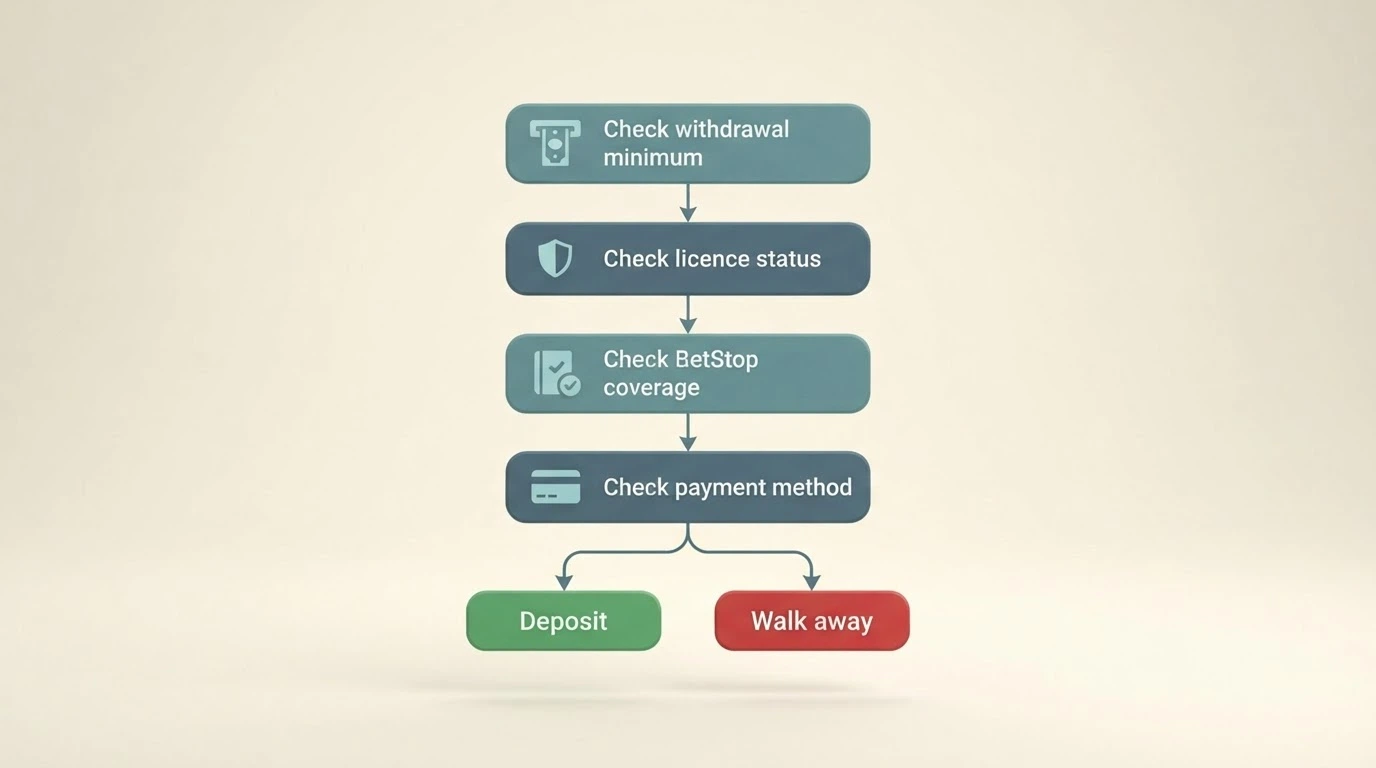
The deposit floor sits at A$5 to A$10; the withdrawal floor at A$25 to A$100. A player who cannot clear the withdrawal threshold leaves the money in the account, where it sits until the operator blocks the site at the DNS level or closes the account on a KYC failure. The payment method tells: a site that asks for credit card or crypto is offshore, by definition, because both have been banned for licensed Australian wagering since 11 June 2024. BetStop covers Australian-licensed wagering only; an offshore site is not in the register, and a self-excluded player can still play there. The responsible-gambling infrastructure — the helpline, the help site, the register — exists regardless of where the player gambles.
The verdict the page’s own figures argue for: a A$10 deposit at an offshore pokies site is a small payment for a product that gives the player none of the protections the Australian licensing framework was built to provide. The check before depositing a single dollar is the withdrawal minimum, the licence status, the BetStop coverage, and the payment method. Where any one of those does not match what an Australian-licensed wagering operator offers, the player has the information they need to make the call. The National Gambling Helpline — 1800 858 858 — is the number to call before the deposit, not after.
Frequently Asked Questions
Can I really win real money with only a $10 deposit on pokies?
A A$10 deposit at A$0.10–A$0.20 per spin runs 50 to 100 rounds. Payouts are withdrawable once the operator’s A$25–A$100 minimum is met and any bonus wagering is cleared. The expected loss for 50–100 spins at 96.5% RTP sits between A$0.18 and A$0.70. A win is possible; the average session still ends in loss.
What pokies can I play with a $10 deposit — and how many spins does $10 actually buy?
Big Bass Bonanza (96.71% RTP), Sweet Bonanza (96.48%) and Gates of Olympus (96.50%) all accept A$0.10–A$0.20 minimum bets. A A$10 deposit buys 100 rounds at A$0.10 or 50 at A$0.20. Some operators run adjustable RTP versions, so the same title can hit 94.5% instead of 96.5% — check the in-game help screen before betting.
Are $10 deposit pokies sites safe for Australian players?
Technically yes — the deposit rails work and the games are not rigged. Legally, no — online pokies are prohibited under the Interactive Gambling Act 2001, no Australian licence exists, and offshore operators are not connected to BetStop. A player has no Australian recourse if the operator refuses a withdrawal or blocks the site.
Can I play $10 deposit pokies on my mobile phone?
Yes. Every major offshore casino works in a mobile browser without an app download. PayID clears a A$10 deposit in under 30 seconds on mobile, the game selection matches the desktop, and the deposit floor is the same A$10. The offshore status follows the player onto the small screen; the regulatory standing does not.
Why do most $10 deposit casinos require a higher minimum to withdraw?
Payment processors charge per transaction; a A$10 withdrawal is uneconomic for the operator. Most sites pass the cost to the player as a floor — the minimum is A$25–A$100. A player who deposits A$10 and ends with A$15 cannot withdraw it; the balance sits until it crosses the threshold or the player tops up.
Is A$10 Really the Lowest You Can Deposit?
The realistic floor sits at A$5 to A$10 via PayID or a bank rail. The A$1 minimum that surfaces in some headlines is an exception almost no Australian-facing operator honours through the mainstream methods. A$5 minimums appear on a handful of sites through specific e-wallets, but the credible working floor for an Australian using PayID, Neosurf or a bank transfer is A$10. POLi, which used to handle lower amounts, was shut down in Australia at the end of September 2023; PayID and Osko functionally replaced it, with a A$10 starting point.
The floor matters because A$10 is also the minimum on a Neosurf voucher from a newsagent. It is what PayID clears without friction. A player who arrives looking for A$1 has not found an entry point — they have found an exception that closes at the cashier.