
Playing at Online Casinos with Tether from Australia: The Real 2026 Picture
Tether (USDT) is a stablecoin pegged one-to-one against the US dollar. Unlike Bitcoin or Ether, a USDT token sitting in a casino wallet does not lose ten percent of its value while you wait for a withdrawal to process. That single property is why offshore casinos built their crypto rails around it. Stablecoins are projected to handle over 70 percent of crypto wagering transactions in 2026, up from under 30 percent two years ago.
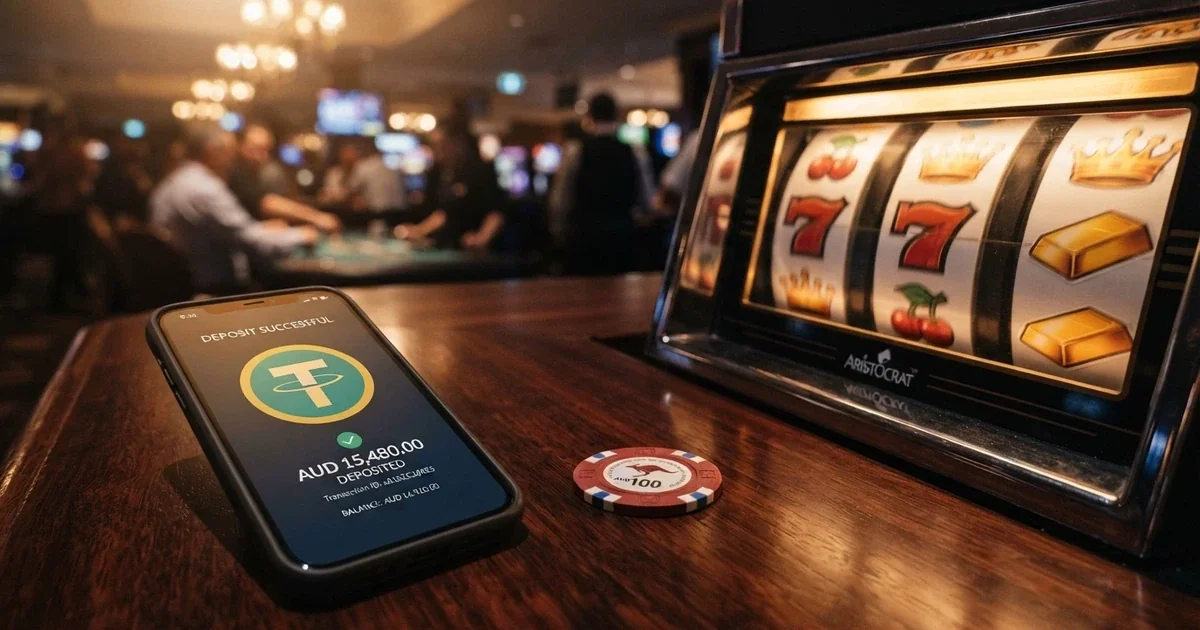
This page is about the casinos accepting that token from Australian accounts, the networks they use, the bonuses they advertise and the regulatory holes Australians step into when they deposit. Two things to carry from the first paragraph: online casino is prohibited in Australia under the Interactive Gambling Act 2001, and no licence for the product exists. Every operator reviewed here is offshore. That is not a stance from this page — it is the structural fact that defines the rest of it.
Data current as of 29 October 2026; licence claims verified against the Curaçao Gaming Control Board register, Kahnawake Gaming Commission public licensee listing, and Anjouan Gaming licence index.
Table of Contents
- From Exchange to Reels: How a USDT Deposit Actually Works
- Why USDT Dominates the Crypto Casino Market
- The IGA Targets Operators, Not Players — and That Is Cold Comfort
- Why Your 2026 Bonus Is Smaller Than the Headline Says
- Deposits and Withdrawals: How USDT Payments Work at Offshore Casinos
- TRC-20 versus ERC-20: The Network Choice That Moves Real Money
- Mobile USDT Casino Play: What the Phone Actually Delivers
- Pokies, Live Dealer and Real-Money Games You Can Play with USDT
- Free Pokies and Demo Mode: What Exists Before You Deposit
- New USDT Casinos: Fresh Faces, Same Regulatory Reality
- How We Evaluated and Ranked the Casinos on This Page
- Is Playing at a USDT Casino Worth the Risk? What It Means for Australian Players
- Frequently Asked Questions
From Exchange to Reels: How a USDT Deposit Actually Works
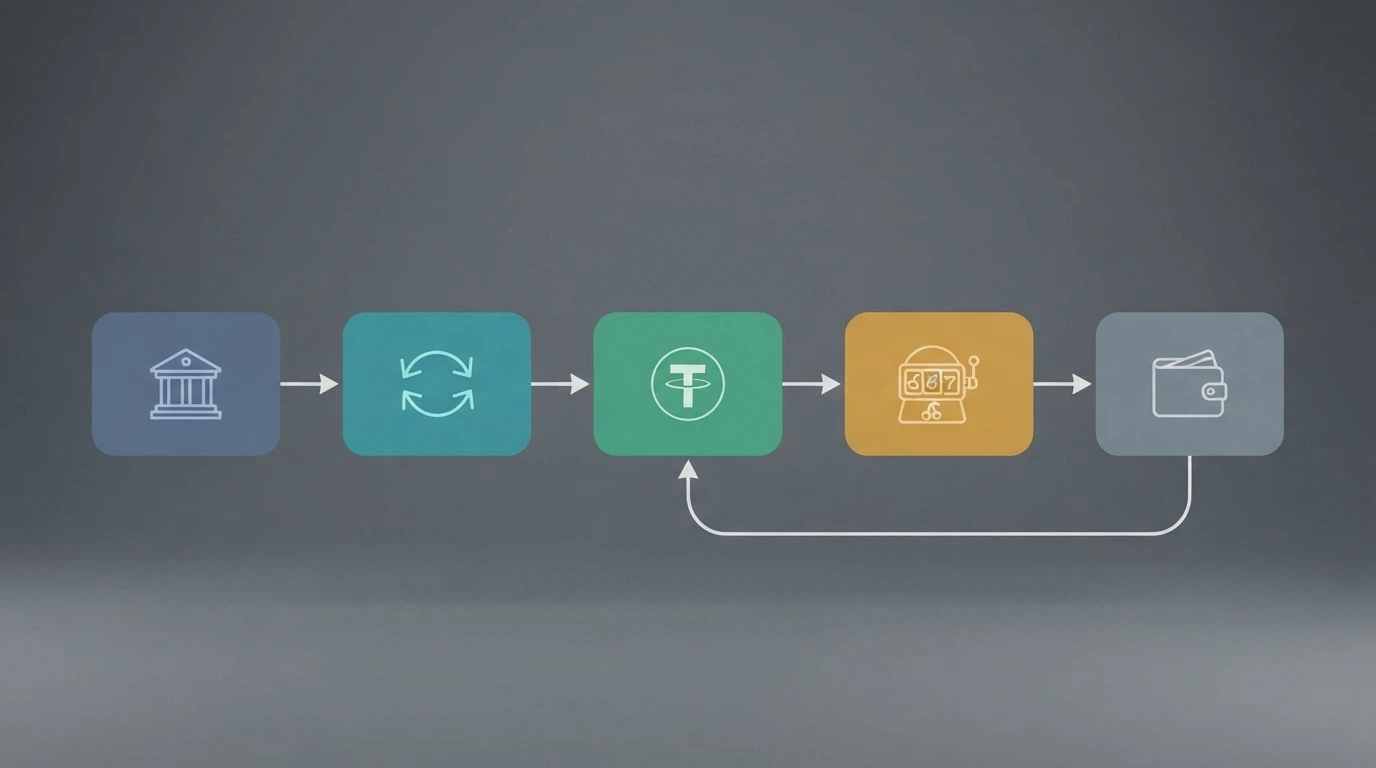
The mechanics for an Australian player are straightforward once the pieces are in place:
- Buy USDT on an AUSTRAC-registered exchange such as CoinSpot or Independent Reserve from an Australian dollar bank transfer.
- Choose your network at the point of withdrawal from the exchange — TRC-20 on Tron is the cheap standard.
- Paste the casino’s USDT deposit address, send the amount, wait for blockchain confirmation (often under a minute on TRC-20).
- The balance appears in the casino wallet, typically within a few minutes for confirmed transactions.
The “clean route” from Australia runs: Australian bank → AUSTRAC-registered exchange → USDT → offshore casino. The Australian banking leg is where friction lives. CommBank and Westpac restrict outbound transfers to crypto exchanges, ANZ and NAB flag them without always blocking, and ING and Macquarie sit at the most permissive end. Players on a CBA or Westpac account may need to switch banks or use PayID to an exchange that accepts it, rather than a direct transfer.
USDT itself is not a single thing. The token exists on multiple blockchains — Ethereum (ERC-20), TRON (TRC-20) and BNB Chain (BEP-20) are the three any Australian casino player will meet. Sending on the wrong network can lose the funds outright; there is no customer service at the protocol level that can reverse a transfer to a mismatched address. The deposit address the casino provides determines which network it expects — match that, exactly.
AUSTRAC’s Travel Rule kicks in at A$10,000 on crypto transfers, which is a reporting threshold rather than a tax or prohibition, but it is the line where exchanges and banks start collecting counterparty information on both ends of a transaction.
Why USDT Dominates the Crypto Casino Market
BTC and ETH made crypto gambling possible; USDT made it predictable. A punter depositing one Bitcoin at A$80,000 when BTC trades at A$80,000 and withdrawing the same number of coins when BTC sits at A$65,000 has lost A$15,000 without playing a hand. A punter depositing 1,000 USDT and withdrawing 1,000 USDT loses nothing to market movement between the legs.
Casinos prefer it for the same reason on the other end: a stablecoin balance does not require treasury hedging, and the settlement value matches the figure shown to the player. Operators have built deposit rails around USDT ahead of other tokens for that reason. The 70 percent figure for stablecoin share of crypto wagering in 2026 reflects the market voting with its deposits: stablecoin rail wins on velocity and accounting certainty, even though Bitcoin still holds the brand position.
For an Australian punter the practical implication is that USDT is the easiest crypto to use, not because the marketing calls it that, but because the largest number of operators, exchanges and analytics tools support it.
The IGA Targets Operators, Not Players — and That Is Cold Comfort
The Interactive Gambling Act 2001 (IGA) makes it illegal for a provider to offer online casinos, online pokies or in-play sports betting to a person physically in Australia. Section 15 contains the core prohibition. No Australian resident has ever been prosecuted for playing at an offshore online casino — the law aims at the operator, and the Australian Communications and Media Authority (ACMA) enforces it that way.

So “not illegal for you” is accurate. It is also incomplete. The same framework means there is no Australian online casino licence — not federally, not in any state. Every product on the page below is supplied by an entity unlicensed to supply it in Australia. The protections that follow from a domestic licence — identity-verified accounts, a complaint path through ACMA or a state regulator, monetary segregation rules, dispute resolution — are absent. “Offshore” in this context is not a geographic detail; it is the absence of Australian regulatory cover.
Section 15C: The Crypto Payment Ban That Closes the Legal Door
In June 2024, section 15C of the IGA took effect. It bans credit cards, credit-related products and digital currency — meaning cryptocurrency — as a payment method for interactive wagering. The penalty for an operator that fails to enforce it is up to A$247,500 per breach. A casino asking an Australian player to deposit USDT is, by definition, operating outside Australian rules. The Australian-licensed betting products licensed in Australia cannot legally accept what these offshore sites demand.
No KYC, No BetStop, No Recourse: The Protections That Disappear
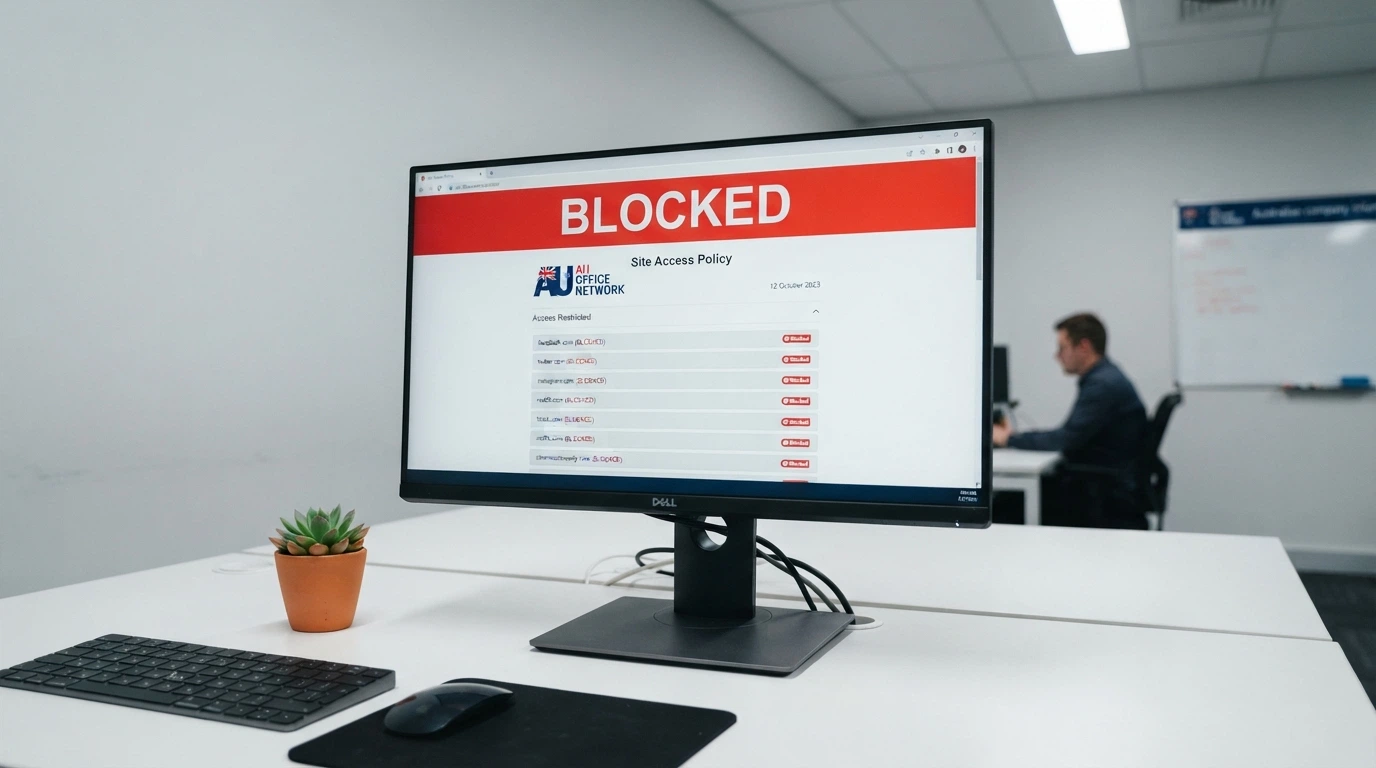
ACMA has blocked 1,788 illegal gambling and affiliate sites through Australian ISPs as of August 2026. The blocking began in November 2019 and has not slowed. Over 230 illegal services have pulled out of Australia since 2017 — they exit not because the regulator shut them down but because blocking and banking friction make the Australian market uneconomic. A site a player keeps a balance on today can be in tomorrow’s blocking list.
BetStop, the National Self-Exclusion Register, has 67,480 registrations as at 31 July 2026; 41,290 of those exclusions are still active. Seventy-eight percent of registrants are under 40, and 38 percent chose lifetime exclusion. BetStop binds Australian-licensed wagering services only. An offshore casino is not connected to the register and will continue taking a self-excluded person’s money. That is a stated design feature of offshore sites, not a defect a support agent can fix.
“No KYC” casinos market the absence of identity checks as a privacy feature. From the player side, it means no paper trail, no regulator to escalate to if a withdrawal is refused, no identity-validated complaint. The deal on offer: privacy in exchange for leverage. Players treating privacy as the headline benefit should run the same logic on recourse.
The 2026 Gambling Reform Bill: What Changes on 1 January 2027
Parliament passed the Interactive Gambling Amendment (Gambling Reform) Bill 2026 on 19 August 2026. Its provisions commence on 1 January 2027. The bill extends existing Australian rules, not the offshore market players rely on, but the friction reaches offshore banking anyway:

- Banks and payment providers gain express authority to block transactions to illegal gambling operators. The Australian-bank → exchange → USDT route the current generation of Australian crypto punters uses is the most exposed link.
- Wagering advertising is capped at three ads per hour between 6:00 am and 8:30 pm, with a blackout from fifteen minutes before to five minutes after live sporting events.
- Athletes, celebrities and influencers can no longer promote wagering products.
- Direct marketing of inducements is prohibited for fourteen days after sign-up with a licensed operator, three months after BetStop deregistration, and indefinitely for customers flagged as at-risk.
- A national wagering advertising opt-out register (AdStop) will be administered by ACMA.
- Online keno and foreign-matched lotteries are prohibited.
Existing sponsorship agreements — jersey logos and the rest — are exempt until 31 December 2031, provided they are not modified. The 1 January 2027 bank-blocking authority is the change most likely to touch the readers of this page. A$32 billion per year is lost by Australians on legal gambling, the heaviest per-person losses of any country on earth. The reform is calibrated against that figure.
| Casino | Licence Jurisdiction | Welcome Bonus | Wagering Requirement | USDT Networks Supported |
|---|---|---|---|---|
| Rocket Play | Curaçao (Dama N.V.) | 100% up to A$1,000 + 100 FS (1st); 200% up to A$1,000 (2nd) | x30–x40 | TRC-20, ERC-20 |
| SkyCrown | Curaçao | 470% up to €5,000 + 400 FS (across 4 deposits) | 40x | TRC-20, ERC-20 |
| Stake | Curaçao | Ongoing rakeback (no match) | None (rakeback) | ERC-20, BEP-20, Polygon, TRC-20, Solana |
| Royal Reels | — | — | — | — |
| WinSpirit | Curaçao | 100% up to A$1,000 + 100 FS (1st); 200% up to A$1,000 (2nd) | 40x | TRC-20 (among others) |
| Rainbet | Curaçao | 250% across 3 deposits up to $2,100 + 60 FS | 40x | USDT, BTC, ETH, LTC, TRX, DOGE, SOL, USDC |
| Scream Casino | — | — | — | — |
| FairGO | — | — | — | — |
| Bizzo Casino | Curaçao + Kahnawake | 100% up to €100 + 100 FS (1st); 50% up to €300 + 50 FS (2nd) | 40x | USDT (22 cryptos total) |
| Rocket Casino | — | — | — | — |
Curaçao is the dominant jurisdiction among offshore operators serving Australians; Anjouan (Comoros) and Tobique (Canada) appear less often. No Australian online casino licence exists by design, not accident. Cells without a confirmed value appear blank above; that is the gap rather than a default “yes”. Ranking order reflects data completeness and term fairness, not promotional spend.
Rocket Play
Rocket Play is the strongest Australian-facing package in this set, primarily because it prices its bonus and minimum in Australian dollars and accepts USDT on both TRC-20 and ERC-20. The welcome package starts with a 100 percent match up to A$1,000 plus 100 free spins on first deposit (minimum A$30), then a 200 percent match up to A$1,000 on the second deposit (minimum A$75). Wagering runs at x30 to x40 on bonus funds.

The game library is around 3,000 pokies from studios including Playson, iGT, Wazdan, BGaming and NETGAME. Curaçao licence, under the Dama N.V. operator group. Crypto withdrawals settle in one to twenty-four hours in independent testing. For an Australian player who wants the bonus expressed in the local currency and a deposit minimum that does not require thoughtful planning, Rocket Play is the operator that respects those preferences most directly.
A dollar-denominated bonus and an A$30 entry point do not offset the offshore position. They do make the cost of finding out what the wagering actually entails cheaper.
SkyCrown
SkyCrown leads the set on game count: 10,000+ titles from 50+ studios, including Evolution and Pragmatic Play for live dealer and pokies. The welcome package is a 470 percent aggregate match up to €5,000 plus 400 free spins split across four deposits — first deposit 120 percent up to €500 plus 125 free spins, second 100 percent up to €1,000 plus 75 free spins, third 50 percent up to €1,000 plus 50 free spins, fourth 150 percent up to €2,500 plus 150 free spins. Wagering is 40x, with fourteen days to complete each stage.
Crypto withdrawals have been tested at under ten minutes. Curaçao licence. The package face value is the largest in this list. The wagering clearance window — fourteen days, four deposits, 40x — is the cost of that face value, and it is the dimension SkyCrown asks the most of from a casual punter’s bankroll.
A player with a sizeable bankroll and the time to clear four stages inside two weeks each extracts the most from this offer. A player without that runway finds the value compressed by week two.
Stake
Stake does not run a traditional welcome bonus in the sense the rest of this set does. The model is ongoing rakeback — a percentage paid back on play rather than a one-off match. There is no wagering multiplier because there is no bonus to clear. That is the structural difference and the headline value, and it is the cleanest offer on this page for a player who would rather play than chase turnover.
USDT support covers five networks: ERC-20, BEP-20 (BSC), Polygon, TRC-20 and Solana — wider than any other operator in this set. The minimum withdrawal is 2.50 USDT, with a fixed 1.00 USDT network fee. Withdrawals settle in minutes. Curaçao licence. Game library around 3,000 titles.
The library, network breadth and withdrawal economics make Stake the strongest pick for a player who values payout infrastructure over a starting bonus. For a player who wants the bankroll boost of a match deposit, Stake is not the right product.
Royal Reels
Royal Reels accepts USDT and Australian players. Licence jurisdiction, bonus terms, provider list and withdrawal speed were not independently verified for this edition, and the entry above carries those gaps honestly rather than filling them with marketing-set claims. The operator is offshore and not Australian-licensed; what is publicly visible suggests a standard offshore product offering, with the standard offshore caveats.
A reader can deposit and play. A reader cannot verify a regulator number, a turnaround window or a bonus multiple from this review alone. The remaining gap is the operator’s own terms page and any independent testing the reader chooses to run with a small balance.
WinSpirit
WinSpirit’s scored Australian-facing offer: a welcome package with AUD-denominated bonuses, A$30 minimum first deposit, plus a 100 FS allocation that lands across five days on named pokies (Lady Wolf Moon, Pearl Diver, Boom! Boom! Gold!, Green Chilli, Dragon Wealth). Backing for that headline is a 40x wagering multiple, a 31-day window to activate the bonus, a 7-day window to wager it, and a max cashout of A$3,000 per deposit bonus with a separate A$300 cap on free-spin winnings.
The library is around 3,400 games. Crypto support covers USDT, BTC, ETH, LTC and XRP. Curaçao licence. Withdrawal speed was not confirmed in this run.
The A$3,000 cashout cap is the clause that changes the maths. A player who hits the volatility to push a balance above that figure on bonus funds can withdraw A$3,000 and watch the rest void. WinSpirit is the textbook case of an offer that looks generous and pays constrained — for a player who can come out ahead inside the A$3,000 ceiling it is fair, for a player who cannot, the cap is the lesson.
Rainbet
Rainbet’s Wager Lock welcome package adds up to 250 percent across three deposits (100 percent, 50 percent, 100 percent) plus 60 free spins on Sweet Bonanza, with a 40x wagering requirement on both the bonus and the free-spin winnings. Minimum deposit is $30, maximum is $700 per deposit — the ceiling is a meaningful constraint on the headline figure. The most restrictive rule is the 2-percent-of-deposit maximum bet while the bonus is active: at a $700 deposit that is $14 per spin, at $30 it is sixty cents.
Crypto support covers USDT, BTC, ETH, LTC, TRX, DOGE, SOL and USDC. Curaçao licence. Minimum withdrawal $15. The package adds up to $2,100 in match bonus plus 60 free spins; the max-bet rule is what turns the offer from generous to demanding.
A high-roller who would naturally bet $14+ per spin is forced into small-stakes grinding to clear the wagering. A casual punter who bets small already works comfortably within the limit. The bonus is calibrated for one reader profile and not the other.
Scream Casino
Scream Casino accepts Australian players and USDT. Full terms, licence jurisdiction, provider list and withdrawal speed were not independently verified this run. The operator is offshore by definition and not Australian-licensed.
A reader interested in Scream Casino should approach with the same caution applied to Royal Reels and the other lightly verified entries: confirm the licence in the registry the operator cites on its terms page, read the bonus fine print before depositing, and treat a small balance as the testing budget.
FairGO
FairGO accepts Australian players and USDT. Licence jurisdiction, bonus terms, provider list and withdrawal speed were not confirmed independently for this edition. The operator is offshore by definition. Same caveats as the other light-data entries. Public-facing branding positions FairGO in the Australian-facing offshore segment; what the marketing claims offer should be checked against the operator’s published terms before any deposit, especially given that “FairGO” as a name has been used by Australian-facing crypto operators with a long history.
Bizzo Casino
Bizzo is the only dual-licensed operator in this ranking: Curaçao Gaming Control Board and Kahnawake Gaming Commission, operated by TechSolutions Group N.V. The game library is around 6,000 titles from 80+ studios, and crypto support covers 22 currencies including USDT. The welcome package totals a 100 percent match up to €100 plus 100 free spins on first deposit and a 50 percent match up to €300 plus 50 free spins on second — €400 plus 150 free spins across the pair.
The conditions: 40x wagering on the bonus amount, a €5 maximum bet per spin, a €50 cashout cap on free-spin winnings and a €10,000 maximum cashout on the deposit bonus. Withdrawals are faster than e-wallets (the e-wallet baseline being one to three hours).
The dual licence is the distinguishing fact about Bizzo. Whether it changes the practical experience of a withdrawal gone wrong is debatable; what it does is give a reader a second regulator to escalate to if Curaçao does not respond. For a player prioritising that option, Bizzo is the entry on this list that offers it.
Rocket Casino
Rocket Casino accepts Australian players and USDT. It is not to be confused with Rocket Play — they share a word and little else, with both running offshore under separate operator groups. Full terms, licence, provider list and withdrawal speed were not independently verified for this edition.
A reader who lands on this page after searching for Rocket Play should confirm which operator they have reached; the names are close enough to misroute a deposit. The data gaps on Rocket Casino are listed plainly: verify the licence in the registry the operator cites, read the bonus terms before depositing, and start with a balance small enough to test a withdrawal.
Why Your 2026 Bonus Is Smaller Than the Headline Says
A 100 percent match up to A$1,000 reads as “free A$1,000”. The arithmetic of a 40x wagering requirement on that bonus converts it into A$40,000 of turnover before any withdrawal from bonus funds. A$40,000 is the number, not the marketing figure.
The arithmetic fans out from there. WinSpirit caps bonus withdrawals at A$3,000 per deposit bonus and at A$300 for free-spin winnings. SkyCrown’s 470 percent offer across four deposits carries a 14-day validity per stage. Rainbet caps individual bets at 2 percent of deposit while the bonus is active, which reshapes how a punter has to play. Bizzo’s free-spin winnings cap out at €50.
The bonus is a marketing number, and the marketing number is the right place to start looking if a player wants to know how much friction the offer carries. The conclusion: a 40x wagering on a A$1,000 bonus means A$40,000 must be turned over before any withdrawal from bonus funds, and most players never clear the requirement inside the validity window.
The mathematical cost of clearing that bonus, applied to the typical slot RTP of around 96.5 percent, gives an expected loss of about A$1,400 on the A$40,000 turnover required. The figure assumes the wagering is completed entirely on a typical slot at that return-to-player, with only the bonus amount being wagered and not the deposit. Real player outcomes vary widely around that estimate — anyone playing high-variance slots through a wagering requirement knows the variance can produce either nothing or a balance above the cashout cap. The expected loss is what an average punter pays to find out.
No KYC and no-deposit claims do not change the math. They are features aimed at a different reader. Rolls of the dice and odds on the reels do not bend to either.
Match Bonuses: What the “100 Percent” Actually Buys
A 100 percent match gives a player the same amount in bonus funds as they deposited, up to the cap. Rocket Play’s A$1,000 match requires a A$1,000 deposit. The bonus then lives separately from the deposit balance and carries its own wagering requirement at x30 to x40. WinSpirit’s A$1,000 match with 40x wagering means the same A$40,000 turnover as the calculation above.
The distinction between wagering on “bonus only” (where the deposit is returned separately) and “bonus plus deposit” (where both are locked until the multiplier clears) matters to the outcome. SkyCrown and Bizzo are bonus-only on the headline; Rainbet’s 40x covers the bonus and the free-spin winnings. Reading the bonus-only versus bonus-plus-deposit mechanic changes the ceiling the player has to clear before withdrawing.
Free Spins and No-Deposit Bonuses: What the Set Actually Offers
Every free-spin offer in this set attaches to a deposit. Rocket Play’s 100 free spins come with the first deposit; SkyCrown’s 400 split across four deposits; WinSpirit’s 100 across five days on named pokies; Rainbet’s 60 on Sweet Bonanza; Bizzo’s 150 across two deposits on Dig Dig Digger, Mechanical Clover, Johnny Cash and Elvis Frog in Vegas. Free spins are how the casino sweetens the deposit, and that they are not free standalone promos reflects how the offshore market for Australian players is structured in 2026.
No featured operator in this edition carries a confirmed no-deposit bonus. That is what the data shows, and a reader expecting otherwise should assume any claim of “no deposit required” in this segment is marketing over substance until it shows up in verified terms.
Cashout Caps, Max-Bet Rules and the Fine Print That Erases Winnings
Three mechanisms can void a bonus win: cashout caps, max-bet rules and game-weighting contributions. Every operator in this set with confirmed terms uses at least one. WinSpirit caps bonus withdrawals at A$3,000 and free-spin winnings at A$300. Rainbet caps individual bets at 2 percent of deposit. Bizzo caps free-spin withdrawals at €50 and individual bets at €5. SkyCrown enforces a 14-day window per stage that, missed, forfeits the bonus.
Game weighting is the hidden third lever. Live dealer and table games typically contribute a fraction of pokies toward the wagering requirement — 10 percent, sometimes 5 percent, sometimes zero on certain titles. A bonus cleared by spinning $40,000 on pokies and a couple of thousand on live blackjack clears faster on paper; the casino’s contribution table says the blackjack barely moves the multiplier. Players who want pokies playthrough should stay on pokies.
A bonus looks like a deal until the writer of the terms page adds the three rules above. A player who reads past the headline into the fine print keeps more of what they win.
Deposits and Withdrawals: How USDT Payments Work at Offshore Casinos
The deposit leg is fast and cheap. A TRC-20 USDT transfer confirms in under a minute and costs between A$1.25 and A$13 (US$0.81 to US$8.45), depending on TRON network conditions. An ERC-20 transfer takes 1–5 minutes and has cost anywhere from US$2 to US$50+ in Ethereum gas fees. BEP-20 on BNB Chain is the cheapest at under US$0.50 with confirmations under 30 seconds, but fewer casinos support it than support TRC-20.
The withdrawal leg has three stages: the operator’s internal review (which can be automated or manual), the blockchain confirmation (which depends on the network chosen), and arrival in the player’s wallet (which is the previous two stages compounding). The blockchain part is fast; the operator review is what makes “instant” either true or false.
Minimum withdrawal thresholds are a separate concern. Stake allows USDT withdrawals from 2.50 USDT with a fixed 1.00 USDT network fee, an unusually low floor. Rainbet’s minimum is US$15, Rocket Play’s tested withdrawals have run between one and twenty-four hours, and SkyCrown’s were under ten minutes. Bizzo’s crypto withdrawals are tested at faster than e-wallets (one to three hours e-wallet baseline).
The asterisk on “instant” is the operator review layer. A withdrawal can be technically instant on TRC-20 and effectively delayed for a day or more by a casino’s manual checks. Players who care about speed should look at tested times where they exist, not at the marketing word.
Minimums and the Australian Banking Hurdle
Australian players have to get USDT before they can deposit it, and that begins at the bank-to-exchange leg. The on-ramp options start with opening an account at an AUSTRAC-registered exchange such as CoinSpot or Independent Reserve. Players then transfer AUD from an Australian bank, noting that CommBank and Westpac restrict outbound transfers to crypto exchanges, ANZ and NAB flag transactions without always blocking, and ING and Macquarie are the most permissive. Finally, players buy USDT and withdraw on the network the casino expects — TRC-20 for almost every operator in this set.
Minimum deposits sit at the casino, not the exchange, end: Rocket Play at A$30, WinSpirit at A$30 first deposit and A$60 second, Rainbet at US$30 with a US$700 maximum per deposit. BC.Game — not in this set — sits lower at around US$5 minimum.
AUSTRAC’s Travel Rule applies at A$10,000. Exchanges collect counterparty information for both ends of the transaction above the threshold. That is not a player-facing blocker, but it is the line where exchange onboarding becomes slower for new accounts.
What “Instant” Withdrawal Means in Practice
SkyCrown tested under ten minutes. Stake tested in minutes. Rocket Play tested at one to twenty-four hours. Bizzo’s crypto withdrawals are faster than its e-wallet baseline (one to three hours). WinSpirit and Rainbet were not confirmed for exact timing in 2026.
The pipeline an Australian player is seeing: withdraw from casino → operator review → blockchain send → confirmation → wallet receipt. SkyCrown and Stake compress that pipeline to minutes because their internal review is automated and their network choice supports fast confirmation. Rocket Play’s wider range suggests manual review on larger withdrawals. WinSpirit and Rainbet are unknown, and the operator’s terms page is where a cautious player checks before depositing a balance they want out quickly.
TRC-20 versus ERC-20: The Network Choice That Moves Real Money
The blockchain choice on a USDT transfer is not aesthetic; it determines fee, confirmation time and failure rate. Three networks carry USDT to casinos:
| Network | Typical Fee (USD) | Confirmation Time | Casino Support |
|---|---|---|---|
| TRC-20 (TRON) | $0.81–$8.45 | Under 60 seconds | Most common at casinos |
| ERC-20 (Ethereum) | $2–$50+ | 1–5 minutes | Widely supported |
| BEP-20 (BNB Chain) | Under $0.50 | Under 30 seconds | Limited at casinos |
The default for an Australian punter depositing to a casino is TRC-20. It is cheaper and faster than ERC-20, and the wider casino support makes it the path of least friction. ERC-20 is the fallback where a casino does not accept TRC-20, and the gas fee spikes on Ethereum are the price of that fallback. BEP-20 is cheapest of all but has the narrowest casino support.
The risk of sending on the wrong network is total loss. The recipient address is structured around a specific token standard and the network that contract lives on. A TRC-20 address is not an ERC-20 address; a token sent across the miss-match sits in a black hole with no recovery path. The casino’s deposit page names the network; the exchange’s withdrawal screen names the network; both labels must read the same string before the player sends.
Crypto-Native Casinos versus Traditional Operators That Added USDT
Crypto-native operators — Stake as the clearest example in this set — built their product for crypto first. The wallet infrastructure supports five USDT networks, withdrawals run on automation, and the bonus structure is rakeback instead of a deposit match. The withdrawal economics are the visible result.
Hybrid operators — Bizzo is the clearest example here, with the largest fiat-style bonus but a traditional bonus-cap structure — added crypto onto a fiat-first product. The 22 supported coins and the ERC-20/TRC-20 rails are real, but the bonus terms still carry the fine print of a casino that was not designed around crypto settlement.
Rainbet sits between those poles: crypto-native in marketing and in bonus mechanics (free spins on crypto-themed pokies, Wager Lock terminology), but with a traditional wagering multiple and max-bet rules. The shape of the offer tells the reader where the operator sits, and a player choosing between Stake’s rakeback and Rainbet’s Wager Lock is choosing between two genuinely different value propositions.
No-KYC, Privacy and What You Actually Trade Away
“No KYC” reads on a landing page as freedom from paperwork. What it means in practice: no identity-verified account, no regulator that the player can escalate to, no paper trail if the operator refuses a withdrawal. The trade is between privacy in the abstract and anonymity in a dispute. The exchange on the crypto end still collects ID under AUSTRAC’s framework — that is where the trail lives for any meaningful transaction.
AUSTRAC’s Travel Rule at A$10,000 is the de facto reporting threshold. Above it, the exchange collects counterparty information for both ends. Below it, the on-ramp is light-touch at Australian exchanges but non-existent at no-KYC casinos.
Players drawn to the “anonymous” pitch should run the same logic on the withdrawal that goes wrong. A regulator-validated identity is a regulator-validated complaint. An identity-free balance is identity-free at the moment it matters most.
Mobile USDT Casino Play: What the Phone Actually Delivers
Every featured operator works in a mobile browser. The UX ranges from a polished responsive design to a desktop layout scaled onto a six-inch screen. Native iOS and Android apps for offshore real-money casinos are rare, because Apple and Google restrict gambling apps without a local licence — players looking in the App Store will mostly find web wrappers or no listing at all.
The USDT deposit and withdrawal flow on mobile is identical to desktop: open the cashier, pick USDT, pick the network, scan or paste the address. The phone does not change the blockchain or the casino’s processing time.
Pokies and Live Dealer on Mobile
Mobile pokies designed by Pragmatic Play, Play’n GO, Hacksaw and Nolimit City are mobile-first. The reels run full-screen, the bonus features translate cleanly, and the touch interface is responsive. The 96.00 to 96.71 percent RTPs and volatility bands the desktop versions carry are unchanged on mobile.
Live dealer on a smaller screen works, with caveats. Evolution and Pragmatic Play Live streams compress the table to fit the screen; betting interfaces scale to touch; multi-camera angles survive. The trade-off is real estate — a blackjack table with side bets at the desktop real estate shrinks into something denser on the phone, and the chat panel is fiddly on a tight viewport. For multi-table play and chat-heavy sessions, a tablet or laptop still wins.
Pokies, Live Dealer and Real-Money Games You Can Play with USDT
The token does not gate the games. A casino accepting USDT deposits shows the same library it would a fiat-funded player; the only difference at the cashier is the payment rail. Across the featured set the game counts and library breadths are: SkyCrown 10,000+, Bizzo 6,000+, WinSpirit 3,400+, Rocket Play 3,000+, Stake 3,000+.
Studio coverage at the top of the range includes Evolution and Pragmatic Play Live for live dealer, and Pragmatic Play, Play’n GO, Hacksaw Gaming, Nolimit City, NetEnt and BGaming for pokies. Real-money is the default mode once the player has deposited; demo mode is available on most pokies without an account or balance, and is covered in the next section.
| Pokie Title | RTP | Provider | Volatility |
|---|---|---|---|
| Big Bass Bonanza | 96.71% | Pragmatic Play | High |
| Sweet Bonanza | 96.51% | Pragmatic Play | High |
| Gates of Olympus | 96.50% | Pragmatic Play | High |
| Crypto Genesys | 96.50% | Pragmatic Play | Very high |
| Wanted Dead or a Wild | 96.38% | Hacksaw Gaming | Very high |
| Book of Dead | 96.21% | Play’n GO | High |
| Crypto Crown 5 | 96.14% | AvatarUX | High |
| Starburst | 96.09% | NetEnt | Low |
| San Quentin xWays | 96.03% | Nolimit City | Extreme |
| Elvis Frog in Vegas | 96.00% | BGaming | Medium–high |
RTP is the expected return across millions of spins and is the closest thing a player has to a long-term cost read. High volatility means bigger wins pay less often; low volatility is the opposite. A player whose bankroll clears a 40x wagering requirement by spinning a single high-volatility pokie will see longer stretches of dead spins than one spinning a low-volatility title, and that difference is what shapes the time-to-clear as much as the stake-per-spin does. Temple of Prosperity is high-volatility at Play’n GO with a 100,000x max win; no specific RTP is confirmed for it in this run.
Live Dealer Tables
Live dealer at USDT casinos means the same Evolution and Pragmatic Play Live studios that supply licensed operators worldwide. Tables run for blackjack, roulette, baccarat and game shows. Table limits vary by operator and by table; the deposit rail does not change what is or is not on offer. Mobile live dealer works as described in the mobile section above.
Crash Games, Crypto Exclusives and Provably Fair
Beyond pokies and live dealer, USDT casinos carry RNG table games, crash-style titles like Aviator and Spaceman, and a growing category of crypto-native games. Provably fair games publish the cryptographic seed or hash before the round so a player can verify the outcome was not altered; that mechanism is a casino-side answer to the trust question, and it sits where the regulator question cannot.
The breadth matters for variety. Bizzo’s 6,000+ games cover everything in the segment. A player who tires of pokies has options; a player who does not has the same options in slot form.
Free Pokies and Demo Mode: What Exists Before You Deposit
Demo mode is the play-money version of a pokie. It uses the same RNG, the same RTP and the same volatility as the real-money version. It does not test withdrawal mechanics, KYC friction or bonus-wagering reality. What it does is let a player feel the bonus frequency, see the volatility rhythm and decide whether a title is worth staking real USDT on — before any deposit or, usually, before an account exists at all.
Demo mode is standard at the offshore casinos in this set. The mechanical point: a player can spend twenty minutes on a pokie for free and learn more about the game’s design than from any review.
No-Deposit Bonuses in 2026
No featured operator in this edition offers a confirmed no-deposit bonus. All confirmed free-spin offers require a deposit. USDT no-deposit bonuses in the offshore market that targets Australian players are rare; any claim of one should be verified against the operator’s current terms before the player assumes it stands.
New USDT Casinos: Fresh Faces, Same Regulatory Reality
New USDT casinos launch regularly, often under existing operator groups like Dama N.V. or TechSolutions Group N.V. that own multiple skins. New does not mean safer. A fresh Curaçao or Anjouan licence carries the same regulatory gaps as an established one, with less operating history to judge.
ACMA has blocked 1,788 sites since November 2019. A site that launched last month can be on the blocking list next week, and a balance left on it becomes unrecoverable. The 1 January 2027 bank-blocking authority makes the on-ramp tighter, and new casinos have the least history demonstrating that a withdrawal will arrive.
What to Look for in a New Casino
The evaluation criteria for a freshly launched USDT casino are the same as for any operator in this set, with the bar raised because there is less track record. Players should first find the licence number on the operator’s footer and verify it in the claimed registry—Curaçao Gaming Control Board, Kahnawake Gaming Commission, or Anjouan Gaming. Next, read the bonus terms including wagering requirements, max-bet rules, cashout caps, and validity windows before depositing. Then, check the game providers; a roster naming Evolution, Pragmatic Play, Hacksaw Gaming, or NetEnt signals real-money studio relationships, while an unnamed roster is a question mark. Finally, test a small withdrawal before trusting a balance, as a withdrawal arriving in minutes settles the question, while one that stalls or refuses is the answer.
The operators in the ranking section include both established and more recent brands. The top of the ranking reflects data completeness, not longevity.
How We Evaluated and Ranked the Casinos on This Page
The ranking criterion is data completeness and term fairness — how much of an operator’s offer can be verified independently, and how the verified terms look against the offshore market serving Australian players. Sources consulted: the ACMA register of blocked sites and the ACMA Action on Interactive Gambling quarterly reports; the Curaçao Gaming Control Board licensee list; the Kahnawake Gaming Commission licensee list; operator terms pages and their bonus terms; player forums; affiliate-testing sites such as Tether Betting AU and PayoutVerdict for withdrawal speeds and network support.
What this review did not do: deposit-and-play testing live at every operator, legal advice, or audit of the game providers’ RNGs. The data behind each ranking decision is named above. Where data is missing, the cell is blank — not filled with a marketing value.
The ranking does not weight an operator higher because they offer a bigger bonus. A 470 percent package with a 14-day window and 40x wagering clears less of the table’s purpose than a smaller bonus with cleaner terms.
Is Playing at a USDT Casino Worth the Risk? What It Means for Australian Players
USDT casino play offers three real upsides: fast deposits and withdrawals on TRC-20, larger bonuses than the Australian-licensed wagering market can offer because the Australian-licensed market does not offer online casino at all, and a privacy rail that keeps the player’s bank statement free of bookmaker entries. Against that, the downside is structural rather than occasional: no Australian consumer protection on a dispute, no BetStop coverage on a self-exclusion request, no guarantee a withdrawal will arrive at all, and no guarantee the site will still exist in a month.
The 1 January 2027 bank-blocking powers tighten the Australian-bank-to-exchange leg the current generation of crypto casino players depend on. The 1,788 already-blocked sites demonstrates that operators in this segment exit unpredictably. The Australian player population in this market is also the heaviest-spending per capita on legal gambling in the world — A$32 billion per year — which is the context figure for the stakes involved.
For a player with money they can afford to lose and a clear-eyed view of what is and is not covered, the offshore USDT casino market is functional in 2026. The legal prohibition sits on the provider, not the player — that distinction is real and it is on this page. For a player carrying bet-sizing risk, a recent gambling harm history, or a balance they cannot afford to lose, the same prohibition points to the licensed Australian market instead: there is no licensed online casino here, but the licensed wagering products and the free help-line infrastructure are designed for Australian residents.
Help is available: the National Gambling Helpline is 1800 858 858, free, confidential and staffed 24 hours a day, every day. Gambling Help Online (gamblinghelponline.org.au) provides online chat and counselling. BetStop (betstop.gov.au) is the National Self-Exclusion Register for Australian-licensed wagering. Calling any of these is a substantive step regardless of where a player is in their gambling activity.
Frequently Asked Questions
Are Tether casino winnings taxable in Australia?
Gambling winnings are not assessable income under section 6-5 of the ITAA 1997 unless the person is carrying on a business of betting or gambling. USDT is treated by the ATO as a CGT asset, which means every conversion between USDT and AUD triggers a capital gains event. Record-keeping on those conversions is what makes the position defensible at year-end.
Can I self-exclude from offshore Tether casinos through BetStop?
BetStop is the National Self-Exclusion Register and binds Australian-licensed wagering services only. An offshore casino is not connected to BetStop, is not licensed in Australia, and will keep accepting a self-excluded person’s deposits. Self-excluding through BetStop is a real protection against licensed Australian wagering products and does not extend to the offshore casino segment this page covers.
What is the minimum deposit at a Tether casino?
The featured operators show A$30 minimums at Rocket Play on first deposit, A$75 on second; A$30 at WinSpirit first, A$60 second; US$30 at Rainbet with a US$700 maximum. Stake’s withdrawal minimum is 2.50 USDT with a fixed 1.00 USDT network fee. Minimums change, and the operator’s cashier page is the live figure.
Are crypto casinos safe for Australian players without local regulation?
The product is prohibited from being supplied to people in Australia under the Interactive Gambling Act 2001. No Australian online casino licence exists, so no operator in this set is local-regulated. Players using these sites have no Australian consumer protection, no ACMA complaint recovery, no BetStop coverage, and no recourse if the operator refuses a withdrawal. Safety here means the operator’s own terms and the operator’s own compliance culture, plus the operator’s own regulator only where that regulator engages with player complaints.
Which pokies can I play with Tether at Australian crypto casinos?
The same games as at any currency: Pragmatic Play titles including Gates of Olympus, Sweet Bonanza and Big Bass Bonanza; Play’n GO’s Book of Dead; Nolimit City’s San Quentin xWays; Hacksaw’s Wanted Dead or a Wild; NetEnt’s Starburst; BGaming’s Elvis Frog in Vegas; and AvatarUX’s Crypto Crown 5. RTPs range from 96.00 to 96.71 percent on the titles with confirmed figures.
How do I deposit with Tether at an online casino?
Buy USDT on an AUSTRAC-registered exchange such as CoinSpot or Independent Reserve. Copy the casino’s USDT deposit address, pick the matching network on the exchange (TRC-20 to most operators), and send. The balance appears after blockchain confirmation — under a minute on TRC-20. Mismatching the network loses the funds outright.