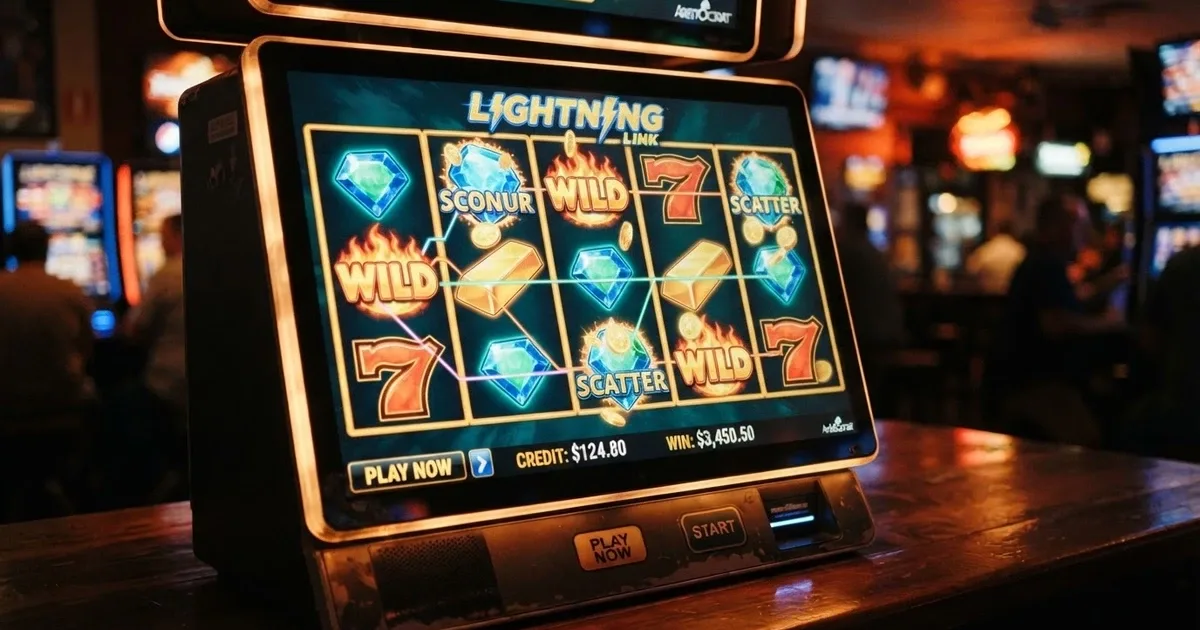
Best 7-Reel Slots Australia: How the Grid Changes the Game and Where Australians Actually Play Them
 Available in AU
Data verified against the ACMA register, operator-published bonus terms and provider line-ups. Last checked 18 October 2026.
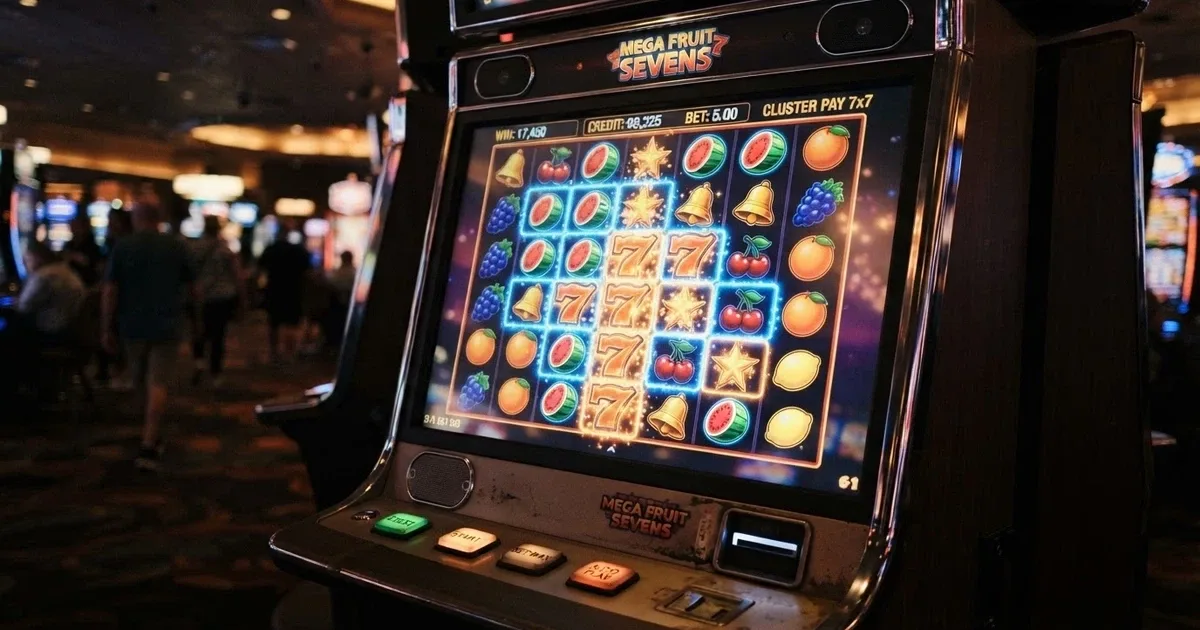
Seven reels do not just add two more lines to a slot machine. They change what a spin can be, what a feature does and how a session feels. Australian players searching for “7-reel slots” are not looking for a marginal variant on the five-reel pokie they already know — they are looking for a different game, one built around a larger grid, cluster pays and feature stacks that smaller formats cannot carry. This page is the work-through: what a seven-reel pokie actually is, which titles carry verified RTP and max-win figures, what the offshore operators offering them look like, and the rules and safety net an Australian player should know before putting a dollar in.
The starting fact matters more than the rankings. There is no online casino licence in Australia — federally or in any state or territory. Online pokies are prohibited to people in Australia under the Interactive Gambling Act 2001, and no licence for online casino exists anywhere in the country. Every real-money 7-reel pokie an Australian player loads is being offered by an offshore operator sitting outside Australian rules. That changes what every operator write-up, every bonus term and every max-win figure on this page means, and it is what this page refuses to soft-pedal.
Table of Contents
- Why a Seven-Reel Grid Changes Everything About the Way You Play
- The Best 7-Reel Slot Titles to Play in 2026
- Where Australians Actually Play 7-Reel Pokies Online — and What It Costs Them
- Online Pokies Are Illegal in Australia — Here Is What That Actually Means
- The Safety Net Most Australian Punters Don’t Know They Have
- How We Selected and Ranked Every Operator on This Page
- Your Move: Picking a 7-Reel Pokie Worth Your Time and Money
- Frequently Asked Questions
Why a Seven-Reel Grid Changes Everything About the Way You Play
Slots are usually counted by their reels because the reel is the visible core of the machine. A three-reel pokie is a recognisable thing — three spinning columns, a single payline down the middle, the mechanics inherited from the mechanical one-armed bandit. The five-reel pokie that dominates online lobbies today is also a recognisable thing: five columns, multiple paylines, scatters and free spins layered on top. Add two more reels and the recognisable thing stops. Seven columns break the payline model. They force a different way of counting wins, and the way wins are counted changes everything downstream — the bonus features, the volatility curve, the size of a payout ceiling and how long a session lasts.
This section is the orientation. It covers how the seven-reel grid actually plays, where it came from, the feature stack it unlocks, how to try one without spending money, what it costs an Australian player to play for real, and the Australian vocabulary that shapes the search.
How the 7-Reel Grid Changes the Way You Play
A classic three-reel fruit machine asks one question: does the symbol on the centre line match? A five-reel pokie multiplies that question across ten to fifty paylines. Seven reels, especially on a 7×7 layout, ask a different question entirely: do five or more matching symbols touch each other, in any direction, anywhere on the grid? That is cluster pays, and it is what turns a slot from a payline-counting exercise into a symbol-tumbling puzzle. Most modern 7-reel titles use cascading reels, multipliers, free spins and charge meter bonuses; older 7-reel games with a 7×3 layout tend to have fewer of those features and feel closer to a fattened five-reel game.
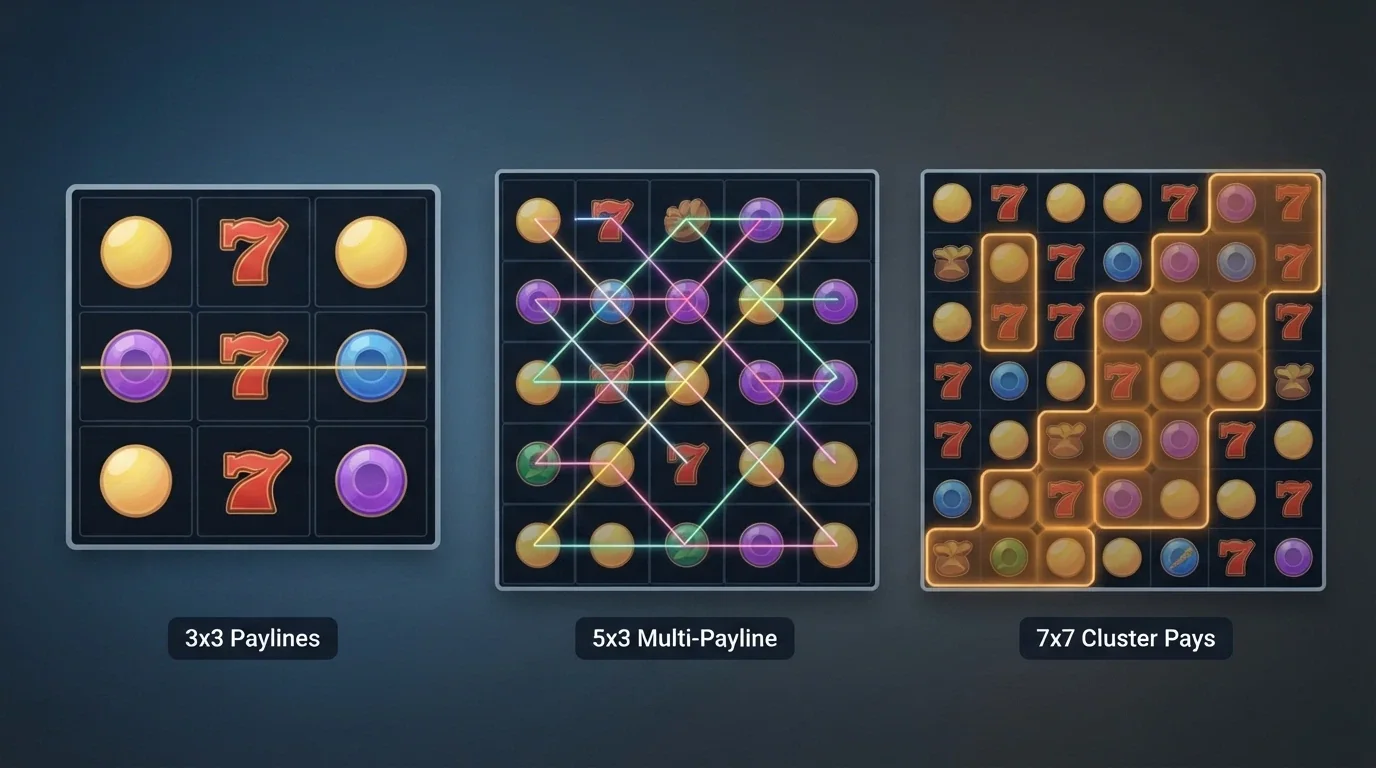
The size of the grid does the work. A 7×7 board has 49 cells in play every spin. A 5×3 board has 15. The bigger surface multiplies the possible win paths in a way fixed paylines cannot, and it opens room for mechanics that only make sense on a larger canvas: charge meters that fill when winning symbols land, cascades that re-drop symbols into cleared cells, and free-spin rounds where the grid grows mid-feature. Sugar Rush 1000 by Pragmatic Play runs on a 7×7 grid with cluster pays and packs the cascading mechanic into its base game, so every spin carries the possibility of snowballing wins instead of stopping at the first matching line.
Classic Fruit-Machine Sevens vs Modern Grid-Powered 7-Reel Slots
Older 7-reel cabinets used a 7×3 layout — seven columns, three rows, seven paylines, one for each reel. They were physically impressive and almost beside the point. Games like Super 7 Reels by Merkur Gaming, with its 96.12% RTP over five paylines, sit in that tradition: a fruit machine that happens to have seven reels, modest features and a steady cadence. The base game feels like a five-reel pokie stretched sideways.
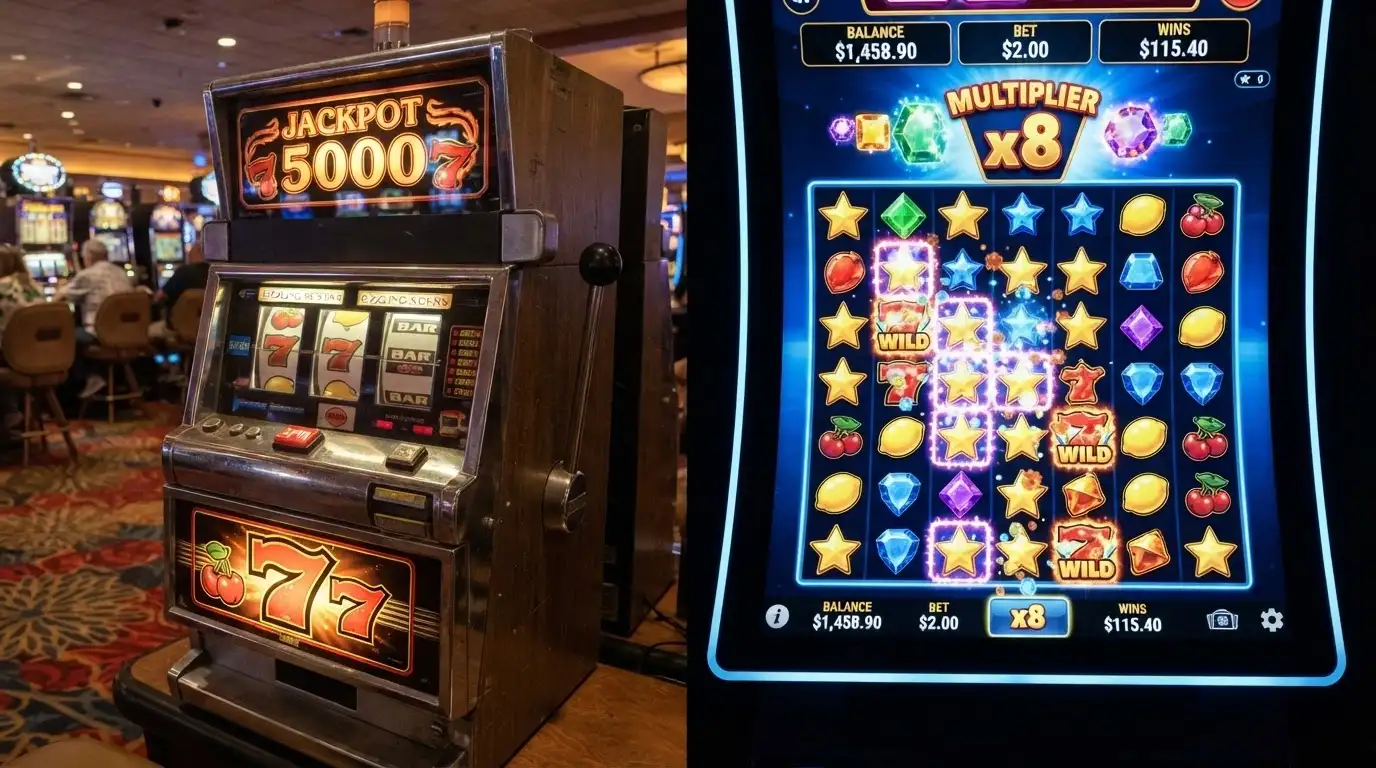
Modern grid-powered 7-reel slots are a different object. They use a square or near-square board — 7×7, 6×5, or 5–7 reels with 5–9 rows — and mechanics that treat the grid as a single playing field. Cascading reels remove winning symbols and drop new ones into the cleared spaces. Multipliers attach to the cascade count so each successive win in a chain is worth more than the last. Charge metres accumulate progress through repeated wins and unlock additional features. The game no longer asks whether the payline lit up; it asks how long the cascade can keep going.
Cascading Reels, Cluster Pays and the Key Features 7-Reel Pokies Unlock
The features that make a seven-reel pokie feel different to a five-reel one live almost entirely in the grid and the cascade mechanics.
Cascading and tumbling reels. A winning combination is removed from the grid and new symbols drop into the vacant cells. The new symbols may form a second winning combination, which is removed, which triggers another drop. Chains can run for several cascades on a single spin, and each step in the chain increases in value when a multiplier is attached.
Cluster pays. Whereas a five-reel pokie pays when matching symbols land on a defined payline, cluster pays counts any group of four, five or more matching symbols that touch horizontally or vertically. A 7×7 grid produces dozens of possible clusters per spin and lets symbols anywhere participate, which is why a winning position can appear far more often than on a payline machine.
Scatter pay and charge metres. Scatter pay removes the symbol-position requirement entirely, paying when a minimum count of matching symbols lands anywhere on the grid. Charge metres track repeated scatter hits across spins and unlock escalating bonuses when they fill.
Expanding grids and respin mechanics. Some 7-reel titles expand the grid mid-feature — adding rows, growing symbols into oversized blocks, or expanding reels. Seven 7’s by Microgaming uses the CONTINUWIN mechanic, where landing a seven or 2x wild on the first reel triggers automatic respins that add reels up to seven.
Bonus Rounds, Free Spins and Multipliers — Where 7-Reel Slots Actually Pay
Base-game wins on a 7×7 grid are modest by design. The real payout events come from the bonus rounds. Sugar Rush 1000’s headline number is 25,000x the stake, achievable through its free-spin multiplier system that carries cascade multipliers across spins. Seven 7’s also tops out at 25,000x, earned through the CONTINUWIN chain where each consecutive respin extends the path. Superstar Sevens by Hacksaw Gaming, on a 6×5 cluster-pay grid with 96.37% RTP, runs three distinct bonus modes — Reel Charge, Lucky Strike and Juicy Joltz — each one a different angle on the same multiplier-heavy gameplay, with a 10,000x ceiling.
Other titles route their payout windows through a single concentrated feature. 7’s Luck by Red Tiger uses a Hold and Respin bonus where filling the grid with Scatter symbols lands a 10,084x max win. 7s Deluxe Wild Fortune Play by Blueprint Gaming runs the Fortune Spins feature with stacking wild multipliers and a 250,000x ceiling that sits far outside anything else on this list. The takeaway is structural: a 7-reel slot pays through a sustained feature run far more often than through a single base-game hit.
Free-Play and Demo Mode — Try Every 7-Reel Slot Without Spending a Cent
Every Australian-facing review site covering 7-reel pokies lets players load a demo version without registering or downloading software. The mechanics of a 7-reel pokie are exposed in demo mode the same way they are on the real-money version — the same grid, the same features, the same hit cadence. A demo run reveals what the volatility class means for session feel: high-volatility titles like 7×7 Zeus Max at 24.88% hit frequency sit long between wins and explode when a feature lands, while medium-volatility cluster-pay games like 7’s Luck at 16.39% hit frequency run smoother.
Demo mode does not simulate the bonus-buy costs of a real-money session, does not apply the operator’s wagering requirement to the bonus balance, and does not slow down or speed up the cascade hits because the bankroll is fictional. What it does is let a player see whether the mechanic suits their taste, at the speed a real session would run, without committing.
Playing 7-Reel Slots for Real Money — What Every Australian Punter Needs to Know
The Australian side of the real-money question is ungenerous. Online casino games and online pokies are prohibited to people in Australia under the Interactive Gambling Act 2001; no licence for online casino exists anywhere in the country. The operators where Australian players actually load 7-reel pokies sit offshore, with no Australian consumer protection, no complaints body and no recourse if a withdrawal stalls. Credit cards and digital currencies are banned as payment for online wagering in Australia since 11 June 2024 — a regulator’s hearing aid that tells a player which operators are serving from inside Australian rules and which are not.
What that means in practice: AUD deposits work at most offshore brands, the welcome offers look generous on the surface, and the wagering requirements that gate withdrawing a bonus are steep — 30x to 60x the bonus amount is the band across the operators covered below. A player who takes a bonus, plays it through 7-reel pokies with high volatility and runs the bankroll down before clearing the rollover gets nothing back. That is the offer behind the offer, and the only honest way to describe it is to describe what the bonus actually costs.
Australian Pokies Lingo — What a “7-Reel Pokie” Means and Where the Term Comes From
Australian players call slots pokies. Short for “poker machines”, a leftover from the early machines that used poker-hand rankings for payouts. An Australian reader looking for “7-reel slots” is searching for what locals call “7-reel pokies”, and an Australian operator’s pokie lobby separates the games a player sees when browsing by category. The vocabulary also shapes what the bonus terms call the games: a wagering contribution table may say “pokies” or “slots” interchangeably, and “real money pokies” means the same thing as “real money slots” on every offshore site that serves Australians.
The term “punter” — frequent in Australian gambling writing — is the reader an offshore casino has written its bonus pages for. PayID and Osko are the real-time Australian payment rails a player expects to see on deposit, even though the offshore operator’s payment page usually routes through a different processor. BetStop is the National Self-Exclusion Register that handles licensed wagering, not offshore casinos. Getting the vocabulary right is what makes the rest of the page make sense.
The Best 7-Reel Slot Titles to Play in 2026
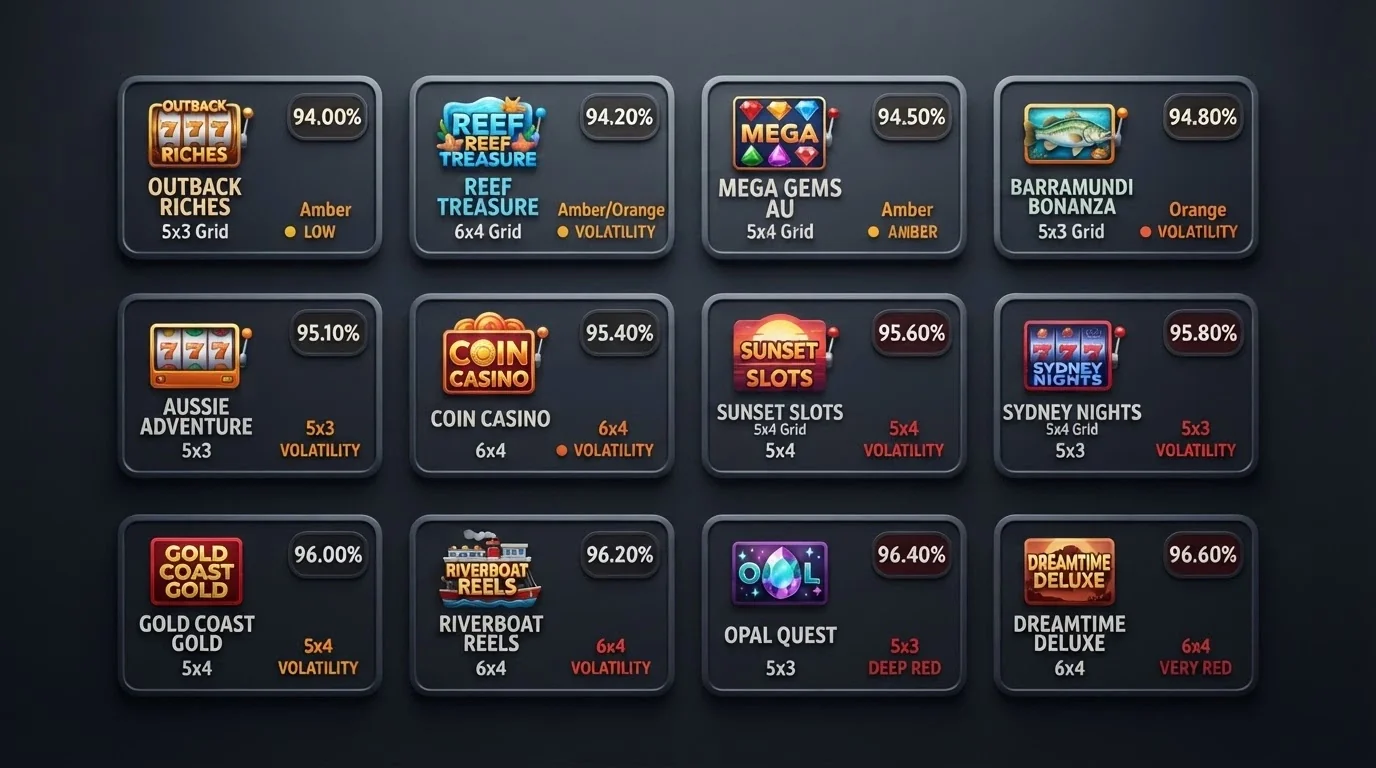
The table below carries every title in this category for which verified RTP, volatility, max win and grid data exist. Twelve games, ranked by the numbers that actually separate a smart pick from a blind spin. Two things stand out before reading the cells. The first is the RTP spread: from 94% on 7×7 Zeus Max and 94.04% on Potion Max 7s at one end, to 96.60% on Seven 7’s at the other. The second is the max-win spread: most titles sit between 7,500x and 25,000x, with 7s Deluxe Wild Fortune Play an outlier at 250,000x and a 5×3 layout — a useful reminder that a max-win number does not always reflect the grid it lives on.
| Title | Provider | RTP | Volatility | Max Win | Grid/Layout |
|---|---|---|---|---|---|
| Sugar Rush 1000 | Pragmatic Play | 96.53% | High (5/5) | 25,000x | 7×7 cluster pays |
| Seven 7’s | Microgaming | 96.60% | High | 25,000x | Up to 7 reels, CONTINUWIN |
| Superstar Sevens | Hacksaw Gaming | 96.37% | Medium | 10,000x | 6×5 cluster pays |
| 7×7 Zeus Max | 4ThePlayer | 94% | High | 17,650x | 5–7 reels, 5–9 rows, scatter pay |
| 7’s Luck | Red Tiger | 95.75% | Medium | 10,084x | Hold and Respin |
| Royal Reels 7 | — | 96.2% | Medium–High | — | 7 reels, 243 ways |
| 7s Deluxe Wild Fortune Play | Blueprint Gaming | 95.5% | High | 250,000x | 5×3, 20 paylines |
| Potion Max 7s | Kalamba Games | 94.04% | Medium–High | 10,000x | — |
| Royal Seven Ultra Deluxe | Gamomat | 96.14% | Medium | 7,500x | 6 reels |
| Toro 7s | ELK Studios | 95% | High | 10,000x | 3×3, 17 paylines |
| 777 Hot Reels Megacharged | Octoplay | 95.87% | Medium | 8,075x | 5×3, 10 paylines |
| Super 7 Reels | Merkur Gaming | 96.12% | — | — | 5 paylines |
RTP, Volatility and What the Slot Numbers Actually Mean for Your Bankroll
Return to player is the long-run average amount a slot returns to the player as a percentage of what it takes in. A 96.53% RTP means the slot keeps, on average, 3.47% of every dollar cycled through it. Volatility describes how that average arrives. High volatility means long dry stretches punctuated by large payouts when features land. Medium volatility means smaller, more frequent returns that smooth the experience. A 96% RTP hit-frequency of 34.48% on Sugar Rush 1000 means roughly one in three spins produces a win of some size, with the major payouts concentrated in the bonus rounds. 7’s Luck by Red Tiger has a hit frequency of 16.39% with a 95.75% RTP — wins land more rarely, and the bulk of the return runs through the Hold and Respin bonus. 7×7 Zeus Max at 94% RTP and 24.88% hit frequency returns less on average than the cluster-pay options above it, and the comparison is the read: RTP is the long-run cost, volatility is what the bankroll feels session by session.
The numbers interact. A 96% RTP with medium volatility eats a bankroll slowly with frequent small returns. A 94% RTP with high volatility eats a bankroll faster but offers a bigger payout ceiling. None of it wins against the house over time — these games, like every slot, return less than they take on aggregate. A higher RTP means a slower bleed, not a path to profit. The player who picks the highest-RTP 7-reel title is buying a longer session for the same deposit, which is a real benefit but not a winning one.
Payout Ceilings — What a Single 7-Reel Spin Can Actually Deliver
The max-win numbers on the table cluster into three bands. The bulk of the titles — Royal Seven Ultra Deluxe at 7,500x, 777 Hot Reels Megacharged at 8,075x, Superstar Sevens, 7’s Luck, Potion Max 7s and Toro 7s at 10,000x or just above — sit in a tight range that maps to where high-volatility 7-reel titles are engineered. A second band runs 17,650x to 25,000x and includes Sugar Rush 1000, Seven 7’s and 7×7 Zeus Max — games where maximum concentration sits in the bonus rounds and where hitting the ceiling requires buying the feature or getting into a thunderous chain. The outlier is 7s Deluxe Wild Fortune Play at 250,000x, sitting on a 5×3 20-payline base grid rather than a 7-reel layout; its Fortune Spins stacking-wild feature is rated for a max win that materially exceeds everything else in the category.
A max-win ceiling is a ceiling, not an expectation. Hitting it requires the bonus round to behave exactly as designed under ideal conditions, and a hit rate measured in fractions of a percent over millions of spins. The numbers are useful for comparing which games would change a player’s session the most if a miracle landed, not for predicting any one session.
Where Australians Actually Play 7-Reel Pokies Online — and What It Costs Them
Every operator below sits outside Australian rules. No online casino licence exists in Australia — federally or in any state or territory — and the offshore brands that accept Australian players are offering an unlicensed product. The table ranks them by the size of the welcome package and the bonus-engineering behind it; the prose below each row carries what the table cannot — what each offer actually costs a player running it through a 7-reel pokie session, and which reader the offer still suits once that cost is known.
| Operator | AU Licence Status | First-Deposit Welcome Offer | Wagering Requirement | Free Spins in Welcome |
|---|---|---|---|---|
| Skycrown | Offshore — no AU licence | 120% up to A$1,200 + 125 FS on Wolf Treasure | 40x (bonus + FS winnings) | 125 |
| Bizzo Casino | Offshore — no AU licence | Tiered 50%–125% up to A$2,500 + 125 FS | 40x | 125 (+ 10 FS no-deposit for PWA install) |
| Rocket Play | Offshore — no AU licence | 100% up to A$1,000 + 100 FS | 40x | 100 |
| WinSpirit | Offshore — no AU licence | 100% up to A$300 + 100 FS | 40x | 100 (batches of 20 over 5 days) |
| FairGO | Offshore — no AU licence | 100% up to A$200 (claimable 5×) | 30x (deposit + bonus) | — |
| Royal Reels | Offshore — no AU licence | — | — | — |
| Stake | Offshore — no AU licence | Rakeback model in lieu of welcome | — | — |
| Rainbet | Offshore — no AU licence | — | — | — |
| Scream Casino | Offshore — no AU licence | — | — | — |
| Rocket Casino | Offshore — no AU licence | — | — | — |
Skycrown
Skycrown’s pitch is structural depth. The welcome package is a four-tier structure scaling to A$8,000 + 400 free spins across the first four deposits, with the first deposit alone delivering a 120% match up to A$1,200 alongside 125 free spins on Wolf Treasure. The provider bench is broader than most offshore rivals — Pragmatic Play and IGTech anchor a lobby of thousands of pokies, which means a player running 7-reel titles like Sugar Rush 1000 from Pragmatic Play can find them without searching across multiple studios.

The maths of the bonus are steep. The 40x wagering requirement applies to the bonus amount and the free-spin winnings. A player taking the first-deposit bonus at A$1,000 needs A$48,000 of wagered volume before any winnings become withdrawable, with A$5,000 the cap on anything that converts. The free-spin component carries an A$300 maximum cashout per tier. The 14-day bonus validity means the rollover has to clear in two weeks — tight for a high-volatility pokie like Sugar Rush 1000, where the real returns run through feature rounds that may not land in the time available. The A$30 minimum deposit is accessible; the path from bonus to withdrawable cash is not, especially on cluster-pay titles with 7-reel mechanics that can swing the bankroll hard against a player before the cascade pays. Best read this for what it actually is: a long-term promo shop with a large structural offer and the typical offshore wagering weight behind it.
Bizzo Casino
Bizzo is the breadth play. Seventy-plus providers and 8,000+ titles make it the widest game library among the operators on this page, and the tiered welcome scales percentage to deposit size — 50% at the smallest deposits, climbing to 125% for those depositing A$250 or more, capped at A$2,500 on the first-deposit maximum. The 175 free spins spread across the four deposits plus the 10 free spins no-deposit for installing the PWA app are lighter than Skycrown’s headline numbers but bundled differently.
The welcome bonus clears on a 40x wagering requirement, with the PWA no-deposit spins capped at a A$75 maximum win and the same 40x rollover applied to the small win. The A$8 maximum bet during wagering is the loosest of the brands here, which lets a player run the bonus through high-volatility 7-reel titles without breaching the bonus terms. The Casino.Guru Safety Index of 8.4 is the highest formal score carried by an operator on this page. For a player who values game variety above bonus size and wants a single operator to leaf through every Pragmatic Play, Hacksaw Gaming and Microgaming 7-reel title in one place, Bizzo is the better-fit option. The CAP on real withdrawable value is harder to surface than for the smaller operators.
Rocket Play
Rocket Play runs the leaner two-deposit structure: 100% up to A$1,000 plus 100 free spins on the first deposit, and a 200% up to A$1,000 on the second. The 200% second-deposit match is the largest percentage in this section of the table — a smaller dollar ceiling but a steeper boost. The 40x wagering requirement on the bonus is standard for the offshore market and aligns with the rest of the rankings bar Skycrown’s identical 40x.
The 7–30 day bonus validity window, the A$30 minimum deposit and the A$7.50 max-bet limit during wagering are the kind of small specifics shape how a welcome bonus plays through on a 7-reel pokie. The free-spin bundle is credited to a single pokie rather than drip-fed across titles, which removes the choice-overhead reward of brands like WinSpirit but also removes the second-site typo of forgettable games. A player who wants a single large match rather than a four-tier package gets one here, and the structure suits a tight budget where the bankroll is committed to one or two 7-reel titles rather than spread across a multi-provider lobby.
WinSpirit
WinSpirit’s first-deposit offer is the smallest of the mainstream welcome packages on this page: 100% up to A$300 plus 100 free spins, with the second-deposit match at 200% up to A$1,000. The free spins are the differentiator. They are drip-fed in batches of 20 across five days on five different pokie titles — Lady Wolf Moon, Pearl Diver, Boom! Boom! Gold!, Green Chilli and Dragon Wealth — which means a player sees a new game every day of the welcome window rather than 100 spins on one title.
The 40x wagering requirement, 7-day bonus validity window, and the A$5 max-bet during wagering are tight. An A$300 free-spin max cashout and an A$3,000 per-bonus max cashout cap the real return. For a player who enjoys exploring several pokies across the welcome window and wants that exploration subsidised, the structure suits. For a player who plans to concentrate the bonus on one high-volatility 7-reel title, the batch structure forces a fragmentation that works against that plan. The smaller match ceiling caps the upside either way.
FairGO
FairGO is the single-provider operator in this section. The entire lobby is RealTime Gaming, which means no Pragmatic Play, NetEnt or Hacksaw cluster-pay 7-reel titles — none of the games in the comparison table above live here. What FairGO does run is a deposit-match bonus claimable five times in succession for up to A$1,000 total in match value, and a rare no-deposit free chip.
The 30x wagering requirement applies to deposit and bonus combined — the lowest multiplier on this page, and a meaningful difference when a player is running a small bankroll through a 7-reel pokie session. The A$100 no-deposit free chip carries a 60x wagering requirement and an approximately A$180 max cashout — the kind of terms where the bonus only converts to something withdrawable if the player hits early and gets out. The deposit bonus has no max-cashout limit, which is the genuine rarity on this page. For a player who wants RTG pokies, who values the lower 30x over a higher match and who wants to test the waters with a no-deposit chip before committing, FairGO runs on its own terms. The single-provider reality means the 7-reel titles above are mostly absent.
Royal Reels
Royal Reels reaches Australian players through affiliate channels and carries a 2.51% market share, which is more than most of the brands below and less than the major operators above. The brand exists in the market; the page-level specifics on welcome bonus terms, wagering requirements and free-spin value did not surface during research.
An Australian player who lands at Royal Reels sees an offshore casino without Australian consumer protection, without a licence and with no clear terms to compare against the other operators in this section. The honest read: the operator is real, the market presence is real, and the current welcome terms need to be checked directly before a player commits any bankroll. Until those terms are confirmed, the comparison is incomplete and the recommended play is to treat the brand as unverified.
Stake
Stake is the crypto-first outlier. The platform operates outside Australian rules entirely, with no Australian licence; the credit card and crypto payment ban for licensed wagering (since June 2024) does not bind offshore operators, but it signals Stake sits outside the Australian regulatory frame. The welcome bonus in the form other operators offer does not exist here — Stake runs a rakeback and VIP model rather than deposit matches, which changes what the player is paying for on each spin.
An Australian player using Stake is using a crypto-casino with no AUD on-ramp from the operator’s published terms, no Australian complaints body, and a different returns model from every other brand on this page. The brand’s 1.28% market share is small but persistent, supported by reputation mechanisms the rakeback structure builds. The honest read for the comparison table: Stake belongs in this ranking as a recognised offshore option, but it does not offer the welcome packages the other operators do, and treating it as comparable on that basis would distort the trade-off. For a player already deep into crypto and comfortable with the rakeback model, Stake is on the table. For everyone else, the table above gives a clearer comparison.
Rainbet
Rainbet sits in the same position as Royal Reels and Stake on the affiliate research: a crypto casino with confirmed Australian player reach and a 1.28% market share, but no bonus terms or game provider details surfaced in the research sweep. The brand is present in the market; the specifics that would let a player compare it directly to Skycrown or Bizzo do not.
An Australian player who finds Rainbet through a search result sees a crypto-only operator with no Australian licence and no verified welcome terms. Treating it as comparable to the operators above without confirmed bonus data would be making up the comparison. The recommendation is the same as Royal Reels: the brand is on the list because it reaches Australian players in real numbers, and the current welcome terms need to be checked at the site directly before any decision is made on its basis.
Scream Casino
Scream Casino carries a 0.99% market share — the smallest of the offshore brands here with confirmed Australian player reach — and the same research gap on bonus terms and game providers as Royal Reels and Rainbet above.
The honest write-up is the same shape: an Australian player lands on a site with no Australian licence, sees an offshore brand, and finds nothing in the research sweep that lets a head-to-head comparison against Skycrown’s specific 40x wagering on a A$1,200 first-deposit bonus. For a player who already has an account and is mainly looking for a sanity check, Scream Casino fits alongside the other small-share offshore brands; for a player comparing visible options, the four main-stream operators above are where the comparison carries weight.
Rocket Casino
Rocket Casino shares only the word “Rocket” with Rocket Play — a distinct operator serving the same offshore-AU market, at a smaller 0.57% market share. The names cause confusion often enough that it is worth naming the difference clearly: Rocket Play has the welcome package and provider bench covered above; Rocket Casino is the smaller brand without confirmed bonus terms in the research sweep.
The diluted comparison: two operators, similar shapes from the outside, very different visibility on terms. An Australian player who recognises the distinction will not double-deposit on what they think is one site and what is actually two. Past that, the recommendation is the same recommendation for every brand below the main four: the brand exists, the market presence is real, and current terms need to be checked directly.
Online Pokies Are Illegal in Australia — Here Is What That Actually Means
It is worth saying plainly. The product this page describes is prohibited under Australian law. Online casino games, online pokies and in-play sports betting are prohibited to people in Australia under the Interactive Gambling Act 2001; no licence for online casino exists anywhere in the country — not federally, not in any state or territory. That is the legal architecture above every offshore operator a player reaches for a Sugar Rush 1000 or Seven 7’s session, and it is what makes every comparison above less settled than the cells look. An Australian player choosing between Skycrown and Bizzo is choosing between two unlicensed products. The choice matters — but it does not matter inside the regulatory cover an Australian player might assume exists.
The Interactive Gambling Act — What It Actually Prohibits (and What It Doesn’t)
The IGA targets the provider, not the individual player. The Act prohibits the supply of prohibited interactive gambling services to people physically in Australia; it does not prosecute the Australian punter for playing offshore. In practice, that means the ACMA — the Australian Communications and Media Authority — enforces the prohibition against operators: through formal warnings, civil penalty proceedings, referral for prosecution and, since November 2019, by directing Australian ISPs to block illegal gambling and affiliate websites. The ACMA’s headline line on the topic makes the framing plain: “Providing a prohibited interactive gambling service to a person in Australia is illegal, and the ACMA pursues it.”
The numbers behind that line are not small. Since its first blocking request in November 2019, the ACMA has had 1,564 illegal gambling and affiliate websites blocked by Australian ISPs, and more than 225 illegal services have withdrawn from the Australian market since enforcement was strengthened in 2017. The product prohibited includes online casino games, online pokies and in-play sports betting. Permitted products include wagering on races and sport placed before the event begins, lotteries and keno — through operators licensed by a state or territory — and there is no upper federal cap on stake or loss, because the deposit-and-loss limit conversation is the conversation about a product the law does not permit.
The 2026 Gambling Reform — What Changed and What It Means for Pokies Players
Passing Parliament on 19 August 2026 and commencing on 1 January 2026+1, the Interactive Gambling Amendment (Gambling Reform) Bill 2026 is the largest change to Australian online gambling rules in a decade. Its measures target licensed wagering — the part of the market that is regulated — but the reach extends to offshore operators through the bank-blocking powers that start in 2026+1.
The advertising rules tighten first. From 2026+1, wagering television ads are capped at no more than three per hour between 5 am and 8:30 pm, with a live-sport blackout running 15 minutes before to 5 minutes after any live sporting event in the same window. Radio ads are barred during school commute hours. Athletes, celebrities and influencers are banned from promoting wagering. Wagering ads cannot appear inside sports venues or on uniforms, and broadcasting live sporting odds is banned. Online wagering ads are restricted to logged-in, over-18 users with an opt-out register (AdStop) administered by the ACMA and funded by a cost-recovery levy on wagering companies.
The inducement rules are sharper. Direct marketing of inducements is prohibited for 14 days after sign-up, for three months after a person deregisters from BetStop, and indefinitely for customers identified as at risk of gambling-related harm. Online keno — “pocket pokies” — and foreign-matched lotteries are banned outright.
And the payment rules shift. From 1 January 2026+1, banks and payment systems gain express authority to block transactions to illegal gambling operators, and the ACMA gains faster powers to block sites. Together with the existing credit card and crypto ban for licensed wagering from 11 June 2024, the payment signal in 2026+1 is the cleanest indicator of where an operator sits relative to Australian rules.
Licensed vs Offshore — The Split Every Australian Player Faces
There is no licensed online casino in Australia. The split the headline implies is not between two regulatory tiers of the same product — it is between a market that exists (offshore, illegal supply) and a market that does not (licensed online casino). Every operator offering real-money pokies to an Australian player is offshore, and every offshore operator means a player sees a site without Australian consumer protection, without an Australian complaints body, and without BetStop coverage: an offshore casino is not connected to the BetStop register and will continue accepting a self-excluded person’s money.
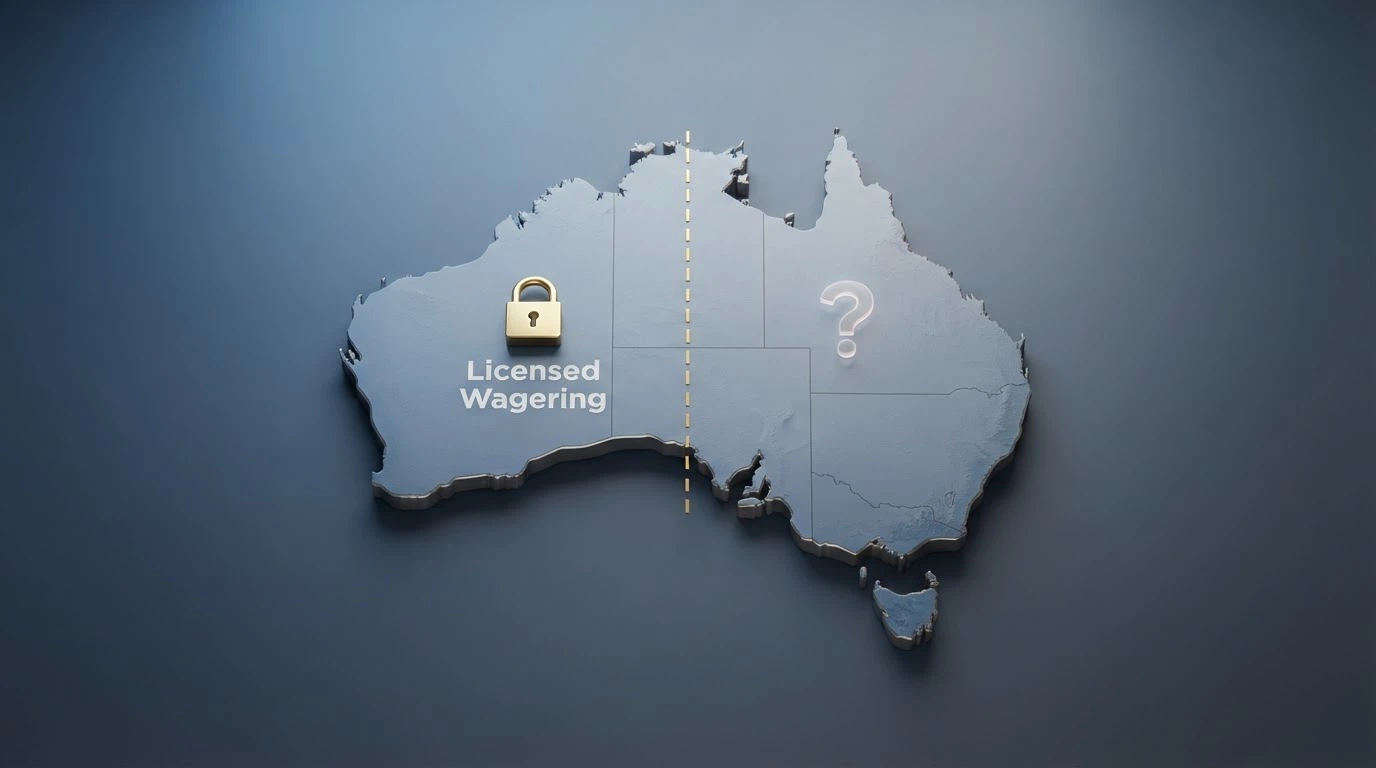
DNS-level blocking by ISPs is the visible enforcement. The ACMA’s block-list sweeps up 1,564 illegal gambling and affiliate sites and counting; the operator a player used yesterday can be blocked next week, with a balance still on the account. There is no Australian regulatory body to escalate a refused withdrawal to. The site can disappear with the bankroll intact, and the only recourse is the operator’s own complaints process.
The payment method is the simplest test of whether an operator sits inside or outside Australian rules at a glance. If an operator accepts credit cards or crypto for online wagering, it is operating outside the framework that licensed Australian wagering runs on — though for offshore brands, those payment bans do not in any event apply. Most offshore operators serving Australians do not, in actual fact, take credit cards or crypto on the Australian-facing site anyway. The signal is informational: a licensed Australian wagering brand does not accept those methods, and an offshore brand usually does.
Credit Cards, Crypto and PayID — What Your Payment Method Says About an Operator
Credit cards, credit-related products and digital currency are banned as payment for online wagering in Australia under the Interactive Gambling Amendment (Credit and Other Measures) Act 2023, with the ban commencing 11 June 2024. The penalty for an Australian-licensed operator accepting those payments runs up to A$247,500. The legal deposit routes for licensed wagering are debit card, bank transfer, PayID/Osko and BPAY.
An operator advertising credit card or crypto deposits to an Australian player is therefore not running inside Australian rules — though the offshore operators this page covers are not legally bound by the ban in any event. The payment method is still a useful signal: a clean AUD deposit via PayID on a site tied to a clear operator is the smaller gap between licensed and offshore — even if it is still offshore. The cleanest read for an Australian player running a 7-reel pokie session: assume the operator is offshore unless its site and terms can show otherwise, and use a payment method that supports a chargeback route or a quick recall through the bank if a withdrawal stalls.
The Safety Net Most Australian Punters Don’t Know They Have
Australian player protection exists. What does not exist is what most players think they have. The next sections walk through what BetStop does, what the limits are, and the harm-prevalence numbers that put online gambling risk in scope.
BetStop, Session Limits and the Tools That Do Exist for Australian Players
BetStop — the National Self-Exclusion Register — has been live since 21 August 2023. A single registration excludes a person from every Australian-licensed online and phone wagering provider in the country, covering the approximately 150 operators bound by the regime. There is no per-operator opt-out: one registration, every licensed bookmaker, racing and sports wagering service, minimum exclusion period three months, maximum lifetime.

The adoption numbers tell the story. By the end of Q3 FY 2026–2026+1, 59,830 people had registered to self-exclude from licensed wagering, and 37,247 people held active exclusions as of 31 March 2026. Among registrants, 78% are under 40 and 38% chose the lifetime exclusion — that last figure is the bracket where a person has decided the issue is not going away. The register is built for sustained exclusion, not as a cooling-off mechanism.
The hard ceiling is precisely where the readers of this page are. BetStop binds approximately 150 licensed wagering providers; an offshore casino is not connected, and an offshore casino will continue accepting a self-excluded person’s real-money deposits. For a player who wants to use a self-exclusion tool as a hard stop, BetStop works — but it works on the licensed wagering side of the market, and the operators running 7-reel pokies are not licensed wagering brands. The session and deposit limits an Australian player can set on a licensed wagering account exist on the same licensed side of that divide.
When the Reels Stop Being Fun — Warning Signs and the Real Harm Numbers
About 2.1% of Australian adults — roughly 430,000 people — experience problem gambling. The NSW Gambling Survey 2024 puts the broader moderate-to-high-risk brackets at 0.9% high-risk, 3.1% moderate-risk, and 6.7% low-risk, totalling 4.0% in the moderate-to-high-risk band. The survey’s risk-factor finding is the one that matters most directly for a page about 7-reel pokie play: online gamblers are nearly five times more likely to experience moderate- to high-risk gambling compared to those who do not gamble online (9.2% versus 2.1%). The survey concludes that online gambling is a significant risk factor at the individual level.
Gender and age narrow the picture. Men are over twice as likely to experience moderate-to-high-risk gambling compared to women (5.7% versus 2.3%), and the highest risk among men aged 18 to 24 sits at 9.3% — nearly five times the population average for that band. The demographic concentration is real, and the warning signs are the standard set: chasing losses, gambling more than intended, hiding play from family or friends, borrowing to fund play, and the gradual shift from entertainment to compulsion.
The Australian Institute of Family Studies’ Australian Gambling Research Centre has put a number to who knows BetStop exists — and the answer is fewer than one in three. Only 33.5% of wagerers know BetStop exists, and just 26.5% of all Australian adults are aware of it. The gap between need and reach is large: an estimated five million Australians wager, including 400,000 high-risk gamblers, yet just 30,000 individuals currently hold active BetStop exclusions.
Where to Get Help — Helplines, Counselling and Self-Exclusion, Step by Step
The National Gambling Helpline — 1800 858 858 — is the first call. Free, confidential, staffed 24 hours a day, seven days a week, with online chat and email counselling through Gambling Help Online. The counselling service runs through gamblinghelponline.org.au for live chat, structured self-help programmes, peer support and counselling sessions by arrangement. BetStop registration lives at betstop.gov.au, with a single registration excluding the person from every licensed wagering provider. Gambler’s Help — gamblershelp.com.au — runs state-funded financial counselling and peer recovery programmes for gamblers and affected family members.
The escalation goes in this order in plain language: call 1800 858 858 if there is a same-day need, register with BetStop if the plan is to stop completely (recognising offshore casinos are not bound), and engage Gambling Help Online or Gambler’s Help if the situation calls for ongoing counselling or financial guidance. The first step does not have to be the biggest one.
How We Selected and Ranked Every Operator on This Page
The operator ranking on this page draws on four sources: the official ACMA register, operator-published bonus terms as listed on the operators’ own sites, the per-provider game line-up as published by each operator’s lobby, and the affiliate-tracked market-share figures that identify which offshore brands reach Australian players in real numbers.
The criteria that ordered the ranking are straightforward, even where the operators are not. Game selection matters first: the question a player asking about 7-reel pokies is asking is whether the games exist on the lobby without a hunt. Bonus value against wagering matters second: the headline number is a payment-up-front, and the multiplier behind it is what the player actually pays to clear it. In-market reputation matters third: where an operator has been tracked by Australian-facing affiliate sites for years, the track record is harder to manufacture than a one-quarter sign-up bonus. Transparency of terms matters fourth: an offshore operator publishing clear wagering terms, free-spin value, and bonus validity is a different proposition from one whose terms only surface after registration.
The criteria did not include licence status in the way Australian licensee and offshore-licensed operators appear in other rankings, because no online casino licence exists in the Australian regulatory frame. The honest frame is what was applied.
Your Move: Picking a 7-Reel Pokie Worth Your Time and Money
The choice the page is built around is the one a player makes after seeing the comparison table and the operator write-ups above: which 7-reel pokie to load, on which operator, with what bonus or none, and what protections to switch on first.
The pick-by-the-numbers case favours Sugar Rush 1000 or Seven 7’s for a player who wants the highest verified RTP in the category and accepts that both run high volatility, meaning longer dry stretches between features. The pick-by-the-features case favours Superstar Sevens for a player who wants three distinct bonus modes to vary their session through. The pick-by-the-payout-ceiling case runs to 7s Deluxe Wild Fortune Play for the player chasing the headline 250,000x, with the caveat that the game sits on a 5×3 layout rather than a fully grid-powered 7-reel format.
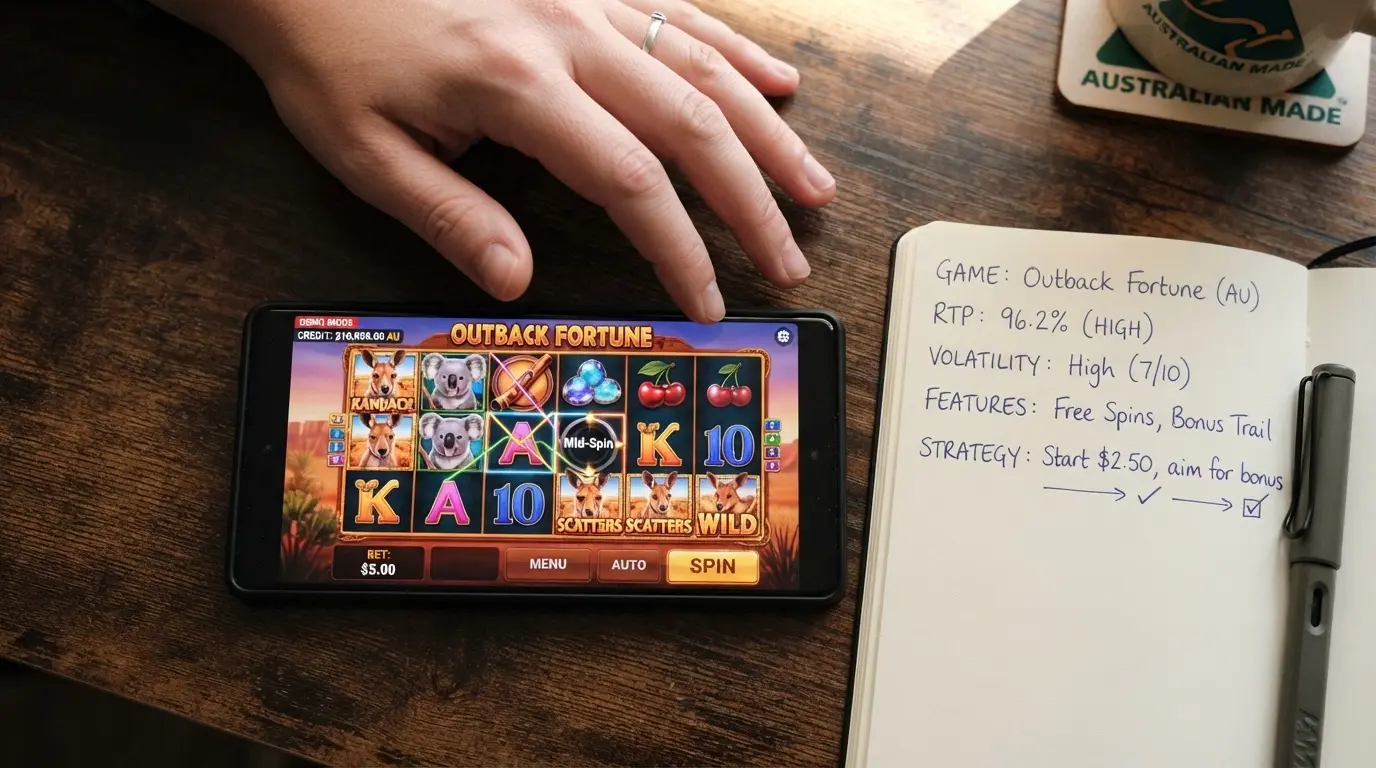
The demo step comes before the deposit. Every 7-reel title on the comparison table above can be loaded without registration on the major review sites, and demo mode replicates the mechanics exactly. A player who has never loaded a cluster-pay pokie should run 100 spins in demo before risking real money, and a player moving from a 5-reel builder like 777 Hot Reels Megacharged to a 7×7 game like Sugar Rush 1000 should expect the session cadence and the variance curve to feel completely different — they will.
On the operator side, the offshore reality does not soften, and the comparison among Skycrown, Bizzo, Rocket Play, WinSpirit and FairGO is a comparison among unlicensed products. The structural depth play is Skycrown or Bizzo. The lower wagering play is FairGO at 30x, with the trade-off that the lobby is RTG-only and the 7-reel titles on the comparison table are mostly absent. The free-spin-experience play is WinSpirit’s drip-fed batches. Most players will benefit from picking one operator for the welcome package and not chasing ongoing promos.
The protection side sits above all of it. BetStop registration at betstop.gov.au is the one Australian safeguard that stops play entirely across licensed wagering services, and it does not work on the offshore brands that actually run the 7-reel pokies on this page — but it is the closest thing to a wall an Australian player can build. Setting a deposit limit at the licensed-wagering bookmaker they do use, registering on BetStop if the limits have been creeping up, and spending five minutes with the gamblinghelponline.org.au self-assessment are the things to do before any reasonable choice of operator and pokie is permanent.
Sitting with all the numbers, the honest shape of 7-reel pokie play in Australia in 2026 is straightforward. The category offers a deeper, more mechanic-driven experience than five-reel pokies, and the best titles — Sugar Rush 1000 with 96.53% RTP and 25,000x max win, Seven 7’s with 96.60% RTP, Superstar Sevens across three bonus modes — reward a player who treats the grid as a new object rather than a stretched five-reel game. The ceiling is higher, the variance is higher, the bankroll melts faster when the features do not land. None of it produces a return on average, and the operator carrying the game sits outside the regulatory cover an Australian player might assume exists.
The biggest lever the player controls is whether the session is structured or reactive. A player who picks the highest-RTP title for the longest session, takes a low-percentage bonus if taking any at all, and never chases a feature loss is already running a more honest session than the marketing on the lobby page would suggest. The spinning reels are entertainment that costs money. The money spent is the price of the entertainment, and the only thing an honest read of a 7-reel pokie session changes is which entertainment is bought with it.
Frequently Asked Questions
Which 7-reel pokie has the highest RTP?
The highest verified RTP in the 7-reel category on this page is Seven 7’s by Microgaming at 96.60%, closely followed by Sugar Rush 1000 from Pragmatic Play at 96.53%, then Superstar Sevens by Hacksaw Gaming at 96.37%. Always check the in-game return configuration the operator loads, because the same title can carry lower RTP variants.
What is the maximum win on popular 7-reel slots like Sugar Rush 1000 or Seven 7’s?
Both Sugar Rush 1000 and Seven 7’s cap at 25,000x the stake. 7s Deluxe Wild Fortune Play by Blueprint Gaming sits well above that figure with a 250,000x max win through its Fortune Spins feature, while Superstar Sevens, 7’s Luck, Potion Max 7s and Toro 7s all sit near 10,000x. The max win is a ceiling, not an expectation — a hit rate measured in fractions of a percent of spins.
How many illegal gambling websites has the ACMA blocked from Australian players?
The ACMA has had 1,564 illegal gambling and affiliate websites blocked by Australian ISPs since November 2019, with more than 225 illegal services having withdrawn from the Australian market since enforcement was strengthened in 2017. Operators on this page sit among the offshore brands the Australian legal frame does not cover.
What is the typical minimum deposit at online casinos that accept Australian players?
Among the operators on this page, A$30 is the typical minimum deposit, with Skycrown, Rocket Play and WinSpirit all citing that floor. FairGO’s deposit match starts at a smaller amount, while Bizzo’s tiered welcome match changes the percentage tier starting from deposits as low as A$25. Offshore brand minimums vary by promotion, so the floor should always be re-checked on the operator’s deposit page at the time of deposit.
What should I do if I think I have a gambling problem in Australia?
Call the National Gambling Helpline on 1800 858 858 — free, confidential and staffed 24/7 — for the same-day response. For ongoing support, Gambling Help Online at gamblinghelponline.org.au offers live chat, email and structured self-help programmes, while Gambler’s Help (gamblershelp.com.au) provides financial counselling and peer recovery support in affected states. BetStop at betstop.gov.au registers a person for self-exclusion from approximately 150 licensed wagering providers in one step, though it does not bind offshore casinos.
Prepared by the Trusted Casinos Australia editorial staff.