
Anonymous Crypto Casinos in Australia: What Anonymity Actually Costs You
 Available in AU
Every casino on this page is offshore. None holds an Australian licence, because no such licence exists. If you are reading this from Australia and a site is asking you to deposit Bitcoin or Litecoin, that single fact tells you almost everything else you need to know about who you are dealing with and what protections will be there when you need them. The privacy promise is real. The protection gap is just as real.
Data current as of 18 October 2026. Licence and operator claims verified against ACMA records, operator terms pages, and named third-party reviews where cited.
Table of Contents
- What Is an Anonymous Crypto Casino (and How Anonymous Is It Really?)
- Top 10 Crypto Casinos for Australian Players in 2026 — Compared by Anonymity, Bonuses and Access
- BC.Game — 100+ Cryptos and the Lowest KYC Hurdle in This List
- Stake — The Industry Giant That Explicitly Bars Australian Players
- BitStarz — 5 BTC Welcome Package Across a 6,000-Game Library
- BetPanda — True No-KYC Registration, Lightning Network, No Gambling Licence
- Fair Go — RTG Pokies and a Standing AU$15 No-Deposit Free Chip
- Rainbet — 250% Welcome Package with Strict Game and RTP Exclusions
- Rocket Play — High Australian Market Share, Limited Public Detail
- Skycrown — Strong AU Presence, Sparse Verified Information
- Royal Reels — Familiar Offshore Brand, Thin Confirmed Data
- WinSpirit — RTP Transparency in an Otherwise Sparse Offshore Field
- Why Your Anonymous Casino Bonus Looks Bigger Than It Is
- Is It Legal? Australia’s Online Casino Laws in 2026
- Responsible Gambling When the Licensed Safety Net Doesn’t Reach You
- How We Evaluate and Rank Anonymous Crypto Casinos
- Your Money, Your Risk — What Australian Players Should Weigh Before They Play
- Frequently Asked Questions
What Is an Anonymous Crypto Casino (and How Anonymous Is It Really?)
An “anonymous crypto casino” markets itself as a place where you can register with no more than an email and a crypto wallet, deposit in Bitcoin or another coin, play, and withdraw without ever uploading a passport or a utility bill. The promise has real content at one end and very little at the other.
At registration, the anonymity is genuine. You give the casino little or nothing that ties back to a real-world identity. Your wallet address is a string of characters; your email, if one is even asked for, is the only handle. At the deposit step, the same applies — crypto moves from your wallet to theirs without a name attached.
The anonymity ends at withdrawal. Curaçao- and Anjouan-licensed operators run internal AML thresholds that typically sit between EUR 2,000 and EUR 10,000 in cumulative deposits or withdrawals. Translated to Australian dollars, that is roughly AU$2,500 to AU$5,000 equivalent before the casino asks for verification. Cloudbet publishes its limit at A$2,200 per day; mBit’s threshold sits around US$5,000+. Above those figures, the casino wants to see a passport, a proof of address, and sometimes the source of the funds. The “no-KYC” promise, in other words, applies up to a number — and the number is the size of a serious win.
The offshore nature of these operators matters as much as the KYC question. Anonymous crypto casinos are not licensed by an Australian authority. They carry no AUSTRAC anti-money-laundering obligations. They sit outside Australian Consumer Law. ACMA blocks their domains; their own terms typically forbid Australian signups. The privacy gain is real. So is the gap.
How Anonymous Sign-Up Actually Works
The no-ID registration flow is the part the marketing is built around. At BetPanda, you provide an email and create a password; there is no document upload, no selfie check, no source-of-funds declaration. BlockSpins goes further: wallet-to-wallet, no email required at any stage, no minimum deposit, KYC never triggered. The casino knows your wallet address and your play history; it does not know your name.
The way a casino verifies you without knowing who you are is by trusting the system rather than the person. Crypto deposits are public on the blockchain, so a wallet’s transaction history is visible to anyone with the address. Provably fair games — common in this category — let the player verify that each spin’s outcome was generated before the bet and not altered after, which removes one category of dispute that a traditional casino cannot address. The identity question is sidestepped by moving it out of scope: there is no identity on file to lose, leak, or sell.
The trade is structural, not technical. Without identity on file, there is also nothing to anchor account recovery. Lose your 2FA device and your email, and the account is gone. Disputes that would normally go to a regulator have nowhere to land. The casino’s terms decide who wins.
The Crypto Payment Rails — BTC, Lightning Network and the Coins That Power Anonymous Play
Bitcoin is the default rail. Ethereum, Litecoin, Dogecoin, USDT (Tether), Solana and XRP are widely accepted. BetPanda’s standout feature is Bitcoin Lightning Network support for payouts, which moves at near-instant speed and at a fraction of the on-chain fee. A withdrawal that takes ten minutes on Lightning can take an hour or more on the Bitcoin base layer depending on fee conditions.
Australian players on-ramp through domestic exchanges that AUSTRAC requires to verify identity — CoinSpot, Swyftx, and Independent Reserve being the names that come up most often. The deposit trail is therefore partly identified: the exchange knows who bought the coin, even if the casino does not. From the casino’s side, what arrives is just another wallet deposit.
The choice of crypto rail is itself the legal tell. Since 11 June 2024, credit cards and digital currency have been banned as payment for online wagering in Australia. An operator that fails to enforce it faces penalties of up to $247,500. No Australian-licensed operator can therefore accept a crypto deposit. When a site asks an Australian player to deposit in Bitcoin, it is by definition outside the Australian rules.
The KYC Trigger Trap — When a “No-ID” Casino Asks for Your Passport
The single most common complaint from players at no-KYC casinos is the verification request that arrives at withdrawal. The player signed up with no documents, played for weeks, hit a balance worth withdrawing, and was suddenly asked for a passport, a recent utility bill, and a photo of the payment card used. The casino’s terms have always reserved the right to verify — the marketing just never mentioned it.
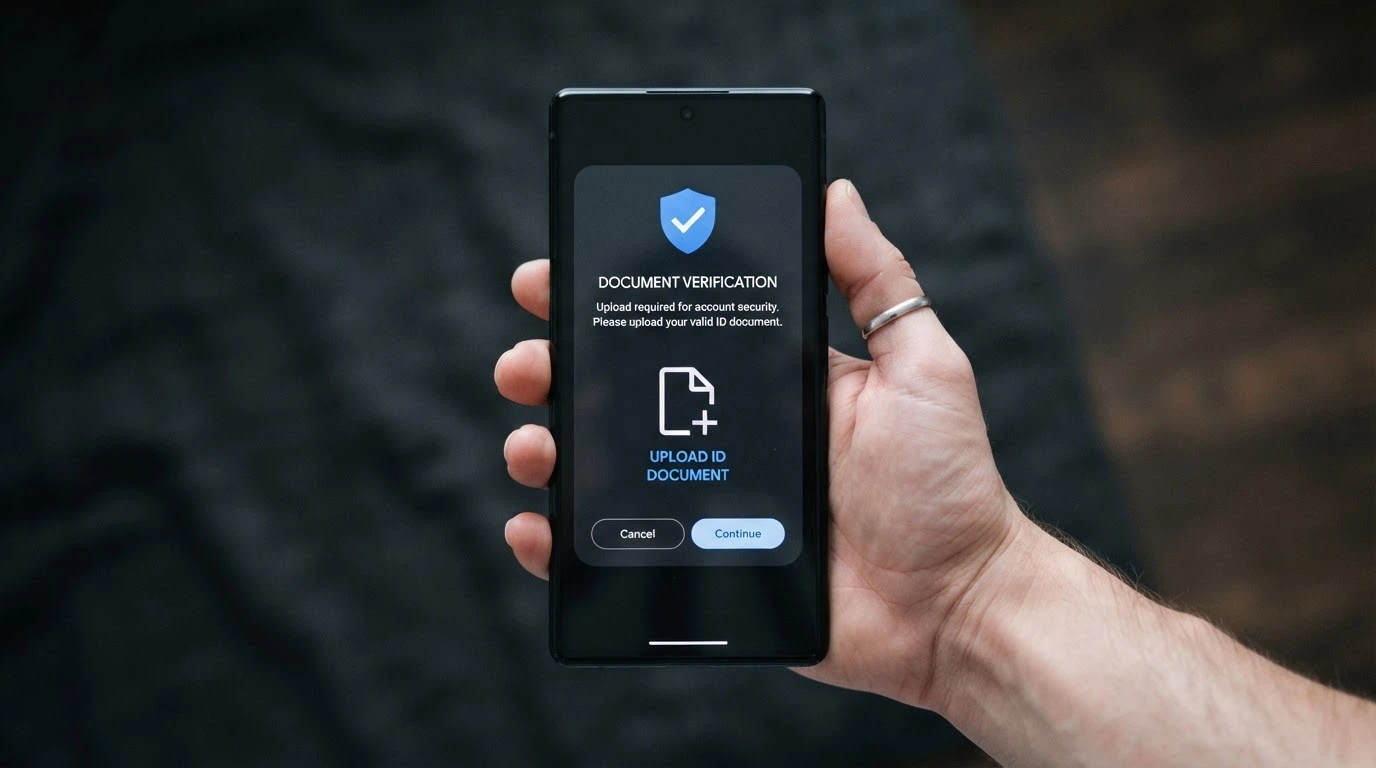
The thresholds are not arbitrary. AML thresholds at Curaçao- and Anjouan-licensed casinos typically sit between EUR 2,000 and EUR 10,000 in cumulative withdrawals or deposits. Translated, that is the AU$2,500 to AU$5,000 band that reputable Bitcoin casinos use as their KYC trigger. Below the trigger, the operator’s anti-money-laundering policy treats the account as low-risk. Above it, the policy demands verification.
Across the featured set the pattern is consistent. BC.Game triggers verification around US$1,000 cumulative — the lowest hurdle in the list and the operator most likely to let a small win go through without documents. Stake triggers around US$1,500 cumulative, with a KYC severity rating of 3.0 out of 10 and a track record of resolving 95% of Australian requests inside 30 hours. Cloudbet publishes a daily no-KYC limit of A$2,200; mBit’s KYC trigger sits around US$5,000. FortuneJack is the outlier in the wider market, with thresholds at US$10,000 single transaction and US$100,000 monthly — but FortuneJack is not on this list.
A cumulative threshold catches players by surprise because each individual withdrawal can look small. Five withdrawals of US$300 each add up to US$1,500 — and that is the moment the casino’s AML system flags the account. The marketing describes a friction-free product; the policy describes a sliding scale that ends at the same paperwork every other bank-grade financial product ends at.
Truly Anonymous vs Just Private — What Separates a No-KYC Casino from the Rest
The category “anonymous crypto casino” is not one thing. There is a spectrum, and a player who cannot tell where a given operator sits on it has not understood what they bought.
At the genuinely anonymous end sit BlockSpins — wallet-to-wallet, no KYC at any stage, capped at US$7,000 per 24 hours — and BetPanda, whose Costa Rica business registration is not a gambling licence at all, whose Trustpilot score sits around 2.3 out of 5, and whose sign-up takes an email and nothing else. These are the operators where the marketing matches the practice. The cap at the anonymous end is the trade-off: BlockSpins will never be a US$50,000-withdrawal casino.
In the middle sits the “threshold-KYC” operator — BC.Game, Stake, BitStarz, Fair Go. Small withdrawals pass without documents; larger ones trigger the AML review the licence requires. Curaçao eGaming-licensed brands cluster here, and the KYC experience varies by operator. FortuneJack, with thresholds at US$10,000 and US$100,000 monthly, sits further along the spectrum toward “KYC-on-large-transactions-only”, and its Privacy Policy explicitly tolerates VPN use.
At the standard end sits the operator that runs full KYC at first withdrawal regardless of amount — closer to a UKGC-regulated casino’s behaviour, often paired with an MGA or Curaçao licence and a customer base that does not need the “anonymous” label to convert.
Costa Rica registration is worth understanding as a category marker. A Costa Rica business registration is not a gambling licence; it is a corporate filing. Operators registered there are outside the Curaçao/Anjouan framework that imposes AML thresholds, and they answer to no gaming regulator at all. The lack of a licence is the price of the genuine anonymity.
What You Trade for Anonymity — Account Recovery, Disputes and the Cost of No KYC
The trade is not subtle. Without your identity on file, the casino has no way to confirm that you are the account holder, no way to push a password reset to a verified channel, no way to honour a dispute that you cannot evidence from inside the system.
If you lose your 2FA device and the email attached to the account, the account is effectively gone. If the operator decides your account was opened under a jurisdictional violation — using a VPN to spoof a permitted country — your balance can be confiscated under the terms you agreed to at sign-up. The wording is usually the same: “We may void winnings and withhold balances if we determine bonus abuse, multi-accounting, or breach of jurisdictional restrictions.” The clause reads standard; the consequence does not.
Dispute recourse is the gap that matters most in dollar terms. A licensed Australian wagering operator answers to ACMA, to the state regulator that issued its licence, and to the Australian Consumer Law. An offshore casino answers to its own customer service team. If that team decides against you, the next step is the Curaçao Gaming Control Board or the Anjouan licensing authority — both reachable in principle, neither fast in practice. ACMA cannot recover your money. BetStop does not reach the site. The ombudsman schemes licensed operators are signed up to are not available.
The deeper paradox is this: a player who needs identity verification to dispute a confiscated balance has chosen a casino specifically because that casino did not verify their identity. The protection gap is not a side effect. It is the price of admission.
Top 10 Crypto Casinos for Australian Players in 2026 — Compared by Anonymity, Bonuses and Access
Every operator below is offshore, licensed in Curaçao, Anjouan or — in one case — Costa Rica. None is licensed in Australia because no such licence exists. The ranking is built around fit to the anonymous-crypto topic: KYC friction, crypto breadth, bonus fairness, and AU accessibility. Market share and advertising spend are not factors.

| Casino | Licence & Regulator | Welcome Bonus | Wagering Requirement | KYC Trigger | Cryptocurrencies Accepted |
|---|---|---|---|---|---|
| BC.Game | Curaçao eGaming | Multi-deposit package reaching 300%+ (BCD token) | 40x | ~US$1,000 cumulative (AUD-converted) | 100+ including BTC, ETH, LTC, DOGE, SOL |
| Stake | Curaçao eGaming | 200% up to $3,000 | 40x | ~US$1,500 cumulative | BTC, ETH, LTC, DOGE, SOL, XRP and others |
| BitStarz | Curaçao eGaming | Up to 5 BTC + 180 free spins across 4 deposits | 40x | First large withdrawal or risk-flag | BTC + 10+ crypto; AUD via fiat side |
| BetPanda | None (Costa Rica business registration) | 100% match up to 1 BTC | 80x | — | BTC (Lightning Network), ETH, LTC, USDT, DOGE |
| Fair Go | Curaçao eGaming | 100% up to $200 × 5 deposits = $1,000 total | 30x (deposit + bonus) | 3–7 days for no-deposit claims | BTC, LTC |
| Rainbet | — | 250% up to $2,100 + 60 free spins across 3 deposits | 40x | — | BTC, ETH, LTC, USDT |
| Rocket Play | — | — | — | — | — |
| Skycrown | — | — | — | — | — |
| Royal Reels | — | — | — | — | — |
| WinSpirit | — | Deposit match + free spins | Applies to bonus funds and free-spin winnings | — | — |
Five of the ten carry licence data; six carry wagering; seven carry bonus shape. The bottom four — Rocket Play, Skycrown, Royal Reels, WinSpirit — have measurable Australian player bases but thin verified public detail on bonus, wagering, KYC trigger and crypto support. Their inclusion reflects market presence, not verified completeness.
BC.Game — 100+ Cryptos and the Lowest KYC Hurdle in This List
BC.Game carries the broadest crypto spread in this list — over 100 coins including Bitcoin, Ethereum, Litecoin, Dogecoin and Solana — and the most permissive KYC trigger. The operator is licensed by Curaçao eGaming and operates from offshore domains that remain reachable for Australian signups, though its own terms officially exclude Australia under IGA enforcement risk.
The KYC numbers are the standout. Verification triggers at roughly US$1,000 in cumulative deposits or withdrawals (AUD-converted) — the lowest bar in the featured set — and BC.Game carries a KYC severity rating of 2.5 out of 10, where 10 is the most intrusive. A small win walks through without documents; a larger one will eventually hit the threshold.
The bonus structure is a multi-deposit package reaching above 300% (paid in BCD, BC.Game’s native token), with 40x wagering. The game library is over 10,000 titles from Pragmatic Play, Evolution, BGaming and Hacksaw Gaming.
BC.Game is the option for breadth and the gentlest KYC friction in this list — the rest is the trade-off.
Stake — The Industry Giant That Explicitly Bars Australian Players
By volume and brand recognition, Stake is the biggest name in crypto casino — and the operator whose terms most clearly prohibit Australians. The Curaçao eGaming licence covers the operation; the geographic exclusion is written into the T&C itself.
The welcome offer is straightforward: 200% up to $3,000, 40x wagering, 30 days to clear, US$50 minimum deposit. KYC triggers at roughly US$1,500 cumulative, with a severity rating of 3.0 out of 10 and a track record of resolving 95% of Australian verification requests inside 30 hours — meaningfully faster than the industry average. The game catalogue is deep (Pragmatic Play, Evolution, Hacksaw Gaming, and Stake’s own provably fair originals), and the crypto list is broad (BTC, ETH, LTC, DOGE, SOL, XRP and others).
The Australian question is the hard one. Stake’s T&C explicitly prohibits players from the US, UK and Australia. Using a VPN to bypass the geo-block violates the terms and exposes the player to account closure with fund forfeiture. The operator has form for enforcing this clause — at scale, and without negotiation. The review data showing fast AU KYC resolution describes cases where the player was verified, not cases where the player was allowed to keep their balance after a jurisdictional breach.
For the right jurisdiction, Stake is peerless. For an Australian reaching it through a VPN, it is one complaint away from losing the balance in the account.
BitStarz — 5 BTC Welcome Package Across a 6,000-Game Library
BitStarz is the multi-currency veteran of the set, with a Curaçao eGaming licence and a 6,000-plus game catalogue from Microgaming, NetEnt, Pragmatic Play, Betsoft and Evolution. It accepts Bitcoin plus ten or more other cryptocurrencies and offers an AUD fiat side for players who want to mix rails.
The welcome package is the headline. Up to 5 BTC plus 180 free spins across the first four deposits, with 40x wagering on the bonus amount. Free spins are credited 20 per day over nine days, and the qualifying deposit must be wagered at least once within 24 hours to unlock free-bonus winnings. The minimum deposit to unlock withdrawal of free-bonus winnings is 20 EUR/USD/AUD or 0.00031 BTC.
KYC is standard: verification triggers on the first large withdrawal or when the account is risk-flagged, which is closer to the conventional end of the spectrum than BC.Game or Stake. One source claimed BitStarz also holds an MGA licence; the operator’s own site did not confirm that this run, so it is treated as Curaçao-only here.
BitStarz is the AUD-friendly multi-rail option — long-established, deep library, conventional KYC.
BetPanda — True No-KYC Registration, Lightning Network, No Gambling Licence
For a player who genuinely values anonymity, BetPanda is the most uncompromising option on this list. The operator launched in 2023, runs email-only registration with no KYC at sign-up, supports Bitcoin Lightning Network for near-instant payouts, and holds no formal gambling licence — only a Costa Rica business registration.
The Trustpilot score sits around 2.3 out of 5, which is the loudest single signal on this page. Volume and visibility are not the same as reliability. The bonus structure is the other tell: 100% match up to a high cap (advertised at roughly US$90,000), but with 80x wagering inside a 7-day clearing window — among the harshest in the industry. The headline number is enormous; the play-through requirement is brutal; the two facts are not in tension, because they are designed for different audiences.
The game library runs on the SoftSwiss platform, with thousands of titles from Pragmatic Play, NetEnt and Evolution. Cryptocurrencies accepted include BTC (with Lightning), ETH, LTC, USDT and DOGE. VPN use is permitted.
Genuine anonymity costs. The 80x wagering window, the Costa Rica filing rather than a licence, the 2.3 out of 5 Trustpilot — all of it is the price of admission to the no-ID option.
Fair Go — RTG Pokies and a Standing AU$15 No-Deposit Free Chip
Fair Go has the longest Australian-facing profile in the set, with a Curaçao eGaming licence, a RealTime Gaming (RTG) platform, and a 280-plus pokie catalogue that has barely changed in ten years — which is the point. Australians who want classic RTG pokies rather than the new Hacksaw and Nolimit City catalogue find Fair Go familiar.
The welcome structure is a five-tier package: 100% match up to $200 across five deposits, totalling $1,000. Wagering is 30x on combined deposit plus bonus, and there is no maximum cashout on the deposit bonus — a meaningful distinction from most of the rest of the list. Minimum deposit per stage is $20.
The standing public offer that earns Fair Go a place here is the no-deposit free chip: A$15, 60x wagering, A$180 maximum cashout, and a requirement that a real-money deposit be placed between any two no-deposit claims. KYC for no-deposit claims runs 3–7 days, with standard verification on the first withdrawal of any size. The casino accepts Bitcoin and Litecoin.
The standing A$15 no-deposit chip makes Fair Go the operator to test first, before committing a deposit.
Rainbet — 250% Welcome Package with Strict Game and RTP Exclusions
Rainbet is the high-headline operator with the most restrictive bonus terms in the featured set. The licence jurisdiction was not confirmed this run, so it sits as unverified. The T&C explicitly restricts Australia and prohibits VPN use, which is the standard offshore posture.
The welcome package is 250% up to $2,100 plus 60 free spins across three deposits: 100% up to $700 plus 20 free spins on the first, 50% up to $700 plus 20 free spins on the second, 100% up to $700 plus 20 free spins on the third. Wagering is 40x. Minimum deposit is $30 USD, maximum $700 USD per deposit. The free spins are tied to Pragmatic Play slots including Sweet Bonanza.
The terms are the part that matters. Slots by Hacksaw and Nolimit City are excluded from bonus play, as are any games with an RTP above 97.4% — which excludes the very games an experienced player would target to clear a bonus. Maximum bet during bonus play is capped at 2% of the deposit amount, which removes any reasonable hedge strategy. A player who reads only the headline will read it wrong.
Rainbet is for the reader who reads the bonus terms in full before depositing — and who is comfortable with the restricted game list that excludes the slots a strategy would target.
Rocket Play — High Australian Market Share, Limited Public Detail
Rocket Play carries a meaningful Australian player base — a significant share of the offshore casino market by internal measurement — and operates without an Australian licence, because none exists. The licence jurisdiction was not confirmed this run, though Curaçao is the most likely. The welcome bonus, wagering requirement, KYC trigger, accepted cryptocurrencies and game providers all sit outside what was reliably verifiable for this article. A reader comparing Rocket Play to the rest of this list is, in practical terms, comparing brand familiarity against a sparse public record.
Rocket Play’s position on this list is brand recognition. The verified specifications are not in the public record at the depth the rest of the list carries.
Skycrown — Strong AU Presence, Sparse Verified Information
Skycrown also carries a meaningful share of the Australian offshore casino market and operates without an Australian licence. The verifiable details are similarly thin: licence jurisdiction, welcome bonus, wagering requirement, KYC trigger, accepted cryptocurrencies and game providers were not confirmed at the depth of the rest of the list this run.
What can be said is that Skycrown is one of the operators with an established Australian audience, that the offer is comparable in shape to other Curaçao-licensed offshore brands, and that the absence of confirmed detail is itself information. An operator with substantial AU market share should have public bonus terms; when it does not, a reader should treat the gap as a feature of the proposition, not a failure of research.
Compare Skycrown on the operator’s own terms page. The gaps here are gaps in the public record, not in the offer itself.
Royal Reels — Familiar Offshore Brand, Thin Confirmed Data
Royal Reels carries a smaller but real Australian player base and, like Rocket Play and Skycrown, operates offshore. The licence jurisdiction is likely Curaçao or Anjouan but was not confirmed this run, and the welcome bonus, wagering requirement, KYC trigger, accepted cryptocurrencies and game providers are not in the verified record.
The brand recognition carries a reader a certain distance. It does not substitute for a public bonus term, a clear KYC threshold, or a verified crypto list. Royal Reels belongs on this list because Australians use it; the verified record is what it is.
WinSpirit — RTP Transparency in an Otherwise Sparse Offshore Field
WinSpirit carries the smallest verified Australian market share in this list and one distinguishing feature: it publishes per-game RTP values for active games. In a category where operators routinely hide the RTP or surface only the marketing-friendly variant, that is a real signal.
The welcome package is a deposit match plus free spins, with specific amounts not confirmed this run. Wagering applies to both bonus funds and free-spin winnings, slots contribute 100%, live and table games less or none. The licence jurisdiction was not confirmed; KYC trigger, accepted cryptocurrencies and maximum cashout all sit in the same unverified column as the rest of the thin-data set.
The RTP transparency is what lifts WinSpirit above the others with similar market presence. A reader who cares about the underlying mathematics of a slot — not the headline bonus — has a single point of comparison here that the rest of the list does not offer.
Published RTP sets WinSpirit apart from the other thin-data operators — a real signal in a category that usually hides it.
Why Your Anonymous Casino Bonus Looks Bigger Than It Is
Every bonus on this page is priced in two currencies. The first is the headline figure: the percentage, the cap, the number of free spins. The second is what the bonus actually costs the player to clear — and that number is almost always larger than the first.

A 200% match up to $3,000 is not US$3,000 of free money. It is US$3,000 of bonus funds that must be wagered 40 times before any of it converts to withdrawable cash. A 100% match with 80x wagering inside 7 days is, on paper, a larger offer than a 30x package — and in practice, a much harder one to convert. The player who reads only the headline pays for it.
The no-deposit offer is the cleanest test of bonus terms because the player’s own money is not on the line. A no-deposit chip at A$15 with 60x wagering and a A$180 max cashout cap has a real conversion ceiling below the headline figure. The deposit bonus is more forgiving on cashout but harder on turnover. Either way, the multiplier is the lever, and the validity window is the deadline.
No-Deposit Bonuses and Free Spins — Free Chips with Heavy Conditions
A no-deposit bonus is a free chip or a bundle of free spins credited without the player making a deposit. It is the purest marketing offer the casino makes: zero risk for the player to accept, full terms enforced against them once they do.
Fair Go’s standing A$15 no-deposit free chip is the cleanest example on this list. Wagering is 60x — twice the level on a deposit bonus at the same operator. Maximum cashout is capped at A$180. The casino requires a real-money deposit between any two no-deposit claims, which means the offer is a stepping stone into the deposit funnel rather than a sustainable free-play option.
BitStarz structures its welcome around deposit-gated bonuses, where a minimum deposit — 20 EUR/USD/AUD or 0.00031 BTC — unlocks the withdrawal of free-bonus winnings. Without that deposit, the winnings stay in the bonus balance and the 40x wagering clock runs. The phrase “no deposit” in this context does not mean what it seems to mean.
Welcome Deposit Matches — What a 200% Bonus Actually Delivers
A 200% deposit match multiplies your deposit by three. A US$100 deposit becomes US$300 in playable balance — US$100 of your own money and US$200 of bonus funds, with the bonus portion subject to wagering before it can be withdrawn. Stake’s headline (200% up to $3,000) is the clearest example: a US$1,500 deposit clears the full bonus, and the player must wager US$120,000 (US$3,000 × 40) before the bonus portion converts.
Multi-deposit packages — BitStarz’s is four-stage, Rainbet’s is three-stage, Fair Go’s is five-stage — lock the player into a sequence. Each stage carries its own terms; missing a stage or failing to clear it within the validity window forfeits the remaining bonus. The headline package is a chain of bets, not a single gift.
BetPanda’s 100% up to roughly US$90,000 with 80x wagering inside 7 days is the extreme case. The cap is enormous; the play-through rate is twice the industry standard; the window is a week. The package exists to attract the player who reads only the cap. It is structured to fail the player who tries to clear it.
Wagering Requirements — The Multiplier That Decides Whether You Cash Out
Wagering is the total amount a player must bet before bonus funds convert to withdrawable cash. A 40x requirement on a US$200 bonus means US$8,000 in total bets, across however many spins or hands it takes to get there. The multiplier is the single number that decides whether the bonus is ever cashed out.
The featured set spans the range. Fair Go’s 30x on combined deposit plus bonus is at the gentle end. Stake, BitStarz, BC.Game and Rainbet sit at 40x — industry standard. BetPanda’s 80x is twice that. The Fair Go no-deposit chip’s 60x sits between the standard and the harsh. The cluster from 30x to 40x is workable for most players; the 80x end is a trap for anyone who has not done the arithmetic.
Game contribution rates matter as much as the multiplier. Slots typically contribute 100% — every dollar bet counts a dollar toward wagering. Live dealer and table games often contribute 10–20%, sometimes nothing at all. A player who tries to clear a bonus at the blackjack table will be there for weeks. A player at the slots will be there for hours. The mathematics rewards the games that the bonus terms quietly steer the player toward.
Bonus Validity Windows, Game Restrictions and Max Bets — The Other Three Traps
Even a cleared wagering requirement can be undone by three secondary traps, and the operators that run them tend not to advertise them on the welcome page.
The first is the validity window. BetPanda’s bonus expires in 7 days. BitStarz’s per-deposit-stage bonus expires in 7 days from each deposit. Stake gives 30 days. A player who clears 40x in 14 days of play has beaten BitStarz’s window; the same player at BetPanda has beaten it by a day. The validity window is a forced-choice between turnover speed and bet sizing.
The second is the game restriction. Rainbet excludes Hacksaw and Nolimit City slots from bonus play, along with any game whose RTP exceeds 97.4%. The list is exactly the games an experienced player would target to clear a bonus — high-variance slots with strong mathematical profiles. The exclusion removes the player’s edge.
The third is the max-bet rule. Rainbet caps bonus play at 2% of the deposit amount. On a US$700 deposit, the maximum single bet during the bonus is US$14 — small enough that variance dominates the play. A player trying to grind out the bonus with discipline is forced into a slow, variance-heavy run that the casino has structured to its own advantage.
For the operators with sparse verified data — Rocket Play, Skycrown, Royal Reels, WinSpirit — these terms were not confirmed this run. A player considering any of them should read the operator’s own bonus page before depositing. The four secondary traps are standard industry practice, and an absence of verified terms does not mean an absence of terms.
Is It Legal? Australia’s Online Casino Laws in 2026
Online casino is prohibited in Australia. There is no licence for it federally or in any state or territory. Every operator on this page is offshore, and the offshore status is not a regulatory nuance — it is the defining fact of the product.

The Interactive Gambling Act 2001 makes it an offence to provide an online casino, online pokies or in-play sports betting to a person in Australia. The IGA targets the provider, not the player; no Australian has been prosecuted for placing a bet at an offshore online casino. The legal protection Australians expect when they spend money — consumer law, regulator complaint pathways, dispute resolution — does not exist for this product. What is permitted in Australia is wagering on races and sport placed before the event, lotteries and keno through state-licensed operators.
The Interactive Gambling Act 2001 — What It Prohibits and Who It Targets
The IGA, strengthened by the Interactive Gambling Amendment Act 2017, prohibits the provision of online casino games, online pokies and in-play sports betting to anyone in Australia. Providing any of those services is the offence. Placing a bet at one is not.
This distinction matters because it determines what protection a player has. The licensed Australian wagering market — SportsBet, bet365, the TABs, the lotteries — is regulated by state and territory bodies, primarily the Northern Territory Racing and Wagering Commission. Operators in that market answer to the regulator, to ACMA on the advertising and inducement side, and to the Australian Consumer Law. A complaint about a licensed operator has somewhere to land.
None of that exists for offshore casino. ACMA can investigate and order ISPs to block the site; it cannot recover a player’s money. The ombudsman schemes are not available. The state regulator’s reach stops at the border. The Australian Consumer Law has no application to a Curaçao-licensed operator with no Australian presence. “Not illegal for you” is not the same as “safe for you.”
The Crypto Payment Ban — Why Any Casino Asking for a Crypto Deposit Is Outside the Rules
The Interactive Gambling Amendment (Credit and Other Measures) Act 2023 banned credit cards, credit-related products and digital currency — crypto — as payment for online wagering, commencing 11 June 2024. An operator that fails to enforce the ban faces penalties of up to $247,500.
The practical consequence is structural. No Australian-licensed wagering operator can accept a crypto deposit; doing so is the breach the regulator pursues. An Australian player who is asked to deposit Bitcoin or Litecoin at a gambling site is therefore being served by an operator outside the Australian rules. The payment method is itself the tell — a single line in the cashier screen that says “deposit with BTC” identifies the operator as offshore before any terms page is read.
The ban extends to credit cards and credit-related products, not just crypto. Australian players who reach an offshore casino with a credit card deposit face two layers of exposure: the operator’s own terms and the Australian prohibition on credit-funded wagering.
ACMA Enforcement — 1,751 Sites Blocked and Millions in Court-Ordered Penalties
The regulator is active at a scale most players never see. ACMA’s enforcement programme against offshore casino has, as of June 2026, ordered Australian ISPs to block 1,751 illegal gambling and affiliate websites, and more than 225 illegal services have voluntarily withdrawn from the Australian market since 2017.
The case load runs deeper than the blocked-site number. In Q4 2025, ACMA received 483 enquiries and complaints; 420 were valid under the IGA; the regulator completed 23 investigations into 45 gambling sites and found 69 breaches — 38 for providing a prohibited service, 26 for an unlicensed regulated service, 5 for advertising. Ten formal warnings were issued. The same pattern ran through Q2 2025: 20 investigations, 24 sites, 14 with breaches found, 30 findings.
The Federal Court’s largest gambling penalty to date came in ACMA v Jones (No 7) FCA 860, which ordered pecuniary penalties totalling $24.24 million against operators and a promoter of prohibited online poker services — Brisbane Poker Pty Ltd $15 million, Rhys Edward Jones $9 million, Brenton Lee Buttigieg $240,000 for aiding and abetting. Combined with a prior $5 million penalty, total penalties in the litigation reached $29.24 million. The underlying scale was close to 30,000 deposits totalling more than $7.2 million, with approximately $4.2 million in profit.
The 2026 Gambling Reform — What Changes on 1 January 2027
The Interactive Gambling Amendment (Gambling Reform) Bill 2026 was introduced on 2 July 2026 and passed Parliament on 18–19 August 2026. Most of its substantive measures commence on 1 January 2027.
The measures most relevant to an offshore casino player: banks and payment providers gain express authority to block transactions to illegal gambling operators. A deposit from an Australian bank account to a Curaçao-licensed casino can, from 1 January 2027, be refused at the payment-rail level. The crypto deposit bypasses that particular block, but the fiat on-ramp at the exchange does not.
The rest of the reform package targets the licensed market and the advertising channel. AdStop — a national wagering advertising opt-out register administered by ACMA — gives Australians a single tool to suppress wagering advertising. Inducements to new customers are banned for 14 days from account sign-up; inducements to former BetStop registrants are banned for 90 days after they come off the register. Wagering companies must identify at-risk customers and cease sending them inducements. The live-sport advertising blackout extends to 15 minutes before a game (from 5 minutes). Wagering advertising is banned during children’s programming and programmes classified G or lower. Athletes, celebrities and influencers are barred from promoting wagering products. Staff commissions on customer gambling activity are banned.
None of this touches the offshore casino channel directly. AdStop does not follow an Australian player to a Curaçao-licensed brand. The inducement bans do not bind an operator outside the regime. The at-risk-customer identification requirement applies to Australian-licensed wagering companies, not to an offshore casino that does not know who its customers are. The reform closes parts of the licensed market that were leaking; it does not open a door to the offshore one.
What You Give Up Playing Offshore — No BetStop, No Consumer Protection, No Recourse
The clearest way to see what an Australian player loses by going offshore is to lay the licensed protections alongside the offshore reality.

| Player Protection | Licensed AU Wagering Operator | Offshore Anonymous Crypto Casino |
|---|---|---|
| BetStop coverage | Yes (~150 licensed providers) | No |
| ACMA complaint mechanism | Yes (advertising, inducements) | Limited to site-blocking only |
| Australian Consumer Law | Applies | Does not apply |
| AUSTRAC AML supervision | Yes | No |
| Dispute resolution | State regulator, ombudsman schemes | Operator’s own customer service |
| VPN terms | Permitted | Often a breach; account closure risk |
| Funds recovery if operator refuses payment | Possible via regulator | Not available |
BetStop — the National Self-Exclusion Register — illustrates the gap. To 31 March 2026, 59,830 Australians had registered to self-exclude from all licensed online and phone wagering providers. Of those, 37,247 exclusions were active and 22,583 had completed or cancelled early. A BetStop registration bars the person from every Australian-licensed wagering operator. It does not reach a Curaçao-licensed offshore casino; the offshore operator is not connected to the register and will keep taking the self-excluded person’s money. The protection gap is total on this point.
The KYC paradox returns here. A player who needs to verify identity to dispute a confiscated balance has chosen a casino specifically because that casino did not verify their identity. The dispute mechanism at an offshore casino is the operator’s own customer service team. If that team decides against the player, the next step is the licensing authority — the Curaçao Gaming Control Board or the Anjouan regulator. Neither is fast, neither enforces consistently, and neither answers in Australian dollars.
Responsible Gambling When the Licensed Safety Net Doesn’t Reach You
The help an Australian player needs most is the help that is reachable regardless of where the gambling happens. The licensed safety net — BetStop, operator-imposed deposit limits, ACMA-monitored inducement rules — stops at the offshore border. The services below do not.

The single most important number on this page is the National Gambling Helpline: 1800 858 858. Free, confidential, 24 hours a day, seven days a week. Available to anyone in Australia, including readers who are weighing whether to open an account at an offshore casino, readers who have already done so, and readers who want to stop.
The Australian Help Infrastructure — Helplines, Counselling and BetStop
Three services form the backbone. The National Gambling Helpline at 1800 858 858 is the phone line — staffed around the clock, free, confidential, and routed through Gambling Help Online for online chat and counselling at gamblinghelponline.org.au. State and territory providers run face-to-face counselling where appropriate. BetStop is the National Self-Exclusion Register, covering approximately 150 licensed wagering providers.
BetStop’s coverage is the catch. An exclusion runs from a minimum of 3 months to a lifetime, and blocks the person from every Australian-licensed operator. It does not block them from an offshore casino. The offshore operator is not connected to the register and will continue to take the self-excluded person’s deposits. A player using BetStop as their only self-exclusion tool has protected themselves against the licensed market; they have not protected themselves against the offshore one.
Problem Gambling by the Numbers — 430,000 Australians and What the 2.1% Means
Approximately 2.1% of Australian adults — roughly 430,000 people — experience problem gambling. The Australian Institute of Health and Welfare put high-risk gambling at 1.8% in 2022. The numbers are stable across surveys but the population behind them is not evenly distributed: lower-income households, certain culturally and linguistically diverse communities, and people with co-occurring mental health conditions carry disproportionate harm.
The 2.1% figure is the reason offshore casino matters. The licensed Australian market has spent two decades building deposit limits, self-exclusion, advertising restrictions, inducement bans and at-risk-customer identification into the wagering product. None of those structures reaches an offshore casino. The channel Australians turn to when the licensed market refuses them — or when the licensed market is closed, as online casino is — is a channel with no operator-imposed limits and no regulator-imposed oversight.
The 2026 reform’s at-risk-customer identification requirement applies to Australian-licensed wagering companies. Offshore operators will not comply with it; the reform does not ask them to. The reform protects the licensed market. It does not protect the offshore one.
Practical Harm-Reduction Tools You Can Use Yourself
The licensed safety net is gone; the offshore casino is not going to set a deposit limit the player did not ask for. What remains is what the player sets for themselves.
Wallet-level discipline is the cleanest: keep gambling funds in a separate wallet, fix a top-up amount per period, and refuse to top up from any other source. Session time limits work the same way — a phone alarm at 60 minutes is more reliable than a casino-side reminder the player can dismiss. Self-exclusion at an offshore casino, where the operator offers it, is worth using; where it is not offered, a third-party gambling-blocking tool such as Gamban, BetBlocker or the in-app restrictions on payment cards can stop deposits at the source.
Underage-play prevention is a separate layer. A crypto wallet is a private key; custody of that key is custody of the gambling budget. Device-level parental controls and hardware-wallets with multisignature approval are the structures that work without an operator’s cooperation. The licensed market builds these structures into its product; the offshore market does not. The reader who needs them sets them up themselves.
How We Evaluate and Rank Anonymous Crypto Casinos
The methodology behind every operator on this page is built around five criteria: KYC severity (how much verification is required, and at what threshold), crypto breadth (how many coins, and which ones), bonus fairness (wagering multiplier, validity window, game restrictions), AU accessibility (whether the operator accepts Australian signups, and on what terms), and licence transparency (where the licence is, who issued it, and what the operator’s T&C actually says about Australians).
Sources are operator terms pages, where the T&C and bonus pages were reviewed directly; affiliate and review-site test data, cross-referenced against the operator’s own claim; ACMA’s published blocklist and BetStop statistics; and the AIHW gambling-harm data. Where a source was unable to confirm a specific figure this run — a licence jurisdiction, a bonus amount, a KYC threshold — that gap is on the page as a gap, not as a “—” disguised as a number.
“AU accessibility” deserves its own note. The product is prohibited; an operator that openly accepts Australian signups is taking regulatory risk the licensed market cannot. An operator whose T&C explicitly excludes Australia is signalling, correctly, that it does not want Australian players. A player reaching either type of operator is reaching an offshore product with no Australian consumer protection. The ranking treats accessibility as a relative measure — which operator is least likely to close an Australian account without notice — not as a recommendation that an Australian player should be playing at any of them.
The limits of the ranking are honest. Four of the ten operators — Rocket Play, Skycrown, Royal Reels, WinSpirit — carry thin verified detail on offer terms this run. They are included because Australians use them, not because their offers are well-documented. A reader comparing them should read the operator’s own bonus and KYC pages before depositing.
Your Money, Your Risk — What Australian Players Should Weigh Before They Play
The central trade is short. An anonymous crypto casino offers deposit privacy — no name on file, no documents uploaded, no card tied to the account. The same operator offers no Australian legal protection: no BetStop, no ACMA complaints pathway, no Australian Consumer Law, no recourse beyond the operator’s own customer service team. Both facts are true at the same time, and the player is choosing between them.

The KYC trigger is the moment the anonymity ends, and for most players it ends at withdrawal. The threshold typically sits at AU$2,500 to AU$5,000 equivalent, with cumulative withdrawals counting toward the limit. A player who has been promised no-KYC play reads the bonus terms, deposits, plays, and discovers at the cash-out screen that the marketing and the policy were not describing the same product.
The 2026 reform adds a new variable. From 1 January 2027, banks and payment providers gain express authority to block transactions to illegal gambling operators. A fiat deposit to an offshore casino can be refused at the payment rail. The crypto deposit is harder to block directly, but the fiat on-ramp at an Australian exchange is the point where AUSTRAC’s reporting obligations apply. The reform does not reach the offshore operator’s wallet — it reaches the player’s bank.
The practical checklist before depositing:
- Check the licence. Curaçao eGaming, Anjouan, Costa Rica, Panama — none are Australian, and none give an Australian player recourse under Australian law.
- Read the bonus terms. Wagering multiplier, validity window, game restrictions, max-bet rules. The headline figure is the smallest part of the decision.
- Know the KYC trigger. Cumulative withdrawals count. The threshold is the size of a serious win.
- Have the helpline number. 1800 858 858, free, confidential, available around the clock. The one number every reader of this page should keep.
The decision belongs to the reader. The page describes the operators, the protections and the gaps, and the law — and stops there.
Frequently Asked Questions
Are anonymous crypto casinos truly anonymous, or will I eventually need to verify my identity?
The anonymity applies at sign-up and deposit, where no-KYC casinos ask for no more than an email and a wallet address. At withdrawal, the operator’s AML policy kicks in — typically AU$2,500 to AU$5,000 in cumulative withdrawals — and passport, address and source-of-funds checks follow. Genuinely anonymous brands cap withdrawals low enough to stay below the threshold.
Will using a VPN to access an offshore casino from Australia get my account banned?
Where the operator’s T&C prohibits Australians, yes. Stake explicitly bans AU, US and UK players and has form for closing accounts and confiscating balances on jurisdictional grounds. BetPanda and FortuneJack tolerate VPN use where the T&C permits. Reading the terms is the only reliable test; the cost of guessing wrong is the balance at enforcement.
What happens if an offshore crypto casino refuses to pay my winnings — do I have any recourse as an Australian player?
Effectively none. ACMA cannot recover money from an offshore operator; Australian Consumer Law does not apply to a Curaçao-licensed entity; the state regulator stops at the border. The complaint goes to the operator’s customer service team, then to the Curaçao or Anjouan licensing authority. Neither enforces consistently; neither answers in Australian dollars. The protection gap is the price of admission.
How does BetStop protect me if I play at an anonymous crypto casino?
It does not. BetStop covers approximately 150 Australian-licensed wagering providers. An offshore casino is not connected to BetStop and is under no obligation to honour a self-exclusion. A registration closes the licensed market; the offshore channel stays open. Closing both requires wallet-level blocks, payment-card restrictions or a third-party blocker on top of BetStop.
Are my gambling winnings taxable if I play at an offshore crypto casino from Australia?
Recreational gambling winnings are not assessable income under section 6-5 of the ITAA 1997, and losses are not deductible under section 8-1. The taxable event is downstream: when crypto is sold, swapped or spent, the disposal triggers capital gains tax at the coin’s acquisition cost. Records of every transaction are the practical requirement.
What is the minimum deposit at a no-KYC crypto casino, and what triggers a KYC request?
Minimum deposits vary: BlockSpins has none; BitStarz sets a 20 EUR/USD/AUD or 0.00031 BTC floor for free-bonus winnings; Stake requires US$50. The KYC trigger is set by the operator’s AML policy — typically EUR 2,000–10,000 cumulative, roughly AU$2,500 to AU$5,000 — with BC.Game lower (~US$1,000) and FortuneJack higher (US$10,000 single, US$100,000 monthly). Both deposits and withdrawals count.
Prepared by the Trusted Casinos Australia editorial staff.