
No-Deposit Bonus Casinos in Australia — What’s Really on the Table
A “no-deposit bonus” at an online casino sounds like free money. The marketing copy calls it that. The reality is a small credit, a high wagering multiple and a cashout cap that turns the headline number into a fraction of its face value — and every brand targeting Australian players does so from offshore, with no licence from an Australian regulator. This page works through the numbers an Australian reader needs to weigh one of those offers.
Current as of 16 October 2026 — operator terms and licence status checked against the ACMA register and Curaçao licence records.
Table of Contents
- What a No-Deposit Bonus Actually Means for Australian Players
- Why Your No-Deposit Bonus Is Smaller Than It Looks
- Real-Money No-Deposit Offers: The Gap Between Free Play and a Cashout
- No-Deposit Casino Bonuses Australians Can Claim: 10 Offshore Operators Compared
- Australian No-Deposit Casino Offers: Why Every One Leads Offshore
- The Pokies That Actually Pay: RTP and Volatility for No-Deposit Spins
- New Casinos With No-Deposit Bonuses
- No-Deposit Bonus Codes
- Getting Paid: Why Your Withdrawal Method Matters More Than the Bonus
- The Law Nobody Talks About: Offshore Casinos and Australian Players
- Staying in Control: Responsible Gambling When Using No-Deposit Bonuses
- How We Evaluate No-Deposit Bonus Casinos
- Making a No-Deposit Bonus Work: What the Numbers Actually Say
- Frequently Asked Questions
What a No-Deposit Bonus Actually Means for Australian Players
The offer is straightforward on the surface. A casino credits your account with bonus funds or a batch of free spins without asking for a deposit. What sits beneath that surface is the same machinery every other online casino bonus runs: a promotional credit, a wagering requirement to convert it into withdrawable cash, a maximum cashout that puts a ceiling on what you can ever take out, and a clock that starts the moment the offer is credited. The “no-deposit” label is a marketing distinction, not a legal category — and in Australia the entire online casino market runs offshore, with the Australian Communications and Media Authority holding the prohibition that keeps it there.
That distinction matters because the same wording on a deposit-match welcome bonus and a no-deposit offer carries the same mechanics. A first-deposit match might be worth A$500 with 40× wagering. A no-deposit bonus might be worth A$20 or 50 free spins with the same 40× wagering. The structure is identical; only the headline figure changes. Both are restricted bonus credit that becomes withdrawable cash only after the player has wagered a multiple of the bonus amount on eligible games.
Why offshore casinos use no-deposit bonuses to attract AU players is the same reason any retailer runs a free sample. The Australian market is competitive, the Interactive Gambling Act prohibition has not stopped players from signing up at foreign-licensed brands, and a no-deposit offer is the cheapest possible way to put a real-money game in front of someone who has not yet committed a cent. The cost is borne by the player who never clears the wagering, not by the casino — a structure we return to when the maths gets done later on this page.
Why Your No-Deposit Bonus Is Smaller Than It Looks
A headline “A$20 no-deposit bonus” is a turnover target, not a payout. At 40× wagering — which sits comfortably inside the 30× to 50× range that most Australian-targeted offers carry — A$20 of bonus credit requires A$800 in total bets before any of the resulting balance becomes withdrawable. The arithmetic is mechanical: bonus multiplied by wagering multiple equals required turnover. A$20 times 40 equals A$800.

This is where the offer’s real cost shows up. Spent on a pokie with a 96% return to player, that A$800 of turnover produces an expected loss of A$32. The math: required turnover multiplied by one minus RTP. A$800 times 0.04 equals A$32. The player who clears the wagering and exits at the average outcome has paid A$32 to extract a A$20 bonus that was offered for nothing. The expected cost of the bonus exceeds its face value by A$12.
Now apply the cashout cap. The typical maximum cashout on an Australian no-deposit offer sits between A$50 and A$100. A lucky outcome could reach the cap; an average outcome cannot. The cap is the ceiling a player is fighting for, and the expected cost is roughly a third of where the ceiling sits for an A$20 bonus. The headline is not a gift — it is a lottery ticket priced above its face value, with a smaller prize on the other side.
Wagering requirements are where this gets worse. Above 40× the probability of any payout collapses. Below 40× the structure improves slightly but the offer is rarer. The offer types cluster around 30× to 60×, with 40× the median and a long tail of 50× on the harsher end. Every extra turn of the multiple increases the turnover and reduces the share of players who reach the cashout. A 60× wager on a A$20 bonus means A$1,200 in turnover and an expected loss closer to A$48 — at which point the player is paying double the headline figure for the privilege of trying to win a capped amount.
Max-cashout caps are the second mechanism. Even a player who lands a lucky run on a high-volatility pokie is not walking away with A$1,000 of bonus winnings — the cap returns the excess to the house. A$100 is a common ceiling. A$150 appears on the more generous offers. A$200 is the upper end of what the Australian-targeted market currently lists. Below the cap the player keeps everything; above it the house reclaims the surplus.
Max-bet rules are the third. While a wagering requirement is being cleared, most operators cap individual bets at A$5 per spin. Exceeding the cap voids the winnings. The rule is enforced because a single large spin can wipe out the playthrough progress; the operator’s risk-management argument is that the player could otherwise bet the entire remaining wagering requirement on one number and walk away with a roulette-sized payout. The player’s experience is that A$5 is a tight ceiling on a game where the bonus fund is small and the multiplier is high.
How a No-Deposit Bonus Works From Claim to Cashout
The lifecycle is mechanical and runs the same way at every brand. The player signs up. The operator runs an identity check — though at an offshore casino the depth of this varies from a thorough document upload to a near-skip, as the section on no-KYC sites discusses. The bonus credits, either automatically or on entry of a code. A countdown begins: most Australian no-deposit offers run between one and seven days, with a 72-hour expiry the most common and the tightest end at 24 hours.
Playthrough tracking runs in the background. Every spin or hand reduces the remaining wagering requirement by the stake multiplied by the game contribution rate. Pokies count at 100% — A$1 wagered reduces the requirement by A$1. Table games typically count at 10% or less — A$1 wagered reduces the requirement by A$0.10. This weighting is not a bug; it is the structure that makes the bonus viable for the operator. A player who could clear a 40× requirement by betting on blackjack would find the requirement trivially easy and the bonus worthless to the house.
The expiry clock is unforgiving. A 24-hour window on 100 free spins at A$0.20 means A$20 of nominal value — but the player needs to spin through the requirement before the credit disappears. A 72-hour window on a A$20 bonus with 40× wagering means A$800 of playthrough in three days. The clock does not pause; if the player has not cleared the requirement when it runs out, the bonus balance and any winnings tied to it are forfeit.
The exit is the cashout. Once the wagering is cleared, the bonus balance converts to withdrawable cash, subject to the cap. The player requests a withdrawal. The operator runs a further check — this one harder to skip, because the cash is leaving the building. A player who has not completed KYC up to this point will be asked to complete it now. Methods vary by operator; the section on payment methods covers the Australian player’s options.
Free Spins vs Free Cash: Two Very Different No-Deposit Offers
The “no-deposit” label covers two structurally distinct offer types. A free-spin pack is a fixed number of spins at a fixed stake on a fixed game or small set of games. A bonus cash credit is a dollar amount the player can spread across the eligible games at the player’s chosen stake.

A free-spin pack usually runs 20 to 100 spins at A$0.10 to A$0.20 per spin. The total nominal value is between A$2 and A$20 — but the wagering requirement applies to the winnings from those spins, not to the spin count. If 100 spins at A$0.20 return A$15 in winnings, the player faces 40× that A$15, or A$600 in playthrough. The player has no control over the stake or the game; both are set by the operator.
Bonus cash is more flexible. A A$20 no-deposit cash bonus lets the player choose the stake, the game, and (within the eligible-games list) the title. The wagering requirement applies to the bonus amount itself, not to a derived figure. The player can spread A$800 of required playthrough across a session that suits their bankroll.
The Australian-targeted market tends toward free spins rather than cash. Cash offers of A$20 to A$50 exist but are rarer; spin packs of 50 to 200 spins are the more common shape. Both end at the same place — bonus credit, wagering requirement, cashout cap — but the player’s control over the journey differs.
Real-Money No-Deposit Offers: The Gap Between Free Play and a Cashout
The phrase “real money” is doing work that the regulatory framework does not back up. In the Australian online casino market there is no legal category of “real-money no-deposit bonus”. There is a credit the player can convert to withdrawable cash by meeting a wagering requirement, and the same credit if the requirement is not met. The label on the offer tells the player the intended outcome; the terms decide whether the player reaches it.
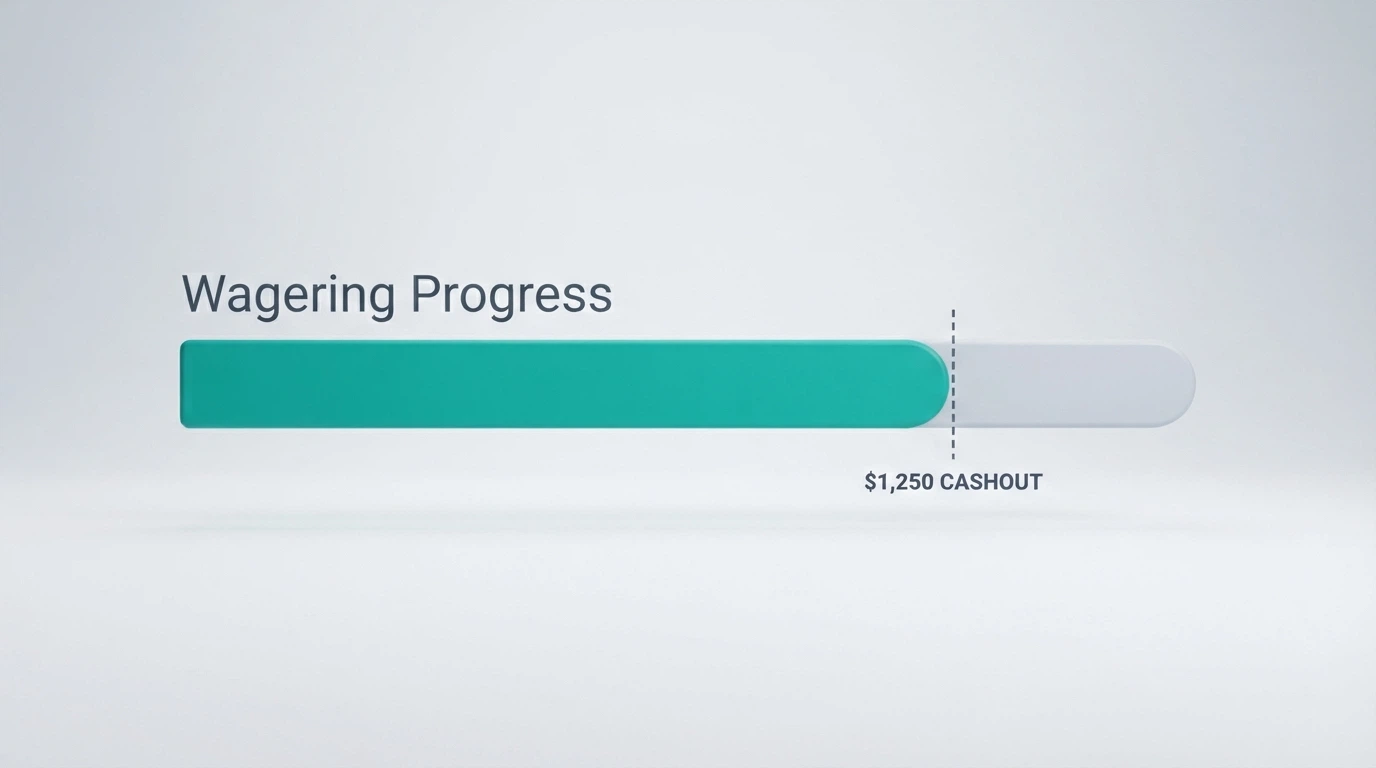
Wagering is the gate every bonus must clear. The numbers cluster around 30× to 50×, with 40× the most common and 50× the harder end. Some offers drop to 25×; some climb past 60×. The range reflects operator risk appetite — a 25× offer is generous and rare; a 60× offer is harsh and signals an operator expecting most players to forfeit before clearing.
Cashout caps limit any win regardless of the balance shown. The player may have A$400 in their account after a lucky run, but if the cap is A$100 the operator pays A$100 and reclaims the rest. The cap applies to the winnings derived from the bonus, not to deposits the player may have made subsequently.
The “real money” label is the marketing gloss on this structure. It tells the player what is on offer if everything goes right. It does not tell the player the probability of reaching that state, the cost of trying, or the limit on what they can take if they do.
Free-Play vs Real-Money No-Deposit: What the Label Actually Means
Both labels — “free play” and “real money” — describe the same restricted bonus credit at an offshore casino. Neither is a regulatory category. Neither is defined in the Interactive Gambling Act 2001 or any state-level gambling code, because both describe a product that the IGA prohibits Australian-licensed operators from offering.
The only operational difference is intent. A “free play” offer is usually structured so the player cannot withdraw at all — winnings convert to bonus credit that itself carries a wagering requirement. A “real money” offer lets the player withdraw after clearing the wagering, subject to the cap. In practice the labels blur: many “real money” offers contain the same effective multiplier and cap structure as a “free play” promotion with extra steps.
For an Australian player the practical reading is identical. The label tells the player the path; the terms tell the player the distance. Treat both as marketing English and read the small print before claiming either.
Wagering and Cash-Out Mechanics on Real-Money No-Deposit Offers
The mechanics are uniform across the market. A wagering multiple between 30× and 50× sits on top of either the bonus amount (cash offers) or the spin-derived winnings (spin packs). Game contribution rates weight pokies at 100% and table games at 10% or less. The max-cashout cap sits between A$50 and A$200 across the offers research has surfaced. The max-bet rule caps individual wagers at A$5 during wagering, with violations voiding winnings.
What varies is the generosity of each component. A A$20 bonus at 30× with a A$100 cap is a better offer than a A$50 bonus at 50× with a A$50 cap, even though the headline figures favour the second. Comparing offers means weighing every term against every other term. The section that ranks the operators does this for the ten brands on this page.
No-Deposit Casino Bonuses Australians Can Claim: 10 Offshore Operators Compared
Ten offshore operators appear across the Australian no-deposit search results in any given month. The table below lists them by market presence among AU-traffic operators; the offers themselves range from confirmed specifics to active listings without confirmed terms. What unites every brand on the list is the licence — all ten run under Curaçao, none holds an Australian licence, and the ACMA can block any of them without notice.
| Operator | Licence | AU Market Share | Wagering on No-Deposit |
|---|---|---|---|
| Rocket Play | Curaçao (offshore) | 9.40% | 40× (expired offer) |
| Skycrown | Curaçao (offshore) | 8.55% | 40× |
| Bitstarz | Curaçao (offshore) | — | 40× |
| FairGO | Curaçao (offshore) | 0.80% | — |
| WinSpirit | Curaçao (offshore) | 1.55% | — |
| Bizzo Casino | Curaçao (offshore) | 0.57% | — |
| Royal Reels | Curaçao (offshore) | 2.51% | — |
| Stake | Curaçao (offshore) | 1.28% | — |
| Rocket Casino | Curaçao (offshore) | 0.57% | — |
| JeetCity | Curaçao (offshore) | — | 40× |
Bitstarz and JeetCity carry no AU market share in the operators ranking — they appear in AU no-deposit search results without breaking the top-20 AU-traffic bracket. FairGO, WinSpirit, Bizzo, Royal Reels, Stake and Rocket Casino all carry no confirmed wagering figure for their no-deposit offer in this round of research. The blanks are honest gaps, not implied values.
Rocket Play
Rocket Play sits third in the AU operators ranking by traffic, with 9.40% AU market share and A$632.69M in tracked revenue — the largest of the featured set. Its no-deposit offer was 20 free spins on Book of Pyramids at 40× wagering on winnings with a A$85 (50 EUR) maximum cashout, but that offer had expired by the search date. A reader visiting the brand today may find a different no-deposit promotion, a sign-up bonus that requires a deposit, or nothing at all on the no-deposit front.
The current welcome package tells the reader what the brand’s structure looks like: 100% up to A$1,000 plus 100 free spins on the first deposit, minimum A$30, 40× wagering on the bonus amount. The 100 free spins credit in batches of 20 per day for five days on Aztec Magic, a BGaming title. The max bet while wagering is A$7.50 — slightly higher than the A$5 norm at competing brands. BGaming and Pragmatic Play anchor the provider roster.
Verdict: largest AU market share in the featured set, with a no-deposit offer that has lapsed. A deposit-funded player gets a generous welcome package and a higher-than-average bet cap while clearing it. Anyone weighing Rocket Play on the no-deposit side alone will need to confirm what the brand is offering today before signing up.
Skycrown
Skycrown runs fourth with 8.55% AU market share and A$436.07M in tracked revenue. Its no-deposit offer is 100 free spins — credited after mobile verification, at 40× wagering on winnings with a A$150 maximum cashout. The A$150 cap is at the upper end of what Australian-targeted offers currently list, behind only JeetCity’s A$200 ceiling.
The welcome package is one of the larger structures in the featured set: up to A$4,000 plus 350 free spins across multiple deposits, with daily and weekly tournaments plus cashback and rakeback on the side. The mobile-verification gate on the no-deposit spins — requiring a phone-confirmed account before credit — is worth knowing about before signing up.
Verdict: high cap, generous welcome, meaningful AU traffic share. A player who qualifies for the mobile-verification credit and has the bankroll to chase the A$150 cap gets the strongest documented ceiling in the set after JeetCity.
Bitstarz
Bitstarz does not appear in the Australian operators top-20 by market share, but it surfaces repeatedly in Australian no-deposit search results. The confirmed no-deposit offer is 100 free spins at A$0.20 per spin, 40× wagering on winnings, A$100 max cashout, 24-hour validity, A$5 max bet during wagering, on a Curaçao licence.
The 24-hour window is the tightest validity in the featured set. A player who claims the offer needs to clear 40× the spin-derived winnings inside one day, against a clock that started the moment the credit hit the account. The 100 spin count at A$0.20 gives the offer A$20 of nominal face value — meaningful only as a starting point for the wagering target.
Verdict: prominent in AU no-deposit search despite a small AU-traffic footprint. The 24-hour validity is a real constraint — the offer rewards a player who signs up ready to play.
JeetCity
JeetCity also sits outside the AU operators top-20 but carries the most detailed no-deposit terms in the search archive. The offer is 20 to 50 free spins at A$0.10 to A$0.20 per spin, 40× wagering on winnings, A$100 to A$200 maximum cashout, 24 to 72 hours spin expiry, and a 7 to 30 day wagering window. Curaçao licence.
The 7 to 30 day wagering window is the longest in the featured set — a meaningful difference from the 24-hour Bitstarz clock or the 72-hour Slots Gallery window. A player who needs time to clear a bonus has more room here than anywhere else on the list. The A$200 cap, when it lands at the top of the range, is the highest documented ceiling for any no-deposit offer on this page.
Verdict: best documented offer terms on the list, longest wagering window, highest cashout cap. Reach it through search rather than market share.
FairGO
FairGO sits sixteenth in the AU operators ranking with 0.80% market share and A$69.11M in tracked revenue. Its no-deposit offer appears in Australian search results as active, but the specific terms — spin count, wagering multiple, max cashout — were not confirmed in this round of research. The brand runs on RealTime Gaming (RTG) software, which makes it one of the few AU-focused operators built on a single US-AU-favoured provider rather than a multi-provider European roster. Curaçao licence.
Verdict: AU-facing brand with a recognisable RTG backbone, but the no-deposit offer’s specifics are not documented. A player considering FairGO needs to read the offer page directly before claiming.
WinSpirit
WinSpirit ranks eleventh with 1.55% AU market share and A$110.3M in tracked revenue. The headline deposit offer is a 200% welcome bonus plus 25 free spins, with ongoing cashback and reload promotions. The no-deposit offer appears in Australian search results as active; its specific terms were not confirmed in this round of research. Industry-standard 40× wagering is implied across the welcome package. Curaçao licence.
Verdict: a 200% welcome match is among the more generous headline figures on the list. The no-deposit offer’s terms need confirming at the source.
Bizzo Casino
Bizzo sits nineteenth in the AU operators ranking with 0.57% market share and A$51.38M in tracked revenue. A no-deposit offer appears in Australian search results; the specific terms were not confirmed this round. Curaçao licence.
Verdict: small AU market presence, no documented no-deposit specifics. A reader who sees the brand in search results needs to verify the offer terms before claiming.
Royal Reels
Royal Reels runs ninth in the AU operators ranking with 2.51% market share and A$243.99M in tracked revenue — the second-largest operator in the featured set by revenue. A no-deposit offer appears in Australian search results; the specific terms were not confirmed this round. Curaçao licence.
Verdict: top-decile AU revenue but no confirmed no-deposit specifics. A reader weighing Royal Reels against smaller brands has the size on its side and the offer terms still to check.
Stake
Stake ranks twelfth with 1.28% AU market share and A$115.67M in tracked revenue. The brand is known for a proprietary platform and a wide game roster including Stake’s own titles. A no-deposit offer appears in Australian search results as active; the specific terms were not confirmed this round. Curaçao licence.
Verdict: recognisable brand with a proprietary platform. The no-deposit specifics remain unconfirmed; a reader curious about Stake needs to read the offer page directly.
Rocket Casino
Rocket Casino ranks twentieth with 0.57% market share and A$43.22M in tracked revenue. It is a separate operator from Rocket Play despite the similar name — a confusion worth flagging because search results sometimes mix the two. While this brand appears in search results, its no-deposit offer terms remain unconfirmed. Curaçao licence.
Verdict: smallest of the featured set and easy to confuse with Rocket Play. Confirm the offer terms and the operator name at the source before depositing or claiming.
Australian No-Deposit Casino Offers: Why Every One Leads Offshore
Every brand on the previous table runs under a Curaçao licence. None holds an Australian one. That is not an accident of selection — it is the structure of the market. The Interactive Gambling Act 2001 prohibits the provision of online casino games, online pokies and in-play betting to people in Australia. There is no licence for online casino anywhere in the country, at any level of government. The familiar high-street wagering brands — the ones that run TAB retail outlets and televised racing coverage — hold sports and racing licences, not casino licences.
A Curaçao licence is a real regulatory instrument. The Curaçao Gaming Control Board issues the licence, runs a complaint process, and can revoke the licence if the operator misbehaves. What it does not do is authorise the operator to target Australia as a domestic market. A landing page screaming “legal Aussie no deposit codes” is using marketing English, not a High Court summary. The product is prohibited under Australian law; the licence is foreign; the operator accepts Australian players at its own legal risk.
The difference matters in three places. First, no Australian consumer protection applies. The Australian Competition and Consumer Commission has no jurisdiction over a Curaçao-licensed operator serving Australians; the operator’s own dispute process is the only one available. Second, BetStop does not reach the offshore casino. A self-excluded Australian can still deposit and play at every brand on this list. Third, ACMA can block the site at any time. Since November 2019, the regulator has had 1,564 illegal gambling and affiliate websites blocked at the DNS level, with more than 225 services withdrawing from the Australian market since 2017. A player with a balance on a blocked site has no Australian recourse to recover it.
The Northern Territory Racing and Wagering Commission, administered through Licensing NT, is the de facto national licensor for online wagering — but the licence it issues is for wagering, not casino games. The NT regime was reformed in 2026 after criticism of the regulator’s structure, but the casino prohibition remains absolute.
AU No-Deposit Casinos: The Offshore Brands Australians Actually Use
The operators that appear when an Australian searches for a no-deposit bonus are the operators reaching Australian players with the most efficient search and affiliate spend. The market-share figures in the table above — drawn from the operators skill AU ranking — measure the traffic these brands attract from Australian IP addresses, not their legality.
Rocket Play at A$632.69M, Skycrown at A$436.07M and Royal Reels at A$243.99M sit at the top of the featured set by AU-tracked revenue. Bitstarz and JeetCity, with no top-20 AU ranking, still surface in Australian no-deposit search results often enough to warrant inclusion. The lesson is that traffic volume and offer availability are not the same thing; a brand does not need AU market dominance to surface in AU no-deposit results.
How these brands reach Australian players despite the prohibition is the question every affiliate page dances around. The IGA targets the provider, not the player; ACMA enforcement works through ISP blocking, civil penalties and referral to international regulators; the operator runs an offshore website that accepts Australian sign-ups as a calculated business risk. The player carries the convenience risk and the payment-method risk, not the legal one.
New AU No-Deposit Offers and Sign-Up Bonuses: What Is Arriving in 2026
The offers listed on affiliate pages in 2026 move faster than any single page can capture. Rocket Play’s 20 free spins on Book of Pyramids expired by the search date. Slots Gallery’s 20 spins on Zeus the Thunderer with 30× wagering, a A$150 cap, A$5 max bet and 72-hour validity was active. JeetCity’s 20 to 50 spin tier was active. Bitstarz’s 100 spins was active. What was current two weeks before the search may have changed by the time the reader reaches the offer page.
The distinction between a sign-up no-deposit bonus and an ongoing reload offer matters because the two carry different mechanics. A sign-up no-deposit bonus is a one-time credit on first account creation — claim it once, never again. An ongoing reload offer is a periodic credit for existing players — claim it weekly or monthly at the operator’s discretion. The reload carries the same wagering mechanics but arrives without the initial signup hook.
For 2026 specifically, the offers surfacing most often in Australian search results are the spin packs at A$0.10 to A$0.20 with 40× wagering, A$100 to A$150 caps, and 24 to 72 hour validity windows. Cash bonuses in the A$20 to A$50 range remain rarer than spin packs but appear at JeetCity and a handful of other brands. The reader who wants current specifics needs to check the offer page directly; what this page carries is the shape of the market, not a real-time list.
The Pokies That Actually Pay: RTP and Volatility for No-Deposit Spins
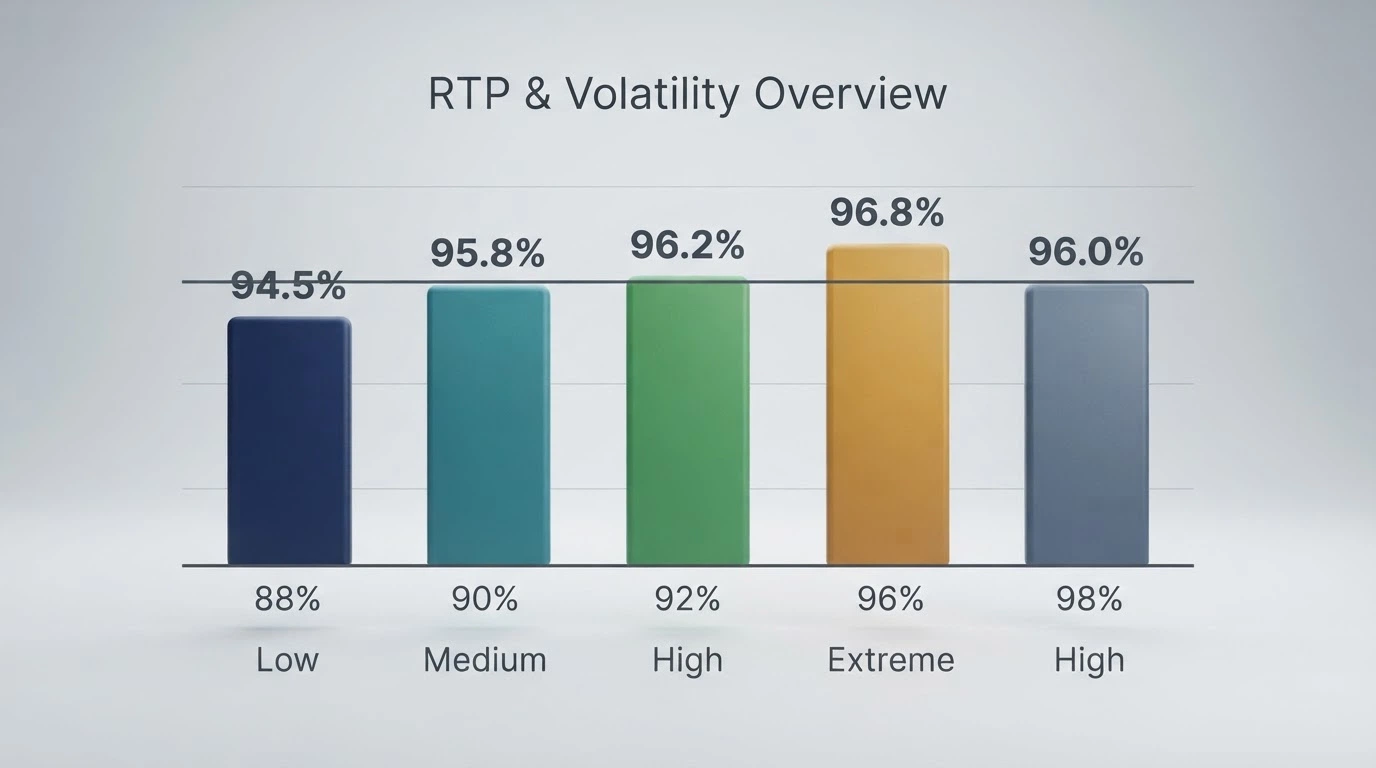
A free spin is only worth as much as the pokie it lands on. RTP — return to player — is the percentage of wagered money a game returns over a long horizon. Volatility is the shape of that return: low volatility pays small amounts often, high volatility pays large amounts rarely. Both matter when a wagering requirement sits between the bonus credit and the cashout.
| Pokie Title | RTP | Volatility | Provider | Max Win |
|---|---|---|---|---|
| Starburst | 96.09% | Low | NetEnt | 500× |
| Gates of Olympus | 96.5% | High | Pragmatic Play | 5,000× |
| Dead or Alive 2 | 96.82% | Extreme | NetEnt | 111,111× |
| Sweet Bonanza | 96.49% | High | Pragmatic Play | 21,175× |
| Gems Bonanza | 96.51% | High | Pragmatic Play | 10,000× |
| Break Da Bank Again | 95.43% | — | Microgaming | — |
| Wolf Gold | 96.01% | Medium | Pragmatic Play | Progressive |
| Mega Moolah | 88.12% | High | Microgaming | Progressive |
The table covers the titles most often tied to no-deposit free-spin offers in Australian search results. Starburst and Dead or Alive 2 anchor the NetEnt offering. Gates of Olympus, Sweet Bonanza, Gems Bonanza and Wolf Gold are Pragmatic Play titles. Break Da Bank Again and Mega Moolah are Microgaming’s contributions. Break Da Bank Again’s volatility rating was not confirmed in this round of research; the provider and RTP are enough to characterise the title.
RTP matters when every spin counts toward a wagering target. A 96% pokie returns A$96 of every A$100 wagered, on average, over a long session. A 95% pokie returns A$95. Across an A$800 playthrough the difference is A$8 in expected loss — not enormous, but compounded across an offer that costs A$32 in expected loss, it shifts the math meaningfully. A 94% pokie under the same terms costs A$48, closing on half the cashout cap.
Volatility changes the experience more than the math. A low-volatility pokie like Starburst pays small amounts frequently, producing a smooth ride toward the wagering target. A high-volatility pokie like Dead or Alive 2 may produce nothing for hundreds of spins and then pay 1,000× stake in a single hit. The player on a wagering target needs the pokie to produce returns regularly enough that the balance does not collapse before the requirement is cleared; the player chasing the max win needs the high-volatility tail. These two goals do not always sit on the same game.
The max-win column shows how far a single spin can stretch. Dead or Alive 2 at 111,111× is an outlier. Sweet Bonanza at 21,175× and Gates of Olympus at 5,000× are closer to the high-volatility norm. Starburst’s 500× is a low-volatility ceiling. Mega Moolah’s progressive jackpot is uncapped in dollar terms but paid out through a separate jackpot pool that the wagering requirement does not always credit against.
Pragmatic Play titles commonly ship at around 96% RTP, though operators can run lower configurations in the 94–96% range. A player who wants the figure on this page to hold at the casino needs to check the game’s information panel — the RTP shown there may differ from the developer’s default.
Online Pokies With No-Deposit Free Spins: Which Titles You Will Actually Play
The pokies most commonly tied to no-deposit free-spin offers are Book of Pyramids (BGaming, tied to Rocket Play’s expired offer), Zeus the Thunderer (tied to Slots Gallery’s 20-spin offer), and Aztec Magic (BGaming, tied to Rocket Play’s welcome free spins on first deposit). These are not the high-RTP NetEnt and Pragmatic Play titles in the table above; they are BGaming-developed games that the operators source for the free-spin mechanic specifically.
Why the pokie matters more than the spin count comes down to the wagering requirement. A 100-spin pack at A$0.20 on a 96% pokie with 40× wagering on winnings is a different proposition from the same pack on a 94% pokie. The first returns A$19.20 of every A$20 wagered on average; the second returns A$18.80. Across the wagering target the difference compounds.
Game eligibility also constrains the player. A no-deposit bonus that names Book of Pyramids as the eligible title cannot be played on Starburst or Gates of Olympus — the operator restricts the bonus to the named game(s) so that the wagering requirement clears under predictable conditions. A bonus cash offer is more flexible; the eligible-games list determines where the playthrough can happen, and pokies contribute 100% while table games contribute 10% or less.
Free vs Real-Money Pokies: What Changes When a No-Deposit Bonus Is on the Line
A demo spin and a bonus-funded spin look identical to the player. The reels do not know whether the credit behind them is real. The math does, though.
Demo play uses fictitious credit. The player can spin forever and the balance never runs out. Bonus-funded play uses restricted credit that disappears if the wagering requirement is not cleared inside the validity window. A player who treats the bonus credit as a free sample is not playing the same game as a player who treats it as a finite bankroll with a turnover target.
Max-bet rules change every decision during wagering. With a A$5 cap per spin, the player cannot chase a losing streak with a doubling strategy. The bet is fixed at the cap, the wagering requirement ticks down at the contribution rate, and the player’s only real decision is which pokie to use. The cap exists because a single oversized bet could complete the wagering in one spin and pay out a capped amount — profitable for the player, unprofitable for the operator.
RTP configuration is the third change. A pokie’s published RTP — say, 96.09% for Starburst — is the developer’s default. An operator can run the game at a lower configuration (94% or 95%), and the difference shows up only in the game’s information panel. A player who claims a no-deposit bonus and clears the wagering at a 94% pokie has paid more in expected loss than the player who cleared the same bonus at a 96% pokie. The bonus headline does not change; the math does.
Leading Providers: Pragmatic Play, NetEnt, Microgaming and RTG No-Deposit Pokies
Four providers dominate the pokies tied to no-deposit offers in Australian search results. Pragmatic Play ships titles at around 96% RTP with operator-configurable variants in the 94–96% range. Gates of Olympus, Sweet Bonanza, Gems Bonanza and Wolf Gold are its most common no-deposit appearances, and all four sit in the high-to-extreme volatility bracket. A player choosing a Pragmatic Play pokie for wagering is choosing a high-variance path with a 5,000× to 21,175× max win ceiling.
NetEnt anchors the low-and-extreme ends of the spectrum. Starburst at 96.09% RTP and low volatility is the smooth, frequent-return pokie a player on a tight wagering target wants. Dead or Alive 2 at 96.82% RTP and extreme volatility is the moon-shot pokie — 111,111× max win, almost no hits in between. The two together cover the player who wants predictability and the player who wants the rare win.
Microgaming contributes two of the older titles in the market. Break Da Bank Again at 95.43% RTP is the medium-variance classic. Mega Moolah at 88.12% RTP is the progressive jackpot — the lowest RTP on this list, because a portion of every wager funds the jackpot pool that pays out rarely but at millions. A player chasing the Mega Moolah jackpot is paying A$11.88 of every A$100 wagered for the chance at a multi-million-dollar hit; the no-deposit bonus math under that RTP is brutal, but the jackpot itself sits outside the wagering requirement in most configurations.
RealTime Gaming (RTG) is the fourth pillar, and it is the backbone of AU-focused brands like FairGO. RTG titles carry their own RTP norms and a US-AU-oriented flavour that distinguishes them from the European-developed NetEnt and Pragmatic Play rosters. A player who prefers FairGO for its RTG catalogue is choosing a specific game experience, not just a brand.
New Casinos With No-Deposit Bonuses
A “new casino” in the offshore AU market is a brand that has launched within the past twelve to twenty-four months. The mechanics are the same as at every other offshore brand — Curaçao licence, bonus credit, wagering requirement, cashout cap — but the player-acquisition playbook runs harder. A new brand cannot rely on search ranking or repeat players; it needs a hook. A no-deposit bonus is the cheapest hook in the toolkit: a small credit that puts a real-money game in front of a player who has not committed a cent.
The legal position is unchanged. The brand is still offshore; the player is still outside Australian consumer protection; BetStop still does not reach the casino; ACMA can still block the site. What changes is the operator’s risk appetite — a new brand may offer a more generous bonus than an established competitor because it needs the player more. It may also be the brand that disappears in twelve months, taking the player’s balance with it.
For a player evaluating a new-casino no-deposit offer, the practical read is the same as for an established brand: confirm the licence, read the wagering terms, check the cashout cap, and note the expiry window. The brand’s age changes the operator’s incentive structure; it does not change the offer’s mechanics.
No-Deposit Bonus Codes
A bonus code is a string of characters the player enters at signup or cashier to trigger the offer. It is a key, not the offer itself. The offer — credit amount, wagering requirement, cashout cap, validity — sits on the operator’s promotion page; the code unlocks it for the player who knows where to type it.
Historically, no-deposit bonuses required a code published on an affiliate page, an email drop, or the casino’s own promo banner. The current Australian-targeted market has shifted toward auto-credited offers — the bonus lands in the account on signup or verification, no code required. Where codes still appear, they are usually published on affiliate listicles, in casino promo sections, or in email campaigns targeted at returning players.
For a player looking for a code, the practical advice is to treat the affiliate listicle as a starting point and the casino’s own terms page as the final word. Affiliate pages rotate offers as fast as the operators do; the code on a page from two weeks ago may no longer work. The casino’s terms page carries the offer the player will actually receive when they sign up.
Codes carry no working value to print here. They rotate faster than any article can keep up with, and a printed code that has expired by the time a reader reaches it is worse than no code at all. The structural information — how codes work, where they appear, why auto-credit is taking over — is what stays useful across the months.
Getting Paid: Why Your Withdrawal Method Matters More Than the Bonus
A no-deposit bonus win is real money only if the player can get it out of the casino. The method of withdrawal decides the speed, the cost, the maximum amount and whether the money arrives at all. For an Australian player at an offshore casino, the choice of payment rail is more important than the choice of bonus.

Five payment categories dominate the offshore AU landscape. PayID and Osko run through the Australian banking system and clear in minutes for in-network transfers; whether an offshore casino sends money back through them depends on the operator’s payment processor. E-wallets (Skrill, Neteller, ecoPayz, MiFinity) sit outside Australian banking rails and offer faster payouts but with their own fees and currency conversion. Crypto (Bitcoin, Ethereum, USDT) routes around banking entirely but is banned as a payment method for licensed Australian wagering from 11 June 2024 — an offshore casino accepting crypto from an Australian is operating outside the Australian rules, and the payment method itself is a signal of offshore status. Bank transfer is the slow fallback — three to seven business days, often with fees at both ends. Prepaid vouchers (Neosurf, Paysafecard) work for deposits but rarely for withdrawals.
For licensed Australian wagering, credit cards, credit-related products and crypto are banned as payment methods from 11 June 2024. Operators failing to enforce the ban face penalties of up to A$247,500 per breach. The legal deposit routes for licensed wagering are debit card, bank transfer, PayID/Osko and BPAY. An offshore casino is not bound by these rules — the ban targets licensed operators, not foreign ones — but the same payment methods are signals of where the operator sits in the regulatory landscape.
From 1 January 2027, banks and payment providers gain express authority to block transactions to illegal gambling operators. A withdrawal from an offshore casino that routes through an Australian bank account may be declined at the bank’s discretion. The reform does not target withdrawals specifically; it targets deposits and bets to illegal operators. But the line between deposit and withdrawal at a payment-processor level is often blurry, and a casino flagged by an Australian bank may find both directions harder.
PayID Deposits at No-Deposit Bonus Casinos
PayID is an Australian banking rail that links a phone number or email address to a bank account. Transfers clear in seconds between participating banks, with no fee. The legal status for licensed AU wagering is settled: PayID is a permitted deposit route, alongside debit card, bank transfer and BPAY.
At an offshore casino the picture is less clean. PayID availability depends on the operator’s payment processor — the casino needs an Australian bank account or an Australian payment intermediary to receive PayID transfers. Some offshore operators offer PayID for deposits; others route through it for withdrawals only; many skip it entirely. A player who wants PayID needs to check the cashier page before signing up.
The gap between depositing via PayID and withdrawing via the same method is the practical point. Most offshore casinos that accept PayID for deposits pay winnings through a different rail — bank transfer, e-wallet, or crypto. The Australian player depositing in seconds through PayID may wait three to seven business days for a bank-transfer withdrawal, with no recourse to PayID’s speed on the way out.
Crypto and E-Wallet No-Deposit Casinos
Crypto deposits and withdrawals sit outside the Australian banking system entirely. An offshore casino accepting Bitcoin from an Australian is operating outside the Australian rules — the credit card and crypto ban that took effect on 11 June 2024 targets licensed wagering, but the spirit of the ban extends to any operator accepting Australian customers via a banned rail. A reader who values the regulatory perimeter should treat crypto acceptance as a signal of offshore status rather than a feature.
E-wallets sit between crypto and traditional banking. Skrill, Neteller and MiFinity are accepted at most offshore casinos; payouts clear faster than bank transfer, usually within 24 hours. The cost is the e-wallet’s own fees — typically 1–2% on top of currency conversion — and the requirement to verify identity with the e-wallet before the first withdrawal.
The trade-off is speed versus protection. Crypto and e-wallets pay out faster than any bank transfer. They also sit outside every Australian consumer-protection mechanism — no AFCA, no eSafety Commissioner, no ACMA complaint process applies to a transaction that never touched Australian rails. A player who values speed accepts that risk; a player who values protection stays on bank transfer and PayID where they are available.
The Law Nobody Talks About: Offshore Casinos and Australian Players
The Interactive Gambling Act 2001 makes it an offence to provide online casino games, online pokies and in-play betting to a person physically in Australia. The Act was strengthened in 2017 to give the ACMA enforcement and blocking powers, and again in 2023 with the credit card and crypto ban. There is no licence for online casino anywhere in the country.
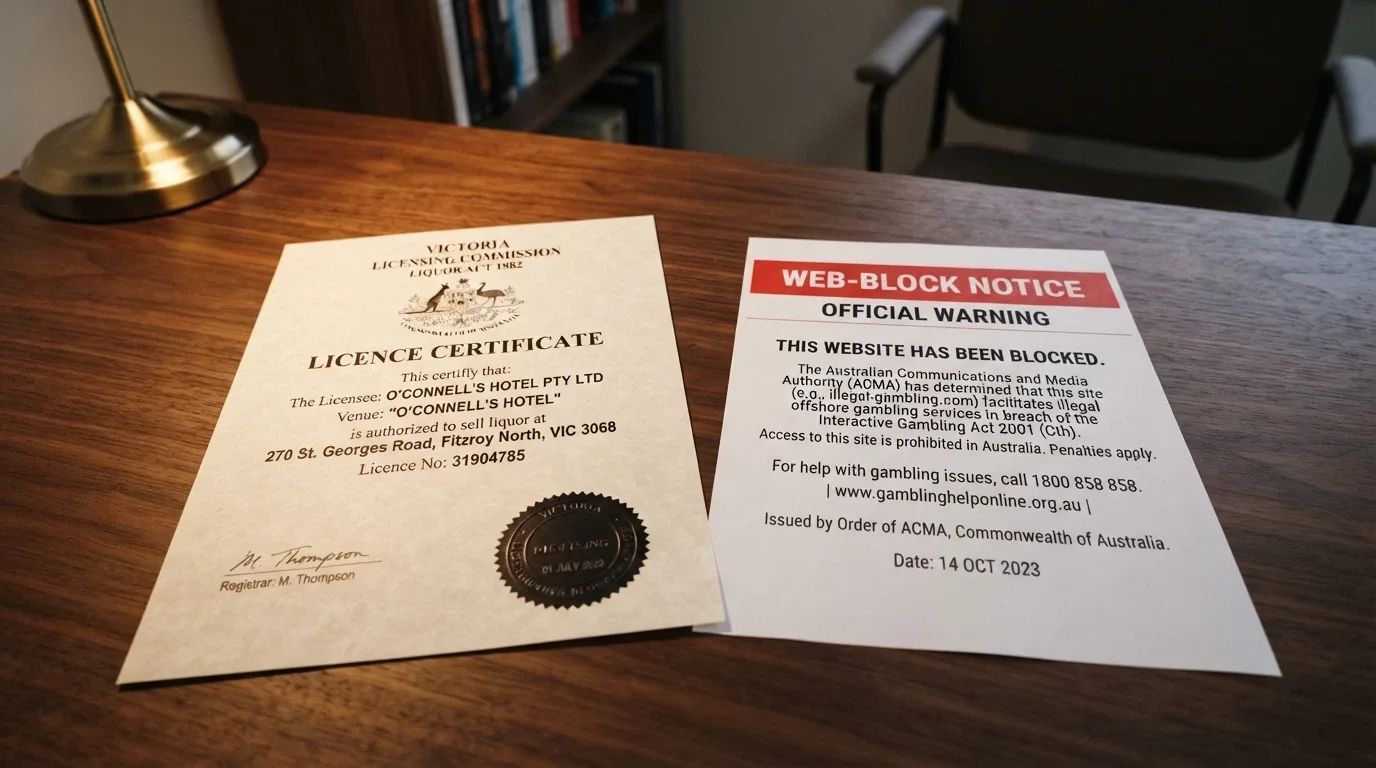
ACMA’s enforcement runs through three mechanisms. Civil penalty proceedings against operators, with potential penalties running into the millions. Formal directions to ISPs to block illegal sites at the DNS level — 1,564 sites blocked since November 2019, with more than 225 services withdrawing from the Australian market since 2017. Referral to international regulators for action in jurisdictions where the operator holds a licence.
The individual player is not prosecuted. Section 15 of the IGA targets the provider of the prohibited service. An Australian who signs up at an offshore casino, deposits, plays and withdraws is not committing an offence under the Act. What the player is doing is using a product the Act prohibits from being offered to them — and the consequences of that flow not from criminal liability but from the absence of the protections an Australian licence would bring.
A Curaçao licence is a real regulatory instrument. It comes with a complaint process, a dispute resolution mechanism, and the genuine possibility of licence revocation. It is not, however, an Australian licence. The difference matters because no Australian consumer protection applies: no Australian Competition and Consumer Commission action, no Australian Financial Complaints Authority dispute, no Office of the Australian Information Commissioner privacy oversight. The player at an offshore casino is using a foreign-licensed product on the operator’s terms, with the operator’s dispute process as the only recourse.
No-KYC Casinos: Playing Without Identity Verification
A no-KYC casino is one that does not require the player to submit identity documents — passport, driver’s licence, proof of address — before depositing or withdrawing. The pitch is anonymity: the player signs up with an email and a password, plays, withdraws, and never shares personal information with the operator.
The trade-off is everything that anonymity costs. A no-KYC casino does not connect to BetStop. A self-excluded Australian can deposit and play without restriction. The casino does not answer to ACMA — the regulator cannot engage with an operator it cannot identify. The casino does not offer Australian consumer recourse — there is no domestic regulator to appeal to, no local complaints body, no AFCA jurisdiction. And the casino can be blocked at the DNS level while holding a player balance; without KYC, the operator may not even be able to verify who the balance belongs to in order to refund it.
For a player who values anonymity above all else, a no-KYC casino delivers what it promises. For a player who values the protections an Australian licence would bring — and the offshore licence is the closest substitute — a no-KYC casino sits entirely outside that perimeter. The brand may be well-run; the legal scaffolding around it is thinner than at any KYC-compliant offshore operator.
The 2026 Reform: What the Gambling Amendment Means for Offshore Bonus Claims
Parliament passed the Interactive Gambling Amendment (Gambling Reform) Bill 2026 on 19 August 2026, and its measures commence on 1 January 2027. The reform changes the landscape for every Australian player claiming an offshore bonus.
The advertising caps take effect first. Wagering advertising on licensed platforms is limited to three ads per hour between 6:00 am and 8:30 pm. A live-sport blackout runs from 15 minutes before a live event until 5 minutes after it ends. Athletes, celebrities and influencers are barred from promoting wagering products. Wagering advertising in sports venues and on player or official uniforms is banned. Online wagering ads can only target logged-in 18+ users with an opt-out. None of these caps reach the offshore casino — the reform targets licensed wagering advertising in Australia — but the marketing pressure on Australian-facing brands is real.
The inducement prohibitions change the post-signup marketing window. Direct marketing of inducements is prohibited for 14 days after a customer signs up with a licensed operator and for three months after a person deregisters from BetStop. An at-risk customer cannot be marketed to indefinitely. The intent is to dampen the chase that follows a self-excluded person back into wagering. Offshore casinos are not bound by these prohibitions, but the licensed operators they compete with for Australian players will be.
The AdStop register is the consumer-facing piece. Administered by ACMA and funded by a cost-recovery levy on wagering companies, AdStop is a single opt-out mechanism for wagering advertising across online platforms. A player who registers with AdStop should see fewer wagering ads in their social media, search results and general browsing. Offshore casino ads sit outside AdStop’s reach.
The bank blocking powers are the change that most directly affects offshore bonus claims. From 1 January 2027, banks and payment providers gain express authority to block transactions to illegal gambling operators. An Australian bank account sending money to an offshore casino may be declined at the bank’s discretion. The reform targets deposits and bets; withdrawals sit in a greyer area, but a casino flagged by Australian banks may find both directions harder to process.
Online keno and foreign-matched lotteries are banned under the reform. The “pocket pokies” keno product and the offshore lotteries that accept Australian players are out. This is the most direct extension of the prohibition since the original 2001 Act.
Staying in Control: Responsible Gambling When Using No-Deposit Bonuses
A no-deposit bonus removes the upfront cost of trying an offshore casino. It does not remove the behaviour patterns that lead to harm, and the tools that protect a player at a licensed Australian bookmaker do not reach an offshore casino.

The National Gambling Helpline is 1800 858 858 — free, confidential, staffed 24 hours a day, with online chat and counselling through Gambling Help Online at gamblinghelponline.org.au. The helpline is the front line for a player who feels their play is no longer under control, regardless of where they play. The minimum age for all commercial gambling in Australia is 18.
BetStop — the National Self-Exclusion Register — has recorded 67,480 registrations since going live in August 2023, with 41,290 exclusions still active as at 31 July 2026. One registration excludes a person from every Australian-licensed online and phone wagering service. 78% of registrants were under 40; 38% chose lifetime exclusion.
BetStop does not bind offshore casinos. The exclusion is enforced at the licensed operator; an offshore casino is not connected to the register and will continue accepting a self-excluded person’s money. This is the most concrete harm of the offshore route for someone trying to stop.
About 2.1% of Australian adults — roughly 430,000 people — experience problem gambling. The Australian Institute of Health and Welfare put high-risk gambling at 1.8% in 2022. The numbers describe a population, not an individual; a player who feels their play is escalating is one of them, and the helpline is the first call.
For a player at an offshore casino, the responsible-gambling infrastructure has to be self-imposed. The platform does not offer deposit limits as a default; the player has to set them. The platform does not connect to BetStop; the player has to track their own play across brands. The platform does not enforce a cooling-off period; the player has to take one. The choice is not whether to gamble — the player has already made that choice — but whether to gamble with the same safeguards an Australian-licensed bookmaker would impose by default.
How We Evaluate No-Deposit Bonus Casinos
This page’s operator ranking draws on the ACMA register for blocked-site context, the operators skill AU ranking for market share and tracked revenue, and the search archive of affiliate and editorial pages (pokiesaustralia.com, slotozilla.com, askbonus.com and others) for offer terms. Operators were checked against the official Curaçao licence registry and cross-referenced with ACMA blocking data to confirm active status.
The ranking criteria, in order of weight: market share among AU-traffic operators, indicating how much of an Australian search footprint the brand carries; relevance to the no-deposit bonus topic in AU search results, filtering to brands that surface for the specific query rather than generic casino search; depth and recency of offer terms confirmed in search data, prioritising brands with documented wagering, cashout cap and validity figures over brands whose terms could not be confirmed in the round of research; and transparency of wagering and cashout terms where available, distinguishing between brands that publish clear terms pages and brands that do not.
What this page does not do is recommend one operator over another for an Australian reader to play at. The decision belongs to the reader armed with the figures on this page. The ranking describes what each brand offers; the choice is the reader’s.
Making a No-Deposit Bonus Work: What the Numbers Actually Say
A no-deposit bonus is not free money. It is a structured offer with a calculable expected cost. The player who reads the terms before claiming it keeps what the player who skips them loses — but the player who reads the terms and still claims it is paying for the chance, not collecting the headline.
The calculation, set out earlier in this article, runs like this. A A$20 no-deposit bonus at 40× wagering requires A$800 in total bets. At a 96% RTP pokie, A$800 of turnover produces an expected loss of A$32 — A$12 more than the face value of the bonus credit. The expected cost of clearing a A$20 bonus is approximately A$32. Against a typical A$50 to A$100 cashout cap, the player needs a result well above average to come out ahead, and only the lucky minority reach the cap.
This is the structural reality every player should weigh before claiming. A 30× bonus is better than a 50× bonus. A A$100 cap is better than a A$50 cap. A 96% pokie is better than a 94% pokie. A 7-day wagering window is better than a 24-hour window. Every term on the offer page is a variable in this calculation, and the calculation is the same regardless of the brand name on the bonus.
No operator on this page is recommended over another. The decision belongs to the reader who has read the terms, done the math, and chosen an offer whose expected cost they accept. A no-deposit bonus is worth claiming when the player understands what it costs; it is worth skipping when the player does not.
Frequently Asked Questions
What happens if I win a jackpot using a no-deposit bonus?
A progressive jackpot hit while clearing a no-deposit bonus is paid subject to the offer’s max-cashout cap. Mega Moolah-style jackpots pay from a separate pool, but the winnings derived from the bonus credit may still be capped at the offer’s stated ceiling (typically A$50 to A$200). The operator’s terms page governs how the jackpot and the cap interact on that specific bonus.
How long do no-deposit bonus offers remain valid after I claim them?
Validity windows range from 24 hours at the tightest end to 7 days at the loosest, with 72 hours (three days) the most common. JeetCity runs a longer wagering window of 7 to 30 days after the spin expiry. The clock starts at credit and does not pause, so a player who has not cleared the requirement when it runs out forfeits the bonus balance and any winnings tied to it.
What is the maximum amount I can withdraw from no-deposit bonus winnings in Australia?
Typical caps sit between A$50 and A$100 across Australian-targeted offers, with A$150 appearing on Skycrown and A$100 to A$200 documented at JeetCity. Above the cap, the operator reclaims the surplus. The cap is a hard ceiling on what reaches the player, not a target the bonus is designed to deliver.
Do I need to verify my identity (KYC) to cash out no-deposit bonus winnings?
Yes — most offshore casinos require identity verification before the first withdrawal, even where signup required minimal documentation. The depth varies from a quick email confirmation to a full document upload. No-KYC casinos exist but offer no Australian consumer protection and no connection to BetStop, which makes the absence of KYC a meaningful trade-off rather than a feature.
Can I use PayID to withdraw winnings from a no-deposit bonus?
PayID availability at offshore casinos varies by operator. Some accept PayID for deposits and route withdrawals through bank transfer or e-wallet. The cashier page is the only reliable source. PayID is a permitted deposit route for licensed AU wagering, but at an offshore casino its use depends on the operator’s payment processor and may not extend to withdrawals.