
Newest Online Casinos No Deposit Bonus for Australian Players in 2026
A no-deposit bonus at the newest online casino looks like a free spin on a real-money account — and the gap between that impression and the actual mechanics is where this page spends its time. The Australian market for these offers is the offshore market, and the offer that arrives in an inbox is the same one a Curaçao-licensed operator is running for ten other countries. This guide ranks ten AU-facing casinos against published terms, walks through the wagering arithmetic that decides what an A$10 no-deposit bonus is actually worth, and lays out the protection gap every Australian player steps into when they sign up to a site the ACMA cannot reach. The listing says “newest”; the law says “illegal to provide”; the offer says “free”. The rest of the page is about which of those three is doing the most work.

Data current as of 16 October 2026 · operator terms checked against each casino’s published bonus pages and, where cited, the Curaçao Gaming Authority public register.
Table of Contents
- What “Newest Online Casinos No Deposit Bonus” Actually Means for Australian Players
- Why Your No Deposit Bonus Is Worth Less Than It Looks
- The Newest Online Pokies Worth Your Free Spins in 2026
- Getting Money In and Out of a New Casino — What Works for Australians
- Free Play vs Real Money — Where the Value Actually Sits
- The Newest AU-Facing Online Casinos — Who Has a No Deposit Offer and Who Doesn’t
- Are Online Casinos Legal in Australia? The Short Answer and the Long One
- Playing Safely — What Actually Protects You (and What Doesn’t)
- How We Selected and Ranked Every Casino on This Page
- Your Move — What to Actually Do With a No Deposit Casino Bonus
- Frequently Asked Questions
What “Newest Online Casinos No Deposit Bonus” Actually Means for Australian Players
A search for the “newest” no-deposit casino collapses two ideas that look the same on a listicle page and behave differently when a player clicks through. One is a genuinely new operator — a brand that did not exist twelve months ago, with a fresh licence and a launch promotion built around a no-deposit hook. The other is an established offshore casino rotating its bonus codes for the new quarter and being re-indexed as “new” by a bonus-aggregator site. Most of what carries the “newest” tag in Australian-facing results is the second kind. A July 2026 check across the brands most commonly named in these listings found very few operators with a confirmed Australian-eligible no-deposit offer still in market; most “new” tags trace back to either a launch from months earlier or a refreshed code on an established account.
The offshore-only reality does the rest of the framing. Online casino is prohibited in Australia under the Interactive Gambling Act 2001, which means no Australian online casino licence exists anywhere in the country and every AU-facing casino in this market is licensed in Curaçao, Kahnawake or Estonia. The “newest” descriptor is honest only at the brand level: the offer itself is the same product running at offshore brands of all ages, and the gap between a 2024 launch and a 2026 launch is the marketing date on the bonus page rather than anything the player feels in their account.
What the word “newest” actually filters out in practice is a useful question to keep in mind. Most AU-facing offshore casinos were launched between 2020 and 2024, and the ones running no-deposit offers today have usually been running them for two or three years. The genuinely new entrants are rare, the listicles recycle, and the operator that appears under “new” this week is most often the operator that appeared under “new” last month. The reader who wants a recent operator is, statistically, reading about the same handful of brands the rest of the market is reading about.
The difference between a genuinely new casino and a recycled bonus code
The honest test of “new” sits in three places, none of them visible from the listicle page. The first is the operator’s licence date, which the Curaçao Gaming Authority public register makes checkable. A brand with a licence issued within the last twelve months is genuinely new; one issued in 2020 is just running a 2026 promotion. The second is the games catalogue: a brand whose library was last updated more than six months ago is not in active launch mode. The third is the bonus terms themselves. A no-deposit offer that has not changed its wagering, max cashout or spin value across two review cycles is not a new offer — it is the same offer being relisted.
A bonus-code refresh cycle is the specific mechanism that creates false novelty. Offshore casinos rotate their bonus codes weekly or monthly for tracking purposes — each affiliate link gets its own code, each new code lets the marketing team attribute a signup. From the player’s seat, the rotation is invisible: the offer terms are unchanged, the eligible games are the same, and the only difference between code A and code B is which affiliate gets paid. The aggregator page that says “new code for 2026” is reporting a marketing event, not a player-relevant change.
What a player should check to tell a genuine new casino from a recycled code is therefore straightforward. The licence date on the public register tells the launch story. The “About” page on the operator’s own site tells the corporate story. The bonus terms tell the offer story. None of those is on the aggregator page. The bonus-aggregator listing is a useful starting point; it is not the place to stop reading.
Mobile-first or an afterthought — what a “newest mobile casino” actually delivers
The newer entrants in the offshore market do tend to lead on mobile, and the reason is generational rather than deliberate. A casino launched in 2024 or later was built with mobile usage as the default design assumption; one launched in 2018 or earlier often ships a desktop site that has been retrofitted with a responsive layout. For a player in Australia, where the majority of online session time now happens on a phone, the difference between the two is not subtle — it is the difference between an interface designed for a thumb and one that has been scaled down to fit one.
What mobile-first usually delivers in practice is faster page loads, simplified navigation, deposit and withdrawal flows that are not buried three menus deep, and live-dealer tables that play in portrait orientation rather than requiring landscape mode. The browser-based experience at a genuinely mobile-first operator is usually enough that a downloadable app adds little. At a retrofit operator, the app is sometimes where the mobile experience actually works, because the desktop-to-mobile conversion is what the app is fixing.
The reason this matters on a no-deposit page is practical. Free spins are typically claimed through a single tap on the operator’s mobile site, and a bonus that requires three navigation steps to activate is a bonus with friction a player does not need. Newer operators understand this; older ones sometimes still do not. The “newest mobile casino” descriptor on a listicle is usually a fair signal — but the test is the same as for novelty in general. The mobile experience is what you find on the operator’s site, not what the aggregator claims about it.
Why Your No Deposit Bonus Is Worth Less Than It Looks
A no-deposit bonus at an AU-facing offshore casino is not one product. It splits into three — free spins, bonus cash and free chips — and each one carries its own wagering rules, cashout cap and expected value. Across all three, the same three forces are at work: the wagering multiplier decides how much turnover the bonus forces the player to generate, the cashout cap decides how much of the resulting balance can actually be withdrawn, and the underlying game RTP decides what the house edge takes out of the turnover in between. The headline number — the A$10, the 50 spins, the A$35 chip — is what the marketing writes. The arithmetic below it is what the bonus is worth.
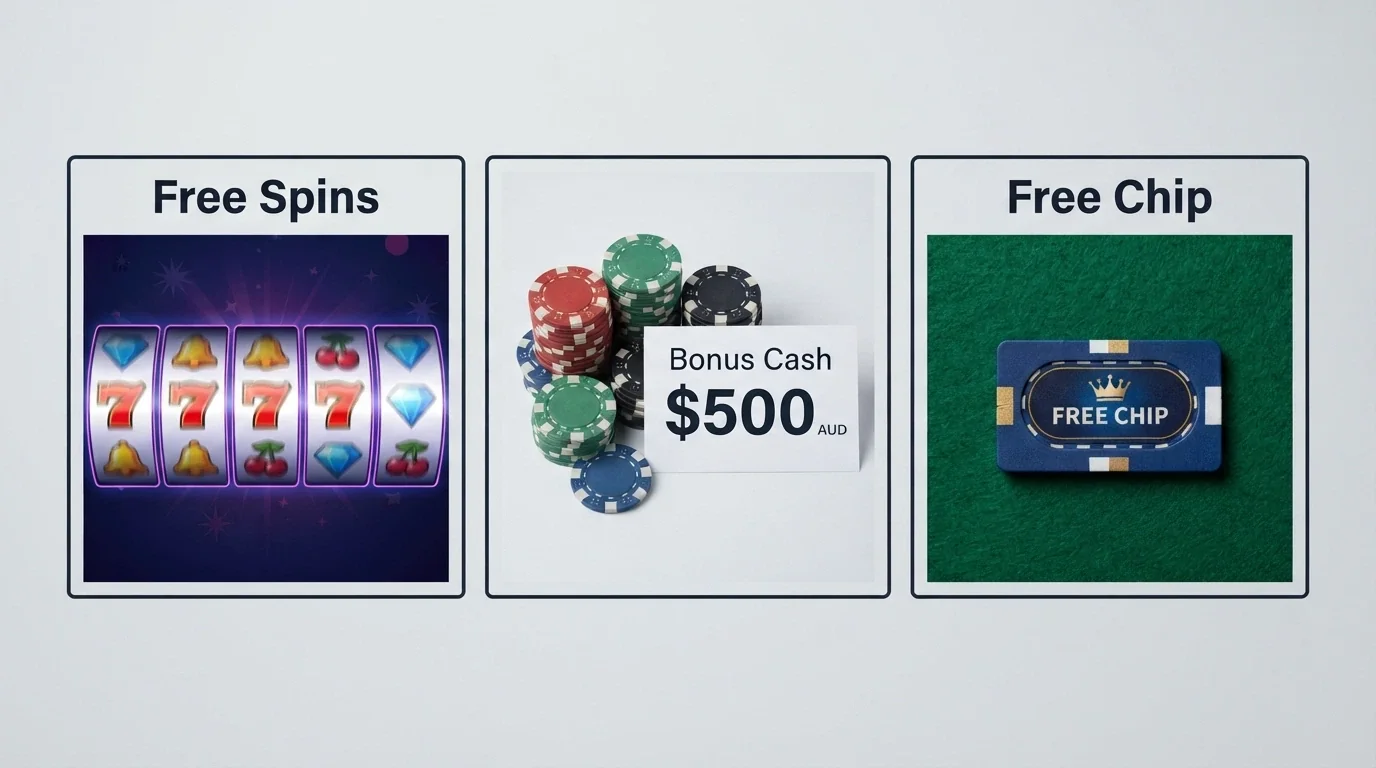
The typical no-deposit offer at an AU-facing casino in 2026 runs between A$5 and A$50 in bonus cash, or between 20 and 100 free spins. The two dials that decide what any of those offers is actually worth are the wagering multiplier (covered below) and the cashout cap (also covered below). Both move the offer’s real value by multiples of the headline number, and the marketing rarely puts them on the same line.
No deposit free spins, bonus cash and free chips — three products wearing one label
Free spins are the most common no-deposit offer at AU-facing casinos, and they are also the most misleading if you read them by count. A bonus that says “100 free spins” can be worth A$5 if the per-spin stake is A$0.05, or A$12.50 if the per-spin stake is A$0.25 — and a bonus that says “50 free spins” can be worth more than the 100-spin one. The spin count is the marketing number; the per-spin value is the real number. Players who compare free-spin offers by count rather than total stake value are usually overpaying for a smaller offer.
No-deposit bonus cash — typically A$5 to A$50 credited to a new account — is more straightforward. The wagering runs on the bonus amount itself rather than on spin returns, which means the turnover requirement scales with the face value: a A$10 bonus at 40x wagering is A$400 in required turnover; a A$50 bonus at the same 40x is A$2,000. The offer looks more generous than a free-spin bundle but the maths work the same way once the wagering is in.
Free chips are the third form and the rarest. They are typically A$10 to A$35 chips usable on live-dealer tables or table games rather than on pokies, which is the niche where the underlying house edge is highest. The wagering on a free chip usually runs on the chip’s face value, and the cashout cap applies the same way it does on cash and spins. For an Australian player, free chips are the type of no-deposit offer most likely to be locked out of pokie play entirely — a fact worth checking before claiming one.
The expected value of any of these three, after wagering and cashout caps, typically lands between A$2 and A$5. That figure is not the marketing number; it is the post-rules number. The same offer that promises 50 spins at A$0.10 each — A$5 in face value — is, once the wagering has eaten its share and the cashout cap has done its job, an offer whose expected return to the player is closer to a few dollars than to a payout.
The 40x wagering that turns a A$10 bonus into A$400 in required turnover
Wagering is the silent cost of a no-deposit bonus. The headline says “A$10 free”; the terms say “40x wagering on the bonus winnings”; the multiplication produces A$400 in turnover that must run through eligible games before any withdrawal is possible. The marketing never puts the two numbers side by side, which is exactly why the wagering requirement is the single most important number on the page.
The turnover requirement is calculated on the bonus amount (or the winnings from free spins, in the case of spin-based offers), not on the deposit. That matters because the player has nothing to lose on the bonus amount itself — the house edge comes out of the turnover generated by playing through it. A 40x requirement at a pokie with 96.5% RTP produces an expected loss of roughly A$14 on a A$10 bonus; the player does not “lose” the bonus, they lose the gap between the bonus face value and the expected cost of clearing it.
Game contribution rates decide which games the wagering can be cleared on. Pokies typically contribute 100% of each spin’s stake toward the turnover requirement; table games, crash titles and live-dealer games typically contribute between 0% and 20%. A bonus that says “wager on pokies only” is not the same as a bonus that says “wager on any game” — at the second kind, a player who spends their wagering on blackjack is only clearing 10% or 20% of the turnover per dollar staked. Reading the contribution table is the difference between a clearing time of an hour and a clearing time of ten.
The wider pattern across the market is a wagering range of 30x to 60x. The bottom of that band — 30x — produces a turnover of A$300 on a A$10 bonus; the top — 60x — produces A$600. The gap between the two is the gap between a manageable clearing requirement and one that requires several hours of play at a single pokie. No-deposit offers at 30x are increasingly rare at AU-facing casinos; 40x to 50x is where most of the market sits.
The cashout cap that shrinks a A$200 win to A$50
The maximum cashout cap is the second force that determines what an offer is worth, and it is the one most players read last. A bonus that lets a player accumulate a A$200 balance from free spins will, at withdrawal, pay out whatever the cap allows — and the cap at AU-facing casinos typically sits between A$50 and A$200. A win above the cap is removed from the withdrawal, not from the player’s screen; the balance reads A$200, the withdrawal reads the cap, and the difference disappears.
The cap interacts with the wagering requirement in a way that is easy to miss. A player who clears the full wagering requirement on a free-spin bonus and arrives at the withdrawal page with a A$300 balance will be paid the cap, not A$300. The remaining A$100 or A$150 is not lost in the technical sense — it is excluded by the bonus terms. For a high-volatility pokie on a free-spin bundle, hitting the cap is more common than exceeding it; for a low-volatility pokie, the cap rarely comes into play because the balance rarely gets there in the first place.
Why this matters in practice is the contrast between the offer’s headline and its payout. A bonus advertised as “win up to A$200” is, in most cases, capped at A$200 — and the “up to” is the maximum, not the expected payout. A bonus advertised as “50 free spins” with no mention of a cap is, in most cases, capped anyway; the cap is in the terms, not the banner. Reading the cap before claiming the bonus is the second half of reading the bonus at all.
The arithmetic — what an A$10 bonus is actually expected to cost
Working through the numbers on a typical AU-facing no-deposit offer — a A$10 bonus at 40x wagering, played through on a pokie at 96.52% RTP — produces a simple calculation. The required turnover is A$10 multiplied by 40, which is A$400. The expected loss on that turnover, at a house edge of 3.48% (the gap between 100% and the 96.52% RTP), is A$400 multiplied by 0.0348, which is A$13.92. The offer is expected to cost the player roughly A$14 in expectation, assuming only the bonus amount is wagered.
That figure — the expected cost — is the bonus’s real price. A A$10 bonus that costs A$14 to clear is, before any winnings are even considered, an offer whose expected value to the player sits below its face value. The cashout cap and the variance of the pokie add noise around that figure, but the underlying arithmetic does not move. A bonus with 30x wagering at the same RTP costs roughly A$10.40; one with 60x wagering costs roughly A$20.90. The wagering multiplier is the dial that determines whether the offer is a cheap look inside the casino or an expensive one.
The arithmetic assumes the player wagers only the bonus amount and stops once the wagering is cleared — it does not assume additional deposits, additional play or chasing losses. Under those conditions, the expected loss is the only number the calculation produces, and it is the number the conclusion rests on. A player who treats the offer as a paid-for look inside the casino is, on average, paying A$14 for the look. Most sessions end below the cashout cap; the few that end above it are the same sessions the marketing designed the offer to advertise.
The Newest Online Pokies Worth Your Free Spins in 2026
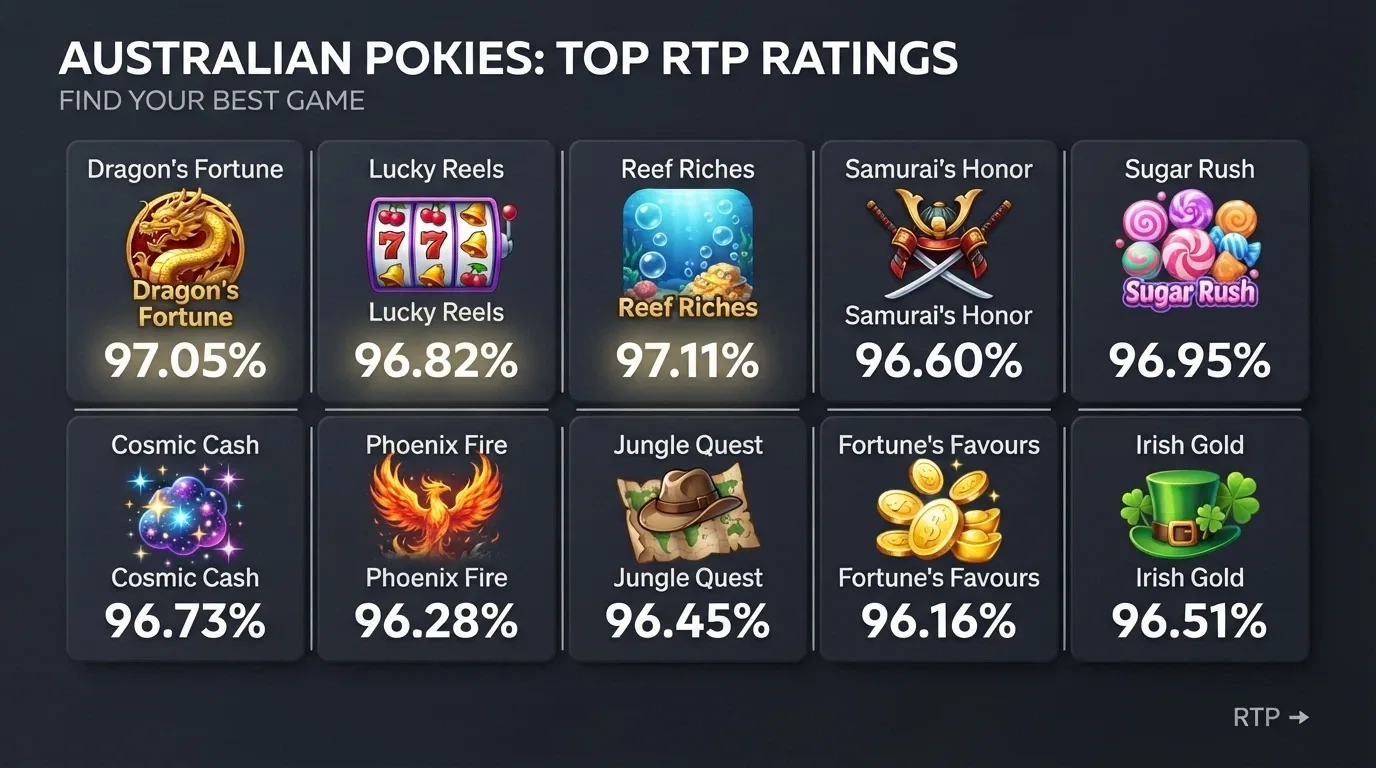
The new-release pokies running across AU-facing casinos in 2026 are dominated by Pragmatic Play, with Popiplay as a high-RTP challenger, Play’n GO and NetEnt picking up secondary slots, and Wazdan’s adjustable-volatility model appearing at the long tail. The RTP figures on these titles — the percentage of every wagered dollar the game returns to players over its full lifetime — are the numbers that decide how much of a free-spin bonus survives the house edge. The table below lists ten 2026 releases with their published RTP, volatility and maximum win.
| Slot Title | Provider | RTP | Volatility | Max Win |
|---|---|---|---|---|
| Bubble Up | Pragmatic Play | 96.52% | Medium | 10,000x |
| Sleeping Dragon Ultra Dark | Pragmatic Play | 96.50% | High | 20,000x |
| Crabby’s Gold II | Play’n GO | 96.25% | High | — |
| Bushido Blood | Popiplay | 97.11% | Medium-High | 10,100x |
| Lokum Rush | Popiplay | 97.04% | Medium | 10,000x |
| Cosmic Clusters | Pragmatic Play | 96.45% | High | 5,000x |
| Sugar Rush 1000 | Pragmatic Play | 96.53% | High | 25,000x |
| Big Bass Bonanza | Reel Kingdom / Pragmatic Play | 96.71% | High | 2,100x |
| Godbreaker | NetEnt | 96.16% | — | 5,468x |
| Burning Reels | Wazdan | 96.63% | Adjustable (L/S/H) | 5,000x |
What a pokie’s RTP and volatility actually mean for your free-spin session
RTP is the long-run average return a pokie pays back to its players. A pokie with a 96.52% RTP — Bubble Up is the clearest example — keeps 3.48 cents of every dollar wagered, on average, over the millions of spins the game runs in its lifetime. For a player running through a no-deposit bonus, the RTP is the figure that determines what the wagering requirement actually costs. A 40x wagering requirement at 96.52% RTP produces an expected loss of A$13.92 on a A$10 bonus; the same wagering at 94% RTP would produce an expected loss closer to A$24. The RTP is the dial.
Volatility is what the player actually feels in a 50- or 100-spin session. A high-volatility pokie pays out rarely and in larger chunks; a low-volatility pokie pays out often and in smaller chunks. Sleeping Dragon Ultra Dark, with a hit frequency of 33.78%, sits at the gentler end of the high-volatility cluster — its wins arrive in just over a third of spins, but the bulk of the return comes from the bonus rounds. Bushido Blood, at 16.39% hit frequency, is the opposite shape: long quiet stretches interrupted by the occasional large win. For a free-spin session of 50 or 100 spins, the volatility determines whether the player is most likely to see small frequent returns or one or two meaningful hits.
What the two numbers together say to a free-spin player is fairly direct. A high-RTP, low-volatility pokie is the cheapest bonus to clear, because the wagering runs through a game with a thin house edge and predictable returns. A high-RTP, high-volatility pokie is the cheapest in expectation and the most volatile in experience — the player’s balance will swing widely, and the cashout cap will be tested more often. A low-RTP pokie, whatever its volatility, is the most expensive bonus to clear and the one most likely to leave a player with a balance below the cashout cap. The free-spin bonus that locks the player onto a 96.5% RTP pokie is a different offer from the one that locks them onto a 94% RTP pokie, and the difference is the difference between an expected loss of A$14 and an expected loss of A$24.
RTG, Pragmatic Play and the studios behind the newest AU-facing titles
The newest releases at AU-facing casinos in 2026 are Pragmatic Play titles — Bubble Up, Sleeping Dragon Ultra Dark, Cosmic Clusters and Sugar Rush 1000 all carry the Pragmatic badge, and the older Big Bass Bonanza is also a Pragmatic-engineered game. The studio’s dominance in 2026 releases is not incidental: Pragmatic ships new pokies monthly, runs the tournament infrastructure many offshore casinos use as a retention layer, and holds the licences AU-facing brands most commonly want on the wall. A free-spin bundle locked to a Pragmatic title is the modal AU-facing free-spin bundle in this market.
Popiplay is the high-RTP challenger in the cluster. Bushido Blood at 97.11% and Lokum Rush at 97.04% sit roughly half a percentage point above the Pragmatic cluster — a meaningful gap on a 40x wagering requirement, where the difference between a 96.5% RTP and a 97.1% RTP is roughly A$2.40 in expected loss on a A$10 bonus. The Popiplay titles are newer to the market and appear less consistently across AU-facing casinos, which is worth knowing when a free-spin bundle locks to a specific pokie.
RTG — RealTime Gaming — remains the legacy position at AU-facing brands like FairGO, which has run an RTG-only library for the duration of its Australian-facing operation. RTG pokies sit at lower RTPs than the Pragmatic and Popiplay clusters — many in the 94% to 96% band — and are the reason an RTG-powered bonus tends to be the most expensive one to clear. For a player loyal to RTG titles, the choice is the studio’s familiarity against the studio’s house edge. Play’n GO, NetEnt and Wazdan appear at the long tail, with Wazdan’s adjustable-volatility model — Burning Reels lets the player pick Low, Standard or High volatility on every session — the most distinctive feature in the table.
Getting Money In and Out of a New Casino — What Works for Australians
The payment story at AU-facing offshore casinos is asymmetrical. PayID handles deposits in under a minute, fee-free, and works at every major Australian bank — but the same speed almost never applies to withdrawals. Crypto clears in minutes on the way out, eWallets within a day, bank transfer over one to three business days. The asymmetry is not a bug at any individual operator; it reflects the structural fact that an Australian-facing offshore casino sits outside Australia’s instant-payment infrastructure on the way out as well as on the way in. A player who picks a deposit method on speed alone is choosing their entry experience and accepting a different exit experience without naming it.
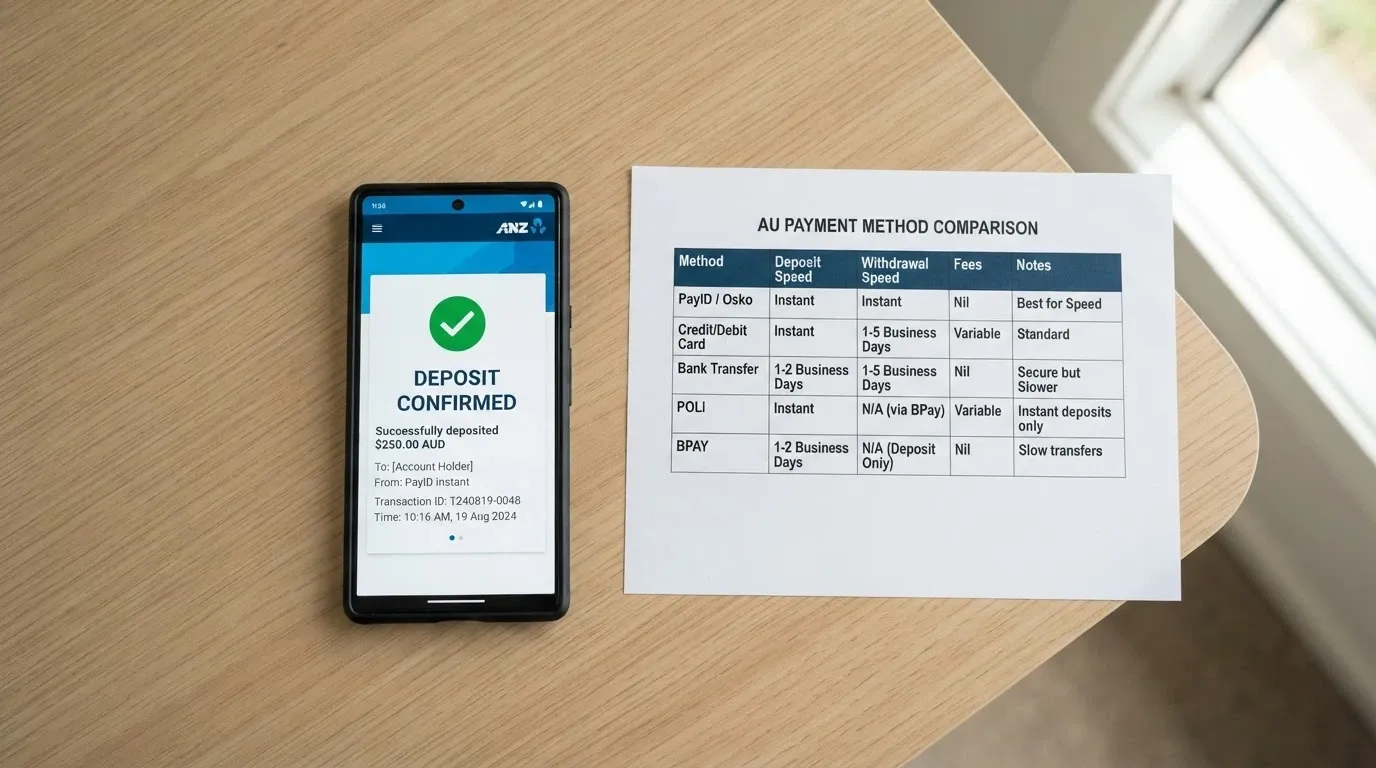
The minimum deposit at AU-facing offshore casinos sits between A$10 and A$30, which keeps the entry barrier low. The minimum withdrawal is typically higher — A$20 to A$50 — and the difference between the two is one of the small frictions that affects a player trying to cash out a no-deposit win. A A$10 deposit minimum is the cheapest way to test an operator behind the no-deposit offer; a A$30 minimum is the more common threshold at the larger brands. The Pay ‘n Play model — where a deposit from a verified bank account creates an account without a separate registration step — is rare at AU-facing casinos; the registration step is still the norm.
PayID: under 60 seconds to deposit, almost never available for withdrawal
PayID deposits at AU-facing offshore casinos process in under 60 seconds, with no fee on the player’s side. The minimum deposit runs from A$10 to A$30 depending on the operator. PayID is supported by more than 100 Australian banks, credit unions and building societies, which means a player with any Australian bank account can use it without setting up a new payment method. For an Australian player, PayID is the most frictionless deposit rail in the market.
The withdrawal side is the gap. PayID cash-outs are rarely supported at AU-facing offshore casinos. The reason is structural: PayID is an Australian instant-payment system, and an offshore casino operating outside the Australian payments framework does not have a PayID-receiving account at an Australian bank. The casino receives the deposit through a partner that does, and the partner handles the PayID leg on the way in. On the way out, the casino’s options are crypto, eWallets or bank transfer — none of which match PayID’s speed.
The practical upshot is that a PayID deposit at an offshore casino is fast, free and familiar; the same player’s withdrawal will run through a slower rail and may carry a fee depending on the method. A player who values the deposit speed and accepts the withdrawal lag is using the casino the way it expects to be used. A player who wants the same speed both ways is asking the offshore model for something it does not provide.
Minimum deposits, Pay ‘n Play and why a A$10 buy-in changes the offer
The minimum deposit at an AU-facing offshore casino is the cheapest part of the offer. A A$10 minimum is the difference between a player who treats the no-deposit bonus as a stand-alone product and a player who treats it as the doorway to a small real-money session. The two players read the same bonus page; the second one opens a different experience.
Pay ‘n Play is the model where a verified bank deposit creates the account, skips the registration form and drops the player straight into the lobby. It is widespread in Nordic jurisdictions and is starting to appear at European-licensed casinos. At AU-facing offshore casinos it is rare — most operators still run a separate registration step with email, password and identity verification before the first deposit. A player who values Pay ‘n Play for the no-registration flow will find few AU-facing offshore casinos offering it; the model assumes a licensed-jurisdiction banking integration that offshore operators do not have.
What a A$10 minimum changes for the offer is the comparison the player is making. A no-deposit bonus is free at the door; the deposit is the price of staying. At a A$10 minimum, the cost of staying is low enough to test the casino with real money behind a single session; at a A$30 minimum, the cost is enough to make a player think twice before the first deposit. The casinos that have lowered their minimums to A$10 are not doing it for generosity — they are doing it because the no-deposit bonus has done its job and the deposit is the conversion step.
Free Play vs Real Money — Where the Value Actually Sits
Demo mode at an AU-facing casino lets a player run a pokie with a play-money balance before any deposit or sign-up. The reels behave the same way they do on real money: the same RTP, the same volatility, the same bonus features. What demo mode does not replicate is the stake behind the spin. A play-money balance that resets itself is not the same instrument as a real-money balance that does not, and the decisions a player makes at the two are not the same decisions.
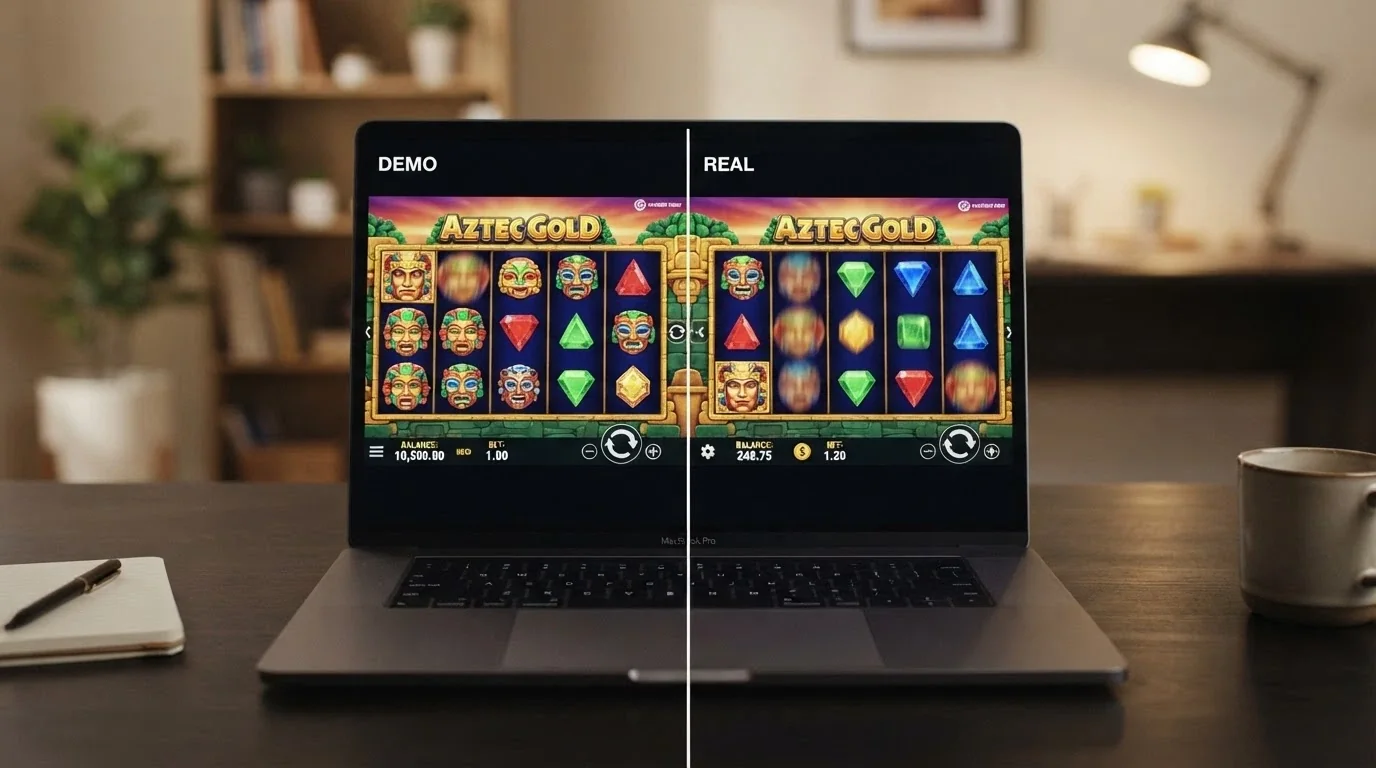
The practical role of demo mode is reconnaissance. A player can test a pokie’s volatility feel — whether it pays out often or rarely, whether bonus features trigger easily or sit behind long waits — without staking a cent. The same player can read the paytable, the rules and the betting range in a low-pressure environment. Demo mode is also where a player can confirm a free-spin pokie is the pokie the bonus is actually locked to, before the free spins activate.
Where demo mode falls short is in the decisions it does not force. The player who would walk away from a real-money session after twenty losing spins will not necessarily walk away from a demo session after twenty losing spins — there is no balance to protect. The player who adjusts their bet size based on a recent win does not have the same read on a demo balance. Demo mode teaches the game; it does not teach the player. The gap is what real money reveals.
Free slots vs real-money pokies — a different game on the same reels
The reels in demo mode and in real-money mode run on the same random number generator and the same RTP. A pokie at 96.5% RTP returns 96.5 cents per dollar in both modes, on average over the long run. The short run, where a 50-spin session lives, is shaped by volatility — and volatility feels different when the spin costs nothing than when the spin costs A$0.25. The reel result is the same; the player’s experience of it is not.
What changes between the two is the stake behind the decision. A demo player who lands a bonus feature watches the same animation a real-money player watches, but the demo player has no balance to protect and no win to count. The real-money player has both. The decision to keep spinning, to increase the stake or to walk away is shaped by the balance in a way demo play cannot replicate. A pokie that feels volatile in demo mode will feel more volatile in real-money mode; a pokie that feels steady in demo mode will feel steadier.
A second difference is the bonus-feature behaviour. Demo mode is intended to demonstrate the full feature set, and most pokies run their bonus rounds at the same frequency in demo as in real-money play. The RTP does not change. What changes is the player’s response to the feature — and the response, not the feature, is what decides whether a real-money session is a good one.
The Newest AU-Facing Online Casinos — Who Has a No Deposit Offer and Who Doesn’t
Ten offshore brands feature in this ranking. The table below shows each one’s licence jurisdiction and whether a no-deposit bonus could be confirmed in this round. The brand write-ups that follow cover what each offer actually contains, what could not be re-verified, and which reader each operator suits.
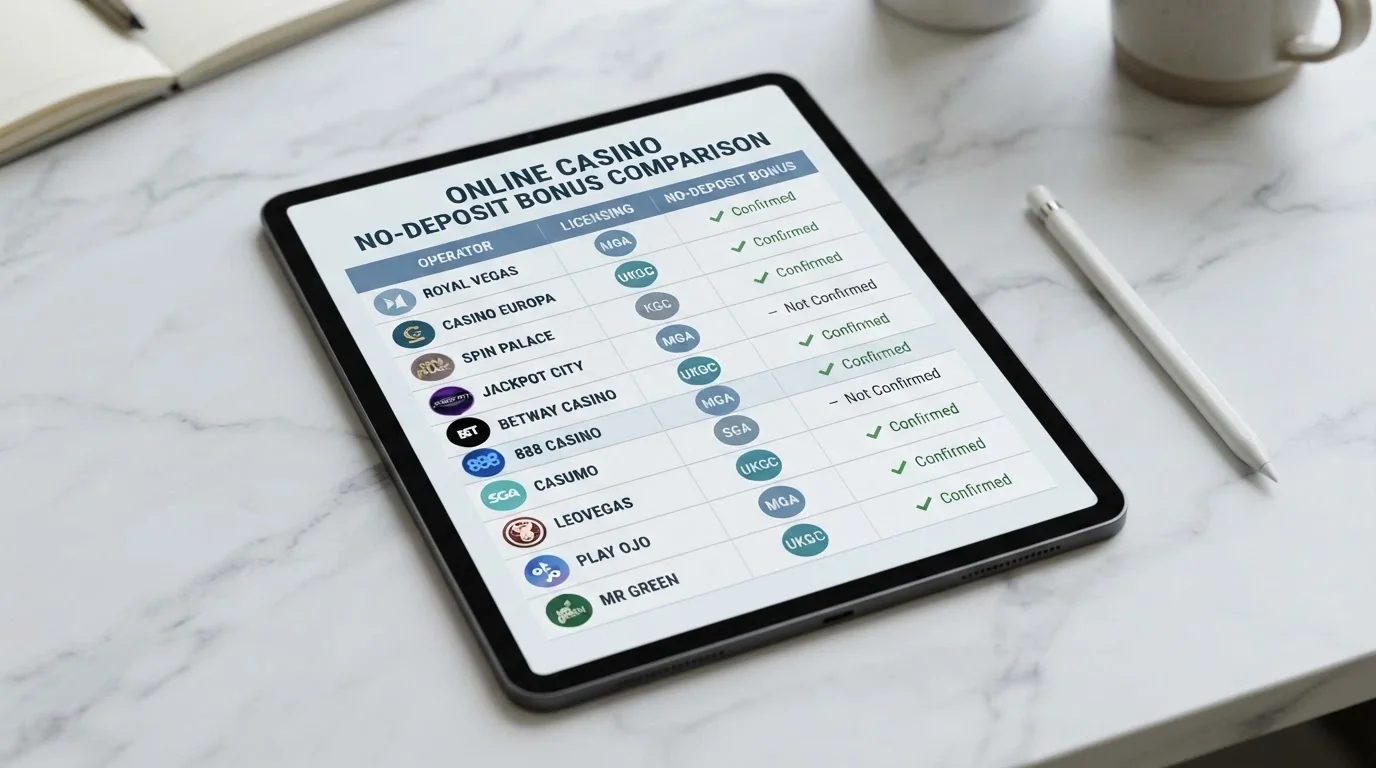
| Operator | Licence | No Deposit Bonus |
|---|---|---|
| Skycrown | Offshore (not AU-licensed) | 100 free spins (mobile verification) |
| Bizzo Casino | Offshore (not AU-licensed) | Free spins confirmed (50x wagering) |
| FairGO | Offshore (not AU-licensed) | NDB codes mentioned (terms unverified) |
| WinSpirit | Offshore (not AU-licensed) | NDB codes mentioned (terms unverified) |
| Rocket Casino | Offshore (not AU-licensed) | NDB codes mentioned (terms unverified) |
| Rocket Play | Offshore (Curaçao) | — |
| Stake | Offshore (Curaçao) | — |
| Royal Reels | Offshore (not AU-licensed) | — |
| Rainbet | Offshore (not AU-licensed) | — |
| Scream Casino | Offshore (not AU-licensed) | — |
Skycrown
The Skycrown offer is the headline number of the featured set: 100 free spins without a deposit, on the condition that a mobile phone number is verified first. The verification gate is the operator’s way of enforcing one-bonus-per-player without a financial deposit, and it is common across offshore casinos running spin-based no-deposit offers. What sits beyond the gate — wagering on winnings, per-spin value, max cashout, bonus validity — could not be re-verified against the operator’s current terms in this round.
Among the ten operators on this page, Skycrown is the largest confirmed no-deposit bonus by spin count. It is also the one where the second half of the terms page matters most — a player who lands a large win and walks to the withdrawal page expecting the same generosity will meet the cap, the wagering and the game-contribution rules all at once. The 100 is real; the read on what comes after is the part that decides whether the offer paid off.
Bizzo Casino
Bizzo is one of two operators in the featured set where the no-deposit offer’s actual wagering number could be re-verified rather than just mentioned. Free spins on registration, 50x wagering on the winnings, A$10 minimum deposit for any subsequent activity. The offer is not at the top of the market by spin count, but it is one of the few where the headline number and the terms number come from the same place.
Fifty times wagering is on the steep side of the typical 30x to 60x band, but the offer’s transparency is the point. A player who wants verifiable terms over headline numbers finds more to work with at Bizzo than at three of the brands above it. The maths on a 50x wagering requirement at 96.5% RTP, applied to a small bonus, still produces an expected cost that exceeds the bonus face value — but knowing the wagering is 50x rather than discovering it after the spins is the difference between reading an offer and guessing one.
FairGO
FairGO runs on RealTime Gaming software, which sets it apart from the Pragmatic-Play-heavy cluster most of the featured set shares. The brand has a long Australian-facing history and an RTG-only library that regulars recognise. Welcome free spins carry 60x wagering on winnings, the top of the AU-facing band, and no-deposit bonus codes are mentioned in bonus-aggregator listings — though the specific terms attached to those codes could not be re-verified this round.
The RTG library and the brand’s long AU-facing history make FairGO a credible alternative for players loyal to RTG pokies. The 60x on the welcome offer and the unverified no-deposit terms together mean the bonus maths deserves a careful read before committing to either. A player who knows they prefer RTG titles and accepts the steep wagering has a reason to be at FairGO; a player after the cheapest bonus to clear has several better options on this page.
WinSpirit
WinSpirit appears on bonus-aggregator lists as offering no-deposit bonus codes. The mention is consistent across several aggregator pages, but no no-deposit type, amount, wagering, cashout cap or validity could be re-verified against the operator’s current terms in this round. A player who lands on WinSpirit from a listicle should treat the mention as exactly that — a mention — and check the operator’s own promotions page for the live terms before signing up.
For a player who has decided to claim a no-deposit offer at WinSpirit, the verification work happens at the operator, not at the aggregator. The aggregator’s role is to point; the operator’s role is to specify. The two pages sometimes agree, sometimes do not, and the operator’s terms page is the binding document.
Rocket Casino
Rocket Casino is a brand the aggregators keep on their lists, not a destination a player should reach through this page. The no-deposit offer exists in mentions only, and the verification work has to happen at the operator, not at the listing. A player who skips that step is reading aggregator chatter rather than an offer.
The fact that two of the ten operators on this page carry identical verification statuses is itself a useful read. The aggregator ecosystem recycles the same handful of mentions across casinos; the operators’ actual terms pages are where the offer lives or does not.
Rocket Play
Rocket Play is one of the larger AU-facing offshore brands by market share — ranked third among the operators reviewed for this page. The brand holds a Curaçao licence, which makes it one of two operators on the page whose licence jurisdiction is specifically named rather than generically described as offshore. No no-deposit bonus, welcome bonus, free spins, wagering, game providers, bonus validity, spin value or max cashout was confirmed this round.
A player looking for a no-deposit offer will not find one at Rocket Play in this round. A player looking for a brand with established AU-facing market presence — and a willingness to verify that presence through the Curaçao public register — has a different question, and the same operator answers it. Rocket Play is on this page for the second reader, not the first.
Stake
Stake is a Curaçao-licensed brand that AU players will encounter whether or not they are looking for no-deposit bonuses. It sits in the upper half of the AU-facing market by share, ranked twelfth among the operators reviewed here. No no-deposit bonus, welcome bonus or free-spin offer was confirmed this round, which is consistent with Stake’s broader product positioning around crypto deposits and sports betting rather than bonus-led acquisition.
Stake is on this page as a brand to recognise, not as a destination for a no-deposit claim. Players who already use Stake know what they are getting; players shopping for a free-spin entry point should keep looking. The brand’s presence on the AU-facing market is the reason for its inclusion, not its offer.
Royal Reels
Royal Reels is an established AU-facing name, sitting in the middle of the featured set by market share at rank nine. The brand has a long history of offshore operation and is recognised by AU players who have been in the market for several years. No no-deposit bonus or welcome bonus was confirmed this round, which puts it alongside five of the other featured operators whose offer status could not be re-verified.
A player who has seen Royal Reels in bonus-aggregator listings should not expect to find a current no-deposit offer there. Nine of the operators above and around Royal Reels on this page carry at least a mention; Royal Reels does not, and the absence is the headline. For an established brand, the absence of a current promotional offer is a position rather than a gap — a market-share brand does not need a no-deposit offer to attract players.
Rainbet
Rainbet is a newer entrant among the AU-facing brands reviewed here, sitting at rank thirteen in market share. The brand is offshore-licensed and has been growing its AU-facing presence over the last several review cycles. No no-deposit bonus or bonus specifics were confirmed this round, which is consistent with a brand still in growth mode rather than at the offer-saturated end of the market.
Rainbet’s presence on the page reflects market share rather than a current offer. A player curious about the brand has a reason to look further; a player after a no-deposit offer has none. The page lists Rainbet for completeness, not for the bonus it offers.
Scream Casino
Scream Casino and Rainbet occupy the same position on this page — present in the AU market, absent from the no-deposit market in this round. Scream Casino rounds out the featured set at the lower end of the AU market-share ranking, sitting at rank fourteen, and the position itself tells the reader what the offer is: a brand with AU-facing presence that has nothing currently in market for the bonus hunter. A player browsing the bottom of the ranking is reading the page for context, not for a claim to make.
The fact that the bottom of the ranking carries no confirmed offer is itself a piece of information: the no-deposit market is concentrated at the top of the AU-facing list, not spread across it.
Are Online Casinos Legal in Australia? The Short Answer and the Long One
Online casino is prohibited in Australia. The short answer stops there; the long one explains why the gap between “illegal to provide” and “not illegal to play” creates the grey zone every Australian player steps into when they sign up to an offshore casino. No Australian online casino licence exists anywhere in the country — not federally, not in any state or territory. Every operator on this page is an offshore entity, and the IGA’s prohibition applies to the provider, not to the person in Australia who uses the service. The distinction is what makes the market possible, and the distinction is also where the protection gap opens.

The Interactive Gambling Act 2001 makes it an offence to provide an online casino, online pokies or in-play betting to a person physically present in Australia. The provider is the entity the ACMA investigates, the entity that faces civil penalties, and the entity whose site the regulator asks ISPs to block. The player is none of those. The enforcement record since 2017 is more than 1,564 illegal gambling and affiliate websites blocked by Australian ISPs, and more than 225 illegal services withdrawn from the Australian market. The numbers describe the supply side, not the demand side.
The Interactive Gambling Act 2001 — what it bans, what it allows and what it has never prosecuted
Section 15(2A) of the Interactive Gambling Act 2001 prohibits providing a prohibited interactive gambling service — online casino games, online pokies, in-play betting — to a customer with an Australian-customer link as defined in section 8 of the Act. The “Australian-customer link” is what brings an offshore operator into the Act’s reach even when the operator’s servers are in Curaçao or Estonia. Civil penalties for providing a prohibited service run up to A$2,475,000 per day for an individual and A$12,375,000 per day for a corporation, with criminal charges also possible.
The Act does not ban wagering on races or sport placed before an event starts, lotteries and keno through licensed operators, or any gambling activity conducted under a state or territory licence. The Northern Territory Racing and Wagering Commission (administered through Licensing NT) is the de facto national licensor for online wagering, with licence terms running up to 20 years. The licensed market — Sportsbet, TAB, Ladbrokes, Bet365 — sits on the other side of the IGA from the offshore casino market, and a player who wants a licensed Australian product is in the wagering market, not the casino market.
The player has never been prosecuted under the IGA. The enforcement model is provider-only: the ACMA investigates the operator, blocks the site, and pursues civil penalties. The player is not the subject of the Act, and “not illegal for you” is the truth. The half of that truth the marketing never finishes is that “not illegal for you” is not the same as “safe” — no Australian consumer protection, no ACMA complaints body, no BetStop coverage, and no recourse if the operator refuses a withdrawal or voids a win. The Act does not prosecute the player; the Act also does not protect them.
The 2026 gambling reform — what changes on 1 January 2027 and why it matters for no-deposit bonuses
The Interactive Gambling Amendment (Gambling Reform) Bill 2026 was introduced into Federal Parliament on 2 July 2026 and passed on 19 August 2026. Its measures commence on 1 January 2027. The reform is the most significant change to the Australian gambling framework since the original IGA, and its effects on the no-deposit bonus landscape are direct — every inducement rule the bill introduces is a rule that constrains the offer this page is built around.
The advertising side of the reform caps wagering advertising at no more than three ads per hour between 6:00 am and 8:30 pm, with a live-sport blackout from fifteen minutes before until five minutes after an event. Broadcasting sporting odds is banned outright, and athletes, celebrities and influencers are barred from promoting wagering products. For a player who sees a no-deposit offer in their inbox, the marketing channel that delivers it becomes narrower from 1 January 2027. The offer still exists; the routes to it are reduced.
The inducement side of the reform prohibits direct marketing of inducements for 14 days after a customer signs up, three months after a person deregisters from BetStop, and indefinitely for at-risk customers. The 14-day post-signup window is the part that matters most for no-deposit offers: an offshore operator that markets a no-deposit bonus to a customer within fourteen days of their first signup is in scope for the new rules. Banks and payment providers also gain express authority to block transactions to illegal gambling operators from 1 January 2027, which is the first time Australian banks have had a clear legal mandate to refuse PayID and card transactions to offshore casinos.
The reform does not legalise online casino. The product remains prohibited. What the reform does is reduce the surface area around it — fewer ads, narrower marketing windows, payment-blocking powers, and inducement restrictions that affect the way bonuses reach Australian players. The 1 January 2027 commencement date is the date the no-deposit offer market as it currently operates starts to look different.
Offshore casinos and Australian players — the protection gap no licence can close
An offshore casino licensed in Curaçao, Kahnawake or Estonia answers to its own regulator, not the ACMA. The Curaçao Gaming Authority, the Kahnawake Gaming Commission and the Estonian Tax and Customs Board each maintain their own licence conditions and dispute processes, and none of them has the authority to compel an operator to pay a withdrawn amount to an Australian player. The licence is real; the licence’s reach ends at the operator’s compliance with its own jurisdiction. For an Australian player, the question is not whether the operator has a licence but whether the licence does anything the player can use.
The payment rules make the picture worse. Credit cards, credit-related products and digital currency (crypto) are banned as payment for online wagering under the Interactive Gambling Amendment (Credit and Other Measures) Act 2023, commencing 11 June 2024. An operator accepting credit card or crypto deposits from an Australian is operating outside the Australian rules, and the player’s deposit route is one the Australian framework does not endorse. The legal deposit routes at licensed Australian operators are debit card, bank transfer, PayID/Osko and BPAY — all of which are available at offshore casinos, but in a context where the operator is not bound by the Australian rules those rails were built for.
The practical reality is plain. No Australian body can recover a player’s money from an offshore casino. BetStop does not reach offshore casinos. The ACMA cannot compel a payout. A player who has a dispute with an offshore casino has the operator’s own customer-support process, the operator’s licensing regulator in its home jurisdiction, and an Australian court that can hear a contract dispute but cannot enforce its judgment outside the country without further steps. The protection gap is not a marketing line; it is the structure of the market.
Playing Safely — What Actually Protects You (and What Doesn’t)
Australia built a strong responsible-gambling safety net, but it was designed for the licensed market, and offshore casinos sit outside it. BetStop, the National Self-Exclusion Register, is the most visible piece of the net — a single registration that excludes a person from every Australian-licensed wagering service. The National Gambling Helpline at 1800 858 858 is the most accessible — free, confidential and staffed 24/7, with online chat and counselling through Gambling Help Online. The problem-gambling prevalence numbers — about 2.1% of Australian adults, or roughly 430,000 people, per the Australian Institute of Health and Welfare in 2022 — are the context that makes both of those services matter.
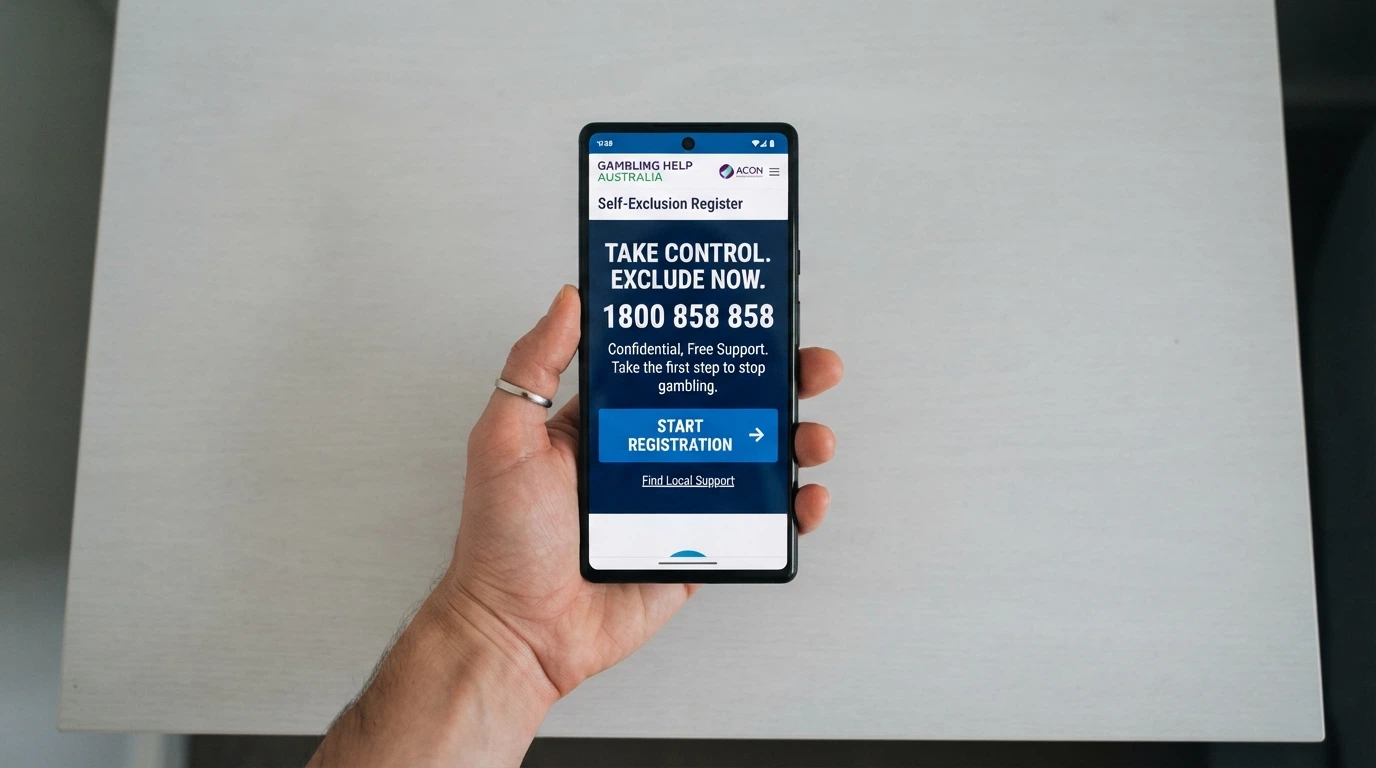
What those services do not cover is the offshore casino market. BetStop’s reach ends at the Australian border, and the helpline’s value is unaffected by where a person played. Registering with BetStop and then continuing to deposit at an offshore casino leaves a person outside both the registration and the operator-side responsible-gambling tools that come with it.
BetStop: 67,480 registrations and counting — but it stops at the Australian border
BetStop recorded 67,480 registrations in three years of operation as at 31 July 2026, of which 41,290 exclusions were still active — more than sixty per cent of everyone who has ever signed up. Seventy-eight per cent of registrants are under 40, and thirty-eight per cent chose lifetime exclusion. The register binds every Australian-licensed wagering service, which means a single registration excludes a person from Sportsbet, TAB, Ladbrokes and every other operator holding an Australian wagering licence. For someone trying to stop gambling on the licensed market, the registration is the entire mechanism.
For someone trying to stop gambling on the offshore market, it is not. BetStop binds Australian-licensed wagering services only. An offshore casino licensed in Curaçao, Kahnawake or Estonia is not connected to the register and will continue accepting a self-excluded person’s deposits. The exclusion a person thought they had registered for does not apply at the casino this page is about. A person who has registered with BetStop and wants to stay stopped at offshore casinos has to enforce the exclusion themselves, at each operator, using whatever self-exclusion tool the operator offers — and the operator’s tool may or may not be honoured.
The reform bill mentioned earlier extends BetStop’s reach in one specific direction: a person who deregisters from BetStop cannot receive direct marketing of inducements from Australian-licensed operators for three months. The rule does not extend BetStop itself to offshore operators. The register’s reach is structural, not promotional, and it stops at the same border it always has.
The help that is real — 1800 858 858 and where to go when the fun stops
The National Gambling Helpline is 1800 858 858 — free, confidential and staffed 24 hours a day, seven days a week. Online chat and counselling are available through Gambling Help Online. The services work regardless of where a person played — licensed or offshore, in Australia or while travelling — and the people staffing them are trained for the calls that do not fit into a checklist. For a reader who has reached the end of this page and is asking themselves a question they would rather not be asking, this is the number to call.
The prevalence numbers are the reason the helpline exists in the form it does. About 2.1% of Australian adults — roughly 430,000 people — experience problem gambling, per the Australian Institute of Health and Welfare’s 2022 estimate. High-risk gambling sits at 1.8%. Those numbers include both the licensed market and the broader gambling environment, and the offshore casino market sits inside them. The responsible-gambling tools at Australian-licensed operators — deposit limits, take-a-break, activity statements, the BetStop registration — are part of the same infrastructure. None of them reaches an offshore casino, but the helpline does, and the helpline is the part of the safety net that any Australian player can use from any operator.
How We Selected and Ranked Every Casino on This Page
The ten operators on this page were drawn from the Australian-facing offshore casino market and reviewed against published terms in July 2026. Each one was checked for a no-deposit bonus, the terms attached to it where re-verifiable, the licence jurisdiction on the operator’s site or the relevant public register, and the brand’s market position among AU-facing operators. Where a no-deposit offer’s terms could be re-verified, they are stated on the brand’s write-up. Where they could not be, the brand is marked as “NDB codes mentioned” or “—” in the comparison table, and the write-up explains the gap.
The ranking order on this page is not a market-share ranking, and the table does not put the operator with the best offer at the top by default. The first brands in the table are the ones whose no-deposit offers were re-verifiable; the brands further down are the ones whose offers were not. The order within each band roughly tracks market presence, with the larger AU-facing brands toward the top. A reader scanning the table for “where is the offer I can actually claim” gets a clearer read than a reader scanning for “which brand is biggest”.
The verification limit is the part of the methodology that matters most. This review checked each operator’s current bonus page and, where possible, the Curaçao Gaming Authority public register. It did not check every bonus code, every payment method or every game title at each operator, and it did not test the bonus terms by claiming them. A re-verification round in six months may produce different results — offers rotate, terms change, and brands enter or leave the AU-facing market. The reader who treats this page as a snapshot rather than a permanent ranking is reading it the way it was written.
Your Move — What to Actually Do With a No Deposit Casino Bonus
A no-deposit bonus is a free look inside a casino, and the right way to use it is for reconnaissance rather than as a withdrawal strategy. The first move is to confirm the offer is still live before signing up — no-deposit offers at AU-facing offshore casinos rotate frequently, and the offer a listicle named a week ago may have been replaced by a different one or withdrawn entirely. The operator’s own promotions page is the source; the aggregator is the pointer.
The second move is to read the cashout cap and the wagering terms before claiming any spins. The headline number — the 50 spins, the A$10, the A$35 chip — is what the marketing wrote. The cap and the wagering are what the bonus is worth. A 50-spin bonus at 40x wagering with a A$100 cashout cap is a different offer from a 50-spin bonus at 30x wagering with a A$200 cap, and the difference is the difference between an expected value of A$2 and an expected value of A$5. Both are tiny; the bigger one is the better one.
The third move is to use demo mode on the pokie the free spins are locked to before claiming the bonus. Demo mode is free and runs on the same RNG and RTP as the real-money game. A player who knows the pokie’s volatility, hit frequency and bonus-feature behaviour before the spins activate is making better decisions during the bonus than a player who meets the pokie for the first time when the spins are running.
The fourth move is to set a time limit regardless of the outcome. The bonus’s expected value sits at A$2 to A$5 after wagering and caps, and most sessions end below the cashout cap. A player who has decided in advance that the session ends in thirty minutes regardless of the balance is the player who gets the most out of the offer. The player who keeps playing to chase a withdrawal above the cap is the player the offer is built to extract from. The expected loss on a A$10 bonus cleared at 40x wagering on a 96.52% RTP pokie is roughly A$14 — meaning the offer is expected to cost the player about A$14 in expectation, with only the bonus amount wagered. Treat any withdrawal as a bonus; the maths says it is one.
Frequently Asked Questions
Can I claim a no deposit bonus more than once at the same casino?
No. Operators track the bonus by account, device, IP and payment method, and a second claim by the same person violates the terms and typically voids the bonus and any winnings. Operators that want to reward repeat players run a separate reload offer, not a re-claim of the original.
How much can I actually withdraw from a no deposit free spins bonus?
Whatever the casino’s max-cashout cap allows — typically A$50 to A$200 at AU-facing offshore brands. Anything you win above the cap disappears at withdrawal. A bonus that advertises 100 free spins and shows a A$300 balance will, in most cases, pay out the capped figure, not the full balance.
What is the difference between no deposit free spins and a no deposit cash chip?
Free spins are locked to one pokie at a fixed stake, with wagering on whatever the spins return. A no-deposit cash chip is a set dollar amount — usually A$10 to A$35 — usable on table games or live-dealer titles, with wagering on the chip’s face value rather than on spin returns.
Does BetStop cover offshore casino sites?
No. BetStop binds Australian-licensed wagering services only. An offshore casino licensed in Curaçao, Kahnawake or Estonia is not connected to the register and will keep accepting a self-excluded person’s deposits. Anyone who has registered with BetStop and wants to avoid offshore sites has to enforce the exclusion themselves at each operator.
Are crypto deposits a better choice than PayID for Australian casino players?
Crypto wins on withdrawal speed — 2 to 60 minutes, against 1 to 3 business days for bank transfer. Crypto loses on legality: digital currency has been banned as payment for online wagering in Australia since 11 June 2024. PayID remains the cleanest AU-aligned deposit route.
Does a 40x wagering requirement on free spins actually leave anything to withdraw?
Rarely anything meaningful. After wagering and the cashout cap, the expected value of a typical AU-facing no-deposit offer sits at A$2 to A$5. A A$10 bonus cleared at 40x wagering on a 96.5% RTP pokie carries an expected loss near A$14. Most sessions end at zero.