
What a Casino Bonus Code Actually Gets an Australian Player
A casino bonus code is a short string of letters and numbers a player enters at a cashier, a coupon field, or a registration form to unlock a promotional offer. The code itself carries no terms. What the code unlocks — a match bonus, a batch of free spins, a free chip — is governed entirely by the offer’s terms and conditions, which live behind the “T&Cs apply” link the marketing page would rather you skim. The code is a key; the lock it opens is the fine print.
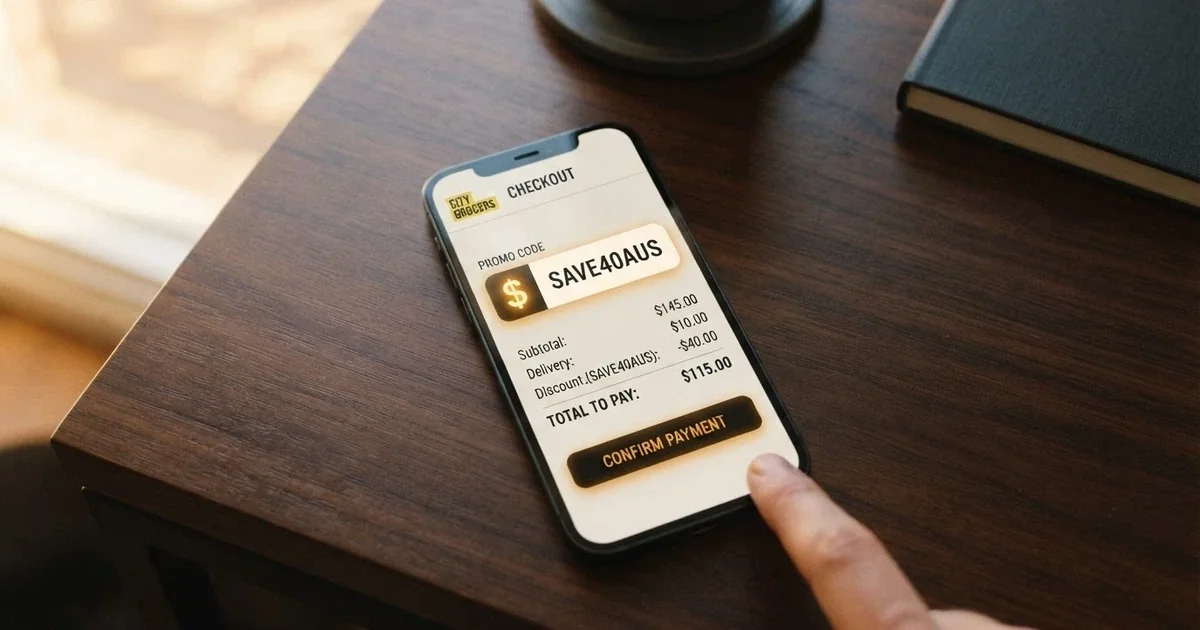
Every bonus code reachable from Australia opens an offshore product. Under the Interactive Gambling Act 2001, providing online casino games to a person in Australia is an offence, and no online casino licence exists anywhere in the country. What this means is straightforward: when you enter a casino bonus code in Australia, you are transacting with a Curaçao-licensed operator sitting outside Australian jurisdiction. The state-licensed venues — Crown, The Star — run table games and pokies on premises, not through online codes. The bonus-code economy is an online-only, offshore-only market that exists precisely because the licensed Australian market does not.
This page walks through what a code actually gets you, which terms decide whether the offer has any value, and why the entire category sits outside Australian law. The operator comparisons that follow are descriptive, not endorsements — the page does not recommend any brand, and it does not print any working code. The aim is to give a player the framework to read the next offer they see, not to send them to a particular casino.
Data current as of 16 October 2026 and verified against the Australian Communications and Media Authority (ACMA) public register.
Table of Contents
- Deposit Bonus Codes vs No-Deposit Codes — the Split That Matters
- No-Deposit and Free Bonus Codes — the Offers That Cost Nothing
- Sign-Up, Registration and Mobile Bonus Codes — Getting Paid to Join
- How Wagering Requirements Eat Your Bonus
- Max Cashout Caps, Expiry and the Fine Print That Kills Your Offer
- Why Every Bonus Code You See Sits Outside Australian Law
- Why a 94% RTP Build Makes Your Bonus Worth Less
- Featured Operators
- Responsible Gambling — Help That Actually Works
- How We Selected and Ranked These Operators
- Your Next Move — Read the Terms, Not the Headline
- Frequently Asked Questions
Deposit Bonus Codes vs No-Deposit Codes — the Split That Matters
The single decision a bonus code forces on a player is whether they pay first. A deposit bonus code requires a real-money deposit before the offer activates; a no-deposit code credits the bonus (cash, chips, or free spins) the moment the code is entered, with no funding required. The two types look similar at the headline level and behave very differently underneath.
A deposit match code is the most common form. The operator commits to matching a slice of the player’s first deposit — often 100% up to a ceiling — and the resulting bonus carries wagering requirements on the bonus amount or the deposit plus the bonus. Fair Go’s structure is typical: 100% up to A$200 per deposit across the first five deposits, with 30× wagering on the deposit plus the bonus. The player hands over A$200, plays with A$400, and must turn the combined amount over 30 times before anything withdraws. The headline is A$200; the working figure is A$12,000 of turnover.
A no-deposit code reverses the flow. The bonus lands before any money changes hands, but the terms the player must clear to extract value are tighter. No-deposit wagering at Australian-facing offshore casinos runs 30× to 60× on the bonus or the bonus winnings, and no-deposit max cashout caps sit between A$50 and A$200. A A$25 no-deposit chip with a A$100 cashout cap and 40× wagering is not a free A$25 — it is a high-friction attempt to clear a small amount of casino credit with a hard ceiling on the upside. The headline on the card is generous; the ceiling on the withdrawal is not.
The AU player’s calculus splits cleanly along that line. A deposit code requires handing money to an offshore operator with no Australian consumer protection — a balance ACMA can block from the outside, and a complaint ACMA cannot recover. A no-deposit code avoids the funding step but raises the wagering and tightens the cashout. Neither is risk-free; they are different shapes of risk.
No-Deposit and Free Bonus Codes — the Offers That Cost Nothing
No-deposit codes come in three flavours: bonus cash, free chips, and free spins. Each has its own delivery mechanic, and the differences between them matter when the T&Cs are read properly.
No-deposit bonus cash typically lands as a small credit — A$10 to A$25 is the dense middle of the market in 2026 — and carries 30× to 60× wagering on the bonus amount. Free chips work the same way at RTG (RealTime Gaming) casinos, where they appear in the “Redeem Coupon” field rather than as a cash credit. Free spins are the most common no-deposit delivery and arrive as a fixed number of rounds — 20 to 50 is typical — on a specific pokie, often with a fixed spin value.
The hidden cost in every no-deposit code sits in two places the marketing line does not draw attention to. The first is the wagering multiple — anything above 50× is practically unclearable for most players, because the turnover required starts to dwarf both the bonus and the expected session length. The second is the max cashout cap: even if a player wins A$1,000 from a no-deposit chip, the withdrawal ceiling is A$50 to A$200. The cap is the operator’s liability limit, and it is also the number that decides whether the offer pays anything at all.
The code string itself carries none of these terms. Whether a code unlocks a 30× wagering requirement or a 60× one depends on the offer attached to it, not on the characters typed into the box. Reading the T&Cs before entering the code is not caution; it is the only way to know what the code does.
No-Deposit Bonus Codes — the Free Cash You Cannot Just Withdraw
A no-deposit bonus code follows a strict sequence. The player enters the code at the cashier or the coupon field, the bonus is credited to a separate bonus balance, and the player wagers that bonus through the required multiple of spins or bets before the cashout cap is tested. If the wagering clears and the balance is below the cap, the player can withdraw up to the cap. Anything above the cap is forfeit.
The numbers tell a quiet story. A A$20 no-deposit bonus with 40× wagering and a A$100 max cashout requires A$800 in turnover before withdrawal. The headline says “free A$20”; the mechanics say “play through A$800, withdraw at most A$100.” Fair Go’s no-deposit coupons sit at the tougher end: 60× wagering with a A$150–A$180 max cashout. WinSpirit sits closer to the market floor: A$20 no-deposit bonus, 40× wagering, A$100 cap. Bizzo’s no-deposit offer is free spins, not cash — 10 spins for installing the PWA app, with a A$75 win cap.
The operator’s business reason for offering free money is acquisition cost math. A no-deposit code that costs the operator A$100 in expected withdrawals, in exchange for a player who deposits and continues playing, is a marketing line item, not a gift. The casino earns the bonus back from the players who do not clear the wagering — and that group, at 30× to 60×, is large.
Free Bonus and Free Chip Codes — the Cash With No Deposit
Free chip codes appear most often at RTG casinos like Fair Go and Ozwin, where they sit in the “Redeem Coupon” field rather than at a deposit screen. The chip is treated as casino credit: it plays through eligible games, generates winnings, and runs the same wagering gauntlet as any other no-deposit offer. The mechanics are not gentler because the delivery label says “free chip.”
WinSpirit’s A$20 no-deposit bonus is a straight cash bonus, the simplest entry point in the set: A$20 credited, 40× wagering, A$100 cap. Fair Go’s no-deposit chips are at the other end — 60× wagering with a A$150–A$180 cap, which sounds generous on the cashout side until the wagering required to reach it is calculated. Ozwin runs 60× on no-deposit codes with a A$180 cap, the same shape as Fair Go. The difference between these offers and a free-spin code is the eligible game list — cash and chip offers tend to be locked to one or two pokies, and the wagering contribution outside those titles drops sharply.
The shared point across free chip, free bonus cash, and free spins is the same: the code is the distribution mechanism, the offer is the economic terms, and the T&Cs decide what the player walks away with.
Sign-Up, Registration and Mobile Bonus Codes — Getting Paid to Join
Registration bonus codes trigger when a player creates an account — entered at the signup form or in the coupon field after registration. The typical reward is a no-deposit bonus: a small cash credit or a batch of free spins. The logic is the same as a no-deposit code entered at the cashier, with one extra step: the player usually has to finish the registration process before the code can be redeemed.
Mobile delivery adds a channel without changing the underlying economics. A mobile no-deposit code entered through a phone browser carries terms typically identical to the desktop equivalent — same wagering multiple, same cashout cap, same eligible games. What changes is the friction: codes tied to a specific device, codes released inside a casino’s mobile app, and codes unlocked by installing the operator’s PWA (progressive web app). Bizzo’s offer is the cleanest example in the set: 10 free spins for installing the PWA, with 40× wagering and a A$75 win cap. The free spins are no-deposit, the install is the trigger, and the terms sit in the offer page rather than the app store listing.
App-install bonuses form a separate category. They are not the same as a registration bonus because they are unlocked by a software action, not an account creation. The terms usually track the casino’s standard no-deposit terms, and the win cap tends to be on the lower end of the market — A$75 at Bizzo is half the Fair Go range. For a player, the install-trigger offer is a way to extract a small promotional value from a casino without funding an account; the value of doing so depends entirely on the terms attached to the code.
The AU-specific risk on any sign-up code is the verification step. To claim a no-deposit bonus and reach a withdrawal, a player must hand over identification documents to an offshore operator — a driver’s licence, a Medicare card, sometimes a utility bill. The Interactive Gambling Act 2001 targets the provider, not the player, so the act of registering is not itself illegal. The act of handing personal documents to a Curaçao-licensed operator outside Australian jurisdiction, with no complaints body ACMA can refer a player to if something goes wrong, is a different kind of exposure.
How Wagering Requirements Eat Your Bonus
The wagering requirement is the single number that decides whether a bonus has any value. It is calculated as a multiple of the bonus amount, or the deposit plus the bonus, and the resulting figure is the total turnover the player must generate before a withdrawal becomes possible. A A$20 no-deposit bonus with 40× wagering requires A$800 of turnover; a A$200 deposit match with 30× on deposit plus bonus requires A$12,000.

The 30×–60× range at Australian-facing offshore casinos in 2026 covers most of the market, and it splits into three bands by player experience. 30× to 35× is reasonable: the turnover is large but achievable over a session of a few hours on pokies at A$1 per spin. 40× is the market middle, where the offer is still winnable but requires commitment. 50× and above is practically unclearable for most players — the time investment starts to outpace the cashout cap, and the expected loss over the wagering window starts to eat the headline value of the bonus.
A second rule sits beside the wagering multiple: the max bet during wagering. Most AU-facing offshore casinos cap wagers at A$5 to A$10 per spin while a bonus is active, and exceeding the cap voids the bonus winnings. Royal Reels sets the cap at A$5 per spin with a A$0.20 fixed spin value on its free spins, which locks the player into a low-volatility play pattern. The max bet rule is the operator’s defence against a player turning a small bonus into a large win through a single high-stakes spin — and it is the rule most often missed by players who assume a standard stake is permitted.
Game weighting sits underneath the wagering multiple. Pokies (slots) typically contribute 100% of each spin toward the wagering requirement. Table games, video poker, and live dealer games contribute 0% to 10% or are excluded entirely. A player trying to clear a bonus on blackjack, where the house edge is lowest, finds that 90% to 100% of their wagering does not count. The weighting rules funnel players to pokies — the highest-house-edge, fastest-played product on the floor.
The Maths of a 40× Wagering Requirement — a Worked Example
A A$20 no-deposit bonus at 40× wagering is the most common shape in the market, and it is worth running through. The bonus requires A$800 in turnover. At A$1 per spin on a pokie, that is 800 spins. At five seconds per spin, that is roughly 67 minutes of continuous play — short enough to clear in one session, long enough that the expected loss becomes meaningful.
The expected loss over those 800 spins, on a pokie such as Big Bass Bonanza at the standard 96.71% RTP, is turnover multiplied by the house edge: A$800 × (1 − 0.9671) = roughly A$26.40. The bonus’s headline value is A$20; the expected cost of clearing it is A$26.40. The player is paying to claim the bonus. The A$100 max cashout cap does not change this calculation — it caps the upside, not the cost.
This is the comparison a player should run before entering any no-deposit code. The expected loss on a 40× bonus at A$1 per spin is close to or above the bonus’s nominal value. At 60× wagering, with the same assumptions, the turnover is A$1,200 and the expected loss is roughly A$40 — double the bonus headline. Above 50×, the math turns against the player regardless of how the bonus is structured.
Game Weighting — Why Blackjack Does Not Count Toward Your Bonus
- Pokies (slots): 100% contribution — every spin counts in full toward the wagering requirement.
- Table games (roulette, craps, baccarat): 0%–10% contribution — most bets do not count, or count at a token rate.
- Video poker: 0%–10% contribution — usually excluded from bonus play entirely.
- Live dealer games: typically excluded — the operator does not want a low-house-edge, slow-played product to clear a bonus.
The weighting rule exists because the operator’s risk on a bonus is the gap between wagering turnover and the house edge of the games the player chooses. Pokies return roughly 3%–5% to the house over thousands of spins; blackjack returns under 1% with optimal play. A player who could clear a bonus on blackjack would shift the expected loss on the bonus toward zero. The weighting rule prevents that shift.
Max Cashout Caps, Expiry and the Fine Print That Kills Your Offer
Two terms sit below the headline bonus number and decide whether the offer pays anything at all. The first is the max cashout cap — the ceiling on what a player can withdraw from a no-deposit bonus, regardless of how much they win. The second is the expiry window — the clock that starts when the code is entered and ends when the bonus and any winnings are forfeit.

The A$50–A$200 No-Deposit Cashout Range — What You Actually Walk Away With
The max cashout cap is the real value of a no-deposit bonus. A A$25 no-deposit chip with a A$100 cashout cap is worth at most A$100 to the player; a A$25 chip with a A$200 cap is worth at most A$200. The bonus headline is irrelevant past the cap. A player who wins A$1,000 from the bonus withdraws the cap amount and forfeits the rest.
The range across Australian-facing offshore casinos in 2026 is A$50 to A$200, with most offers clustering around A$100 to A$180. Fair Go’s no-deposit coupons carry a A$150–A$180 cap, depending on the specific code. Bizzo’s free-spin offer sits at A$75 — lower than the cash range because free spins carry a smaller bonus value. WinSpirit’s A$20 no-deposit bonus caps at A$100. Ozwin’s no-deposit codes cap at A$180. Skycrown’s no-deposit listings, per SlotsPeak, cap at A$80.
The cap is the operator’s liability limit on the offer. It is also the single best number to compare across offers. Two no-deposit bonuses with identical headline amounts but different caps — one at A$100, one at A$180 — are not the same product. The higher cap is the better offer by a margin that matters.
Expiry Windows and Spin Value — Why 24 Hours Is Not Enough
Free-spin offers at Australian-facing offshore casinos commonly expire 24 to 72 hours after the code is entered. Wagering windows on small no-deposit packages run 1 to 7 days. The clock starts when the code is redeemed, not when the player is ready to play, and the bonus and any winnings are forfeit when the window closes.
The pressure is the point. A 24-hour expiry on a batch of free spins forces a player to play through them immediately, on the operator’s terms, in a session long enough that the wagering contribution fills the required turnover. A 7-day wagering window on a small cash bonus gives the player more room, but the bonus still has to be cleared before the window closes — and an uncleared bonus is not a partial bonus, it is a zero.
Spin value is the third term that lives in the expiry conversation. Royal Reels sets free spins at a fixed A$0.20 stake, which is below the standard spin size on most pokies and locks the player into a low-volatility play pattern. Other casinos set the spin value at the game’s minimum bet, which can vary by title. A fixed low spin value reduces the volatility exposure of the bonus but also reduces the upside per spin.
Deposit bonuses carry longer windows. Rocket Casino’s first-deposit offer — 100% up to A$333 plus 50 free spins — runs a 14-day validity. The 14-day window is a benchmark for the deposit-bonus market in 2026: long enough to clear wagering at a reasonable pace, short enough that the bonus cannot be parked indefinitely.
Why Every Bonus Code You See Sits Outside Australian Law
Every bonus code on this page unlocks an offshore product. There is no Australian-licensed online casino to anchor to, because the licence does not exist. This is the legal frame the entire market sits inside, and reading it correctly is the difference between treating an offshore casino like a regulated product and treating it like what it is.
The IGA 2001 — Why No Online Casino Holds an Australian Licence
The Interactive Gambling Act 2001 makes it an offence to provide online casino games, online pokies and in-play betting to a person in Australia. The Act was strengthened in 2017 by an amendment that closed the loopholes offshore operators had used and gave ACMA its enforcement and blocking powers. The structure of the prohibition is clean: wagering on races and sport before the event starts is licensed and regulated; online casino games are prohibited; in-play betting is prohibited.
No licence for online casino exists anywhere in Australia. The Northern Territory Racing and Wagering Commission, via Licensing NT, is the de facto national licensor for online wagering — but online wagering is not online casino. State and territory regulators license land-based casinos, not online ones. The state-licensed venues — Crown in Melbourne, The Star in Sydney — operate on premises under state licences; they do not run online casino games through a code-based economy.
ACMA Enforcement — 1,564 Sites Blocked and Counting
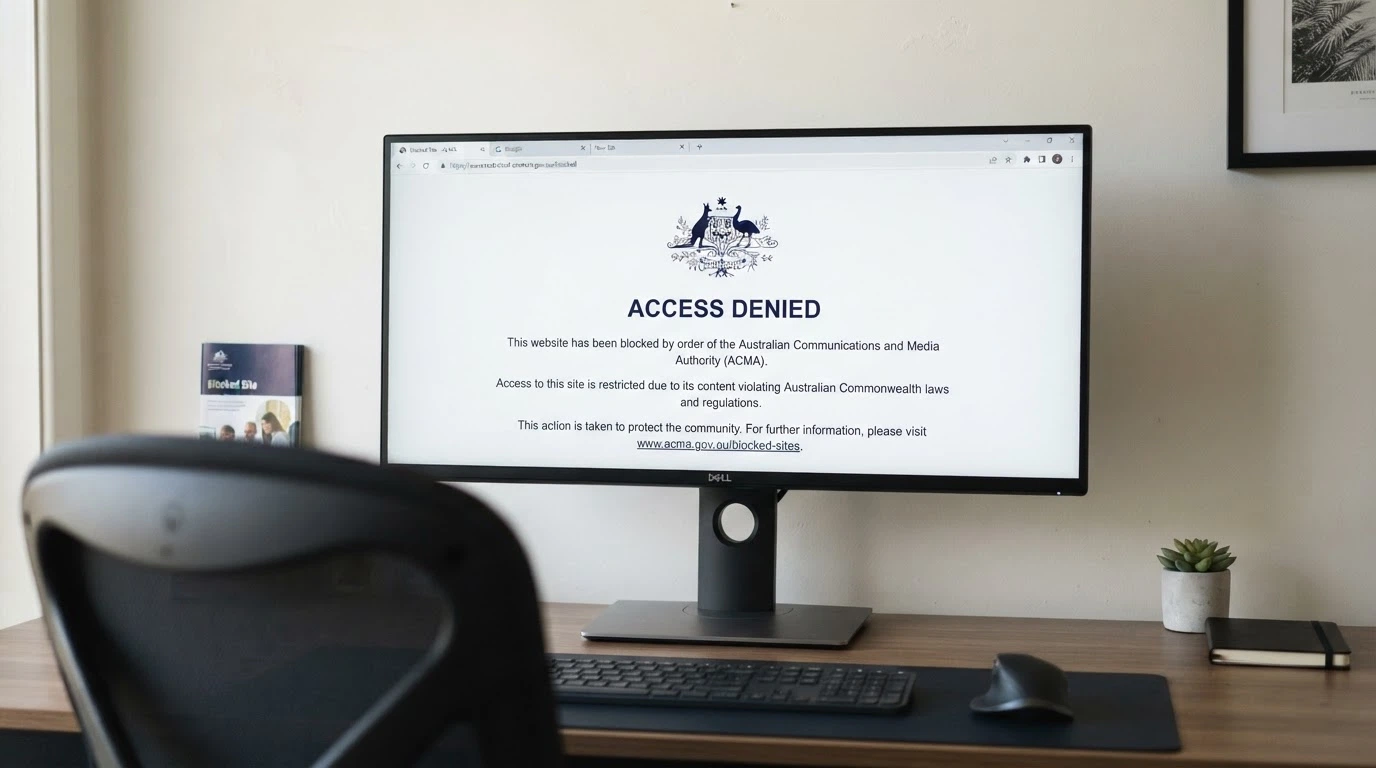
Since its first blocking request in November 2019, ACMA has had 1,564 illegal gambling and affiliate websites blocked by Australian ISPs, as at March 2026. More than 225 illegal gambling services have withdrawn from the Australian market since the 2017 amendment strengthened enforcement. Fair Go was among the first sites ACMA ordered blocked, in November 2019.
Blocking is DNS-level and ISP-enforced: the page does not load for an Australian connection, the affiliate link does not redirect to the casino, and the player’s access is cut. The mechanism is not evasion-proof in principle, but it is enforced at scale. ACMA’s blocking list grows with each enforcement cycle, and the affiliate sites — the pages that aggregate bonus codes and rank casinos — are blocked alongside the casinos themselves.
The 2026 Reform — What Changes for Bonus Codes
The Interactive Gambling Amendment (Gambling Reform) Bill 2026 passed Parliament on 19 August 2026 and its measures commence on 1 January the following year. The reform tightens advertising and payments but does not change the casino prohibition itself. The headline changes are:
- Advertising cap: wagering advertising is limited to three ads per hour between 6:00 am and 8:30 pm.
- Live-sport blackout: wagering advertising is prohibited from 15 minutes before a live sporting event until 5 minutes after it ends, between 5 am and 8:30 pm.
- Athlete/celebrity/influencer ban: prominent figures are barred from promoting wagering products.
- Inducement restrictions: direct marketing of inducements is prohibited for 14 days after a customer signs up, for three months after a person deregisters from BetStop, and indefinitely for customers identified as at risk of gambling-related harm.
- Payment blocking: banks and payment providers gain express authority to block transactions to illegal gambling operators.
The reform does not legalise online casino. It does not create an online casino licence. It does not change the offshore-only status of any bonus code currently in market. What it adds is a harder enforcement perimeter around the prohibition, particularly on the payments side — from 1 January the following year, a transaction to an offshore casino can be blocked at the bank level, not just at the DNS level.
What the Player Risks — No Consumer Protection, No Recourse
Using an offshore casino means the player has no Australian consumer protection. ACMA cannot recover player funds from an offshore operator; there is no Australian complaints body to refer a dispute to; refused withdrawals have no formal appeal path. The site can be blocked at any time, with the player’s balance still on it, and the player’s recourse is whatever the offshore operator’s own terms provide.
The individual player is not prosecuted under the IGA — the Act targets the provider. But the absence of prosecution is not the same as the presence of protection. A self-excluded Australian who continues to play at an offshore casino will find the offshore casino still accepts their deposits, because BetStop binds only Australian-licensed wagering services. The gap between what the licensed market offers and what the offshore market provides is the gap the player falls into.
Payment Methods as a Legal Tell — Credit Cards and Crypto
The deposit method a casino requests is itself a signal. Credit cards, credit-related products and crypto have been banned as payment for online wagering in Australia since 11 June 2024, with penalties of up to A$247,500 for non-compliant operators. The ban binds licensed wagering operators; it does not bind offshore casinos, because offshore casinos are not Australian licensees. But an Australian being asked for a credit card or a crypto deposit by a gambling site is being served by someone outside the Australian rules.
The legal deposit routes for licensed wagering are debit card, bank transfer, PayID, and BPAY. From 1 January the following year, banks and payment providers can block transactions to illegal operators — which means a transaction to an offshore casino can be refused at the payment rail, not just at the DNS level. The tell is not subtle: a deposit page that offers credit card or crypto first is signalling that the operator is outside the Australian framework.
Why a 94% RTP Build Makes Your Bonus Worth Less
The same pokie title can run on different RTP versions, and the version the bonus is locked to changes the expected loss over the wagering window. Big Bass Bonanza, for example, has a standard 96.71% RTP version and lower RTP builds at 95.67% and 94.5%, all from the same provider. A bonus code locked to the 94.5% build is not the same economic object as one locked to the 96.71% build of the same title.
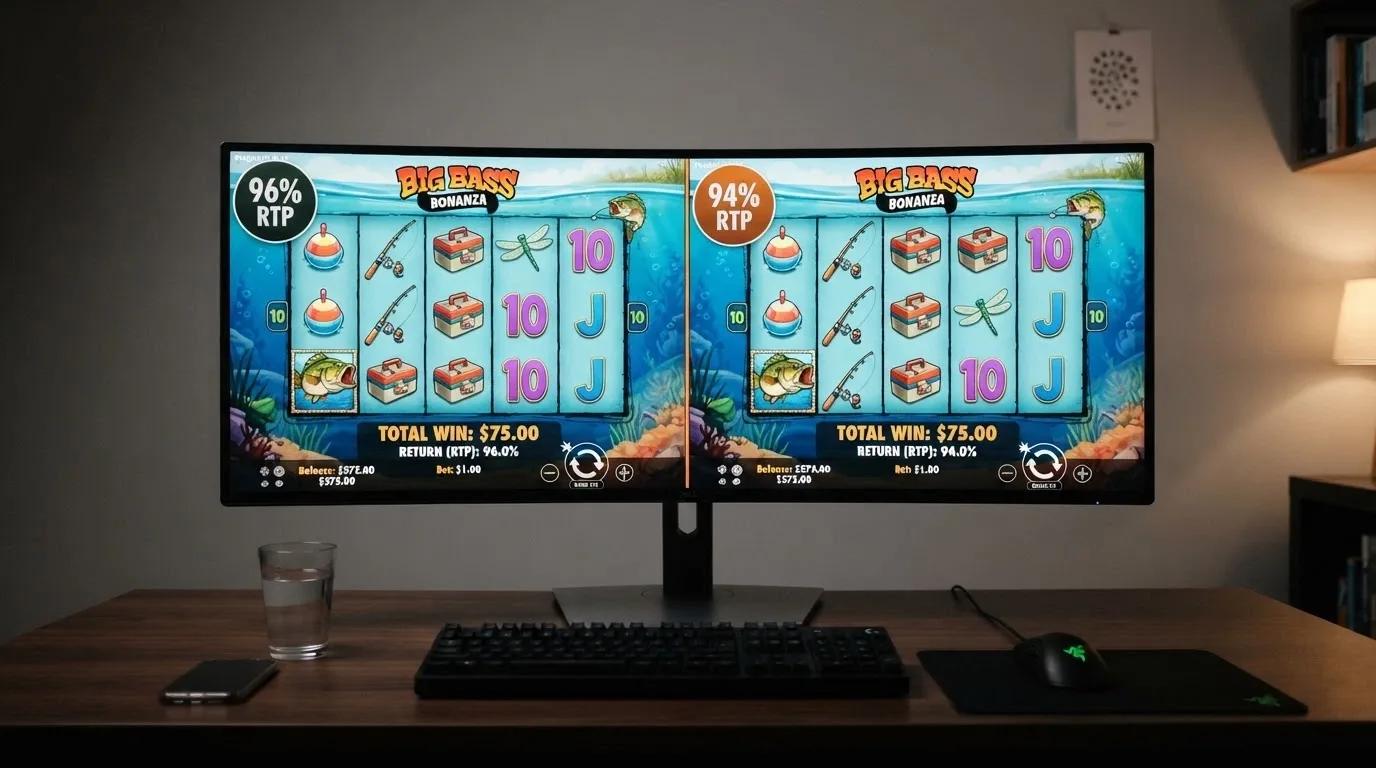
The difference shows up in the expected-loss calculation. A A$20 no-deposit bonus at 40× wagering on the 96.71% build carries an expected loss of roughly A$26.40 over the A$800 turnover. The same bonus on the 94.5% build carries an expected loss of A$44 — a 67% increase in cost for the same headline value. The operator chooses the lower-RTP build for bonus play because the wider house edge funds the bonus; the player pays for the choice through higher expected loss.
Two pokie titles dominate AU-facing bonus offers because they appear across multiple operators and multiple bonus types.
| Slot Title | RTP | Provider | Volatility | Max Win |
|---|---|---|---|---|
| Big Bass Bonanza | 96.71% (lower builds at 95.67% and 94.5%) | Pragmatic Play / Reel Kingdom | Medium-high (4/5) | 2,100× stake |
| Sweet Bonanza | 96.48%–96.51% | Pragmatic Play | Medium-high | 21,175× stake |
The RTP figures above are the standard versions. A bonus code locked to a lower RTP build of either title should be treated as a higher-cost offer than the headline suggests. The volatility class is medium-high for both — which means the bonus will be cleared through sessions that swing above and below the expected loss line, not through a steady drip. The max win figures are headline numbers, not achievable outcomes: a 2,100× max win on Big Bass Bonanza requires a feature hit at full stake, which the wagering cap on most bonus play (A$5–A$10 per spin) prevents.
Featured Operators
The operators below actively target Australian players with bonus codes. Every one is offshore and unlicensed in Australia — the offshore-only status is a fact of the market, not a footnote. The comparison is descriptive: it shows what each operator’s terms look like, where ACMA enforcement has reached them, and where the data gaps are. The page does not recommend any operator.

| Brand | Licence / Status | Welcome Bonus | Free Spins | Wagering (Deposit) | NDB Max Cashout | ACMA Status |
|---|---|---|---|---|---|---|
| Rocket Play | Curaçao (offshore, not AU-licensed) | 100% up to A$1,000 | 100 FS (20/day × 5 days) | 40× on bonus | A$180 | Not confirmed blocked this run |
| Skycrown | Curaçao (offshore, not AU-licensed) | Up to A$8,000 + 400 FS | 400 FS | — | A$80 | Confirmed on ACMA blocked/warned record |
| Royal Reels | Curaçao (offshore, not AU-licensed) | A$2,500 + 50 FS (3 deposits) | 50 FS | 35× on bonus only | A$100 | Not confirmed blocked this run |
| Fair Go | DeckMedia N.V. in liquidation since Dec 2018; operates without effective licence | 100% up to A$1,000 (5 deposits) | Varies by coupon | 30× deposit+bonus (welcome); 60× (NDB) | A$150–A$180 | First site ACMA blocked, November 2019 |
| Bizzo Casino | Curaçao (TechSolutions Group N.V., launched 2021) | Up to A$7,250 + 175 FS (4 deposits) | 175 FS (welcome); 10 NDB FS (PWA install) | 40× on bonus | A$75 | Confirmed on ACMA blocked/warned record |
| WinSpirit | Curaçao (offshore, not AU-licensed) | A$20 NDB | — | 40× on bonus | A$100 | Not confirmed blocked this run |
| Stake | Curaçao (offshore, not AU-licensed) | — | — | — | — | Not confirmed blocked this run |
| Rocket Casino | Curaçao (offshore, not AU-licensed) | 100% up to A$333 + 50 FS | 50 FS | 45× on bonus | — | Not confirmed blocked this run |
| Rainbet | Curaçao (offshore, not AU-licensed) | — | — | — | — | Not confirmed blocked this run |
| Scream Casino | Curaçao (offshore, not AU-licensed) | — | — | — | — | Not confirmed blocked this run |
The em-dash entries in the table are gaps, not failures. Stake, Rainbet, and Scream Casino returned no bonus-term data in the sweep behind this page, and Skycrown’s deposit wagering is not on a public terms page that was reached. The gaps are where the data stops, and they are worth more than a guessed figure.
Rocket Play — 100 Free Spins and a A$1,000 Match With 40× Wagering
Rocket Play runs the strongest deposit-match package in the set on the headline: 100% up to A$1,000 plus 100 free spins, with 40× wagering on the bonus and a A$30 minimum deposit. The free spins release 20 per day for five days, which is a retention mechanic as much as a welcome offer — the player is brought back to the site for five consecutive days to claim each batch. The wagering multiple sits at the market middle; the A$1,000 ceiling is the highest in the deposit-match set; the no-deposit cashout cap of A$180 is at the upper end of the market range.
Rocket Play holds a Curaçao licence and lacks an Australian licence. ACMA enforcement for this brand was not verified during the latest review — the site was absent from the blocked/warned list at the time, though its offshore status means regulatory action remains a possibility. For a player comparing offers, Rocket Play’s package is the largest by ceiling and the most transparent on terms; what the offshore status costs the player is the protection framework a licensed venue provides.
Skycrown — A$8,000 Welcome Package, but ACMA Has Already Blocked It
Skycrown’s welcome package is the largest headline in the set: up to A$8,000 plus 400 free spins across the deposit structure. The number is striking; the context is more striking. Skycrown is confirmed on ACMA’s blocked/warned record, which means an Australian ISP is currently blocking the site. The NDB listings carried by aggregators cap at A$80, on the lower end of the market.
The tension in this offer is the gap between the headline and the enforcement risk. A player who finds the Skycrown site accessible has either moved past ACMA’s block or reached it through a path the block does not cover. Either way, the site sits outside Australian consumer protection, ACMA cannot recover funds lost to it, and the block can expand. The package is generous; the recourse is thin.
Royal Reels — 35× Wagering on Bonus Only, the Lowest in the Set
Royal Reels runs a three-deposit welcome package — 100% up to A$500 on the first, 75% up to A$750 on the second, 100% up to A$1,250 on the third, total A$2,500 plus 50 free spins — with 35× wagering on the bonus only. The wagering on bonus only is the cleanest structure in the set: the player wagers A$2,500 in bonus money, not the deposit plus the bonus, which halves the turnover relative to a 35× deposit+bonus structure. The A$5 per-spin cap during wagering and the A$0.20 fixed spin value on free spins are both on the conservative side of the market.
Royal Reels holds a Curaçao licence and operates without an Australian licence. Regulatory enforcement was not flagged against this operator in the latest sweep. For a player who reads the terms carefully, Royal Reels offers the lowest wagering friction on deposit match in the set — the bonus-only calculation keeps the turnover manageable, and the spin caps keep the volatility exposure under control. The offshore status is the constant.
Fair Go — the RTG Stalwart With 60× No-Deposit Wagering
Fair Go is the longest-running AU-facing brand in the set, and the terms reflect it. The welcome package is 100% up to A$200 on each of the first five deposits, total up to A$1,000, with 30× wagering on deposit plus bonus. The no-deposit coupons sit at the tougher end: 60× wagering, A$150–A$180 max cashout. The game library is locked to RTG (RealTime Gaming), which means the no-deposit wagering is locked to RTG pokies and the eligible-game list is narrower than a multi-studio casino.
The licence status is the complication. Fair Go’s operator, DeckMedia N.V., has been in liquidation since December 2018. The brand operates without an effective Curaçao licence. ACMA ordered Fair Go blocked in November 2019 — the first site on the regulator’s blocking record. A player who reaches Fair Go today is transacting with a brand whose corporate structure is disputed, whose regulator status is unclear, and whose site has been the subject of an Australian enforcement action for over six years. The brand’s longevity is real; the protection behind it is not.
Bizzo Casino — 10 No-Deposit Spins for Installing the App
Bizzo is the only operator in the set offering a genuine no-deposit entry point through a PWA install: 10 free spins for installing the progressive web app, with 40× wagering and a A$75 win cap. The deposit welcome — up to A$7,250 plus 175 free spins over four deposits — is the second-largest headline in the set, with 40× wagering and an A$8 max bet during wagering. The game library runs 70+ studios and 8,000+ games, the broadest in the set.
The operator, TechSolutions Group N.V., is a Curaçao-licensed company. Bizzo is confirmed on ACMA’s blocked/warned record. The A$75 NDB win cap is the tightest cashout ceiling on the no-deposit offers in the set — a player who hits a feature on the PWA-install spins withdraws at most A$75, regardless of the actual win. For a player weighing the PWA-install offer, the value is the no-deposit entry point, not the cap.
WinSpirit — A$20 No-Deposit Bonus With A$100 Max Cashout
WinSpirit runs the simplest no-deposit offer in the set: A$20 bonus credited on registration, 40× wagering on the bonus, A$100 max cashout. The structure is plain — a small cash bonus, a market-middle wagering multiple, a market-middle cap. There is no free-spin bundle, no deposit-match headline, no multi-stage package. The offer is what the T&Cs say it is.
WinSpirit is a Curaçao-licensed operator. Like others in the set, it lacks an Australian licence, and regulators had not flagged it in the latest review. For a player who wants the lowest-friction entry point into the set — no deposit, no install, no app — WinSpirit’s A$20 NDB is the cleanest path. The cap keeps the upside modest; the offshore status keeps the recourse thin.
Stake — Crypto-Focused Casino With No Surfaced Bonus Terms
Stake is a major crypto-leaning operator targeting Australian players. It holds a Curaçao licence and has no Australian licence; the providers include Pragmatic Play and Evolution, which gives the game library a depth the smaller offshore brands do not match. The bonus terms for this brand were not surfaced in the sweep behind this page — no welcome package, no-deposit bonus, or free-spin bundle appeared in the sources reached.
The absence of surfaced bonus data is itself information. A crypto-focused operator is outside Australian rules by virtue of the payment method: credit cards and crypto are banned for licensed AU wagering since 11 June 2024, and an operator leaning into crypto deposits is signalling its offshore status. For a player evaluating Stake, the casino is reachable and active; the bonus-code offering behind it is not documented in the sources this page is built on.
Rocket Casino — 45× Wagering and a 14-Day Window
Rocket Casino runs a deposit-match offer that sits at the conservative end of the set: 100% up to A$333 plus 50 free spins on the first deposit, 45× wagering on the bonus, 14-day validity, A$20 minimum deposit. The headline is the smallest in the deposit-match set; the validity window is the longest and the most clearly stated. The 45× wagering sits above the market middle but below the unclearable range.
Rocket Casino is also Curaçao-licensed and lacks an Australian licence; it was not listed as a target for ACMA enforcement in the most recent data. For a player who values clarity on the bonus window over headline size, Rocket Casino’s 14-day validity is the cleanest benchmark in the set. The terms are stated in plain numbers; the offshore status is the constant.
Rainbet — Crypto Casino With Unverified Bonus Terms
Rainbet is a crypto-focused operator with Australian market presence, included on the strength of market-share data rather than surfaced bonus terms. No welcome bonus, no-deposit bonus, or free-spin bundle appeared in the sources reached for this page. The Curaçao licence status is the same as the rest of the offshore set; the bonus offering is not documented.
A crypto-focused operator signals offshore status through the payment method — crypto deposits are banned for licensed AU wagering since 11 June 2024. For a player, the gap is the comparison: there is no bonus-code data to read, which means there is no terms document to weigh against the cashout caps and wagering multiples the rest of the set carries. Rainbet is in the market; the offer behind it is not on the page.
Scream Casino — Market Presence Without Surfaced Bonus Data
Scream Casino is a Curaçao-licensed operator with Australian market share and no bonus-code terms surfaced in the sweep behind this page. Inclusion in the featured set is on the strength of market presence, not surfaced bonus data. The brand did not appear on ACMA’s recent blocked/warned lists.
The data gap is the verdict. Where the rest of the set carries a welcome bonus, a wagering multiple, a cashout cap, and a validity window, Scream Casino carries a licence status and not much else. For a player, the absence of terms is the absence of a comparison — the offer cannot be read because it has not been documented in the sources this page is built on.
Responsible Gambling — Help That Actually Works
The tools that exist for Australian players are real, well-funded, and effective — within the limits of what they cover. The limits are the part most players do not hear about, and the part that matters most when the choice is between a licensed venue and an offshore casino.
BetStop — What It Covers and What It Does Not
BetStop, the National Self-Exclusion Register, has recorded 67,480 registrations since going live in August 2023, with 41,290 exclusions still active as at 31 July 2026. More than 60% of everyone who has ever registered is still in the register. Of registrants, 78% are under 40 and 38% chose lifetime exclusion.
The register is powerful inside the licensed market. One registration excludes a person from every Australian-licensed online and phone wagering service, and the operator side of the system enforces the exclusion at the account level. The system does not cover offshore casinos. A self-excluded Australian who opens an account at an offshore casino will find the offshore casino still accepts their deposits, still offers them bonus codes, and still processes their withdrawals — because the offshore casino is not connected to BetStop and is not bound by its exclusion list. The protection BetStop provides ends at the Australian border; the harm it addresses does not.
Getting Help — 1800 858 858 and Gambling Help Online
The National Gambling Helpline — 1800 858 858 — is free, confidential, and staffed by trained gambling counsellors around the clock. Calls are not listed on phone bills. Interpreters are available through 131 450. Gambling Help Online offers live chat, email support, and self-help resources at gamblinghelponline.org.au. Financial counselling is available through Department of Social Services-funded services for people who cannot pay bills because of gambling harm.
About 2.1% of Australian adults — roughly 430,000 people — experience problem gambling; the Australian Institute of Health and Welfare put high-risk gambling at 1.8% in 2022. Young men aged 18–24 are the most at-risk group. Nationally, problem gambling affects 0.4%–1.2% of adults, with another 1.9%–3.7% reporting moderate-risk gambling. The numbers are a reminder that the bonus-code market reaches people who are already in harm’s range — and that the offshore-only status of the market means the registered help services are the only protection that reaches them.
How We Selected and Ranked These Operators
The operators in the featured set were selected from Australian market-share data and a bonus-code availability sweep. Each operator was checked against the ACMA blocked/warned record; each licence claim was checked against the Curaçao Gaming Authority register, where a per-brand lookup was possible; the official Australian licence whitelist confirmed that no online casino holds an Australian licence, because no such licence exists.
Bonus terms were sourced from operator sites and affiliate trackers. Where a term was not surfaced — a welcome bonus, a wagering multiple, a cashout cap — the entry in the table is the em-dash gap rather than a guess. The ranking order reflects bonus value adjusted for wagering and cashout cap, transparency of terms, and ACMA enforcement status; the data gaps are stated where they exist, and the absence of a wagering multiple is not silently replaced with the market middle.
The set is descriptive, not evaluative. No operator is recommended. The page does not send any reader to any casino. What it does is lay out the offer each operator surfaces, the terms each offer carries, and the enforcement status each operator holds — so a reader can do the comparison the marketing page would rather they skip.
Your Next Move — Read the Terms, Not the Headline
A bonus code is a key. What it opens is the offer behind it, and the offer is defined by three numbers: the wagering multiple, the max cashout cap, and the expiry window. The headline bonus figure is marketing. The terms are the product. A A$1,000 welcome package at 40× deposit+bonus is A$40,000 of turnover before a cent withdraws; a A$20 no-deposit chip at 60× is A$1,200 of turnover and an expected loss higher than the bonus’s nominal value. The headline tells the player what the casino wants them to see; the terms tell them what they will actually do.
The offshore-only status of the entire market is the second thing to read. There is no Australian licence for any online casino; every code on this page unlocks a Curaçao-licensed product; ACMA can block the site at any time and there is no Australian body that can recover a refused withdrawal. The protection frameworks that apply to licensed wagering — BetStop, deposit limits, consumer protection, complaints bodies — do not reach the offshore market. The player who enters a bonus code accepts the gap.
The decision framework is straightforward. If a player chooses to use a bonus code, they should read the terms before entering it, treat the bonus as entertainment spend rather than expected value, and know that the legal reality is what it is. The page does not recommend any operator, does not endorse any offer, and does not encourage any reader to use any service. What it does is provide the comparison the affiliate pages do not.
Frequently Asked Questions
Are mobile bonus offers different from what you get on a desktop?
Mobile no-deposit offers typically carry the same terms as their desktop equivalents — same wagering multiple, same cashout cap, same eligible games. What changes is the delivery channel: codes tied to a specific device, codes released inside a casino’s mobile app, or codes unlocked by installing the operator’s progressive web app. Bizzo’s 10 free spins for the PWA install is a mobile-channel offer; the terms are no-deposit, the trigger is the install. The mechanics under the terms do not shift between desktop and mobile.
Why do some bonus codes last only a day while others give you a week?
Free-spin offers commonly expire 24 to 72 hours after the code is entered, while wagering windows on small no-deposit cash bonuses run 1 to 7 days. The clock starts when the code is redeemed, not when the player is ready to play. Deposit bonuses carry longer windows — 14 days is a current benchmark — because the wagering turnover is larger and the player needs more time to clear it. A short window is a pressure tactic; the bonus and any winnings are forfeit when the window closes.
Can I claim more than one free sign-up offer at the same casino?
Casino terms typically restrict a player to one no-deposit or sign-up offer per account, household, or IP address. The restriction is in the offer T&Cs, not in the code itself, and a second claim on the same brand will usually be voided at withdrawal. Multiple sign-up offers across different casinos are permitted, since each operator’s terms bind to that operator’s account — but the underlying wagering and cashout math does not change between brands.
What happens to my bonus balance if an Australian ISP blocks the casino site?
If an Australian ISP enforces an ACMA blocking order against the casino, the player cannot reach the site and the account is inaccessible until the block is lifted or bypassed. Any balance — bonus or real money — sits on the operator’s server, outside Australian jurisdiction. ACMA cannot recover the balance for the player. The block can be lifted, expanded, or replaced; the player’s recourse is whatever the offshore operator’s customer support provides.
Does the national self-exclusion register cover offshore casinos?
BetStop, the National Self-Exclusion Register, binds Australian-licensed wagering services only. Offshore casinos are not connected to the register and will continue accepting a self-excluded person’s deposits and sign-ups. The register excludes from licensed venues — land-based and online — across the country, with a minimum 3-month exclusion and options up to lifetime. The protection ends at the Australian border; the offshore market is unaffected.
What happens if I try to withdraw before meeting wagering requirements?
Withdrawing before the wagering requirement is met forfeits the bonus and any winnings generated by it. Some operators allow a real-money withdrawal of an initial deposit at the cost of forfeiting the bonus; others lock the entire balance until the wagering clears. The terms on early withdrawal are specific to each operator and should be read before any deposit is made, since the cost of misunderstanding the rule is the bonus and the winnings together.